
 Česky (CZK)
 Slovensky (EUR)
 Magyar (HUF)
 Polski (PLN)
 English (EUR)
 Deutsch (EUR)
 Français (EUR)
 Español (EUR)
 Português (EUR)
 Italiano (EUR)
 Svenska (SEK)
 Suomi (EUR)
 Nederlands (EUR)
 Dansk (EUR)
 Lëtzebuergesch (EUR)
 Eesti (EUR)
 Latviešu (EUR)
 Lietuvių (EUR)
 Slovenščina (EUR)
 Română (RON)
 Български (EUR)
 Hrvatski (EUR)
 Ελληνικά (EUR)
 Українська (EUR)
 Norsk (EUR)
 Srpski (EUR)
 Tiếng Việt (EUR)


Beyond the AeroPress
The AeroPress revolutionized home coffee brewing – and inspired an entire generation of innovative coffee tools. The Delter Coffee Press and Twist Press from Barista & Co are among the most interesting successors to this revolution. Both are compact, travel-friendly, and designed for those seeking a clean, precise cup without compromise.
While the AeroPress builds on the immersion principle, Delter comes with a radically different approach – and the Twist Press offers a third path with its own elegance. We'll examine both devices in detail and compare them with the legendary AeroPress.
Delter Coffee Press – the jet-brew principle
What is jet-brew and why it matters
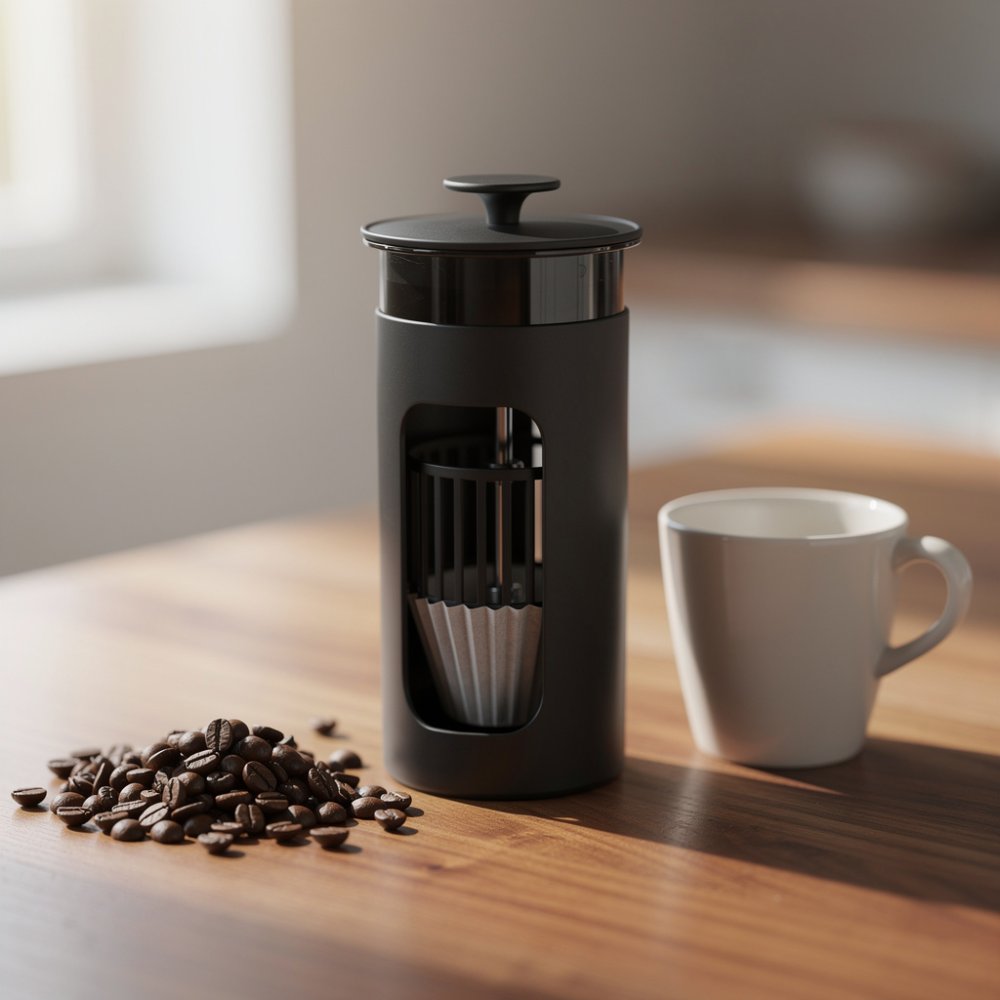
At first glance, the Delter Coffee Press resembles an AeroPress – a plastic cylinder with a piston and paper filter at the bottom. Inside, however, it works completely differently. The key is the patented jet-brew (injection brewing) system: water doesn't contact the coffee until you press the piston. Water sits in the upper chamber, coffee in the lower – and between them a seal that prevents premature mixing.
When you press the piston, water flows through the coffee bed from top to bottom, similar to a pour over method, not as with immersion brewing. The result is:
- No unwanted extraction during waiting – coffee doesn't begin extracting until you move the water
- Full control over contact time – you determine flow rate by pressing pace
- Cleaner, clearer taste – the result resembles pour over more than French press
- Minimal bitterness – jet-brew eliminates agitation that sometimes leads to over-extraction in the AeroPress
Brewing Parameters – Delter Coffee Press
| Parameter | Value | Note |
|---|---|---|
| Coffee dose | 14 -- 16 g | For a full cup |
| Water volume | 200 -- 400 ml | Maximum capacity is 400 ml |
| Water temperature | 90 -- 95 °C | Light roasts: 94 -- 95 °C |
| Grind size | Medium to medium-fine | Comandante C40: 22 -- 28 clicks |
| Total brew time | 2:30 -- 3:30 | Including bloom phase |
| Filter | Paper (proprietary) | Compatible with AeroPress filters as replacement |
| Yield | 200 -- 350 ml | One large cup |
Brewing Guide – Delter Coffee Press
1. Preparation: Insert the paper filter into the lower cap and attach it to the lower chamber. Rinse the filter with hot water to remove paper taste. Add freshly ground coffee to the lower chamber.
2. Fill with water: Pour hot water (90 -- 95 °C) into the upper chamber. Attach the piston – water remains separated from the coffee thanks to the seal.
3. Blooming (0:00 -- 0:30): Gently press the piston so approximately 30 -- 40 ml of water passes through the coffee. Wait 30 seconds. During this bloom phase, CO2 gases escape from fresh coffee, which would otherwise hinder even extraction.
4. Main pressing (0:30 -- 2:30): Press the piston slowly and evenly. The entire pressing should take approximately 2 minutes. Don't press quickly – gentle, constant pressure is key to quality extraction. For even more complex results, try the pulse technique: press, stop for 5 seconds, press again.
5. Finish: Once the piston reaches the bottom, stop. The resulting coffee is clean, clear, with pronounced acidity and floral notes – by profile closer to V60 pour over than AeroPress.
Twist Press – an elegant approach to filtration
Design and operating principle
The Twist Press from Barista & Co is a minimalist coffee device working on the principle of pressure filtration – a thoughtful combination of immersion and pressure methods enclosed in a compact, design-clean body.
The principle is straightforward: place a filter in the lower chamber and add coffee, pour water, attach the upper chamber, and by twisting (twist) the piston downward begin extraction. The spiral motion creates gentle, even pressure on the coffee bed – and that's what sets the Twist Press apart from simple pouring.
Paper vs. Metal Filter – a crucial difference in taste
The Twist Press is compatible with both filter types, making it one of the most flexible small brewers on the market. Check out coffee filters in our selection.
Paper filter:
- Clean, clear coffee without sediment
- Captures most coffee oils – the result is lighter and more delicate
- Highlights acidity and floral notes
- Ideal for light and medium roasts
- Single-use – you need a supply of replacement filters
Metal filter:
- Fuller body, more pronounced texture
- Allows coffee oils through – richer, heavier cup
- Highlights chocolate, nut and caramel notes
- Ideal for medium to dark roasts
- Reusable – more eco-friendly option
- Fine sediment at the bottom of the cup is normal
Practical tip: If you're unsure, start with a paper filter. It offers forgiving extraction with less risk of over-extraction bitterness. Switch to the metal filter once you've mastered the optimal ratio of coffee, water and steeping time.
Brewing Parameters – Twist Press
| Parameter | Value | Note |
|---|---|---|
| Coffee dose | 12 -- 15 g | According to desired intensity |
| Water volume | 150 -- 200 ml | One cup |
| Water temperature | 90 -- 96 °C | Depends on roast level |
| Grind size | Medium-fine | Similar to pour over |
| Steeping time | 1:00 -- 2:00 | Before twisting |
| Pressing time (twist) | 0:30 -- 1:00 | Slow, even twisting |
| Filter | Paper or metal | Paper = cleaner, metal = fuller |
Comparison with AeroPress – three approaches, three results
The AeroPress, Delter Coffee Press, and Twist Press look similar at first glance, but each brings a different cup experience. The following table summarizes the key differences.
| Parameter | AeroPress | Delter Coffee Press | Twist Press |
|---|---|---|---|
| Extraction principle | Immersion + pressure | Percolation (jet-brew) | Immersion + pressure |
| Flavor profile | Full body, low acidity | Clean, clear, pour over style | Between pour over and French press |
| Capacity | max. 260 ml | max. 400 ml | max. 200 ml |
| Brew time | 1:30 -- 2:30 | 2:30 -- 3:30 | 1:30 -- 3:00 |
| Filter | Paper / metal | Paper | Paper / metal |
| Variability | Very high (dozens of recipes) | Medium (pour over style) | Medium (two filter types) |
| Cleaning | Very simple (5 s) | Simple (10 s) | Simple (10 s) |
| Travel | Compact, lightweight | Similar size, lighter | Most compact of the three |
| Sediment in cup | Minimal | None | Depends on filter |
| Extraction control | High (time, temperature, pressure) | Very high (pressing pace) | Medium |
| Price | ~ 35 -- 45 EUR | ~ 40 -- 50 EUR | ~ 30 -- 40 EUR |
Who is the Delter Coffee Press for?
Delter is an ideal choice if you:
- Love pour over but want a travel version without a dripper, gooseneck kettle, and server
- Hate bitterness in some AeroPress recipes – the jet-brew principle fundamentally limits over-extraction
- Want maximum control – piston pressing pace directly influences the flavor profile in the cup
- Drink lightly roasted single origin coffees – Delter highlights delicate floral and fruity notes better than the AeroPress
- Brew larger volumes – 400 ml capacity is 140 ml more than the AeroPress
Check out Delter Coffee Press in our selection.
Who is the Twist Press for?
The Twist Press is the right choice if you:
- Want maximum compactness – fits in a backpack, suitcase, or office drawer
- Value flexibility – paper filter for a clean cup on Monday, metal for full body on Friday
- Seek a design piece – the Twist Press is among the most visually accomplished coffee tools on the market
- Are a beginner – fewer variables than the AeroPress or Delter, forgiving brewing procedure
- Drink one cup a day – 200 ml volume is ideal for single-serve routine
Check out Twist Press in our selection.
Frequently Asked Questions (FAQ)
Can I use AeroPress filters in the Delter Coffee Press?
Yes. The Delter has its own filters, but standard paper filters from the AeroPress are compatible as a temporary replacement. Delter's original filters are slightly thicker and optimized for the jet-brew principle – for best results we recommend them.
Is the Twist Press suitable for espresso?
Not in the true sense. The Twist Press doesn't create the 9 bar pressure needed for true espresso. The result is rather strong filtered coffee with full body – something between pour over and French press. If you want an espresso concentrate, reach for the AeroPress with fine grind and strong pressure.
Which of the three brewers is best for travel?
All three are designed with portability in mind, but the Twist Press is the most compact. The Delter and AeroPress are similar in size, with the Delter being slightly lighter. If you're traveling with carry-on luggage and every centimeter counts, the Twist Press wins.
How often do you need to change filters?
Paper filters are single-use – one filter per brew. The metal filter for the Twist Press lasts virtually indefinitely: rinse it with hot water after each use and wash it more thoroughly once a week, ideally with a coffee cleaning solution. Check out coffee filters in our selection.
What coffee is best for Delter and Twist Press?
For Delter we recommend light to medium roasted single origin beans – Ethiopian, Kenyan, or Colombian for floral and fruity notes. For Twist Press with paper filter the same applies; with a metal filter, medium to dark roasts work great – Brazilian or Guatemalan beans with a chocolate-nutty profile.
Can I use the Delter in an inverted method like the AeroPress?
No. The Delter's jet-brew principle requires water to flow from top to bottom through the coffee bed. The inverted method would eliminate the main advantage of this device – separating water from coffee before extraction itself. If you prefer the inverted method, stick with the AeroPress.
Delter Coffee Press and Twist Press prove that even after decades of intensive development, there is still room for original ideas. Whether you choose the surgical cleanliness of jet-brew or the flexibility of two filter types – both devices deserve a place in the equipment of a modern coffee enthusiast. Browse Delter Coffee Press and Twist Press in our selection.