
 Česky (CZK)
 Slovensky (EUR)
 Magyar (HUF)
 Polski (PLN)
 English (EUR)
 Deutsch (EUR)
 Français (EUR)
 Español (EUR)
 Português (EUR)
 Italiano (EUR)
 Svenska (SEK)
 Suomi (EUR)
 Nederlands (EUR)
 Dansk (EUR)
 Lëtzebuergesch (EUR)
 Eesti (EUR)
 Latviešu (EUR)
 Lietuvių (EUR)
 Slovenščina (EUR)
 Română (RON)
 Български (EUR)
 Hrvatski (EUR)
 Ελληνικά (EUR)
 Українська (EUR)
 Norsk (EUR)
 Srpski (EUR)
 Tiếng Việt (EUR)


Turkish Coffee / Cezve – Traditional Turkish Coffee: Complete Preparation Guide
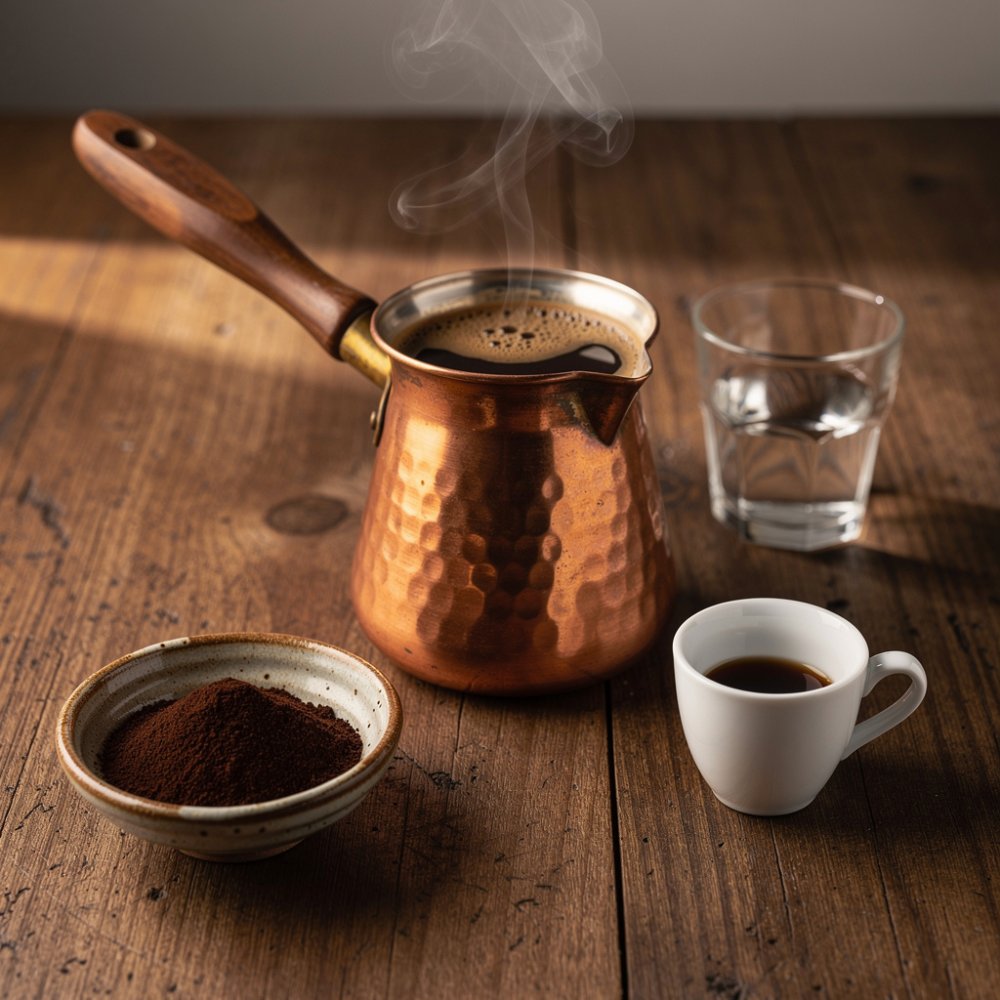
When UNESCO Protects a Coffee Brewing Method
In December 2013, something exceptional happened in Baku, Azerbaijan – the UNESCO Intergovernmental Committee inscribed the tradition of Turkish coffee on the List of Intangible Cultural Heritage of Humanity. What is protected is not a specific recipe or bean variety, but the entire ritual: from grinding through preparation in a cezve to serving in small cups and communal drinking accompanied by conversation. It is one of the few coffee traditions that has deserved such recognition.
Turkish coffee is not just a beverage – it is a five-hundred-year philosophy of hospitality, patience, and sensory experience. In Turkey, they still say: "Kahvenin kırk yıl hatırı vardır" – one cup of coffee deserves forty years of gratitude. In this guide, you will learn to prepare it exactly as they do in Istanbul coffee houses and in the Anatolian countryside: slowly, attentively, and with respect for a centuries-old tradition.
What You Need – Equipment and Ingredients
The beauty of Turkish coffee lies in its simplicity. You don't need expensive equipment or sophisticated accessories – a cezve, quality coffee, and a bit of patience will suffice.
- Cezve (jezve / ibrik) – a conical metal pot with a long handle, ideally made of copper or brass – cezves in our offer
- Freshly roasted whole bean coffee – medium to medium-dark roast, single-origin or blend – whole bean coffee for espresso
- Grinder capable of extremely fine grinding – finer than espresso, consistency almost like powdered sugar – coffee grinders
- Cold filtered water – water quality directly affects the final taste and crema formation
- Small cups (fincan) – volume 60 -- 90 ml
- Measuring spoon and optionally sugar, cardamom, or other spices
Cezve selection: For one cup, a cezve with a volume of 100 -- 150 ml is sufficient. For two cups, choose 200 -- 300 ml. The key is that the water level reaches below the point where the cezve widens toward the neck – this is precisely where the crema (kaymak) forms and must have enough space to develop.
Cezve material: Copper is the traditional choice due to excellent thermal conductivity, which allows precise temperature control. Brass is more durable and easier to maintain, while stainless steel is the most versatile. The interior should be tinned so that copper does not come into direct contact with the coffee and does not affect its taste.
Turkish Coffee Preparation Parameters
| Parameter | Value | Note |
|---|---|---|
| Coffee dose | 7 -- 10 g per cup | Traditionally 1 full spoon = ~7 g |
| Water volume | 60 -- 90 ml per cup | Cold filtered water |
| Grind size | Extra fine (< 100 microns) | Finer than espresso – powdered sugar consistency |
| Heating temperature | Slow heat, max. 70 -- 90 °C before boiling | Never let it boil completely |
| Preparation time | 3 -- 5 minutes | Depends on cezve size and heat intensity |
| Sugar | 0 -- 2 spoons per cup | Added before brewing, not after |
| Coffee to water ratio | ~ 1 : 9 | Significantly stronger than filtered coffee |
| Serving temperature | 65 -- 70 °C | Coffee is drunk slowly, in small sips |
Traditional Recipe – 6 Steps to Perfect Turkish Coffee
Step 1: Water Preparation
Pour cold filtered water into the cezve – 60 -- 90 ml per cup. Experienced Turkish baristas measure water directly in the cup where they will serve the coffee: this ensures precise volume without unnecessary guessing. If you want sweet coffee, add sugar right now – into cold water before the coffee. Sugar added to hot coffee will not dissolve evenly and will not promote crema formation as favorably. Classic sweetness categories in Turkey: sade (no sugar), az şekerli (half spoon), orta şekerli (1 spoon), çok şekerli (2 spoons).
Step 2: Adding Coffee
Sprinkle finely ground coffee onto the water surface – 7 -- 10 g per cup (1 full spoon). Do not stir. Let the coffee saturate itself with water and settle to the bottom. This step is crucial: premature stirring will disrupt later crema formation and complicate even extraction.
Step 3: Slow Heating
Place the cezve on the smallest burner set to low flame. With an electric stove, choose the lowest setting; with induction, we recommend power around 400 -- 600 W. The slower the heating, the richer the extraction and thicker the crema – this is the basic principle that separates average Turkish coffee from exceptional. After about one minute, when the coffee begins to dissolve, stir once gently with a spoon to ensure even saturation. Then do not stir anymore.
Step 4: Monitoring the Crema (kaymak)
As the temperature approaches boiling point, dark, thick crema will begin to rise on the surface – kaymak. This is the heart of Turkish coffee and also the most important visual signal of the entire process. The crema will slowly rise toward the edge of the cezve. At the moment it reaches the edge, immediately remove the cezve from heat. Never let the coffee boil completely – you will lose the crema, aroma, and flavor balance.
Step 5: Triple-Rise Technique (Optional)
For a more intense flavor and thicker crema, repeat the crema-rising process two or three times. After the first removal from heat, let the crema subside slightly (5 -- 10 seconds), return the cezve to the stove, and let the crema rise again. Repeat once more. This traditional technique extends the contact time of coffee with heat and builds a more pronounced flavor depth. The modern approach favors a single rise – the result is cleaner and less bitter. The choice depends on personal taste and bean roast.
Step 6: Pouring and Serving
First, use a spoon to distribute the crema evenly into cups – it is both an ornament and part of the taste. Then slowly pour in the remaining coffee. Pour from low and with a smooth motion to avoid breaking the crema. Before serving, let the coffee rest for 20 -- 30 seconds to allow the sediment to settle to the bottom. Serve the coffee with a cup of cold water (to cleanse the palate before the first sip) and a piece of Turkish delight or dried fruit.
Tips for Advanced Users – Spices and Variations
Cardamom – The Classic Choice
Cardamom (hel) is the most popular natural additive for Turkish coffee throughout the Arab world. Crush 1 -- 2 cardamom seeds and add them directly to the cezve with the coffee. Cardamom imparts a refreshing, slightly eucalyptol note that naturally complements the coffee's bitterness and softens its intensity. In some Middle Eastern regions, up to a full spoon of ground cardamom is added per 2 cups – the result is significantly more aromatic and less bitter.
Saffron – The Luxury Variant
In Iran and some parts of the Middle East, a few saffron threads are added to Turkish coffee. Saffron brings a delicate floral aroma, slightly honeyed sweetness, and a golden color. Just 2 -- 3 threads placed in the cezve before heating will suffice. This is an occasional variation suitable for special moments – and a great way to surprise guests.
Other Spices
- Cinnamon – a pinch of ground cinnamon added to the cezve imparts a warm, sweet note, especially effective with darker roasts
- Cloves – one clove per cezve for a spicy, distinctive aroma; use sparingly
- Nutmeg – a pinch of ground nutmeg for a delicate, complex flavor layer
- Mastic – traditional in the Greek variant (ellinikos kafes), imparting a characteristic resinous, piney taste
Variation Without Spices – Focusing on the Bean
For specialty coffee lovers, there is also a modern, minimalist approach: single-origin beans, medium roast, finely ground, without sugar and without spices. The cezve is surprisingly effective at highlighting the full body and chocolate-nutty notes of quality beans. Try Ethiopian Sidamo for fruity notes or Brazilian Santos for velvety chocolate sweetness – the result will surprise even experienced coffee enthusiasts.
Serving – How They Do It in Istanbul
Turkish coffee is not drunk quickly – it is a ritual that requires time, space, and attention.
Traditional serving arrangement:
- Glass of cold water – you drink it before the first sip of coffee. It cleanses the palate and prepares your taste buds for the full intensity of the beverage. In some coffee houses, slightly sparkling water is served, which intensifies the effect.
- Cup of coffee (fincan) – small, without a handle or with a small handle, volume 60 -- 90 ml. Traditionally served on a metal or porcelain saucer.
- Turkish delight or sweet – a piece of Turkish delight, dried fruit, or a small piece of quality dark chocolate to lighten the intensity of the coffee between sips.
- Time and peace – coffee is drunk in small sips over 10 -- 15 minutes. The sediment (telva) at the bottom of the cup is not drunk – let it settle peacefully.
Fortune-telling from coffee grounds (tasseography): After finishing, the cup is turned upside down on a saucer and left to cool for 5 -- 10 minutes. The patterns the sediment creates on the cup's walls are used for fortune-telling – a tradition alive in Turkish culture today and an inseparable part of the entire ritual.
Frequently Asked Questions (FAQ)
What grinder do I need for Turkish coffee?
You need a grinder capable of grinding to the consistency of powdered sugar – significantly finer than espresso (under 100 microns). Most common grinders do not offer this setting. Among hand grinders, for example, Comandante C40 (setting 3 -- 5 clicks), 1Zpresso JX-Pro, or Kinu M47 can handle Turkish grinding. From electric grinders, the Eureka Mignon with the finest setting is suitable. Check out grinders in our offer.
Can I use pre-ground coffee?
Yes, pre-ground Turkish coffee is a good starting point – for example, the Turkish brand Kurukahveci Mehmet Efendi has the correct grind size and is available. After opening, however, it quickly loses aroma and oxidizes. If you buy pre-ground, check the freshness date and store it in an opaque airtight container.
Why does my coffee have no crema?
The most common causes are three: heating too quickly (you need to lower the flame and slow down the entire process), old or insufficiently finely ground coffee, or too much water in the cezve (the level must be below the widening of the neck). Also make sure that after the first stir, you do not stir the cezve further – you will disrupt crema formation.
What coffee is best for Turkish preparation?
Traditionally, arabica of medium to medium-dark roast is used. Brazilian and Ethiopian beans are classic and proven choices. In Turkey, blended mixtures predominate, but single-origin high-quality arabica will bring a more interesting and complex result. Try whole bean coffee from our offer.
Is Turkish coffee healthy?
Turkish coffee contains approximately 50 -- 65 mg of caffeine per cup (60 ml) – a comparable amount to other brewing methods. Since it is not passed through a paper filter, it contains higher amounts of diterpenes (cafestol, kahweol) – just like French press or moka. These compounds can raise cholesterol levels with excessive consumption, but at moderate intake of 1 -- 2 cups per day, they pose no health risk for most people.
Can Turkish coffee be prepared on an induction cooktop?
Yes, but you need a cezve with a ferromagnetic bottom – made of stainless steel or a special copper cezve with an induction bottom. Traditional all-copper cezves do not work on induction cooktops. A practical solution is an induction adapter – a small metal disc on which you place any cezve and control the temperature indirectly.
Turkish coffee is not just about taste – it is about pausing in the middle of the day. Prepare your cezve, watch the crema slowly rise, and treat yourself to a ritual that has endured five centuries. If you are looking for a cezve, fresh coffee, or a grinder for Turkish grinding, check out our offer.