
 Česky (CZK)
 Slovensky (EUR)
 Magyar (HUF)
 Polski (PLN)
 English (EUR)
 Deutsch (EUR)
 Français (EUR)
 Español (EUR)
 Português (EUR)
 Italiano (EUR)
 Svenska (SEK)
 Suomi (EUR)
 Nederlands (EUR)
 Dansk (EUR)
 Lëtzebuergesch (EUR)
 Eesti (EUR)
 Latviešu (EUR)
 Lietuvių (EUR)
 Slovenščina (EUR)
 Română (RON)
 Български (EUR)
 Hrvatski (EUR)
 Ελληνικά (EUR)
 Українська (EUR)
 Norsk (EUR)
 Srpski (EUR)
 Tiếng Việt (EUR)
Matcha – Japanese Green Tea Powder


The Tea You Drink Entirely
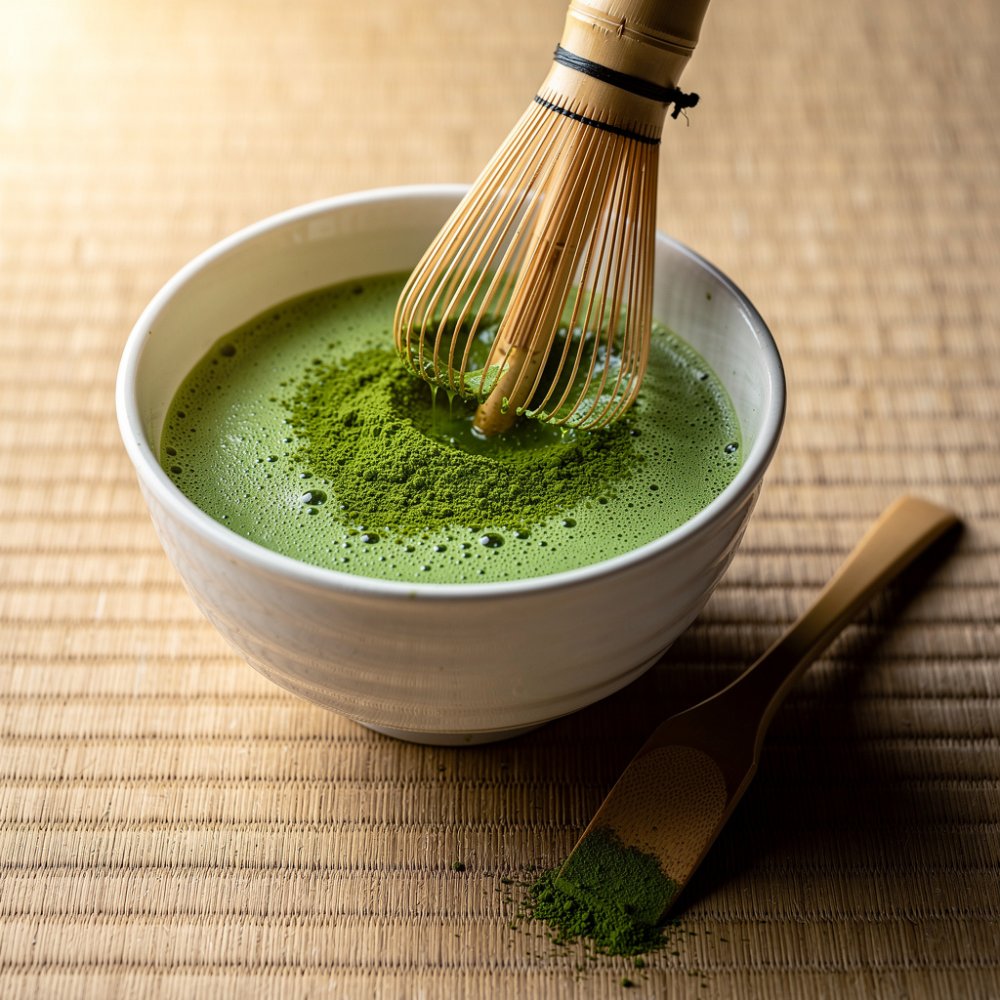
With ordinary green tea, you steep the leaves in water and then discard them. With matcha, you drink the entire leaf – finely ground into an ultra-fine powder and whisked into water. This is precisely why matcha contains a much higher concentration of bioactive compounds than any other green tea.
Matcha is not just "green tea powder." It is a specific type of Japanese green tea cultivated, harvested, and processed in a unique way that has been perfected over centuries.
Discover our matcha products – from ceremonial grade to culinary.
What Makes Matcha Matcha
Shading
Approximately 20–30 days before harvest, the tea bushes are covered with special nets or bamboo structures that reduce sunlight exposure by 80–90%. Shading triggers two key changes in the plant:
- Increased L-theanine production – an amino acid responsible for umami flavor and relaxation effects. In sunlight, L-theanine naturally converts to catechins; in shade, it is preserved in full quantity
- Increased chlorophyll production – the plant compensates for lack of light by producing chlorophyll more intensively, resulting in the characteristic deep green color of the powder
Harvesting and Processing
After harvest, the leaves go through a four-stage process:
- Steaming – immediate halt of oxidation, typical for Japanese green teas
- Drying – in special kilns at precisely controlled temperature
- Stem and vein removal – only the pure leaf surface remains. At this stage, the raw material is called tencha
- Grinding on stone mills – traditional granite mills grind tencha at approximately 40 g per hour, creating an ultra-fine powder with particle size of 5–10 microns
Slow stone grinding is key – it generates minimal heat, thereby preserving flavor, color, and bioactive compounds. Industrially ground matcha cannot fully replicate these qualities.
Ceremonial vs. Culinary Matcha
| Property | Ceremonial | Culinary |
|---|---|---|
| Harvest | First spring harvest (ichibancha) | Later harvests |
| Shading | 20–30 days | Shorter period |
| Color | Intense, vibrant green | Yellow-green to olive |
| Flavor | Sweet, umami, creamy, minimal bitterness | More pronounced, robust, bitter |
| L-theanine | High content | Lower content |
| EGCG | High content | May be slightly higher (more sun) |
| Use | Drinking pure matcha (usucha, koicha) | Lattes, smoothies, baking, cooking |
| Price | 30–80+ EUR / 30 g | 10–25 EUR / 50–100 g |
How to Recognize Quality
- Color: Vibrant, saturated green signals quality and freshness. Yellow, brown, or olive hues indicate lower grade or old matcha
- Aroma: Fresh matcha smells sweet and grassy, with subtle seaweed notes (umami)
- Texture: Fine, silky powder without lumps – when you run your finger through it, it should not feel gritty
- Origin: The most recognized regions are Uji (Kyoto), Nishio (Aichi), and Kagoshima in Japan
- Taste: Quality ceremonial matcha is sweet and creamy. Predominant bitterness is a sign of low quality or aged powder
The Japanese Tea Ceremony – Chanoyu
Matcha is inseparably linked to the Japanese tea ceremony (Chanoyu or Sadō – "the way of tea"). This ritual stems from Zen Buddhism and its current form was codified in the 16th century by tea master Sen no Rikyū.
Four Principles
- Wa (harmony) – between guest, host, and surroundings
- Kei (respect) – mutual respect of all participants
- Sei (purity) – physical and spiritual
- Jaku (tranquility) – inner peace achieved through the ritual
Basic Utensils
| Utensil | Japanese Name | Function |
|---|---|---|
| Bamboo whisk | Chasen | Whisking matcha |
| Ceramic bowl | Chawan | Preparation and drinking |
| Bamboo scoop | Chashaku | Measuring matcha |
| Sieve | Furui | Sieving powder and removing lumps |
| Cloth towel | Chakin | Wiping and cleaning the bowl |
A full ceremony includes additional utensils and can take several hours. For home preparation, a chasen, chawan, and chashaku will suffice – or alternatively a regular tea spoon for measuring.
Preparing Matcha at Home
Usucha – Light Matcha (Standard)
- Sieve 1–2 g matcha (approximately 1–2 bamboo scoops) directly into the chawan through a sieve – sieving prevents lumps and ensures a smooth foam
- Pour 70–80 ml of water at 70–80 °C – boiling water should cool for about 5 minutes, or use a thermometer
- Whisk with the chasen using a rapid motion in the shape of the letter "W" or "M" – not circular motions, which destroy the foam
- Whisk for 15–20 seconds – until an even, fine, and durable foam forms
- Drink directly from the chawan immediately after preparation – matcha settles quickly
Tip: If you don't have a chasen, a small milk frother works. It's not traditional, but the result is acceptable.
Koicha – Thick Matcha (Ceremonial)
- Sieve 3–4 g matcha into the chawan
- Pour only 30–40 ml of water (80 °C)
- Stir slowly and thoroughly – without whisking foam – the goal is a smooth, glossy, thick paste with the consistency of honey
- Koicha is prepared exclusively from the highest quality ceremonial matcha – lower grades would be too bitter
Matcha Latte – Recipe
Matcha latte is the most popular modern way to prepare matcha. For lattes, culinary matcha is preferable – its more pronounced and robust flavor will cut through the milk, whereas the delicacy of ceremonial grade would be lost.
Ingredients
- 2 g matcha (culinary)
- 30 ml hot water (80 °C)
- 200 ml milk – dairy, oat, or almond (oat creates the creamiest texture)
- Honey or agave syrup to taste
Instructions
- Sieve matcha into a cup
- Pour 30 ml hot water and whisk into a completely smooth paste without lumps
- Heat milk to 60–65 °C and froth it
- Pour frothed milk into the matcha paste – by pouring slowly, you can create latte art
- Sweeten to taste
- Iced version: pour the matcha paste into a glass filled with ice, add cold milk, and stir
Quality matcha preparation equipment can be found in the matcha section.
Health Benefits of Matcha
Because drinking matcha means consuming the entire tea leaf, you receive substantially higher concentrations of bioactive compounds than from any form of steeped green tea.
EGCG – The Strongest Catechin
Epigallocatechin-3-gallate (EGCG) is the most thoroughly studied antioxidant in green tea. Matcha contains approximately 3 times more EGCG than ordinary green tea, because you consume the entire leaf. Research links regular EGCG intake to:
- Anti-inflammatory effects at the cellular level
- Cardiovascular system protection
- Metabolism support and fat burning
- Antioxidant protection of cells against oxidative stress
- Skin protection from UV radiation damage
L-theanine + Caffeine – Unique Synergy
Matcha contains a high concentration of L-theanine – an amino acid that supports alpha brain waves associated with calm alertness – as well as caffeine in amounts of 60–70 mg per serving. This combination creates a physiological effect distinctly different from coffee:
- Calm, focused energy – caffeine stimulates, L-theanine dampens nervousness; the result is clear focus without irritability
- Slower onset and longer duration – energy from matcha builds gradually and lasts 4–6 hours
- Improved cognitive function – studies have shown improvements in memory, attention, and reaction time with the L-theanine and caffeine combination
- Smooth wind-down – without the sudden energy crash typical of coffee
Additional Nutritional Values
- Chlorophyll – supports detoxification processes and helps maintain acid-base balance
- Fiber – consuming the entire leaf provides fiber that steeped tea does not
- Vitamins and minerals – vitamin C, selenium, chromium, zinc
- Antioxidant capacity – matcha's ORAC score is many times higher than most foods marketed as superfoods
Storing Matcha
Matcha is an extremely sensitive ingredient damaged by four factors:
- Air – oxidation quickly degrades both color and flavor
- Light – UV radiation destroys chlorophyll and catechins
- Heat – accelerates the breakdown of all bioactive compounds
- Moisture – matcha is hygroscopic and readily absorbs moisture from the air, leading to lumping and mold
Storage Rules
- Unopened: Store in the freezer – it will stay fresh for several months
- Opened: Transfer to an airtight container and store in the refrigerator; use within 3–4 weeks
- Never: Near the stove, on a windowsill, in a transparent container, or in places with fluctuating temperatures
- Practical tip: Buy smaller packages of 30 g – matcha loses quality quickly once opened, so a larger package is not economical
Frequently Asked Questions (FAQ)
What is the difference between matcha and ordinary green tea?
Matcha is shaded 20–30 days before harvest, stems are removed, it is ground on stone mills, and is consumed as an entire leaf suspended in water. Ordinary green tea is steeped and the leaves are discarded. The result is significantly higher content of L-theanine, chlorophyll, and EGCG. Learn more about green tea and other true teas in our true tea guide.
How much matcha per day is safe?
Standard recommendations are 1–2 servings daily (2–4 g). One serving contains 60–70 mg of caffeine, which is two servings of recommended daily caffeine intake, roughly equivalent to one cup of coffee. Don't drink matcha late in the afternoon – caffeine can affect sleep quality the same way coffee does.
Why is matcha so expensive?
Shading, hand-picking of the first delicate shoots, the labor-intensive removal of stems, and slow grinding on stone mills are extremely time-consuming and labor-intensive processes. A granite mill grinds only about 40 g of matcha per hour. Quality ceremonial matcha is a legitimately luxurious product with a fully justified price.
Can I use matcha for baking and cooking?
Yes – always reach for culinary matcha for cooking and baking. It is more pronounced, robust, and its flavor will not be lost among other ingredients. Ceremonial matcha would be unnecessarily expensive in cakes or sauces and its delicacy would be wasted anyway.
Why does my matcha taste bitter?
The four most common reasons are: water that is too hot (above 80 °C), low-quality matcha (yellow-green or olive color), matcha that is too old (opened for more than a month), or an inappropriate ratio of powder to water. Try lowering the water temperature and ensure your matcha is fresh and hermetically sealed.
Is matcha suitable for people who don't tolerate coffee?
Absolutely. L-theanine balances the stimulating effect of caffeine, so matcha does not irritate the stomach or nervous system the way coffee might. Many people who switched from coffee to matcha report more stable and even energy throughout the day. If you're looking for other caffeine alternatives, try yerba mate.