Česky (CZK)
 Slovensky (EUR)
 Magyar (HUF)
 Polski (PLN)
 English (EUR)
 Deutsch (EUR)
 Français (EUR)
 Español (EUR)
 Português (EUR)
 Italiano (EUR)
 Svenska (SEK)
 Suomi (EUR)
 Nederlands (EUR)
 Dansk (EUR)
 Lëtzebuergesch (EUR)
 Eesti (EUR)
 Latviešu (EUR)
 Lietuvių (EUR)
 Slovenščina (EUR)
 Română (RON)
 Български (EUR)
 Hrvatski (EUR)
 Ελληνικά (EUR)
 Українська (EUR)
 Norsk (EUR)
 Srpski (EUR)
 Tiếng Việt (EUR)
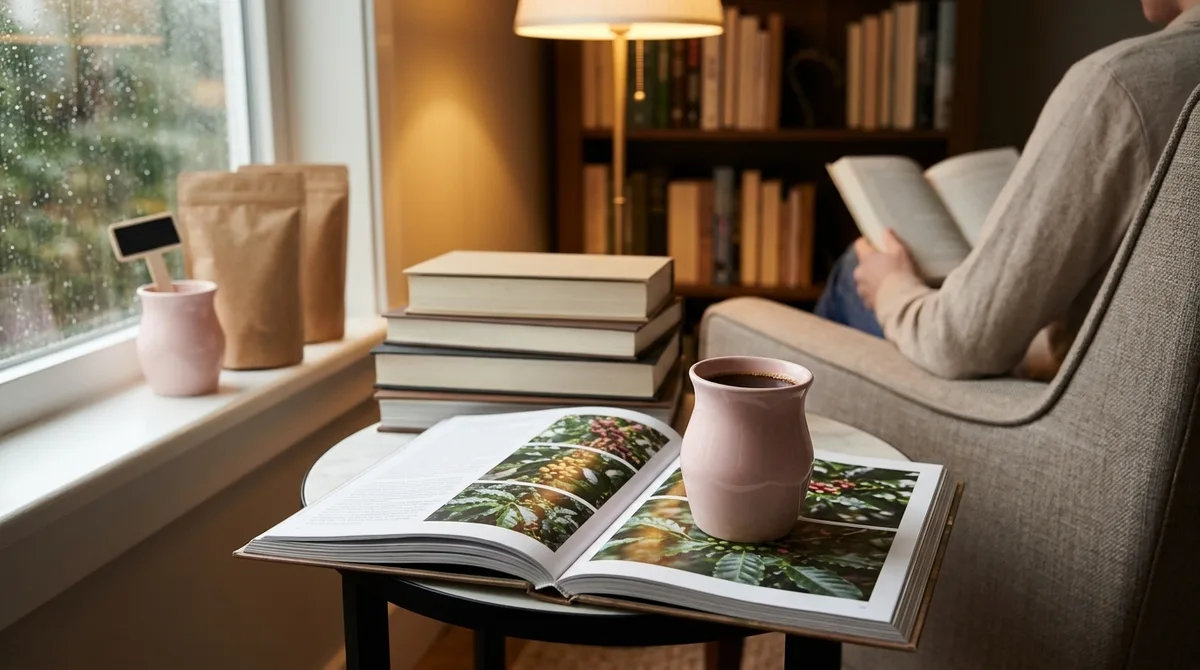



Books About Coffee – top 10 for beginners and advanced

Why read about coffee
In the age of YouTube tutorials and Instagram reels, a book about coffee might seem like an anachronism. It isn't. A video shows you technique – a book gives you understanding. A video explains "how" – a book explains "why." And it's precisely this "why" that distinguishes someone who can make good coffee from someone who truly understands it.
These books are not collections of recipes. They are windows into a world that begins on tropical farms, continues through processing stations and roasteries, and ends in your cup. Each title has brought something to coffee literature that you won't find in any video or blog post.
Explore our books about coffee – many of the titles reviewed below are available directly in our selection.
1. The World Atlas of Coffee – James Hoffmann
For whom: Anyone who wants to understand coffee comprehensively – from beginner to advanced.
James Hoffmann is World Barista Champion (2007), a YouTuber with millions of followers, and probably the most influential figure in modern coffee culture. His atlas is essentially the standard reference work for anyone serious about coffee.
What you'll learn:
- A complete overview of coffee regions worldwide – country by country, with maps, climate conditions, and flavor profiles
- How coffee processing works – natural, washed, honey, and their specific impact on the final taste
- Principles of roasting and their effect on your cup, including differences between light, medium, and dark roasts
- Coffee preparation through various methods, emphasizing understanding of principles rather than just procedures
Why it's exceptional: Hoffmann writes clearly, without unnecessary jargon, with a scientist's precision and a practitioner's passion. The atlas is rich in illustrations and works equally well as both reference material and a coffee table book. The second edition from 2018 was expanded with new producing regions and updated information reflecting specialty coffee's evolution.
Rating: If you're buying just one book about coffee, this is the one.
2. God in a Cup – Michaele Weissman
For whom: Those who want to understand the story behind the cup – the human dimension of specialty coffee.
Michaele Weissman traveled with four third-wave pioneers on their coffee journeys – visiting farms in Ethiopia, Central America, and Indonesia. The result is a journalistic account of how the specialty coffee revolution was born, told through specific people and specific decisions.
What you'll learn:
- Stories of farmers, exporters, and roasters who shaped the third wave and defined its values
- How the specialty coffee market works – Cup of Excellence auctions, direct trade and its reality, certifications
- The human cost of a quality cup of coffee – labor, risk, multi-year investments with no guaranteed outcome
- The political and economic reality of coffee-producing countries that most consumers never see
Why it's exceptional: This isn't a technical manual – it's a report that gives you emotional understanding of why specialty coffee costs more and why it should. After reading this book, you view a single-origin cup completely differently.
3. Coffee Obsession – DK Publishing
For whom: Visual learners, beginners, and people who want to master coffee preparation quickly and practically.
DK (Dorling Kindersley) is synonymous with visually rich guides, and Coffee Obsession is a textbook example of this format. Each page combines photographs, diagrams, infographics, and step-by-step instructions into an accessible whole.
What you'll learn:
- Coffee preparation through more than 15 methods – from espresso to siphon – with photo documentation of every step
- Basics of latte art with visual guides for commonly available patterns
- An overview of coffee regions with maps and flavor profiles for quick orientation
- Recipes for coffee drinks – from classic cappuccino to creative cocktails with and without alcohol
Why it's exceptional: This is the most accessible coffee book for visual learners. If long text blocks discourage you, Coffee Obsession will guide you through the world of coffee through images without loss of substance. An ideal gift for someone just starting out with coffee.
4. Craft Coffee: A Manual – Jessica Easto & Andreas Willhoff
For whom: Home baristas who want to understand the variables behind your cup and learn to systematically troubleshoot.
Craft Coffee is a practical guide focused on making the best possible cup at home with commonly available equipment. Jessica Easto (journalist) and Andreas Willhoff (Q-grader) combine scientific approach with advice immediately applicable in your kitchen.
What you'll learn:
- Extraction in practice – what underextraction and overextraction are, how to recognize them by taste, and how to fix them by adjusting variables
- The impact of individual variables – grind size, water temperature, brew ratio, contact time – on your final cup
- Overview of more than 10 brewing methods with optimized recipes
- How to read a coffee's flavor profile and choose beans and brewing method accordingly
Why it's exceptional: While most books say "use water at 96 °C," Craft Coffee explains why exactly that temperature and what happens if you use 92 °C or 100 °C. It's a book that teaches you to think analytically about coffee and solve problems without blindly following recipes.
5. Water for Coffee – Maxwell Colonna-Dashwood & Christopher Hendon
For whom: Advanced enthusiasts and professionals who want to understand the most important – and simultaneously most overlooked – ingredient in your cup.
Coffee is 98% water. Yet most people pay no attention to water. Maxwell Colonna-Dashwood (barista and cafe owner) and Christopher Hendon (chemist from University of Bath) wrote the first book exclusively focused on water and its impact on extraction and taste.
What you'll learn:
- Water chemistry – TDS, total hardness, alkalinity, and their specific impact on extraction
- Why the same coffee tastes different in different cities and cafes – and why it's not a mystery but chemistry
- How to adjust water at home for optimal extraction without expensive equipment
- Mineral recipes – how to mix "ideal" water for different coffee profiles
Why it's exceptional: This book literally changed the coffee industry. After its publication, water chemistry became a standard topic at barista championships worldwide. It's not light reading – it contains chemical formulas and graphs – but for those who want to go truly deep, it's an irreplaceable resource.
6. The Professional Barista's Handbook – Scott Rao
For whom: Professional baristas and advanced home baristas who prefer technical precision over visual appeal.
Scott Rao is one of the most respected technical authors in the coffee world. His handbook is dense, systematic, and uncompromising – no decorative photographs, just clean, verified information.
What you'll learn:
- Precise extraction parameters – extraction yield, TDS, brew ratio, and their mutual relationships
- Tamping, coffee distribution in the portafilter, and pressure profiling – details that determine consistency
- Diagnosis of common problems – channeling, uneven extraction, donut effect
- Maintenance and calibration of espresso equipment for long-term consistency
Why it's exceptional: It's a reference you return to. Not meant for one-time reading – it's a manual you open when something isn't working and you need precise technical explanation.
7. Espresso Coffee: The Science of Quality – Andrea Illy & Rinantonio Viani
For whom: Scientists, engineers, and people who want to understand coffee at the molecular level without oversimplification.
Andrea Illy – chemist and chairman of Illycaffè – compiled an academic work that belongs more in a research facility library than in a home barista's collection. Peer-reviewed studies, chemical formulas, and physical models are standard here.
What you'll learn:
- Chemistry of roasting – Maillard reaction, caramelization, and pyrolysis in full scientific depth
- Physics of extraction – water flow through coffee bed, hydraulic resistance, impact of pressure and temperature on extraction curves
- Sensory analysis – taste and aroma perception at neurological and biochemical levels
- Quality control systems from farm level through final cup
Why it's exceptional: This isn't a book for evening reading – it's a textbook. But if you truly want to understand why coffee tastes the way it does and seek answers at the level of molecules and physical processes, there's no better source.
8. The Curious Barista's Guide to Coffee – Tristan Stephenson
For whom: Enthusiasts seeking a combination of history, science, and practical recipes in an accessible and readable format.
Tristan Stephenson is a barista, bartender, and author who can present even complex topics without them feeling like a studied textbook. His book is visually attractive and substantively solid.
What you'll learn:
- History of coffee from Ethiopian highlands through Ottoman kahvehs to the third wave
- Science behind coffee – extraction, roasting, grinding – explained without unnecessary simplification or unnecessary complexity
- More than 20 brewing methods with detailed instructions including less common alternatives
- Recipes for coffee cocktails and creative drinks suitable for home experimentation
Why it's exceptional: If you find The World Atlas of Coffee too encyclopedic and Craft Coffee too technical, Stephenson is the natural middle ground. It combines education with entertainment in a way that isn't standard in coffee literature.
9. Blue Bottle Craft of Coffee – James Freeman, Caitlin Freeman & Tara Duggan
For whom: People who want to understand the philosophy of the third-wave coffee through the story of one of its most influential roasteries.
Blue Bottle Coffee is for many people synonymous with specialty coffee in the United States. James Freeman and co-authors wrote a book that is partly memoir, partly barista manual, and partly cookbook – and all three levels work.
What you'll learn:
- The story of Blue Bottle and its central philosophy: coffee no older than 48 hours from roasting as the foundation of freshness
- Preparation methods that made Blue Bottle famous – siphon, nel drip, Japanese iced pour-over
- Recipes for coffee pastries and desserts from Caitlin Freeman, formerly Blue Bottle's pastry chef
- How to develop your taste compass in selecting and evaluating coffee
Why it's exceptional: This is the most inspiring book on this list. Freeman can communicate values through what seems a simple coffee story – quality, freshness, craft, community. After reading, you'll think of coffee as a artisanal product, not a commodity.
10. Coffee: A Comprehensive Guide – Robert W. Thurston, Jonathan Morris & Shawn Steiman
For whom: Academics, historians, and people seeking an encyclopedic view of coffee from every angle simultaneously.
This isn't a book by one author – it's a collection of essays from dozens of experts: historians, economists, agronomists, sensory scientists, and sociologists. Each chapter is an independent expert contribution.
What you'll learn:
- Complete history of coffee from the 15th century to present, including lesser-known chapters of trade history
- Global coffee economics – trade relationships, fair trade vs. direct trade, impacts of climate change on production
- Agronomy – botanical varieties, diseases like coffee leaf rust, modern cultivation practices
- Processing, roasting, and preparation from a purely scientific perspective without practical recommendations
- Cultural context – coffee culture in different countries and historical periods
Why it's exceptional: It's the most comprehensive work about coffee currently in existence. It's not meant to be read straight through – it's a reference you consult when you want truly deep insight on a specific topic.
Comparison table
| Book | Author | Level | Focus | Pages | Language |
|---|---|---|---|---|---|
| The World Atlas of Coffee | Hoffmann | Everyone | Comprehensive overview | 272 | EN |
| God in a Cup | Weissman | Everyone | Stories, journalism | 240 | EN |
| Coffee Obsession | DK | Beginner | Visual guide | 256 | EN/SK |
| Craft Coffee | Easto & Willhoff | Intermediate | Practice, troubleshooting | 272 | EN |
| Water for Coffee | Colonna-D. & Hendon | Advanced | Water chemistry | 150 | EN |
| Professional Barista's HB | Rao | Professional | Espresso technique | 120 | EN |
| Espresso Coffee | Illy & Viani | Expert | Science, chemistry | 400+ | EN |
| Curious Barista's Guide | Stephenson | Intermediate | History + practice | 224 | EN |
| Blue Bottle Craft | Freeman et al. | Everyone | Philosophy, recipes | 240 | EN |
| Comprehensive Guide | Thurston et al. | Advanced | Encyclopedia | 400+ | EN |
How to choose the right book
Your first book about coffee? → The World Atlas of Coffee
Hoffmann's atlas gives you a solid foundation. You'll understand the big picture – from farm to cup – and gain context to know which direction to dive deeper.
Want to make better coffee at home? → Craft Coffee
Easto and Willhoff teach you to think analytically about coffee. Less theory for theory's sake, more immediately applicable practice.
Interested in the story, not the technique? → God in a Cup
Weissman opens your eyes to the human dimension behind every cup and changes how you view coffee prices.
Advanced and want to go deeper? → Water for Coffee + Professional Barista's Handbook
These two books together cover two key variables that determine quality of every cup: water composition and extraction technique.
Looking for a gift? → Coffee Obsession or The Curious Barista's Guide
Visually attractive, content-rich, look good on any shelf.
Frequently Asked Questions (FAQ)
Are there quality coffee books in Slovak or Czech?
Most top coffee literature is published in English. Some titles – including Coffee Obsession by DK – have been translated to Czech. Czech market has local publications from domestic roasteries and baristas, but world bestsellers are available primarily in the original. Good English is a significant advantage in studying coffee.
Are coffee books still relevant in the age of YouTube?
Yes – and not in competition but in symbiosis. Video is better for technique (you see hand movement during latte art, proper distribution in the portafilter), books are better for understanding principles, history, and science. Most effective approach: read books for understanding, watch videos for technique.
Which book makes the best gift for a coffee lover?
The World Atlas of Coffee – it's beautifully bound, functions as home décor. Coffee Obsession is excellent for more visual types. Both can be found in our coffee books section.
Do I need to read all 10 books?
No. Start with one matching your level and interests. Most coffee professionals have 3–5 titles from this list and return to them repeatedly based on current needs.
Do these books contain recipes?
Coffee Obsession, The Curious Barista's Guide, and Blue Bottle Craft of Coffee contain recipes for coffee drinks and pastries. Craft Coffee contains optimized recipes for various brewing methods. Other titles are primarily theoretical or technical.
Sources
- Goodreads – Best Coffee Books
- Specialty Coffee Association – Coffee Education
- James Hoffmann – Book recommendations (YouTube)
- Barista Hustle – Recommended Reading