
 Česky (CZK)
 Slovensky (EUR)
 Magyar (HUF)
 Polski (PLN)
 English (EUR)
 Deutsch (EUR)
 Français (EUR)
 Español (EUR)
 Português (EUR)
 Italiano (EUR)
 Svenska (SEK)
 Suomi (EUR)
 Nederlands (EUR)
 Dansk (EUR)
 Lëtzebuergesch (EUR)
 Eesti (EUR)
 Latviešu (EUR)
 Lietuvių (EUR)
 Slovenščina (EUR)
 Română (RON)
 Български (EUR)
 Hrvatski (EUR)
 Ελληνικά (EUR)
 Українська (EUR)
 Norsk (EUR)
 Srpski (EUR)
 Tiếng Việt (EUR)
9, 15 or 19 bar: what is the ideal pressure in an espresso machine?
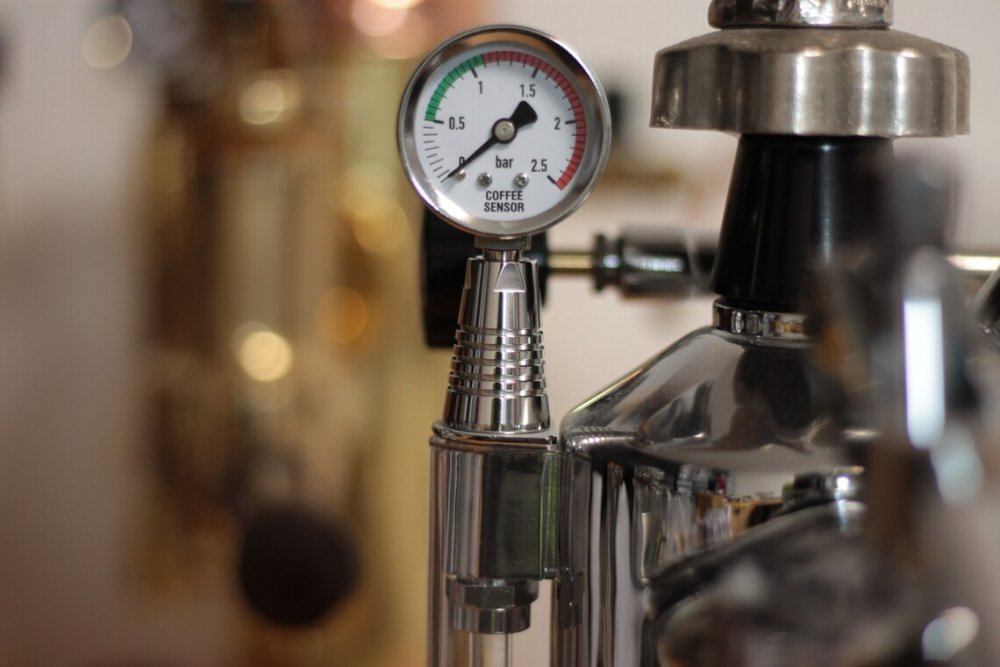
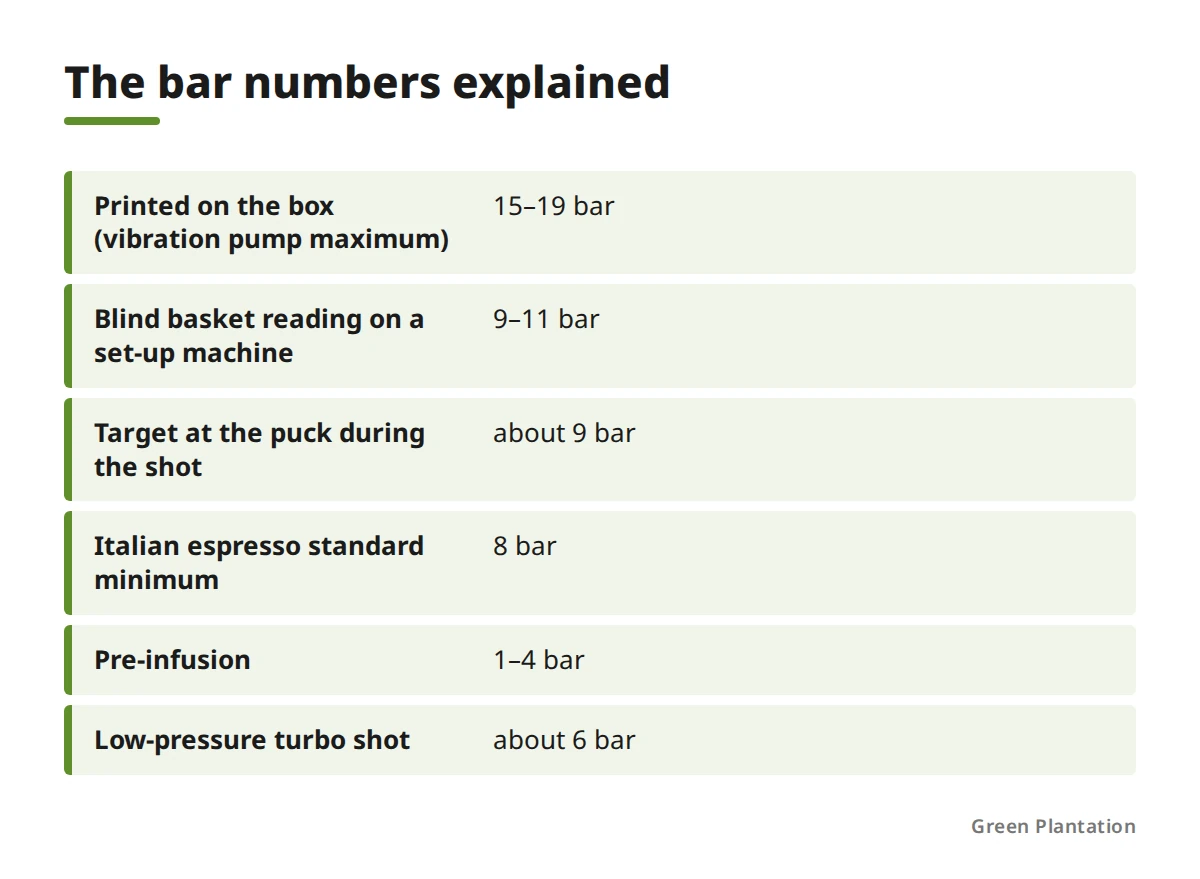
In short: Espresso brews best at around 9 bar at the coffee puck. The 15 or 19 bar on the box is the vibration pump's maximum, not brewing pressure. A good machine limits it with an over-pressure valve (OPV), and many baristas now get sweeter shots at 6–9 bar.

| Target brewing pressure | About 9 bar at the puck (8–10 bar works) |
|---|---|
| Italian espresso standard | At least 8 bar, 90–96 °C, 20–27 seconds |
| 15 or 19 bar on the label | Maximum of the vibration pump with the outlet blocked |
| Valve that limits pressure | OPV (over-pressure valve), usually set to 9–10 bar |
| Blind basket reading | Typically 9–11 bar, slightly above the real shot |
| Low-pressure "turbo" shot | About 6 bar, coarser grind, around 15 seconds |
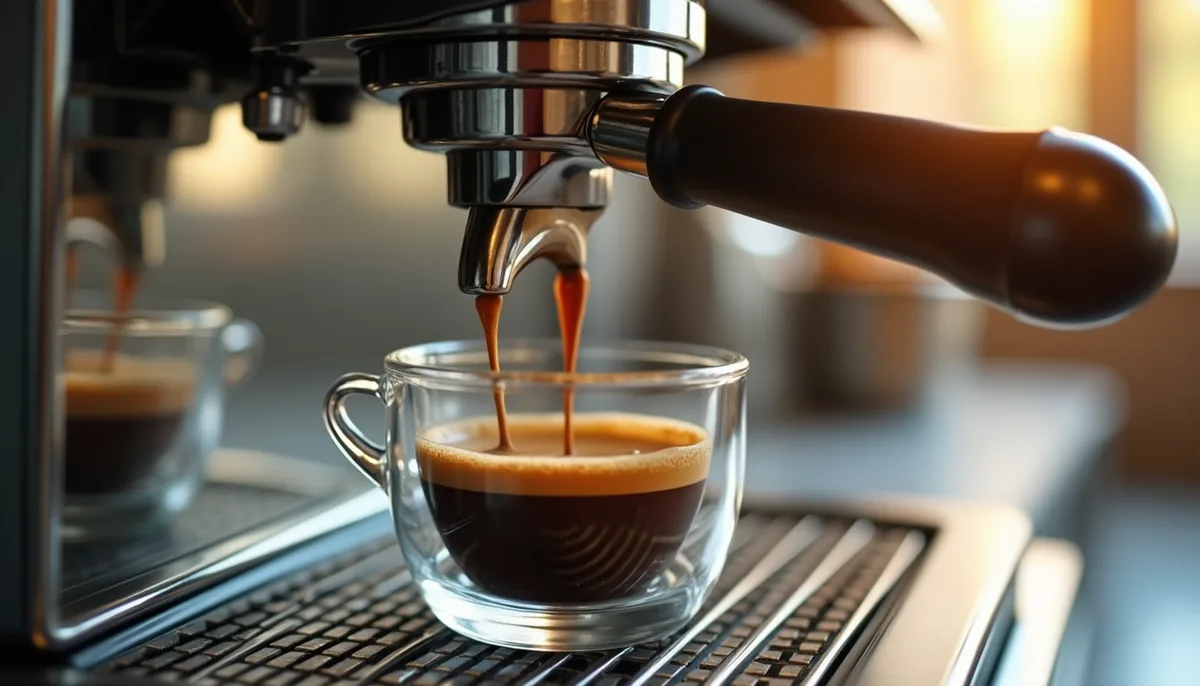
Machine boxes in UK shops compete on one number: 15 bar, 19 bar, sometimes 20. It looks like horsepower on a car. It is not. Below: what pressure really does to espresso, what the OPV is, how to check your machine and when to go below 9 bar.
Pump pressure vs brewing pressure: two different numbers
The figure printed on the box is the maximum static pressure of the pump. Most home machines use a small vibration pump (Ulka, CEME and similar) rated at 15 bar with the outlet closed; some brands quote 19 or 20 bar for the same class of pump. It is a dead-end figure, not what reaches your coffee.
The figure that matters is brewing pressure: the pressure in the group head while water is flowing through the coffee puck. On a well set-up machine that sits around 9 bar. On many cheaper machines nobody limits it, so the pump pushes as hard as the puck lets it, and the shot runs at 12–15 bar whenever the grind is fine enough.
Pressure is a tug of war between the pump and the resistance of the puck. Grind too coarse and even a 19 bar pump shows only 3–4 bar, because water rushes straight through. A low reading during a shot almost always points to grind, dose or puck prep, not a weak pump.
Why 9 bar became the standard
Nine bar is a practical compromise, not a law of physics. It pushes water through a dense bed of 16–20 g of fine coffee in 25–30 seconds and emulsifies oils into crema, without compacting the puck so hard that water finds cracks instead (channelling).
The Italian espresso specification published by the Comitato Italiano Caffè sets extraction pressure at a minimum of 8 bar, water temperature at 90–96 °C, 7–9 g of coffee per single shot and an extraction time of 20–27 seconds. Its own test rig is calibrated to 9 bar. Commercial machines are typically set to about 9.5–10 bar with a blind basket so that they land near 9 bar during a real shot, as Clive Coffee's technical guide explains.
Above roughly 10–11 bar, extra pressure buys little. The puck compresses, flow stops rising in proportion and channelling becomes more likely: bitter edges plus a sour, thin body.
What different machines actually brew at
The table below shows typical real-world values. Individual machines vary, and anything without an OPV depends heavily on how fine you grind.
| Machine type | Pressure on the box | Typical pressure at the puck | How it is limited |
|---|---|---|---|
| Entry-level home machine, pressurised basket | 15–20 bar | Varies, often 10–15 bar | Often no OPV; the pressurised basket creates the "crema" |
| Bean-to-cup (super-automatic) | 15–19 bar | Roughly 8–12 bar, depends on grind and model | Internal valve and brew unit |
| Prosumer single boiler or heat exchanger (vibration pump) | 15 bar pump | About 9 bar | Adjustable OPV, brew gauge |
| Dual boiler with rotary pump | Rarely printed | About 9 bar, set on the pump bypass | Rotary pump bypass screw, often a gauge at the group |
| Flow-control paddle or pressure profiling | Rarely printed | Anything from 1–2 bar up to 9–10 bar during one shot | Needle valve at the group or electronic pump control |
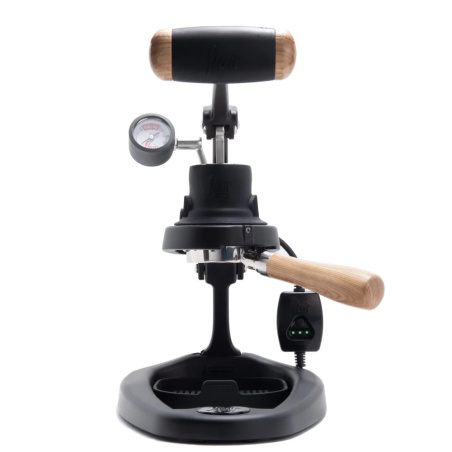
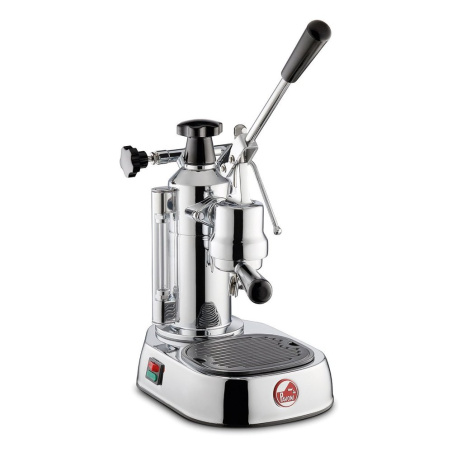
| Manual lever (Flair, La Pavoni) | No pump | Whatever your arm delivers, typically 6–9 bar | You, watching the gauge |
On cheaper machines the bar figure is marketing; on better ones it is barely mentioned, because what counts is how pressure is controlled and displayed.
The OPV: the part that turns 15 bar into 9
An over-pressure valve is a small spring-loaded valve between the pump and the group. Once pressure reaches its set point, it opens and returns surplus water to the tank or the drain. On a vibration-pump machine that is set to 9 bar, the pump still "has" 15 bar available, but anything beyond 9 bar never reaches the puck.
Some popular entry machines leave the factory with the OPV set well above 9 bar, hence the "9 bar OPV mod" common in home-barista forums. Prosumer machines from Lelit, Profitec, ECM or Rocket ship set to about 9–10 bar; rotary pumps use a bypass screw instead. For a deeper look at the parts, see our article on the ULKA pump and OPV valve inside home coffee machines.
The OPV is not the boiler safety valve, nor the three-way solenoid valve that releases group pressure after the shot so the puck comes out dry.
How to check your machine's brewing pressure at home
If your machine has a brew pressure gauge, checking takes two minutes:
- Insert a blind basket (the one without holes used for backflushing) into the portafilter and lock it in.
- Start the pump and watch the gauge for about 10 seconds until the needle settles.
- Read the value. Around 9–11 bar is normal on a blind basket; the real shot will sit slightly lower because the puck lets some water through.
- If it reads 12 bar or more, the OPV or pump bypass is set too high. If it reads well under 8 bar, the pump may be worn, the OPV may be stuck open or there is scale in the system.
Machines without a gauge can be checked with a portafilter pressure gauge. Adjusting the OPV means opening the case of a mains-powered appliance with a hot boiler inside, so leave it to a technician unless the manufacturer's manual describes the procedure.
If the blind basket shows 9 bar but the shot only 3–5 bar, the machine is fine: grind finer and check dose and tamping. Our guide to common espresso mistakes covers the usual culprits.
Is 15 or 19 bar better than 9 bar?
No. A 19 bar machine and a 15 bar machine both need to brew at about 9 bar to make a balanced espresso, and if they do not, that is a flaw rather than a feature. A higher pump rating can even be a small negative on a machine without an OPV, because there is nothing to stop the shot from running at 13–15 bar once the grind is fine.
What 15 or 19 bar does tell you is the pump class: both are vibration pumps. A rotary pump is quieter, can be plumbed in and delivers pressure instantly and steadily, but it is not "stronger" in any way that matters to the cup.
So when you compare machines, look at these points instead of the bar figure:
- Is there an adjustable OPV or pump bypass set to about 9 bar?
- Is there a brew pressure gauge, ideally at the group rather than at the pump?
- PID temperature control and a 58 mm portafilter?
- An espresso grinder that adjusts in small steps? Pressure control is worthless without it.
Lower pressure, pre-infusion and pressure profiling
Baristas no longer treat 9 bar as sacred. Three ideas matter.
Pre-infusion. Wetting the puck at 1–4 bar for a few seconds before full pressure reduces channelling. The E61 group does a mild version mechanically. More detail in our article on espresso preinfusion.
Lower peak pressure. A 2020 study in the journal Matter (Cameron et al.) modelled espresso extraction and found that grinding slightly coarser and brewing at lower pressure, around 6 bar, made shots more reproducible and reduced waste without losing extraction yield. The authors were careful to say taste is still personal. This is the origin of the popular "turbo shot": about 6 bar, a coarser grind, roughly 15 seconds and a longer ratio. It suits light roasts especially well.
Pressure and flow profiling. Here the pressure changes during the shot: a slow ramp up, a peak of 8–9 bar, then a decline to 5–6 bar as the puck erodes. Owners of paddle machines report that a declining profile tames bitterness in darker roasts and adds sweetness to lighter ones. It is done in two ways: a needle valve at the group that the barista turns (Lelit Bianca, E61 flow control kits) or an electronically controlled pump that runs a saved profile (Rocket R NINE ONE and similar).
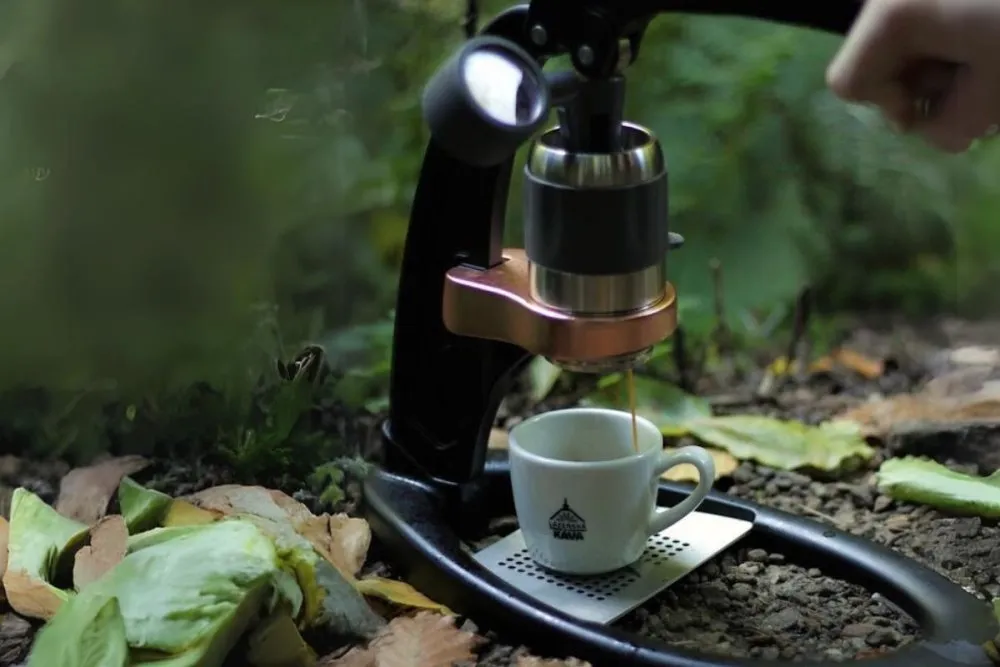
Manual lever machines have always worked this way. You build pressure with your arm, watch the gauge and let it fall naturally as the shot ends. If you own a Flair, see how to hit the correct pressure on a Flair.
Troubleshooting: pressure too low or too high
| Symptom | Most likely cause | What to do |
|---|---|---|
| Gauge under 6 bar during the shot, shot runs fast and sour | Grind too coarse, dose too low, stale beans | Grind finer, weigh the dose, use beans 1–4 weeks off roast |
| Gauge low even with a blind basket | Worn pump, OPV stuck open, scale, empty or leaking tank | Descale, check the tank seal, then call a technician |
| Gauge 12 bar or more, shot chokes or drips | OPV set too high or missing, grind too fine | Grind coarser; have the OPV set to about 9 bar |
| Pressure fine, taste harsh and hollow | Channelling from uneven distribution or tamping | Improve distribution, try pre-infusion or a lower peak |
Frequently asked questions
What is the best pressure for an espresso machine?
About 9 bar at the puck during the shot. Anything from 8 to 10 bar gives good espresso, and lower values of around 6 bar work with a coarser grind. Above 11 bar flavour usually gets harsher, not better.
Is 9 bar or 15 bar better for espresso?
9 bar. The 15 bar figure is the pump's maximum, and a good machine reduces it to about 9 bar with an OPV. A 15 bar label is not a reason to choose or reject a machine.
Why do coffee machines say 15 or 19 bar?
It is the rated maximum of the vibration pump inside, measured against a closed outlet. Bigger numbers sell, so manufacturers print them, but they do not describe the pressure your coffee sees.
Why does my pressure gauge show low pressure?
In most cases the grind is too coarse or the dose too small, so water flows through without resistance. Test with a blind basket: if it reaches 9–11 bar there, the machine is fine and the puck needs adjusting.
What pressure does a lever espresso machine use?
Spring levers peak at around 8–10 bar and fall as the spring extends. On manual levers such as Flair or La Pavoni you set it by hand, usually 6–9 bar.
Machines that let you control pressure
If pressure is the reason you are upgrading, these machines and accessories give you an honest gauge and real control. For a broader comparison of the brands, see Lelit vs ECM vs Rocket Espresso.
- Lelit Bianca PL162T – dual boiler with a rotary pump, a gauge on the group and a paddle that controls flow during the shot.
- Rocket Espresso R NINE ONE – electronically controlled pump that repeats saved pressure profiles shot after shot.
- Profitec PRO 400 – heat exchanger with PID, E61 group and a double gauge that shows pump pressure during the shot.
- ECM E61 Flow Control Kit – adds manual flow control to an existing E61 machine.
- Flair 58 – manual lever with a built-in gauge. Ideal for experimenting with 6 bar shots.
- Eureka Mignon Specialita – stepless espresso grinder. Pressure control only works with a finely adjustable grind.
Sources
- Comitato Italiano Caffè: Disciplinare Caffè Espresso Italiano Tradizionale (2018)
- Cameron et al. (2020), Systematically Improving Espresso: Insights from Mathematical Modeling and Experiment, Matter
- Clive Coffee: Understanding Your Brew Pressure Gauge
Updated: November 2026
Author: Petra Novotná, editorial name of the Green Plantation.
Recommended products (2)
- Bestseller
- Free shipping
- Free gift
- Free shipping
- Free gift
You might also like
 Coffee machine portafilter cup - which one to choose?
How to choose a portafilter basket and achieve better espresso extraction? Tastier coffee from a lever coffee machine is our topic today. We will see how to… 17. 12. 2024
 Water for the coffee machine - How hardness and pH affect the taste of espresso
What kind of water for the coffee machine and why not use bottled water for espresso? If you desire the perfect taste of coffee, you must use water with an… 4. 12. 2024
 How to ensure the correct pressure in the Flair coffee machine?
You want 9 bars, but you can't achieve that many bars when making espresso in the Flair? Flair Espresso only needs you to adjust one step in the coffee… 12. 9. 2024