Česky (CZK)
 Slovensky (EUR)
 Magyar (HUF)
 Polski (PLN)
 English (EUR)
 Deutsch (EUR)
 Français (EUR)
 Español (EUR)
 Português (EUR)
 Italiano (EUR)
 Svenska (SEK)
 Suomi (EUR)
 Nederlands (EUR)
 Dansk (EUR)
 Lëtzebuergesch (EUR)
 Eesti (EUR)
 Latviešu (EUR)
 Lietuvių (EUR)
 Slovenščina (EUR)
 Română (RON)
 Български (EUR)
 Hrvatski (EUR)
 Ελληνικά (EUR)
 Українська (EUR)
 Norsk (EUR)
 Srpski (EUR)
 Tiếng Việt (EUR)
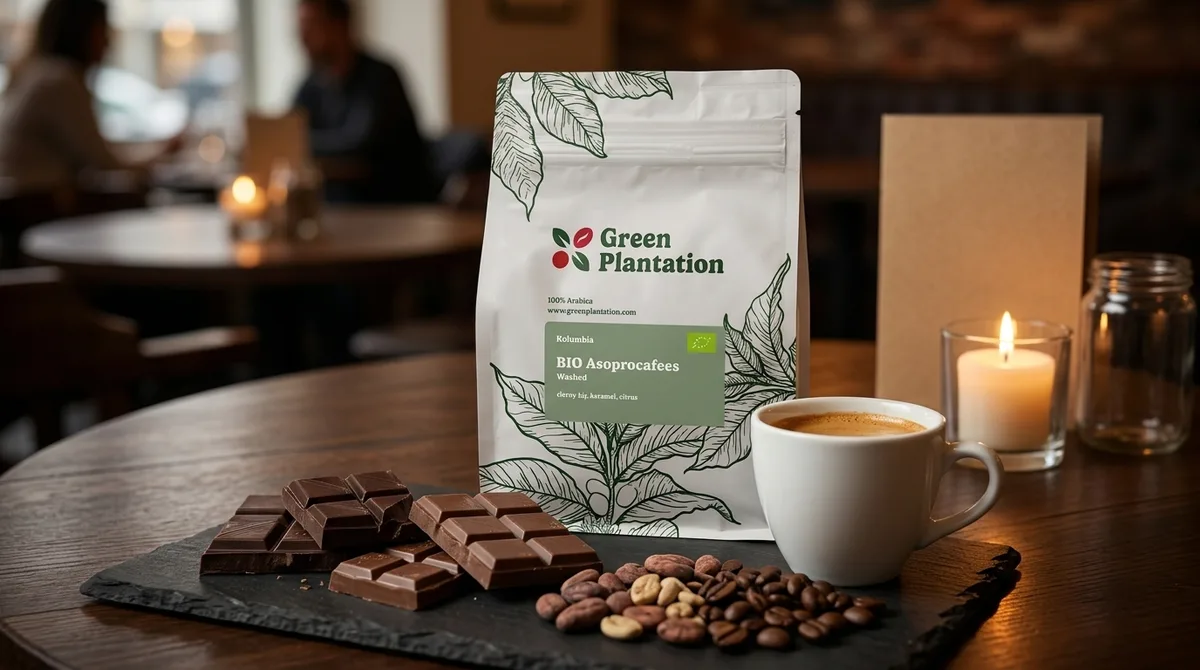
Why Chocolate and Coffee Belong Together
The combination of chocolate and coffee is not a fashionable trend – it has deep botanical, chemical, and flavor foundations. The cacao tree (Theobroma cacao) and coffee plant (Coffea) are tropical plants cultivated in a narrow belt around the equator, which producers call the "bean belt." Both fruits undergo fermentation, drying, and roasting – processes in which hundreds of flavor precursors transform into complex aromatic compounds. This is why the concept of "terroir" has become established in both the specialty coffee and fine chocolate worlds: origin, soil, altitude, and microclimate shape the final taste just as fundamentally as processing itself.



Shared Flavor Compounds
Coffee and chocolate share more than 300 aromatic compounds. The most significant ones determine the character of each pairing experience:
| Compound | Flavor Profile | Origin |
|---|---|---|
| Pyrazines | Nutty, roasted flavor | Maillard reaction during roasting |
| Aldehydes | Caramel, honey tones | Caramelization of sugars |
| Furans | Caramel, buttery sweetness | Roasting of both raw materials |
| Theobromine | Subtle, lingering bitterness | Prominent in cocoa, trace in coffee |
| Chlorogenic Acid | Fruity acidity | Present in both raw materials |
When you pair chocolate with coffee, shared compounds reinforce each other – while the unique components of one product complement the missing dimensions of the other. The result is a flavor experience richer than the sum of individual components.
Discover our chocolates and whole bean espresso coffee for your own pairing experiments.
Bean-to-Bar Chocolate – Basics
Just as the third wave of coffee shifted attention to origin, processing, and single origin beans, the bean-to-bar movement brought the same standard to chocolate. Bean-to-bar producers control the entire chain – from selecting cacao beans to the finished bar – and every decision in the process is directly reflected in the final flavor.
Production Process
- Harvesting and Fermentation – Cacao beans ferment for 5–7 days in wooden boxes. Fermentation is the crucial step: it breaks down the fruit pulp and develops flavor precursors, analogously to aerobic fermentation processes in coffee processing.
- Drying – In the sun or in dryers, moisture is reduced to 6–8%. Slow sun drying supports a more delicate flavor profile.
- Roasting – The Maillard reaction develops characteristic aromatic compounds. Lower temperatures preserve fruity and floral notes, higher temperatures emphasize nuttiness and intensity.
- Crushing and Grinding – Roasted beans are crushed into cacao nibs and subsequently ground into cacao mass.
- Conching – Prolonged mixing and heating in a conching machine (hours to days) smooths the texture, removes unwanted volatile compounds, and rounds out the flavor.
- Tempering – Precise cycles of cooling and heating stabilize cocoa butter into form V crystals, giving chocolate a glossy surface and a satisfying crisp "snap" when broken.
Types of Chocolate
- Dark 70–85% – Intense cacao flavor, minimal sugar, bean character shines fully
- Dark 55–70% – Balanced, more approachable, ideal for pairing experiments with broader audiences
- Milk 30–50% – Cacao mass with added milk powder, creamy and caramel
- White – Cocoa butter without cacao mass, vanilla and buttery; serves as a neutral flavor canvas
- Ruby – From ruby cacao bean varieties, naturally pink color, pronounced fruity and raspberry acidity with no added coloring
Pairing Guide – Chocolate and Coffee by Origin
Dark Chocolate + Ethiopian Natural Coffee
Pairing for lovers of complexity and fruity intensity. Ethiopian natural coffee – dried in the whole cherry – has pronounced notes of blueberry, red wine, and tropical fruit. Dark chocolate with 70–80% cocoa from Madagascar or Peru adds bitter depth and its own fruity acidity.
Why It Works: Fruity esters from natural processing resonate with the fruity acidity of quality dark chocolate. The bitterness of cocoa meanwhile balances the natural sweetness of natural coffee and prevents it from tasting overly sweet.
Coffee Preparation: Filter – pour-over or AeroPress preserve the delicate fruity notes. Espresso would suppress them with extraction intensity.
Milk Chocolate + Brazilian Coffee
Brazilian coffee is typically nutty, chocolatey, with low acidity and full body. Milk chocolate adds caramel and creamy tones that naturally complement this profile.
Why It Works: Both raw materials share a nutty-caramel foundation, so they don't compete but reinforce each other. The creaminess of milk chocolate underscores the full body of Brazilian coffee. It's a "comfort" pairing – simple, coherent, and satisfying.
Coffee Preparation: Espresso or moka pot. Dense extraction highlights chocolate notes that merge with milk chocolate into a cohesive whole.
White Chocolate + Kenyan or Colombian Coffee
White chocolate contains no cacao mass – it's cocoa butter with sugar and vanilla. It lacks its own distinct flavor character, making it an ideal creamy canvas for the fruity and citrus profiles of Kenyan or Colombian washed coffees.
Why It Works: Fat molecules in cocoa butter coat the tongue and mute the sharper acidity of coffee. The vanilla tones of white chocolate complement the fruitiness, and the contrast between creaminess and bright citrus acidity feels refreshing.
Coffee Preparation: Filter – Chemex or V60 for clean and transparent flavor without disruptive extraction bitterness.
Dark Chocolate 55–65% + Medium Roast Colombia or Guatemala
Universal pairing suitable for any occasion. Medium roast Colombian or Guatemalan coffee offers a balanced flavor – nutty and caramel tones with subtle fruitiness and distinct sweetness. Medium-dark chocolate adds depth without overwhelming bitterness.
Why It Works: Both components are in the "sweet spot" of their profile – complex enough to be interesting and accessible enough to appeal to every guest.
Browse our whole bean filter coffee – single origin selections from Ethiopia, Colombia, Kenya, and Brazil.
Tasting Methodology
Pairing chocolate and coffee is not about eating a piece and washing it down – it's a structured sensory experience where you gradually build an understanding of how individual flavor compounds interact. Professional tasters proceed as follows:
Step 1: Taste the Chocolate Alone
Place a piece of chocolate on your tongue and let it melt slowly. Don't chew – slow melting releases aromatic compounds in layers. Observe the opening notes (sweetness or bitterness), middle tones (fruity, nutty, floral), and the finish (length, character of lingering perception).
Step 2: Taste the Coffee Alone
Sip the coffee and let it flow across your entire tongue – from the tip (sweetness) through the sides (acidity) to the back (bitterness). Note the body, acidity, and dominant flavor tones.
Step 3: Combination
Let a piece of chocolate partially melt, then sip the coffee. Carefully observe:
- What new flavors appeared that weren't present alone?
- Did the coffee amplify certain tones of the chocolate?
- Did the chocolate mute the bitterness or sharpness of acidity in the coffee?
- How does the finish of the combination differ from each ingredient separately?
Step 4: Record Your Impressions
Just as with coffee cupping, written notes help develop flavor memory and systematically find combinations that suit you best.
Recipes with Chocolate and Coffee
Mocha – Classic Harmony
Ingredients:
- 1 double espresso (60 ml)
- 15 g quality dark chocolate (60–70%) or 1 tablespoon quality Dutch cocoa
- 200 ml milk (dairy or oat)
- Whipped cream (optional)
Instructions:
1. Dissolve the chocolate directly in hot espresso – stir until a smooth, glossy mixture forms with no lumps.
2. Heat the milk and steam it to 60–65°C. Higher temperatures impair milk flavor.
3. Pour steamed milk into the cup with espresso-chocolate mixture and gently blend.
4. Top with whipped cream and grated chocolate.
Tip: Use espresso from Brazilian or Colombian coffee – the natural chocolate tones of the beans merge with chocolate coherently, not competitively.
Chocolate Affogato
Ingredients:
- 1 espresso (30 ml), freshly extracted
- 1 scoop vanilla ice cream
- 15 g dark chocolate, coarsely grated
Instructions:
1. Place a scoop of ice cream in a glass or wide cup.
2. Sprinkle with grated chocolate.
3. Pour freshly extracted hot espresso directly over the ice cream.
4. Serve immediately – the contrast of hot coffee and cold ice cream is the essence of this dessert.
Chocolate Cold Brew
Ingredients:
- 200 ml cold brew (concentrate diluted 1:1 with water)
- 2 tablespoons chocolate syrup or 20 g melted dark chocolate
- 100 ml milk
- Ice
Instructions:
1. Mix cold brew with chocolate syrup until evenly combined.
2. Fill a glass with ice.
3. Pour milk, then the coffee-chocolate mixture.
4. Gently stir and serve.
Pairing Overview
| Chocolate | Coffee | Preparation | Resulting Profile |
|---|---|---|---|
| Dark 80%+ Madagascar | Ethiopian natural | V60 / AeroPress | Fruity, berry, intense |
| Dark 70% Peru | Guatemala Antigua | Pour-over | Nutty, chocolatey, balanced |
| Milk 45% | Brazil Santos | Espresso / moka | Caramel, creamy, comfort |
| White | Kenya AA | Chemex | Fruity notes on creamy foundation |
| Ruby | Colombia washed | AeroPress | Fruity acidity, raspberry notes |
| Dark 60% with nuts | India Monsooned | French press | Spiced, nutty, full body |
Frequently Asked Questions (FAQ)
What is the difference between quality and mass-produced chocolate when pairing?
Fundamental. Mass-produced chocolate (most supermarket brands) contains minimal cacao mass, high sugar content, vegetable fats instead of cocoa butter, and synthetic vanillin. Its flavor profile is flat – distinctly sweet without other dimensions. Bean-to-bar chocolate has a complex character with fruity, nutty, floral, or spiced notes that interact with coffee on a far more interesting level. For pairing experiments, mass-produced chocolate simply won't do.
Does temperature matter for chocolate?
Significantly. Chocolate releases aromatic compounds most intensely at temperatures close to body temperature – around 32–36°C. Chocolate straight from the refrigerator will be muted in flavor and firm texture will slow aroma release. Remove it from the refrigerator at least 15–20 minutes before tasting and store it ideally at 16–18°C.
Can I pair chocolate with tea?
Absolutely. Dark chocolate pairs beautifully with Earl Grey – bergamot notes complement the bitterness of cocoa. Milk chocolate with chai creates a creamy and spiced combination. White chocolate with matcha offers a striking contrast of sweetness against green freshness with subtle grassy bitterness.
How much chocolate per cup of coffee?
For a tasting pairing, 10–15 g is sufficient – that's 1 to 2 squares of a bar. The goal is not to consume as much chocolate as possible, but to find synergy between coffee and cocoa. Larger amounts overpower taste discrimination and reduce receptor sensitivity.
Why do the same tasting notes appear in descriptions of both coffee and chocolate?
Because both products undergo fermentation and roasting. The Maillard reaction and caramelization of sugars during roasting generate the same classes of aromatic compounds – pyrazines, aldehydes, furans – in both raw materials. Similar processing leads to similar aromatic vocabulary.
Sources
- Journal of Agricultural and Food Chemistry – Volatile Compounds in Chocolate and Coffee: Similarities and Differences
- Specialty Coffee Association – The Coffee Taster's Flavor Wheel
- International Cocoa Organization – Fine Flavour Cocoa
- Bean-to-Bar Chocolate – How Bean-to-Bar Chocolate is Made