
 Česky (CZK)
 Slovensky (EUR)
 Magyar (HUF)
 Polski (PLN)
 English (EUR)
 Deutsch (EUR)
 Français (EUR)
 Español (EUR)
 Português (EUR)
 Italiano (EUR)
 Svenska (SEK)
 Suomi (EUR)
 Nederlands (EUR)
 Dansk (EUR)
 Lëtzebuergesch (EUR)
 Eesti (EUR)
 Latviešu (EUR)
 Lietuvių (EUR)
 Slovenščina (EUR)
 Română (RON)
 Български (EUR)
 Hrvatski (EUR)
 Ελληνικά (EUR)
 Українська (EUR)
 Norsk (EUR)
 Srpski (EUR)
 Tiếng Việt (EUR)
Eureka Costanza Review: HX Machine with PID, Costanza R and Owner Experiences
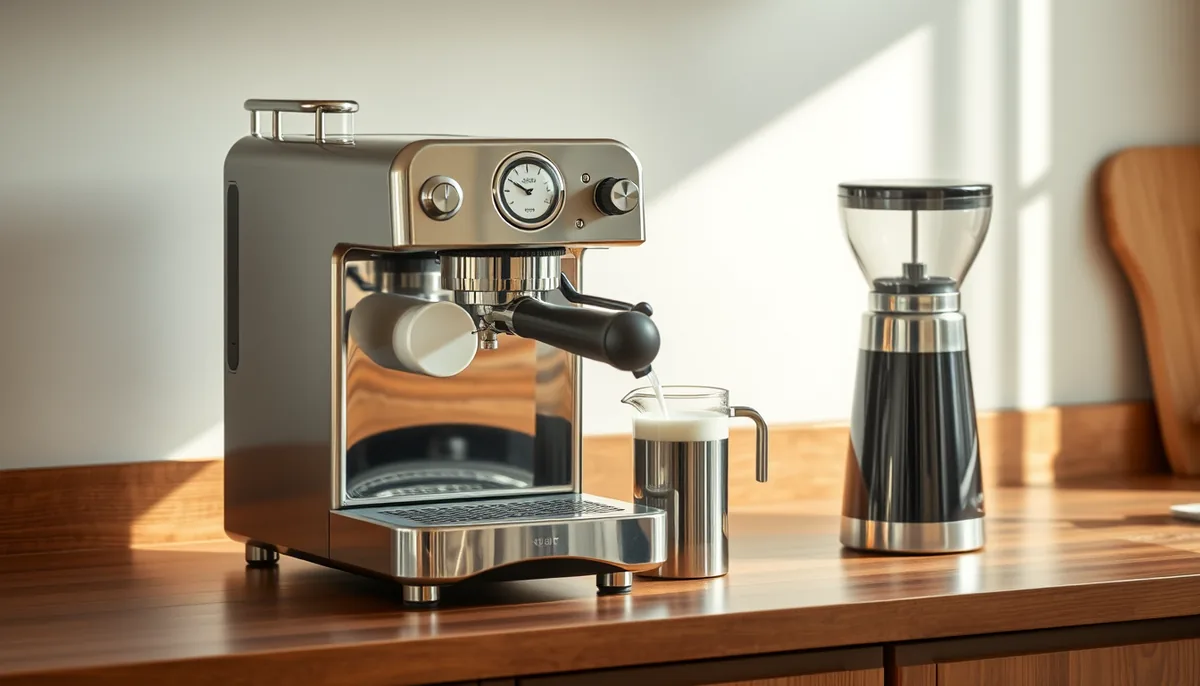
In short: The Eureka Costanza is a compact E61 heat exchanger machine with a 1.5-litre stainless steel boiler, three-step PID control (90, 93 and 96 °C), a shot timer and a weekly timer. It is not a dual boiler. The Costanza uses a vibration pump, the Costanza R a quiet rotary pump. Steam power is its strong suit, which makes it a natural fit for cappuccino and flat white households.



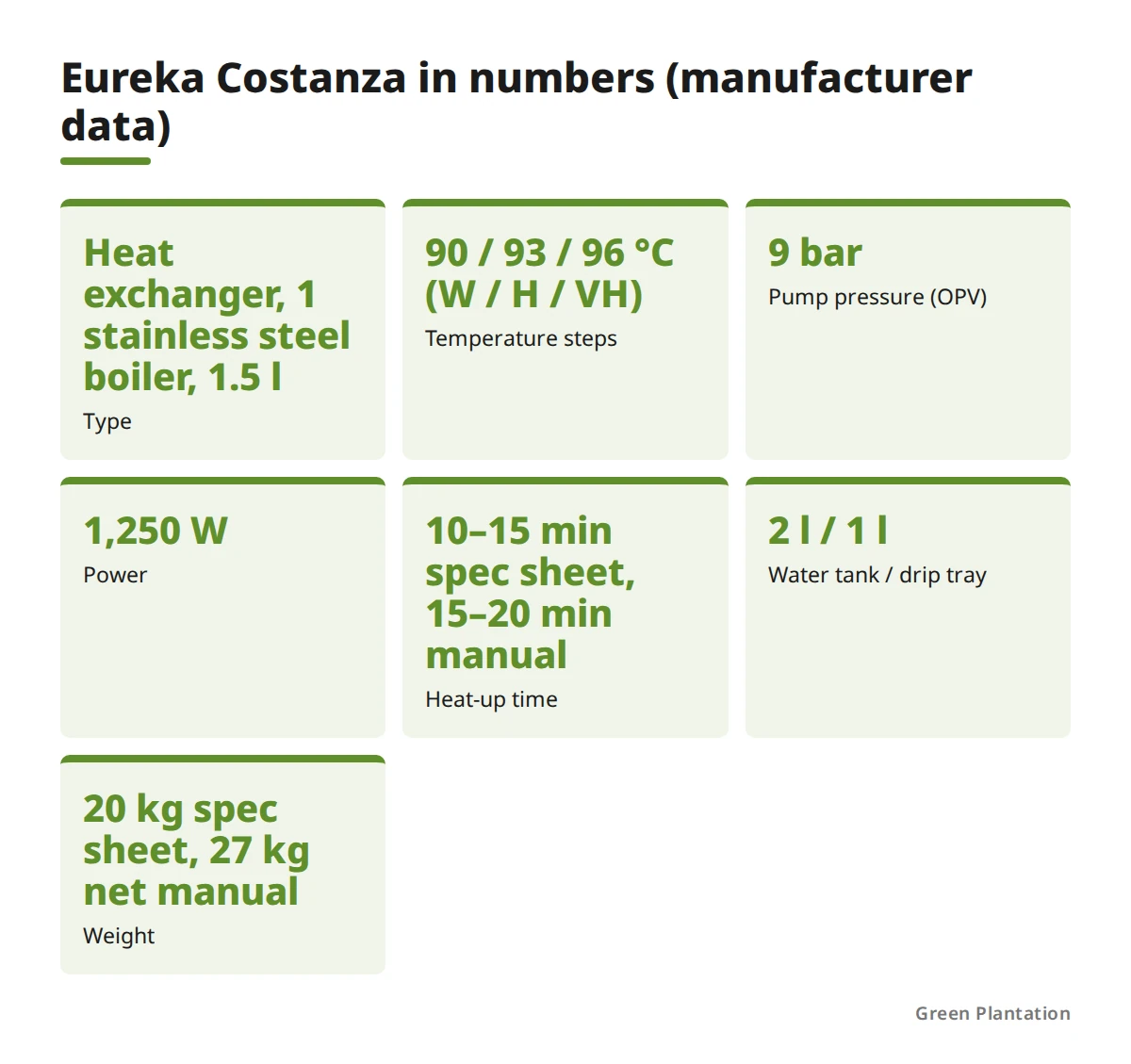
| Type | Heat exchanger (HX), one insulated 1.5 l stainless steel boiler |
|---|---|
| Group head | E61, 58 mm portafilter, pre-infusion |
| Temperature | PID via a digital pressure switch, 3 steps: 90 / 93 / 96 °C |
| Pump | Costanza: vibration pump, Costanza R: rotary pump, OPV set to 9 bar |
| Power and water | 1,250 W, 2 l water tank |
| Heat-up time | 10–15 min per the spec sheet, 15–20 min per the manual, retailers measure up to 25 min |
Who is the Eureka Costanza for?
A typical starting point: you already have a Eureka Mignon on the worktop, you make two cappuccinos every morning and you want to move up from an entry-level machine or a bean-to-cup to a "proper" E61 espresso machine. There is not much clearance under your wall cabinets, and you would like the machine to match the grinder. That is exactly the scenario Eureka designed the Costanza for.
The Costanza belongs to the "Eureka 1920" line and, together with the Pura, is the first espresso machine from the Florence-based grinder maker. At 337 mm tall according to the spec sheet, it is one of the lowest E61 machines on the market. If you steam a lot of milk, stick to one favourite bean and appreciate convenience features such as a timer and eco mode, you are in the right place. If you switch every morning between light filter roasts and dark espresso blends and want to set the temperature to the exact degree, a dual boiler is the better choice.
A note on the name in our shop listing: the word "lever" refers to the brew lever of the E61 group. The Costanza is a classic pump-driven espresso machine, not a manual lever machine.
Dual boiler or heat exchanger? Clearing up the confusion
Search for "Eureka Costanza" and you will find conflicting information. Some shops list it as a dual boiler, others as a "dual circuit" machine or a heat exchanger, and a US retailer review calls it a heat exchanger with PID. Eureka's own documents leave no doubt:
- The spec sheet lists one 1.5 l stainless steel boiler with thermal insulation.
- The Eureka brochure describes the identical Pura as using "professional heat exchanger technology".
- The spare parts list in the manual includes a "heat exchanger tube" and a "heat exchanger fitting".
So the Costanza is a heat exchanger: the boiler supplies steam and hot water, while the brew water flows through a tube inside the boiler and is heated on the way. "Dual circuit" means two water circuits, not two boilers, which is most likely where the mix-up with dual boilers comes from.
The PID control also works differently from what many people expect. According to a retailer's introduction on the German forum kaffee-netz.de, the electronics regulate the boiler via a digital pressure switch rather than a conventional temperature probe. That matches the manual: for eco mode you do not choose a temperature but a boiler pressure of 0.1, 0.5 or 0.8 bar. According to the manual, the three steps W, H and VH correspond to 90, 93 and 96 °C. The US review by Whole Latte Love gives boiler pressures of roughly 0.75, 1.0 and 1.5 bar for these steps. On a heat exchanger, the figure in degrees is always a guide to the brew temperature, not a measured temperature at the puck.
Costanza or Costanza R: what you are actually buying
The range has four models with the same boiler, the same E61 group, the same footprint and 1,250 W. The differences lie in the pump and the electronics:
- Pura: vibration pump, conventional pressurestat, no display, one pressure gauge.
- Pura R: as the Pura, but with a rotary pump.
- Costanza: vibration pump plus a display with PID, three temperature steps, shot timer, shot counter, weekly programme, eco mode and a dual gauge for boiler and pump pressure.
- Costanza R: everything the Costanza has, plus a rotary pump.
Across European retailers, the Costanza R is the model you will see most often. The rotary pump is noticeably quieter and, according to the manufacturer, delivers more stable pressure. One retailer also names it as a prerequisite for the optional plumbed-in water connection. The manual does indeed include a "direct connection / tank" menu item and requirements for the mains supply (2 to 5 bar, cold water). The spec sheet, on the other hand, lists only "tank" for all four models. If you want to plumb the machine in, check with the retailer before buying whether the conversion is approved for your model, and have it fitted in line with your local water regulations. With the vibration-pump Costanza, realistically plan on using the 2 l tank.
Our version is the Costanza Chrome with a vibration pump and a polished stainless steel body. The "CU" (Custom) variants have a body that takes separately sold side panels in white, black, red, walnut, oak or olive. This changes nothing in terms of function.
Day one: setting up and pulling the first shots
According to the list of contents, you get a portafilter with a double spout, a single and a double basket, a blind basket and heat-protection sleeves. Eureka does not include a tamper. Here is a sensible way to start:
- Check your water: The manual calls for a total hardness of 50 to 60 ppm (mg/l as calcium carbonate), which is about 5 to 6 °f or roughly 3 °dH. Much of England, including London and the South East, has hard water of 200 ppm or more, while Scotland, Wales and parts of northern England are often much softer. Test your water and use filtered or suitably mineralised water.
- Fill the tank and switch on: The machine fills the boiler automatically. It is ready when the heating indicator goes out. For a fully heated E61 group, the manual allows 15 to 20 minutes.
- Choose a temperature step: Start with H (93 °C) for medium roasts. W (90 °C) suits dark roasts, VH (96 °C) light roasts.
- Set the weekly programme: Have the machine switch on 25 minutes before you get up. That takes care of the heat-up time in everyday use.
- Dose: With the standard double basket, use 16 to 17 g of ground coffee. One owner reports that 18 g barely fits.
- First shot: Aim for a brew ratio of about 1:2 (for example 17 g in, 34 g out) in 25 to 30 seconds. The shot timer on the display helps, but it does not replace a scale.
- Run a cooling flush: As is usual with heat exchangers, the water in the exchanger can overheat after a longer idle period. A short flush of a few seconds before the first shot brings you closer to the selected step.
The E61 group offers mechanical pre-infusion: if you raise the brew lever only halfway, mains-level pressure is applied without full pump pressure. According to Eureka, the Costanza is also available with a flow control kit.
Milk texturing: a lot of steam
Steam power is the most frequently mentioned point in every owner report. The wand has a four-hole tip, with 1.5 mm holes according to one owner. For 150 to 250 ml of milk, that is a lot of power. Here is how to get to silky microfoam faster:
- Use a larger jug (500 ml or more) so the milk has time to roll.
- Open the valve only halfway at first and keep the stretching phase short.
- Stop at 60 to 65 °C, as the manual recommends.
- If you mostly steam small amounts: some owners swap the tip for one with smaller holes.
You can read more about the science behind good foam in our article about milk in coffee and how milk foam forms.
Cleaning, backflushing and descaling
The manual sets out a clear routine:
- Daily: Purge the steam wand for at least 2 seconds before and after steaming and wipe it with a damp cloth. Briefly flush the shower screen after the last shot.
- Backflushing: Insert the blind basket, add cleaning powder and run five cycles of 5 seconds each. Then remove the powder and rinse with another five cycles of 5 seconds.
- Baskets and portafilter: Soak for 30 minutes in a hot cleaning solution without submerging the handle, then rinse thoroughly.
- Descaling: every three months according to the manufacturer. There is a manual procedure via the tank and an automatic programme in the menu. In the automatic programme the heating switches off and the solution runs through the heat exchanger. Vinegar is explicitly prohibited.
A descaling function is rare on heat exchangers and a genuine plus. It is no substitute for good water, though: with soft, filtered water the boiler scales up much more slowly. In hard-water areas this matters even more. We explain how to tell whether your water is harming your machine in our article on water and limescale in coffee machines. In the maintenance menu you can also set after how many shots a service reminder appears.
What owners report
The Costanza has been on the market since 2024, so the number of owner reports is still small. We went through seven threads on the German forum kaffee-netz.de (two of them introductions by a retailer), five posts with around 20 comments on Reddit's r/espresso and a detailed retailer review from the US. The upside: the comments are consistent.
- Steam power: The main topic in four of the six relevant sources. Praised as "like a café machine", but hard to control, especially with small jugs and for people upgrading from entry-level machines.
- Espresso: Consistently positive. Owners coming from an entry-level machine describe a clear step up.
- Heat-up time: The manufacturer quotes 10 to 15 minutes. One owner manages with about 10 minutes on step W, a German retailer measures 20 to 25 minutes until the shot is truly hot, and forum users mention 25 minutes or more. The real answer depends on the step and your expectations.
- Build quality: Metal rotary valves and a large 1 l drip tray that slides straight out. One owner replaced the knobs with joystick-style valves from another E61 manufacturer because he did not like turning them.
- Faults: One owner reports a warranty claim after extended use (blank display, brew lever not working). Another post describes pre-infusion without any water flow. Two isolated cases do not point to a pattern.
- Group head in standby: One forum question concerns the E61 group staying hot even after hours in eco mode. That is down to the design: the group is connected to the boiler via the thermosiphon, and the boiler is kept at low pressure in standby.
Weaknesses and what to watch out for
- Only three temperature steps: There is no setting to the exact degree. For tinkerers who switch roasts often, that is too coarse.
- Conflicting manufacturer figures: The spec sheet gives 20 kg and 337 mm in height, the technical data in the manual 27 kg net and 355 mm. Allow some extra room, especially under wall cabinets.
- Heat-up time and energy use: An E61 heat exchanger is not a quick starter. The weekly timer and eco mode help, but the boiler stays warm in standby.
- Accessories: No tamper and only one portafilter, with a double spout. A retailer review also criticised that the manual was not available in German at the time. The current version from the manufacturer covers English and German.
- Vibration pump: The Costanza is louder than the R version. If a quiet morning matters to you, that is the strongest reason to choose the R.
- Water hardness: The 50 to 60 ppm requirement is strict, and in hard-water areas you will almost certainly need a filter or bottled water. Without one, limescale and warranty trouble are likely.
Comparison: Costanza, Costanza R, Pura and an alternative
The figures come from the manufacturers' spec sheets. The Ascaso Steel DUO is a compact alternative without a boiler if a short heat-up time matters more to you than an E61 group.
| Feature | Costanza | Costanza R | Pura / Pura R | Ascaso Steel DUO |
|---|---|---|---|---|
| Type | Heat exchanger, 1.5 l | Heat exchanger, 1.5 l | Heat exchanger, 1.5 l | 2 thermoblocks, no boiler |
| Group head | E61, 58 mm | E61, 58 mm | E61, 58 mm | Ascaso's own group |
| Pump | Vibration | Rotary | Vibration / rotary | Vibration |
| Temperature control | PID, 3 steps | PID, 3 steps | Pressurestat | Electronic, no display |
| Display, shot timer, weekly timer | Yes | Yes | No | No |
| Eco mode | Yes | Yes | No | No |
| Pressure gauge | Dual (boiler, pump) | Dual (boiler, pump) | Single | Front thermometer |
| Power | 1,250 W | 1,250 W | 1,250 W | 2,068 W |
| Ready in | 10–20 min | 10–20 min | 10–20 min | Steam approx. 1.5 min |
| Water tank | 2 l | 2 l | 2 l | 2 l |
| Dimensions W × H × D | 30 × 34 × 44 cm | 30 × 34 × 44 cm | 30 × 34 × 44 cm | 27 × 36 × 31.5 cm |
| Weight (spec sheet) | 20 kg | 20 kg | 20 kg | 15 kg |
The Pura is worth it if you can live without the display and timer and prefer technology that is as simple as possible. We explain the basic difference between the two boiler designs in our article Two boilers vs heat exchanger, and whether you really need PID in our piece on PID control at home.
Verdict: who the Costanza is worth it for
The Eureka Costanza is an honest, well-equipped E61 heat exchanger in a very compact format. It is not a dual boiler and does not try to be one. Its strengths are powerful steam, well-thought-out convenience features, an easy-to-use descaling programme and looks that match the Mignon perfectly. Its weaknesses are the coarse temperature steps, the heat-up time typical of E61 machines and the strict water requirement.
If you mainly drink cappuccinos and flat whites and stick to one bean, you can hardly go wrong with it. If a quiet kitchen matters, go for the Costanza R. If you often switch between light and dark roasts, a dual boiler will serve you better. To find out how Eureka grew from a grinder maker into a machine maker, read our profile Eureka: 100 years of grinders, now machines too.
Frequently asked questions about the Eureka Costanza
Is the Eureka Costanza a dual boiler?
No. According to the spec sheet and the manual, it has a single 1.5 l boiler with a heat exchanger, so it is an HX machine. The "dual boiler" label used by some shops is wrong.
What is the difference between the Costanza and the Costanza R?
Only the pump: the Costanza has a vibration pump, the Costanza R a quieter rotary pump. The display, PID, boiler, group and dimensions are the same.
How long does the Costanza take to heat up?
Eureka quotes 10 to 15 minutes in the spec sheet and 15 to 20 minutes in the manual for a fully heated machine. Retailers and owners report anything from 10 minutes (step W) to 25 minutes. With the weekly programme it is still ready when you get up.
Can the Costanza be plumbed in?
The spec sheet lists only the 2 l tank. The manual does include a menu item for a direct connection, but one retailer names the plumbed-in option as a feature of the R version with its rotary pump. Check this before you buy.
Which temperatures can I set?
Three steps: W at 90 °C, H at 93 °C and VH at 96 °C according to the manual. Some retailers quote slightly different figures (for example 95 °C for VH).
Which grinder suits the Costanza?
An espresso-capable grinder with flat burrs that allows fine adjustment. In terms of looks and technology, the Eureka Mignon range is the best match, see our recommendations below. For a detailed overview, read our comparison of Eureka Mignon grinders.
Recommended products
- Eureka Costanza Chrome: the version described here, with a vibration pump, PID and shot timer.
- Eureka Mignon Zero 65 All Purpose: a single-dose grinder with 65 mm burrs, ideal if you switch beans now and then. A perfect visual match for the Costanza.
- Eureka Nadir 65 Touch: a grinder with a bean hopper and touch controls for anyone who always drinks the same bean.
- Eureka Atom Pro: a grinder from Eureka's commercial range for households that pull a lot of shots every day.
- Eureka adjustable handle tamper, 58.35 mm: the Costanza comes without a tamper, and this one fits the 58 mm basket.
- Puly Caff Plus cleaning powder, 900 g: for backflushing with the supplied blind basket.
Sources
- Eureka: Costanza product page and spec sheet (eureka.co.it)
- Eureka: User manual for the Costanza and Pura espresso machines (PDF)
- Eureka: "Eureka 1920 Espresso Machine Line" brochure with comparison table (PDF)
- Whole Latte Love: The Eureka Costanza Espresso Machine Review
- kaffee-netz.de: forum threads on the Eureka Costanza and Costanza R (German)
Updated: November 2026
Author: Petra Novotná, editorial name of the Green Plantation.
You might also like
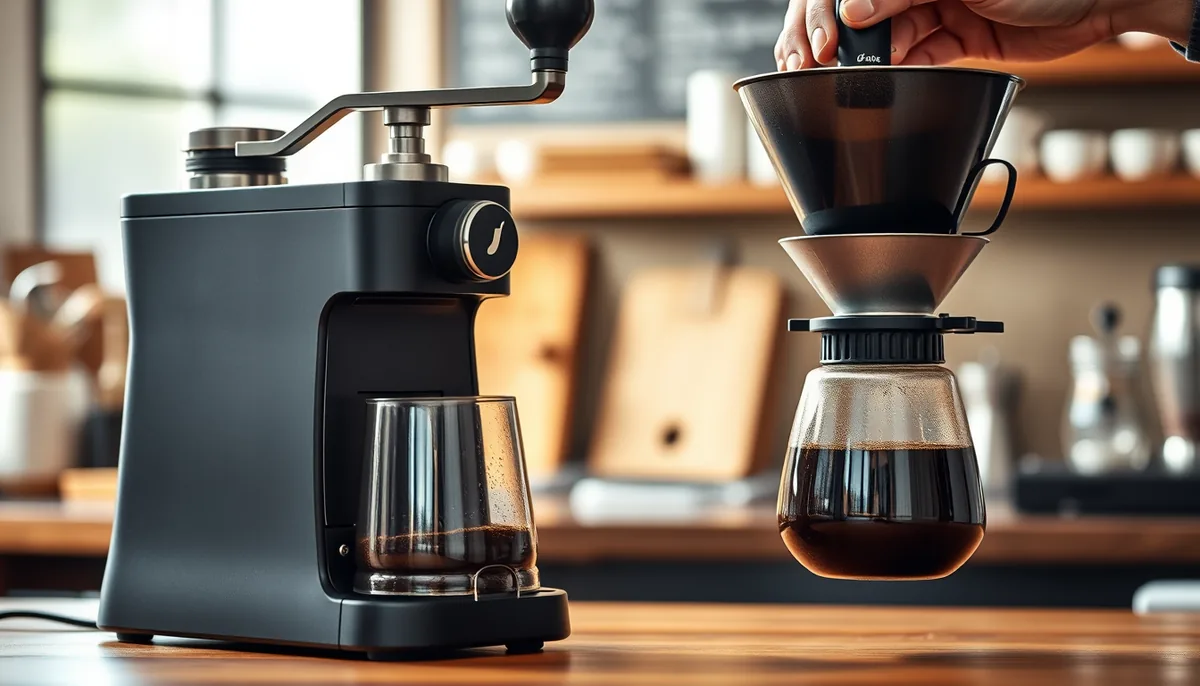 Eureka Atom Pro review: experience, tech and limits of the 75 mm filter grinder
The Eureka Atom Pro is a filter grinder with 75 mm brew burrs and a Blow-Up bellows. Who it is worth it for, how to set it up and why it is not an espresso… 26. 11. 2026
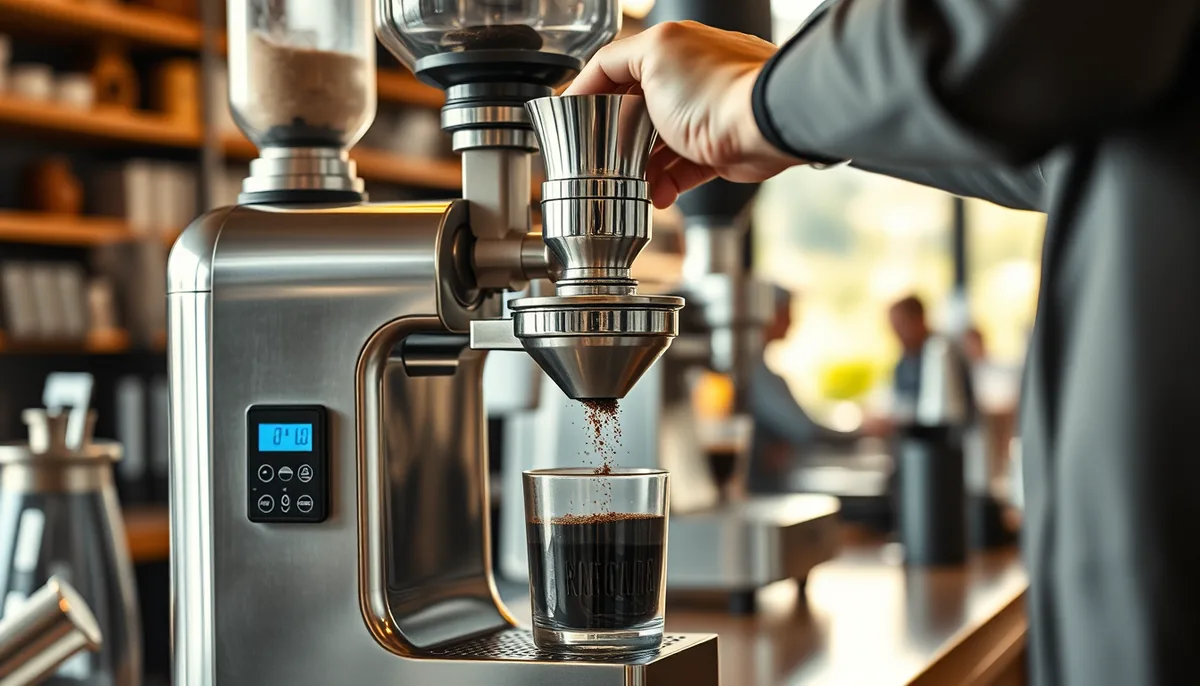 Grind-by-Weight Coffee Grinders: Eureka Atom W 65, Atom W 75 or Mahlkönig E65S GbW? 2026 Comparison
Comparison of the Eureka Atom W 65, Atom W 75 and Mahlkönig E65S GbW grind-by-weight grinders: dose accuracy, speed, step-by-step calibration and a calculation… 26. 11. 2026
 Timemore Sculptor 078S review: 078, 078S or 064S, which one should you buy?
The Sculptor 078S explained: how it differs from the 078 and 064S, espresso and filter settings, maintenance, flaws reported by owners and single dose… 26. 11. 2026