
 Česky (CZK)
 Slovensky (EUR)
 Magyar (HUF)
 Polski (PLN)
 English (EUR)
 Deutsch (EUR)
 Français (EUR)
 Español (EUR)
 Português (EUR)
 Italiano (EUR)
 Svenska (SEK)
 Suomi (EUR)
 Nederlands (EUR)
 Dansk (EUR)
 Lëtzebuergesch (EUR)
 Eesti (EUR)
 Latviešu (EUR)
 Lietuvių (EUR)
 Slovenščina (EUR)
 Română (RON)
 Български (EUR)
 Hrvatski (EUR)
 Ελληνικά (EUR)
 Українська (EUR)
 Norsk (EUR)
 Srpski (EUR)
 Tiếng Việt (EUR)
Grind-by-Weight Coffee Grinders: Eureka Atom W 65, Atom W 75 or Mahlkönig E65S GbW? 2026 Comparison
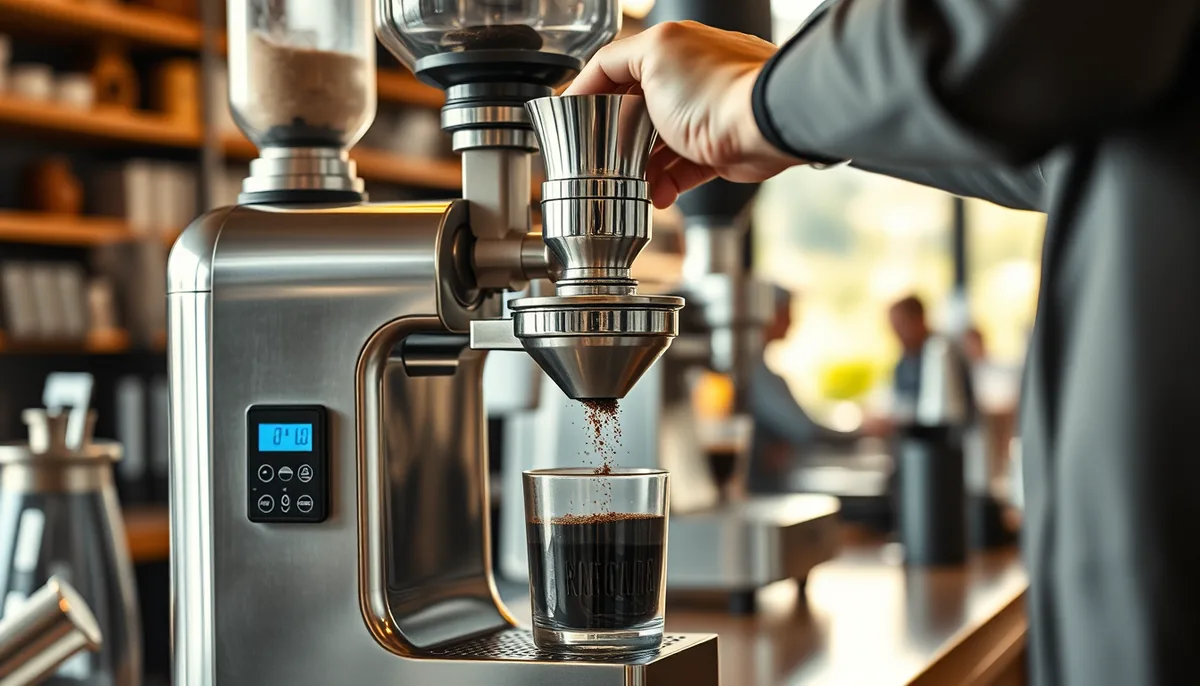
In short: a grind-by-weight grinder stops at a target weight, not a timer. The Eureka Atom W 65 and Atom W 75 claim repeatability of ±0.2 g; the Mahlkönig E65S GbW grinds 18 g in 4–5 s. For a café going through 10 kg a week, the savings run to tens of kilos a year.



| How it works | Load cell under the portafilter fork, motor stops at the programmed weight |
|---|---|
| Claimed repeatability | ±0.2 g (Eureka Atom W 65 / W 75) |
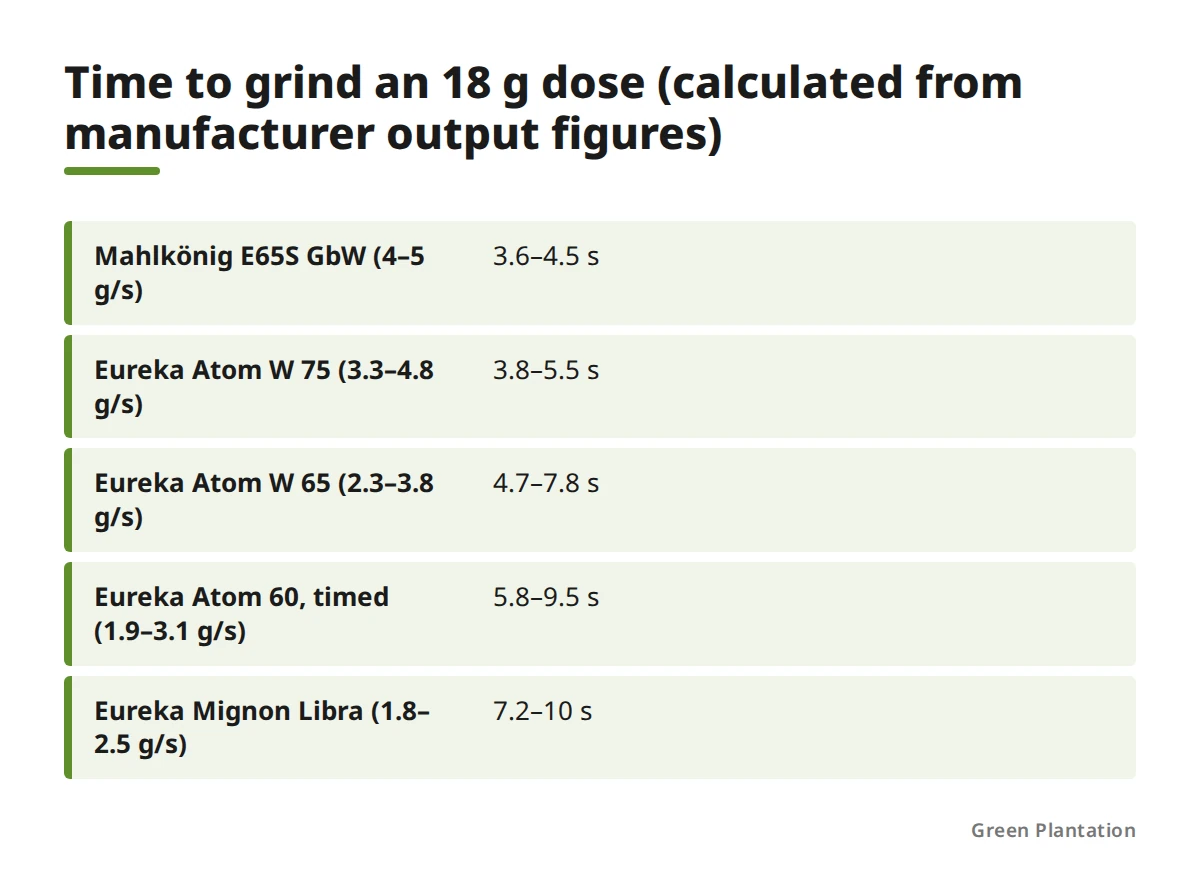
| Time for 18 g | 3.6–4.5 s (E65S GbW), 3.8–5.5 s (Atom W 75), 4.7–7.8 s (Atom W 65) |
| Burrs | Flat steel, 65 mm or 75 mm |
| Calibration | Reference weight, every six months and after every move (Mahlkönig) |
| Best for | Coffee shops using 3–30 kg a week, home baristas who stick to one coffee |
You are opening a coffee shop in Manchester. Between 8 and 9.30 in the morning, two baristas take turns on the same grinder. The first checks every dose on a scale and swipes off the excess with a finger; the second, swamped, tamps whatever falls into the basket. By 11 o'clock, the second barista's espressos are running at 34 seconds instead of 28, and the flat white has lost its sweetness. Nobody touched the grind setting: the dose drifted. That is exactly the problem a coffee grinder with a built-in scale solves, and it is why we are comparing the three grind-by-weight (GbW) models we stock here, backed by manufacturer figures.
Why weigh instead of timing
A conventional on-demand grinder, such as the Mahlkönig E65S or the Eureka Atom 60, grinds for a fixed time. But output in grams per second shifts with grind size, hopper level, bean age and burr temperature. A time dialled in for 18 g at opening no longer gives you 18 g in the middle of the rush. In an 18 g basket, one gram is more than 5% of the recipe – enough to throw off your shot time.
Timed dosing also costs you coffee. To avoid underdosing, teams set the time slightly generous and then bin or leave the excess. Here is that surplus over 50 weeks, using simple assumptions: an 18 g target dose and an average surplus of 0.5 g (a careful team) or 1 g (busy service, no routine checks).
| Espresso consumption | Doubles per week (approx.) | Coffee per year | Loss at +0.5 g | Loss at +1 g |
|---|---|---|---|---|
| 5 kg / week | 270 | 250 kg | 6.8 kg | 13.2 kg |
| 10 kg / week | 540 | 500 kg | 13.5 kg | 26.3 kg |
| 20 kg / week | 1,080 | 1,000 kg | 27.0 kg | 52.6 kg |
| 30 kg / week | 1,620 | 1,500 kg | 40.5 kg | 78.9 kg |
Calculation: loss = annual consumption × surplus ÷ (18 g + surplus). Multiply by what you pay per kilo: at €25/kg, the 26.3 kg lost by a café using 10 kg a week comes to roughly €660 a year. GbW does not eliminate everything (morning purges, retention, the remaining ±0.2 g), but it brings the average surplus close to zero. Treat this as a ballpark figure to rework with your own numbers, not a study. Another benefit: with a consistent dose, every grind adjustment becomes easy to read.
How a grind-by-weight grinder works
On all three models, weighing happens under the fork that holds the portafilter. On the Mahlkönig, a load cell tracks the weight in real time throughout grinding. The cycle is the same on each: you place the portafilter, the grinder tares, starts automatically and cuts the motor once the programmed weight is reached.
Two differences matter day to day. The E65S GbW recognises up to six portafilters by their weight (Portafilter Detection) and links each one to a recipe: single, double, competition basket. It also displays the actual distance between the burrs (Disc Distance Detection), so you can record a numerical setting rather than a mark on a dial. The Atom W models keep things simple: three doses programmable to a tenth of a gram, a continuous mode, stepless micrometric adjustment and a touchscreen. Both brands let you switch back to timed mode if the scale plays up.
The three models compared
| Specification | Eureka Atom W 65 | Eureka Atom W 75 | Mahlkönig E65S GbW |
|---|---|---|---|
| Burrs | 65 mm flat, hardened steel | 75 mm flat, hardened steel | 65 mm flat, special steel |
| Idle speed | 1,370 rpm | 1,400 rpm | 1,400 rpm (50 Hz) |
| Power | 280 W | 430 W | 440 W (230 V) |
| Claimed output | 2.3–3.8 g/s | 3.3–4.8 g/s | 4–5 g/s at 250 µm |
| Calculated time for 18 g | 4.7–7.8 s | 3.8–5.5 s | 3.6–4.5 s |
| Dose repeatability | ±0.2 g | ±0.2 g | Not published on the spec sheet |
| Recommended throughput | 1 kg at peak hour, 2.3–3.8 kg/day | 2 kg at peak hour, 4.5–5.5 kg/day | Not stated |
| Burr life | Not stated | 600 kg | About 800 kg (medium setting) |
| Grind adjustment | Stepless micrometric | Stepless micrometric | Stepless, burr distance displayed |
| Portafilter recognition | No | No | Yes, up to 6 |
| Hopper | 1.2 kg | 1.2 kg | About 1.2 kg |
| Height / weight | 544 mm / 11.5 kg | 544 mm / 12 kg | 620 mm / 12.2 kg |
| Manufacturer status | Current range | Current range | Legacy range, replaced by the E65W GbS |
To sum up: the Atom W 65 suits a small café or a demanding home barista; the Atom W 75 keeps the same footprint with 10 mm more burr and an extra 150 W for sustained service. The E65S GbW is still the fastest and has the richest set of control tools, but Mahlkönig has moved it out of its active range: check that your service engineer supports this model before making it your main grinder. To see where these grinders fit on a full bar, our guide on how to choose a grinder for a coffee shop breaks down volumes per station.
Set-up and calibration step by step
- Place the grinder on a stable, level surface. Load cells hate vibration: avoid a worktop shared with the espresso machine or the dishwasher. Non-slip feet stop the grinder from creeping during service.
- Adjust the fork height so the basket sits centred under the spout. On the Atom W, there are two screws under the fork; on the E65S GbW, use the holder and the adjustable spout.
- Calibrate the scale. Atom W: hold the calibration button for 3 seconds, enter the value of the reference weight, place the empty portafilter, tare, put the weight in the basket and confirm; a green "V" confirms success. E65S GbW: Service menu, "Calibrate weighing scales", place a 1 kg weight on the holder when the screen prompts you.
- Register your portafilters (E65S GbW): Portafilter management menu, "Add portafilter", one portafilter at a time.
- Programme your doses to a tenth of a gram, then check the first five on a separate scale. If the deviation is consistent, adjust the target or recalibrate.
- Dial in the grind for your shot time, purging one dose after each significant change.
Mahlkönig recommends recalibrating every six months, after any adjustment to the holder and after every move. Eureka says it is only needed if accuracy drops: a weekly check with your barista scale is enough to spot it.
Day to day on bar
Do not touch the portafilter while grinding: on the Atom W, a knock pauses the dose and you have to restart it with a button; some knocks are read as removal and reset the cycle. To grind another dose, take the portafilter out, wait about two seconds and put it back. On the E65S GbW in weight mode, removing the portafilter is not a true pause: when you put it back, the scale tares again, so top up with the manual button rather than by reinserting it. Keep the hopper more than half full during the rush, as consistency depends on it. Finally, if the Atom W stops detecting any change in weight while grinding (empty hopper, jammed beans), it shuts off to protect the motor: that is by design, not a fault.
Maintenance
Every day, brush the fork, the spout and the scale cover: coffee caked on the fork skews the tare. Every week, open the grinding chamber and clean the declumper (the "flapper" on the Mahlkönig, the ACE system on the Eureka). Café users of the E65S GbW are emphatic: skip it for a few days and grounds start spraying out of the basket. Mahlkönig advises replacing the flapper as soon as it becomes porous or misshapen, and clearing a blocked spout by opening the grind to "8" and running the grinder. Never lift a GbW grinder by the front: the load cell is fragile and expensive.
For burrs, go by the manufacturer figures: about 800 kg on the E65S GbW and 600 kg on the Atom W 75. A café using 10 kg a week will therefore replace them roughly every 18 months on the Mahlkönig and every 14 months on the Atom W 75. Our article on replacing grinder burrs explains the job, which should be followed by a recalibration.
What users say, weak points included
We read 14 Reddit threads (r/espresso and r/barista, 2022 to 2026, around 315 comments) on the E65S GbW, the Atom W and grind by weight in general. The sample is international, mostly North American and Australian, and split evenly between home users and cafés. Praise centres on three points: fluffy grounds that often make WDT unnecessary, modest noise and a short learning curve for less experienced teams. One operator says they regularly check doses on their E65S GbW and never see more than 0.1 g of deviation once the grinder is calibrated.
The most common complaint is cleaning the Mahlkönig, which users find slow and fiddly to reassemble (screws, washers, a flapper that has to go back the right way round). On the Atom W 65, several owners report grounds piling up on one side of the basket or dropping out when the portafilter is removed, often fixed by realigning or cleaning the anti-clump fork. On the E65S GbW, the display shows the target by default rather than the weight actually ground (a menu option fixes this, depending on the software version), and the firmware has not been updated since 2021. Finally, one former Atom W 65 owner went back to single dosing to switch coffees more often.
When grind by weight is not worth it
- You change coffee every couple of days. A 1.2 kg hopper and a few grams of retention mean constant purging; a single-dose grinder makes more sense.
- You grind less than a kilo a week. Beans go stale in the hopper and the coffee savings become negligible.
- You grind into a dosing cup or funnel. The scale weighs everything resting on the fork: some Atom W owners have had to modify their funnel for the cycle to trigger properly.
- Your service exceeds 5 kg a day on a single station. That is beyond Eureka's recommended range, even for the Atom W 75.
- Your team already weighs every dose meticulously. GbW will save you time, not coffee.
To see how GbW compares with other technologies (assisted adjustment, connected grinders), read our feature on smart electric coffee grinders.
Verdict by user type
- Home barista, one coffee at a time: the Eureka Atom W 65 for grind quality and quiet running; the Eureka Mignon Libra (55 mm, ±0.2 g, 6.5 kg) if space or budget is tight.
- Small café, 3–15 kg a week: the Atom W 65, which handles up to 3.8 kg a day according to Eureka.
- Busy coffee shop, 15–30 kg a week: the Eureka Atom W 75, faster and rated for 4.5–5.5 kg a day.
- Large team, several baskets, need for traceability: the Mahlkönig E65S GbW, for portafilter recognition and the burr distance display, bearing in mind its legacy status.
If you are still undecided on burr size or grinder type, our guide on how to choose a professional espresso grinder goes through the criteria one by one.
Frequently asked questions
Is a grind-by-weight grinder accurate to a tenth of a gram?
You can programme it to a tenth, but Eureka claims repeatability of ±0.2 g for the Atom W – roughly one coffee bean. Mahlkönig does not publish a tolerance figure for the E65S GbW; café users report deviations of around 0.1 g after calibration.
Do I need to recalibrate the scale often?
Mahlkönig advises every six months, after adjusting the holder and after a move. Eureka says only if it drifts. Either way, a weekly check on a separate scale is enough to know when to step in.
Does GbW replace the scale under the cup?
No. The grinder takes care of the dry dose; the beverage yield depends on the espresso machine. Keep a scale on the drip tray, or use a machine with brew-by-weight, to control your ratio.
Is a GbW grinder worth it for 2 or 3 coffees a day?
Yes, if you stay with the same coffee for several days: only fill the hopper for three or four days and the convenience is real. If you switch coffee with every cup, a single-dose grinder is a better fit.
Our recommended products
- Eureka Atom W 65 white: 65 mm and 280 W, ideal for lower volumes.
- Eureka Atom W 65 grey: the same grinder in a grey finish.
- Eureka Atom W 75 black: 75 mm and 430 W for the rush.
- Mahlkönig E65S GbW: the fastest, with portafilter recognition.
- Mahlkönig E65S: the timed version, same grinding.
- Eureka Mignon Libra: built-in weighing in a home format.
Sources
- Mahlkönig – E65S GbW, product page and technical specifications
- Mahlkönig – E65S GbW, original instruction manual (PDF)
- Eureka – Atom W 65, technical data sheet
- Eureka – Atom W 75, technical data sheet
- Eureka – Atom W, multilingual user manual (PDF)
Updated: November 2026
Author: Petra Novotná, editorial name of the Green Plantation.
You might also like
 Eureka Atom Pro review: experience, tech and limits of the 75 mm filter grinder
The Eureka Atom Pro is a filter grinder with 75 mm brew burrs and a Blow-Up bellows. Who it is worth it for, how to set it up and why it is not an espresso… 26. 11. 2026
 Eureka Costanza Review: HX Machine with PID, Costanza R and Owner Experiences
The Eureka Costanza is a compact E61 heat exchanger machine with PID and a shot timer. We clear up the dual boiler myth, explain how it differs from the… 26. 11. 2026
 Timemore Sculptor 078S review: 078, 078S or 064S, which one should you buy?
The Sculptor 078S explained: how it differs from the 078 and 064S, espresso and filter settings, maintenance, flaws reported by owners and single dose… 26. 11. 2026