
 Česky (CZK)
 Slovensky (EUR)
 Magyar (HUF)
 Polski (PLN)
 English (EUR)
 Deutsch (EUR)
 Français (EUR)
 Español (EUR)
 Português (EUR)
 Italiano (EUR)
 Svenska (SEK)
 Suomi (EUR)
 Nederlands (EUR)
 Dansk (EUR)
 Lëtzebuergesch (EUR)
 Eesti (EUR)
 Latviešu (EUR)
 Lietuvių (EUR)
 Slovenščina (EUR)
 Română (RON)
 Български (EUR)
 Hrvatski (EUR)
 Ελληνικά (EUR)
 Українська (EUR)
 Norsk (EUR)
 Srpski (EUR)
 Tiếng Việt (EUR)
Eureka Pura and Pura R review: experience, tech and an honest verdict on the E61 heat exchanger
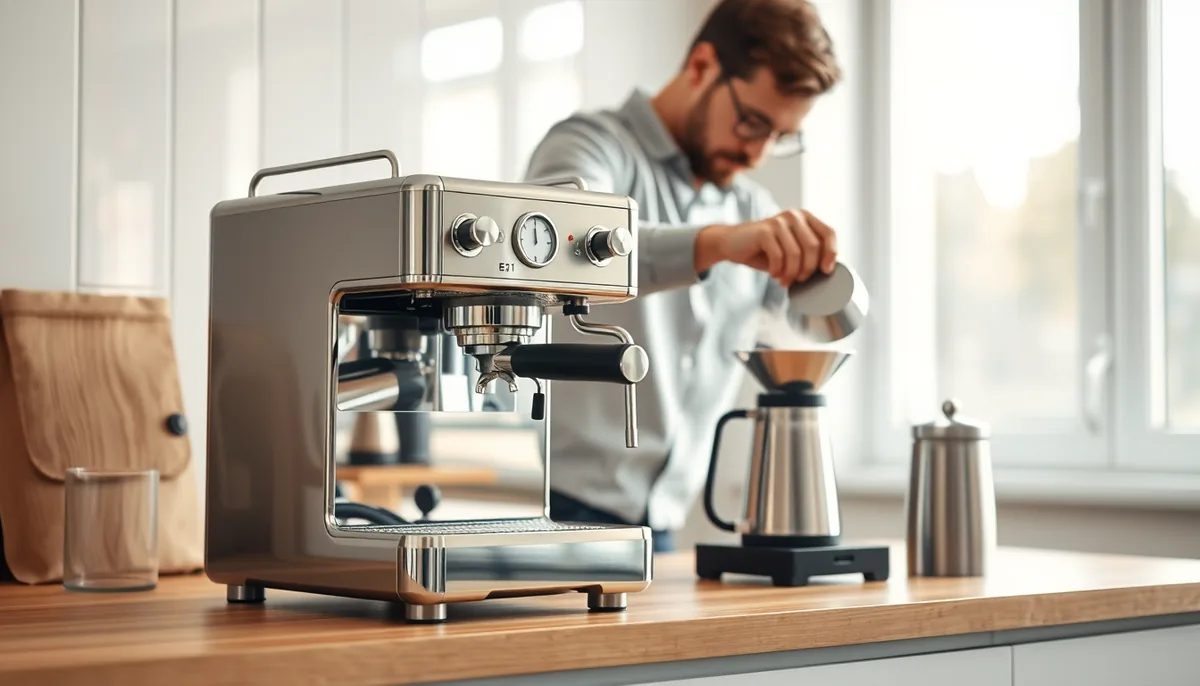
In short: The Eureka Pura is a classic heat exchanger machine with an E61 group head, a 1.5-litre stainless steel boiler and a pressurestat, with no PID and no display. The Pura R is identical but uses a rotary pump instead of a vibration pump. Both suit milk-drink households that want robustness and can live with a long warm-up.



| Type | Heat exchanger (HX), E61 group head, 58 mm portafilter |
|---|---|
| Boiler and control | 1.5 l stainless steel, insulated, pressurestat, no PID |
| Pump | Pura: vibration pump, Pura R: rotary pump, OPV set to 9 bar |
| Warm-up time | Manufacturer 10 to 15 min, manual 15 to 20 min, in practice more like 20 to 25 min |
| Power and water | 1,250 W, 2 l tank, 1 l drip tray, not plumbed in from the factory |
| Who it is for | Cappuccino households looking for a simple, mechanical machine |
The typical starting point: a Mignon on the worktop, a single boiler at its limit
You own a Eureka Mignon, two cappuccinos go out every morning and friends come round at the weekend. Your single boiler makes you wait for steam after every shot. Since 2024 Eureka has offered matching espresso machines, and the Pura is the entry point to this "Eureka 1920" line.
The question then is: Pura or Pura R? Or go straight for the Costanza with PID? And is a heat exchanger still the right technology in 2026? Search for "Eureka Pura" and you will mostly find shop pages with identical spec sheets. Here you get the manufacturer's data, the contradictions between sources, a look at owner and retailer reports, and a concrete routine for day one.
Pura or Pura R: the real difference is the pump
According to Eureka, both machines are identical apart from the pump: the same insulated 1.5-litre stainless steel boiler, the same E61 group with a 58 mm portafilter, 2-litre tank, 1-litre drip tray, 1,250 W and an over-pressure valve (OPV) set to 9 bar. According to the official spec sheet, the Pura R also draws its water from the tank.
| Feature | Pura | Pura R |
|---|---|---|
| Pump | Vibration pump | Rotary pump |
| Noise | typical buzz during extraction | much quieter, reviewers call it almost silent |
| Pressure build-up | slower, gentle ramp | full, even pressure straight away |
| Plumbing in | not intended | tank from the factory, conversion possible in principle according to retailers, check the kit beforehand |
| Look | polished stainless steel only | stainless steel, also as a Custom version with interchangeable panels (wood, colours) |
| Replacement pump | cheap, small | more expensive, larger |
Does espresso from the rotary version taste better? In the Pura buying-advice thread on kaffee-netz.de, a large German forum, opinions are clearly split. Several experienced users consider a taste difference unproven and see the main benefit in noise. One user who has owned both pump types never wants to go back to a vibration pump. Honest summary: you buy the Pura R for a quiet morning and the option to plumb in, not for a different espresso.
Both have a pressure gauge. According to several reviewers it shows boiler pressure, i.e. steam pressure, not brew pressure. One English-language review contradicts itself on this point, so if in doubt, look at the dial.
The tech explained: heat exchanger, pressurestat and E61
In a heat exchanger machine the boiler is permanently under steam pressure. The brew water flows separately through a tube running through the middle of the boiler, the heat exchanger, and is heated on the way. The advantage: you can steam milk straight after pulling a shot, even at the same time. How this differs from a dual boiler is covered in our article on heat exchangers versus two boilers.
The Pura uses a classic pressurestat to control boiler pressure. Brew temperature follows this pressure indirectly. If you want to change it, you can only do so via the pressurestat setting inside the housing or by flushing for longer or shorter before the shot. Precise, degree-by-degree experimenting is not on the cards with the Pura. If that matters to you, read first when PID control is worth it at home.
The E61 group is heavy, made of brass and heated from the boiler by thermosiphon. It comes with mechanical pre-infusion: the first click of the lever wets the coffee, the second, with the lever fully raised, starts the actual extraction. Spare parts such as the group gasket and shower screen are standard E61 items and easy to get.
Warm-up time and electricity: plan for 25 minutes rather than 12
Warm-up is where the sources disagree most, even within Eureka itself:
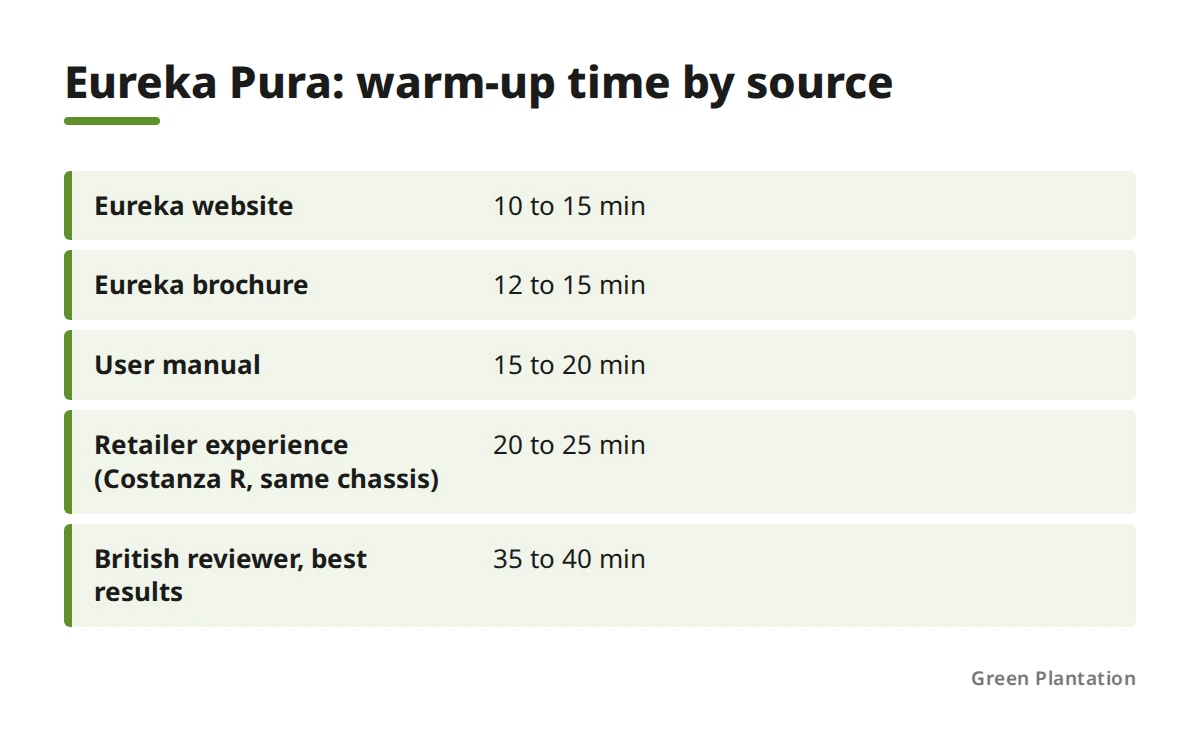
The reason is the mass of the E61 group. The heating light goes out earlier, but the group is not yet up to temperature. The manual itself says the machine must be warm "in all its parts" and gives 15 to 20 minutes for that. A retailer who unboxed and used the Costanza R, which shares the same chassis, talks of 20 to 25 minutes until the first good shot. A British reviewer even recommends 35 to 40 minutes for the best results.
The Pura has neither an eco mode nor a weekly timer; those only come with the Costanza. It is switched on with a toggle switch. Many E61 owners therefore use a plug-in timer. Note, however, that the manual explicitly prohibits adapters, multi-socket extensions and extension leads. If you still opt for a plug-in timer, make sure it is safely rated for 1,250 W (a 13 A timer in the UK and Ireland).
Day one with the Pura: step by step
- Check your water. The manual calls for softened drinking water with a maximum total hardness of 5 to 6 French degrees, i.e. roughly 50 to 60 mg/l (ppm) as calcium carbonate or about 3 °dH, plus TDS of 50 to 250 ppm and a pH of 6 to 8. Tap water in much of England, especially the south and east, and in parts of Ireland is well above this. How to measure it and what hard water does is explained in our article on water in your coffee machine.
- Fill the tank and switch on. The machine fills the boiler automatically. On the very first start two lights flash as a filling error. According to the manual this is normal: switch off and on again once.
- Warm up with the portafilter locked in. That way it heats up too and the group gasket does not dry out.
- Cooling flush. When a heat exchanger machine sits idle, the water in the heat exchanger overheats. Before the first shot, run water through the group until the hissing and spitting stops. The longer the idle time, the longer the flush. This is normal workflow on E61 heat exchangers, not a fault.
- Dose. As a starting point, 18 g of coffee in the double basket, about 36 g out in 25 to 30 seconds, a 1:2 ratio. A matching 58 mm tamper is not included, so budget for one. Which sizes go together is explained in our article on portafilters, baskets and tampers.
- Milk. Purge the steam wand for at least 2 seconds, fill the jug a third full with cold milk and stop at 60 to 65 °C. The manual reckons on 250 ml for one and 500 ml for two cappuccinos. Reviewers of the Costanza R describe the steam as very powerful; milk for a flat white was ready in 8 to 9 seconds. As a beginner, use a larger jug.
- After the shot. Flush briefly, lock the portafilter back in, wipe and purge the wand straight away.
Cleaning, backflushing and descaling
Daily: wipe the steam wand with a damp cloth and purge it, rinse the basket, empty the drip tray. The 1-litre tray slides out horizontally without tipping.
Backflushing: a blind basket is included. With cleaning powder in the blind basket, run the pump five times for 5 seconds, then five more times for 5 seconds without powder to rinse. With daily use, about once a week works well. According to the manual, soak the baskets and portafilter (without the handle) for 30 minutes in hot water with cleaning powder.
Shower screen and gasket: lever them out with a flat-head screwdriver of at least 6 mm, soak for 30 minutes, brush and rinse.
Descaling: Eureka gives an interval of three months. On the Pura it is a manual job: put descaler solution in the tank, run the whole tank through via the brew lever, then rinse with fresh water. Two practical notes. Vibration pumps do not like running continuously for minutes, so take breaks. And this method mainly flushes the brew path through the heat exchanger; the boiler itself is barely reached. Whole Latte Love generally advises against home descaling of heat exchangers and relies on filtered water instead. Prevention with soft water is therefore more important than any descaler. According to the manual, vinegar is off limits.
What owners report
To be upfront: the pool of genuine owner reports is small. We went through five threads on kaffee-netz.de, including a Pura buying-advice thread with 67 posts and two retailer introductions of the Costanza, plus seven threads on r/espresso and two English-language reviews of the identically built Costanza R. We found no long-term reports covering more than a year. One Reddit user wrote in November 2026 that they could hardly find any owner experiences, and in the other threads almost everyone posting is a prospective buyer.
- Most praised: build quality and a compact 30 cm width, metal knobs, the large drip tray. Both reviews and the retailer introduction on kaffee-netz.de mention this.
- Quiet rotary pump: everyone who has used an R version highlights how quietly it runs.
- Powerful steam: both Costanza R reviews, transferable because boiler and power are the same.
- Most common criticism: the warm-up time. Retailers and reviewers measure much more than the advertised 10 to 15 minutes.
- Fundamental criticism: in both large kaffee-netz threads several users ask why you would still buy a heat exchanger rather than a dual boiler or a thermoblock with PID in this price range. Others counter that the design, looks and steam power are worth the money to many.
- What is in the box: one retailer complains that the Costanza R comes with only a double portafilter and no tamper.
Weaknesses and what to watch out for
- No direct temperature setting. If you switch between lots of light roasts, you will hit limits.
- Stricter water requirement than many competitors: around 3 °dH (about 50 mg/l) is hard to achieve without a filter.
- Contradictory dimensions. The Eureka website gives 337 mm height and 20 kg, the manual 355 mm and 27 kg net. Measure under your wall cabinets using the larger figure.
- Incorrect shop listings. Some retailers list a PID for the Pura R. According to Eureka, neither the Pura nor the Pura R has one.
- Plumbing in the Pura R is not set up from the factory. Check before buying whether and how a conversion is possible.
- No eco mode: the boiler keeps running as long as the machine is on.
Comparison: Pura, Pura R, Costanza and an alternative
| Feature | Eureka Pura | Eureka Pura R | Eureka Costanza | Ascaso Dream PID |
|---|---|---|---|---|
| Type | Heat exchanger, E61 | Heat exchanger, E61 | Heat exchanger, E61 | Thermoblock, no boiler |
| Temperature | Pressurestat, indirect | Pressurestat, indirect | PID, 3 settings (90, 93, 96 °C according to the manual) | PID, 80 to 110 °C in 1 °C steps |
| Pump | Vibration | Rotary | Vibration | Vibration (retailer data) |
| Boiler / tank | 1.5 l / 2 l | 1.5 l / 2 l | 1.5 l / 2 l | no boiler / 1.3 l |
| Display, timer, eco | no | no | yes, with weekly programme and shot timer | yes, with volumetric dosing and pre-infusion |
| Pressure gauge | yes, boiler pressure | yes, boiler pressure | dual according to the brochure, reviewers report units without | not stated in the spec sheet |
| Power | 1,250 W | 1,250 W | 1,250 W | 1,100 W |
| Dimensions W × H × D | 300 × 337 × 445 mm | 300 × 337 × 445 mm | 300 × 337 × 445 mm | 245 × 345 × 280 mm |
| Weight | 20 kg (manual 27 kg) | 20 kg (manual 27 kg) | 20 kg (manual 27 kg) | 10 kg |
| Strength | simple, robust | quiet | temperature choice, timer to beat the long warm-up | heats up fast, precise temperature |
The Eureka Costanza solves the warm-up problem neatly with its weekly programme: the machine is hot when you get up. The Ascaso Dream PID is the choice if you mainly drink espresso, want to save space and do not want to wait a quarter of an hour.
Verdict
The Pura is an honest, no-frills E61 heat exchanger: solidly built, powerful steam and no electronics to distract you. It suits you if you make milk drinks every day, rarely change beans and plan around the warm-up time. The Pura R is worth it if the machine runs early in the morning while others are asleep or if you want to plumb it in later. If you like to play with temperature, you are better served by the Costanza or a PID machine. And remember the grinder: our comparison of Eureka Mignon grinders shows what fits.
Frequently asked questions about the Eureka Pura
Does the Eureka Pura have PID control?
No. The Pura and Pura R control the boiler with a pressurestat. PID with three temperature settings only comes with the Costanza.
What is the difference between the Eureka Pura and Pura R?
Only the pump: the Pura has a vibration pump, the Pura R a quieter rotary pump. According to the manufacturer, boiler, group head, power and dimensions are the same. The Pura R is also available as a Custom version with interchangeable panels.
How long does the Eureka Pura take to warm up?
Eureka advertises 10 to 15 minutes, the manual says 15 to 20 minutes. Retailers report 20 to 25 minutes until the E61 group is properly heated through.
Can the Pura R be plumbed in to the mains water supply?
From the factory both models run from the tank. According to retailers, a conversion is possible in principle on the rotary version. For plumbing in, the manual specifies a mains pressure of 2 to 5 bar and a water softener. Get this confirmed before you buy.
Which grinder suits the Eureka Pura?
Eureka deliberately designs the machines to match the Mignon. For classic espresso a Mignon Silenzio 55 is enough. If you want single dosing and filter coffee too, go for the Mignon Zero 65 All Purpose.
Recommended products
- Eureka Pura R Chrome: the quiet rotary version, if noise and a later plumb-in option matter.
- Eureka Pura Chrome: the straightforward heat exchanger with a vibration pump for milk drinks.
- Eureka Mignon Silenzio 55: a quiet espresso grinder in matching design for everyday classic espresso.
- Eureka Mignon Zero 65 All Purpose: a single-dose grinder with 65 mm burrs, if you often change beans.
- Eureka Tamper 58.35 mm: not included with the machine and fits the 58 mm basket.
- Urnex Cafiza 2: cleaning powder for weekly backflushing with the included blind basket.
Sources
- Eureka: Pura, technical specifications
- Eureka: Pura R, technical specifications
- Eureka: User manual Costanza and Pura (PDF)
- Eureka: Espresso Machine Line brochure with comparison table (PDF)
- Ascaso: Dream, technical specifications (PDF)
Updated: November 2026
Author: Petra Novotná, editorial name of the Green Plantation.
You might also like
 Eureka Atom Pro review: experience, tech and limits of the 75 mm filter grinder
The Eureka Atom Pro is a filter grinder with 75 mm brew burrs and a Blow-Up bellows. Who it is worth it for, how to set it up and why it is not an espresso… 26. 11. 2026
 Eureka Costanza Review: HX Machine with PID, Costanza R and Owner Experiences
The Eureka Costanza is a compact E61 heat exchanger machine with PID and a shot timer. We clear up the dual boiler myth, explain how it differs from the… 26. 11. 2026
 Grind-by-Weight Coffee Grinders: Eureka Atom W 65, Atom W 75 or Mahlkönig E65S GbW? 2026 Comparison
Comparison of the Eureka Atom W 65, Atom W 75 and Mahlkönig E65S GbW grind-by-weight grinders: dose accuracy, speed, step-by-step calibration and a calculation… 26. 11. 2026