
 Česky (CZK)
 Slovensky (EUR)
 Magyar (HUF)
 Polski (PLN)
 English (EUR)
 Deutsch (EUR)
 Français (EUR)
 Español (EUR)
 Português (EUR)
 Italiano (EUR)
 Svenska (SEK)
 Suomi (EUR)
 Nederlands (EUR)
 Dansk (EUR)
 Lëtzebuergesch (EUR)
 Eesti (EUR)
 Latviešu (EUR)
 Lietuvių (EUR)
 Slovenščina (EUR)
 Română (RON)
 Български (EUR)
 Hrvatski (EUR)
 Ελληνικά (EUR)
 Українська (EUR)
 Norsk (EUR)
 Srpski (EUR)
 Tiếng Việt (EUR)
Filter coffee vs espresso (and moka pot): differences, caffeine and when filter makes sense
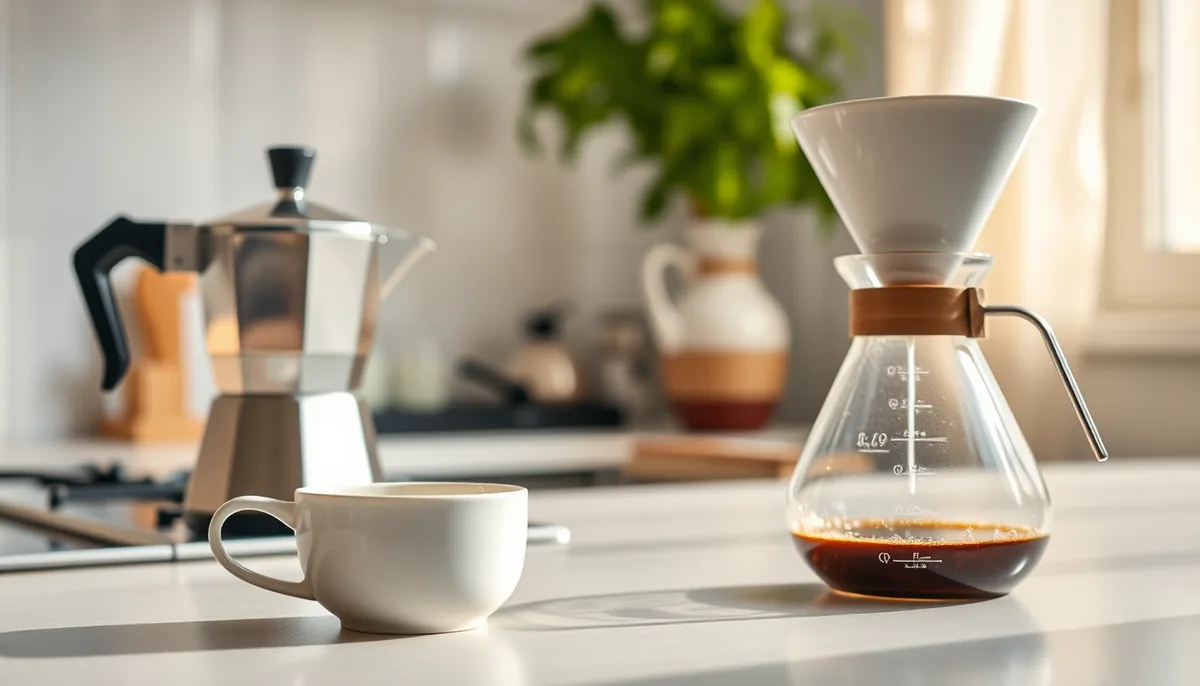
In short: espresso is a concentrate (7–9 g of coffee, 25–40 ml (about 1 fl oz), 9 bar, 25–30 seconds), while filter coffee is a long drink made without pressure (60–65 g per litre, 92–96 °C, 3–4 minutes). Per millilitre espresso wins, but per cup filter coffee almost always has more caffeine.



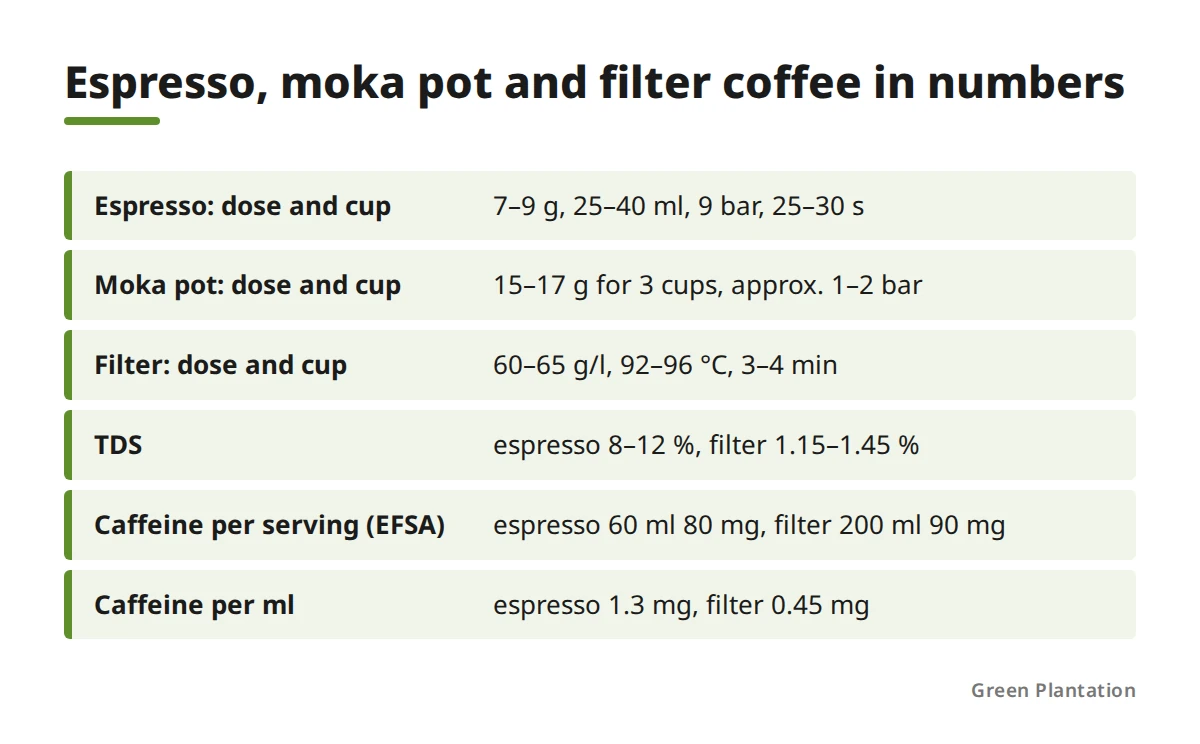
| Caffeine per serving (EFSA) | espresso 60 ml approx. 80 mg, filter 200 ml approx. 90 mg |
|---|---|
| Caffeine per ml | espresso approx. 1.3 mg/ml, filter approx. 0.45 mg/ml |
| Pressure | espresso 9 ± 1 bar, moka pot approx. 1–2 bar, filter none (gravity) |
| Dose | espresso 7–9 g (double 14–18 g), filter 15 g per 250 ml |
| Total dissolved solids (TDS) | espresso 8–12 %, filter 1.15–1.45 % |
| Grind | espresso very fine, moka pot fine, filter medium |
You have already had a couple of espressos and now you want something to sip while you work. A small cup is gone in three sips; a three-cup moka pot drunk on your own will keep you awake all night. This is exactly where filter coffee makes sense: a big mug that stays warm for half an hour, with a clean taste that has nothing in common with the stewed coffee from a hotel breakfast buffet.
Filter coffee often has a bad reputation, and it is frequently deserved: jugs left on a hot plate for hours and stale coffee. But well-made filter coffee is a different drink altogether, not a watered-down espresso.
Filter coffee vs espresso vs moka pot: the full comparison
The espresso values follow the parameters of the Istituto Nazionale Espresso Italiano (INEI) for certified Italian espresso, widened to cover common speciality café practice. Caffeine per serving is the figure given by EFSA. Moka pot values are indicative, because they depend on the model and the heat.
| Parameter | Espresso | Moka pot | Filter coffee |
|---|---|---|---|
| Coffee dose | 7 ± 0.5 g single (INEI), double 14–18 g | approx. 15–17 g in a 3-cup moka pot | 60–65 g per litre, i.e. 15–16 g per 250 ml |
| Drink in the cup | 25 ± 2.5 ml (INEI), up to 40 ml in speciality cafés | approx. 50 ml per small cup | 200–300 ml (7–10 fl oz) |
| Coffee to drink ratio | 1:2 to 1:3.5 | approx. 1:7 to 1:10 | 1:15 to 1:17 |
| Pressure | 9 ± 1 bar | approx. 1–2 bar (steam) | none, gravity only |
| Water temperature | 88 ± 2 °C at the group head (INEI), 92–94 °C in speciality cafés | close to boiling, not adjustable | 92–96 °C |
| Extraction time | 25 ± 5 s | 1–2 minutes of flow, 4–6 minutes on the hob | 3–4 minutes (dripper), 5–6 minutes (drip coffee machine) |
| Grind | very fine, almost like flour | fine, but coarser than espresso | medium, similar to table salt or semolina |
| Total dissolved solids (TDS) | approx. 8–12 % | in between, no standard | 1.15–1.35 % (SCA), up to approx. 1.45 % |
| Caffeine per serving | approx. 80 mg in 60 ml (EFSA), Italian single under 100 mg (INEI) | depends on the dose, similar to an espresso per small cup | approx. 90 mg in 200 ml (EFSA) |
| Oils and crema | crema, oils in the cup | no real crema, some oils | oils held back by the paper filter |
| Body and flavour | dense, syrupy, intense | full, roasty, slightly bitter | light, clean, fruity and floral notes |
The key row is dissolved solids: an espresso contains 8–12 g per 100 g of drink, a filter coffee just over 1 g. It is not "strong" versus "weak", but two different concentrations of the same coffee.
Why filter coffee is not an americano
An americano is an espresso topped up with hot water: 25–40 ml of concentrate plus 100–150 ml of water. The extraction is still an espresso extraction, with its bitterness and body, just diluted. Filter coffee is long from the start: water passes through the ground coffee for several minutes and dissolves the compounds in a different balance, with less bitterness and a clearer acidity. If you want to know how much water to add to an americano, we have an article on the ratio of water to coffee in an americano.
In practice: with an americano you taste the café, with filter coffee you taste the coffee. A washed Ethiopian brewed in a V60 tastes of citrus and black tea; as an americano it often says very little.
Extraction: pressure and seconds versus gravity and minutes
Espresso. The pump forces water at around 9 bar through a tamped puck of very finely ground coffee. The huge surface area of the particles allows everything to be extracted in 25–30 seconds, and the pressure emulsifies oils and carbon dioxide into the crema. The details are in our guide on how to make great espresso.
Moka pot. Steam in the lower chamber pushes very hot water through the coffee at low pressure, around 1–2 bar. With no temperature control, a moka pot turns bitter if it stays on the heat after it starts to gurgle.
Filter coffee. Water flows by gravity alone through a bed of medium-ground coffee in a paper filter. The paper holds back oils and fine particles: less body, more clarity.
How much caffeine is really in a cup
This is where most of the confusion lies. The answer changes depending on whether you compare the cup or the millilitre.
- Per millilitre, espresso wins. According to EFSA, a 60 ml espresso has about 80 mg of caffeine (about 1.3 mg/ml) and a 200 ml cup of filter coffee about 90 mg (about 0.45 mg/ml). The USDA database points the same way: 212 mg per 100 g of espresso versus 40 mg per 100 g of brewed filter coffee.
- Per serving, filter coffee almost always wins. A 25 ml Italian espresso stays under 100 mg (INEI), and with 7 g of coffee it is usually well below that. A 250–300 ml mug of filter coffee is brewed from 15–18 g of coffee and generally contains more.
- The dose decides. Caffeine extracts easily, so more grams of coffee means more caffeine. An 18 g double espresso and a cup of filter coffee made with 15 g are very close.
So filter coffee is not "lighter" in caffeine: it is lighter in concentration. You drink it more slowly, and the caffeine is spread over half an hour. EFSA considers up to 400 mg a day safe for healthy adults, and up to 200 mg in a single dose; during pregnancy and breastfeeding up to 200 mg a day. That is roughly four 200 ml cups of filter coffee or five 60 ml espressos.
Is filter coffee bad for you? The facts on cafestol
Coffee contains two diterpenes, cafestol and kahweol, which studies link to a rise in LDL cholesterol when the coffee is unfiltered. A paper filter holds back the oily fraction: according to a 1997 analysis (Gross and colleagues, Food and Chemical Toxicology), paper-filtered coffee contains negligible amounts, espresso about 1 mg of cafestol per small cup, and boiled and Turkish coffee 5–7 mg per cup. A Swedish study from 2025 measured a median of 12 mg/l in paper-filtered coffee, compared with much higher values in boiled coffee and in some office machines.
If you keep an eye on your cholesterol, paper-filtered coffee is therefore the more cautious choice; metal and cloth filters let more oils through, as we explain in our comparison of cloth, metal and paper filters. This is not medical advice: if you have high cholesterol, talk to your doctor.
Grind and roast: do not use the same coffee blindly
The grind has to match the method. With espresso-fine coffee, a pour-over clogs the paper, takes 6–7 minutes to drain and tastes bitter. With a filter grind, an espresso runs through in 10 seconds and tastes watery and sour. Supermarket pre-ground coffee for moka pots works only so-so in a V60: it is finer than needed and almost always dark roasted.
Espresso roasts are darker, so the concentrate stands up to milk; filter roasts are lighter, to bring out fruit and floral notes that would come across as sourness in an espresso. You can still put an espresso blend in a dripper: you will get a more chocolatey, fuller-bodied filter with less acidity. Lower the water to 90–92 °C so you do not accentuate the bitterness.
Your first filter coffee at home, step by step
A starting recipe for one large mug with a V60-style dripper: 15 g of coffee, 250 g of water at 92–96 °C, total time 3–4 minutes.
- Heat the water. Bring it to the boil and let it rest for 30–60 seconds, or set your kettle to 94 °C. Water that is not too hard helps: if your tap water is very hard (above roughly 250–300 mg/l calcium carbonate), try a low-mineral bottled water.
- Rinse the filter. Place the paper filter in the dripper and wet it with hot water: this removes the papery taste and preheats the dripper. Discard this water.
- Grind. 15 g, medium grind, freshly ground. The grinder matters more than the dripper.
- Bloom. Pour 30–40 g of water, wet all the coffee and wait 30–45 seconds.
- Pour in a spiral. In two or three pours, reach 250 g by 1:45–2:00, with a slow, steady stream from the centre outwards, without hitting the edges of the paper.
- Let it drain. The coffee bed should empty between 3:00 and 4:00.
- Adjust. Drains in under 2:30 and tastes sour? Grind finer. Takes longer than 4:30 and tastes bitter? Grind coarser.
With a drip coffee machine the principle is the same: 60–65 g per litre, a rinsed paper filter, medium-ground coffee. Choose a machine that heats the water to 92–96 °C (cheap ones often do not get there) and drink the coffee within 30–40 minutes: on a hot plate it loses aroma and turns into exactly the stewed brew everyone remembers. A thermal carafe is better. For a more refined dripper technique, see our guide to the perfect cup with the Hario V60.
When filter coffee makes sense and when it does not
| If you drink… | Choose | You need |
|---|---|---|
| cappuccino, latte, a quick espresso | espresso | pump machine with a steam wand, espresso grinder |
| a strong, traditional morning coffee | moka pot | moka pot in the right size, moka-grind coffee |
| a big mug to sip while you work | filter | dripper, paper filters, gooseneck kettle |
| coffee for 4–8 people at once | filter | drip coffee machine with a thermal carafe |
| light single-origin coffees, to discover the taste of the origin | filter | filter-roast coffee, burr grinder |
| little money and little time | moka pot or filter | nothing electric apart from a kettle |
The honest limits of filter coffee. It makes no crema and does not stand up to milk the way espresso does. With dark, stale coffee it performs worse than a moka pot. It requires scales and a bit of method, at least for the first few weeks. After years of moka pot coffee, the first cup may feel "thin". If you would rather stick with the moka pot, you will find tips in how to choose a moka pot.
What coffee enthusiasts say
We read 72 discussions comparing filter coffee and espresso in the international r/Coffee community on Reddit. The most frequent topic, in 33 threads, is the grinder: people moving to filter coffee find that an espresso grinder produces more fines and a filter grinder cannot grind fine enough for espresso. The V60 comes up in 20 threads as the most recommended first dripper. Twelve threads deal with sourness, usually solved by grinding finer or raising the water temperature.
Frequently asked questions
What is the difference between filter coffee and espresso?
Espresso is extracted at 9 bar in 25–30 seconds from very finely ground coffee, into 25–40 ml. Filter coffee is extracted without pressure in 3–4 minutes from medium-ground coffee, into 200–300 ml. The same coffee produces two drinks whose concentration differs by a factor of 8–10.
Does filter coffee have more caffeine than espresso?
Per cup, usually yes: about 90 mg in 200 ml versus about 80 mg in a 60 ml espresso (EFSA), and even less in a 25 ml Italian espresso. Per millilitre, espresso is about three times more concentrated.
Are americano and filter coffee the same thing?
No. An americano is an espresso diluted with hot water; filter coffee is a long extraction without pressure. An americano has more bitterness and body, filter coffee more clarity and origin flavours.
Is filter coffee lighter or bad for you?
It is less concentrated, not lower in caffeine. The paper holds back almost all of the cafestol, which is linked to raised cholesterol.
Can I use moka pot coffee for pour-over?
Yes, but it will be more bitter and less aromatic: it is finely ground and dark roasted. Use water at 90–92 °C and shorten the brew time slightly. Better still, use whole beans roasted for filter, freshly ground.
Recommended products
- Hario V60-02 dripper in red ceramic: the most popular dripper, size 02 for 1–4 cups; ceramic holds heat well if you preheat it.
- Hario VCF-02-100W paper filters (100 pcs): the original filters for size 02, to be rinsed before use.
- Hario Fit V60 gooseneck kettle 1200 ml: the narrow spout allows the slow, even pour that filter coffee needs.
- Timemore Chestnut S3 manual grinder: conical steel burrs and fine adjustment, suited to filter and also usable for the moka pot.
- Rhinowares digital scale: weighs coffee and water in grams and times the extraction.
- Moccamaster KBGT 741: Dutch drip coffee machine with a 1.25 l thermal carafe, for anyone who wants filter coffee for the whole family without pouring by hand.
Sources
- EFSA, scientific opinion on the safety of caffeine (2015) and caffeine fact sheet
- Istituto Nazionale Espresso Italiano: parameters of certified Italian espresso
- USDA FoodData Central: caffeine content of espresso and brewed coffee
- Specialty Coffee Association: Golden Cup Standard (TDS and extraction)
- Gross G. et al. (1997), Analysis of the content of the diterpenes cafestol and kahweol in coffee brews, Food and Chemical Toxicology
Updated: November 2026
Author: Petra Novotná, editorial name of the Green Plantation.
You might also like
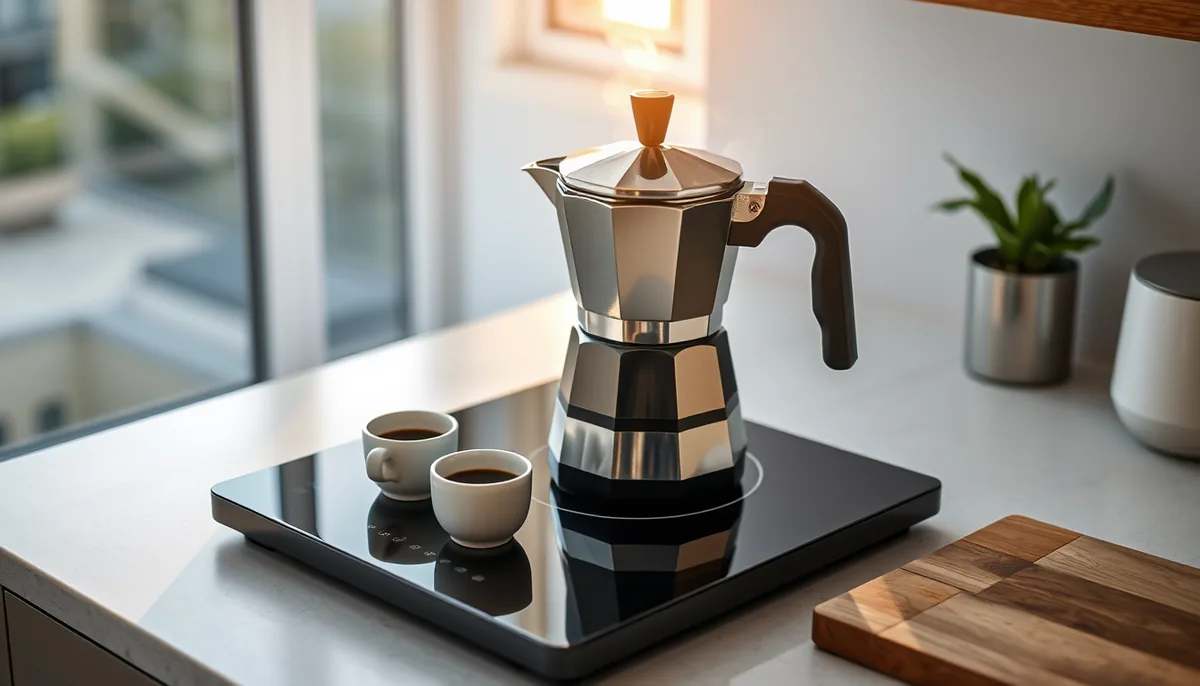 Moka pot on an induction hob: why aluminium won't work, what to choose and when an electric one makes sense
Why an aluminium moka pot won't work on induction, how to spot an induction-ready moka pot, what an adapter plate can do and how to set the power so your… 26. 11. 2026
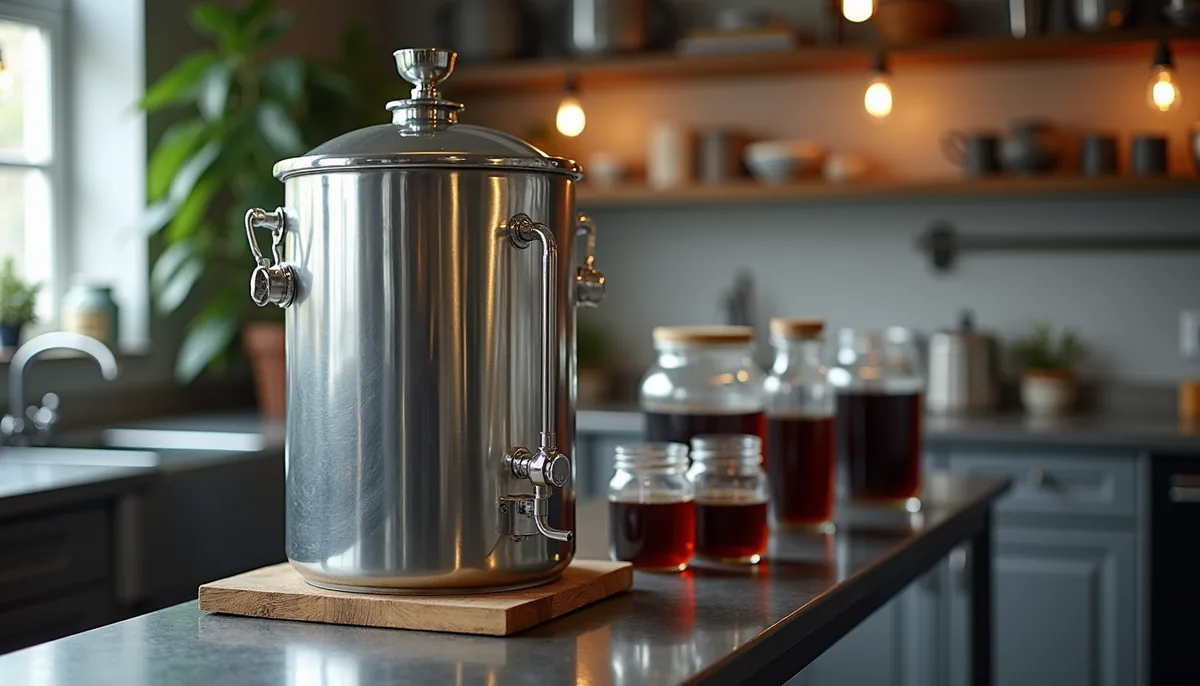 Toddy Pro Series 20 review: yield planning for high-volume cold brew
The Toddy Pro Series 20 makes about 38 litres of cold brew concentrate per batch. Here is how that translates into daily serves, when it beats two smaller… 24. 11. 2026
 Toddy Cold Brew Pro Series 10 review: yield, ratio and daily use in a café
An in-depth look at the Toddy Pro Series 10 for cafés and hotels: batch size, real yield, ratio, dilution, cleaning and the issues owners of large Toddy… 24. 11. 2026