
 Česky (CZK)
 Slovensky (EUR)
 Magyar (HUF)
 Polski (PLN)
 English (EUR)
 Deutsch (EUR)
 Français (EUR)
 Español (EUR)
 Português (EUR)
 Italiano (EUR)
 Svenska (SEK)
 Suomi (EUR)
 Nederlands (EUR)
 Dansk (EUR)
 Lëtzebuergesch (EUR)
 Eesti (EUR)
 Latviešu (EUR)
 Lietuvių (EUR)
 Slovenščina (EUR)
 Română (RON)
 Български (EUR)
 Hrvatski (EUR)
 Ελληνικά (EUR)
 Українська (EUR)
 Norsk (EUR)
 Srpski (EUR)
 Tiếng Việt (EUR)
Moka pot on an induction hob: why aluminium won't work, what to choose and when an electric one makes sense
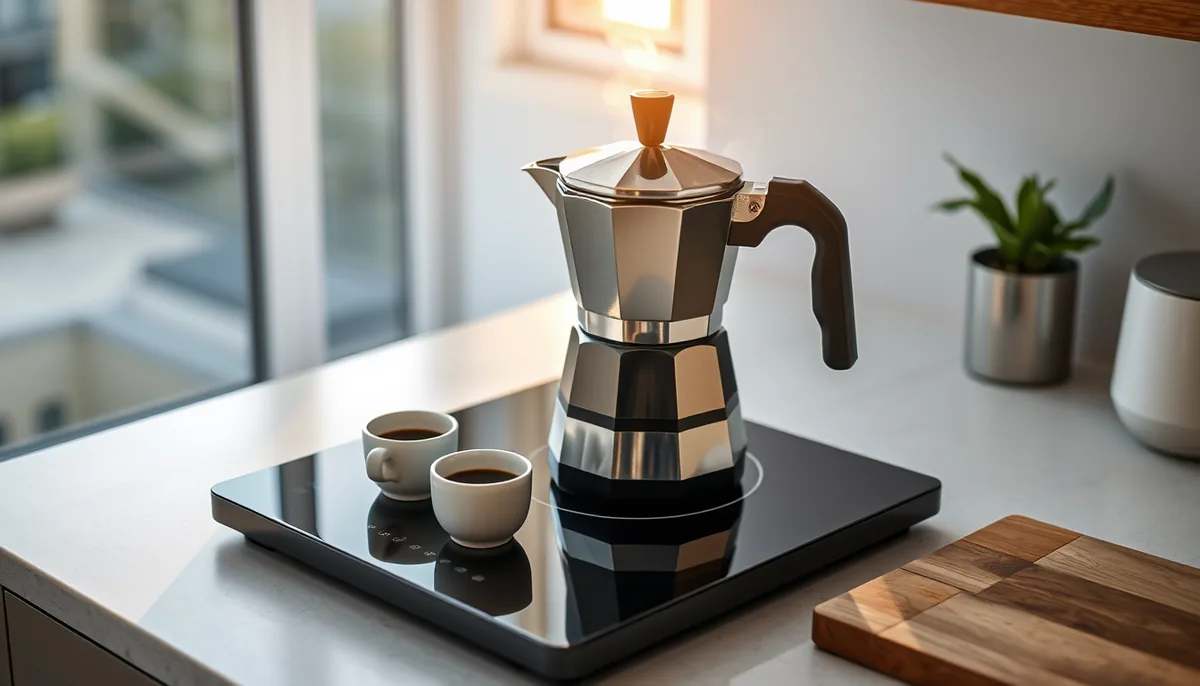
In short: An induction hob only heats cookware with a magnetic base. That is why the classic aluminium moka pot won't work on it: you need either an induction moka pot with a steel (ferromagnetic) base or a thick steel adapter plate. If you would rather skip the hob altogether, go for an electric moka pot. On induction, never brew on maximum power or with the booster.



| Induction requirement | a base that a magnet sticks to firmly |
|---|---|
| Unsuitable materials (AEG) | aluminium, copper, brass, glass, ceramics |
| Minimum pan base (MORA) | 145 mm zone: at least 80 mm, 180 mm zone: 100 mm, 210 mm zone: 130 mm |
| Power on induction | medium, not the highest setting (Bialetti) |
| Bialetti Moka Elettrika | 2 cups, 210–230 W, switches to standby after 10 minutes |
| Dishwasher | not for any of the Bialetti moka pots in this article |
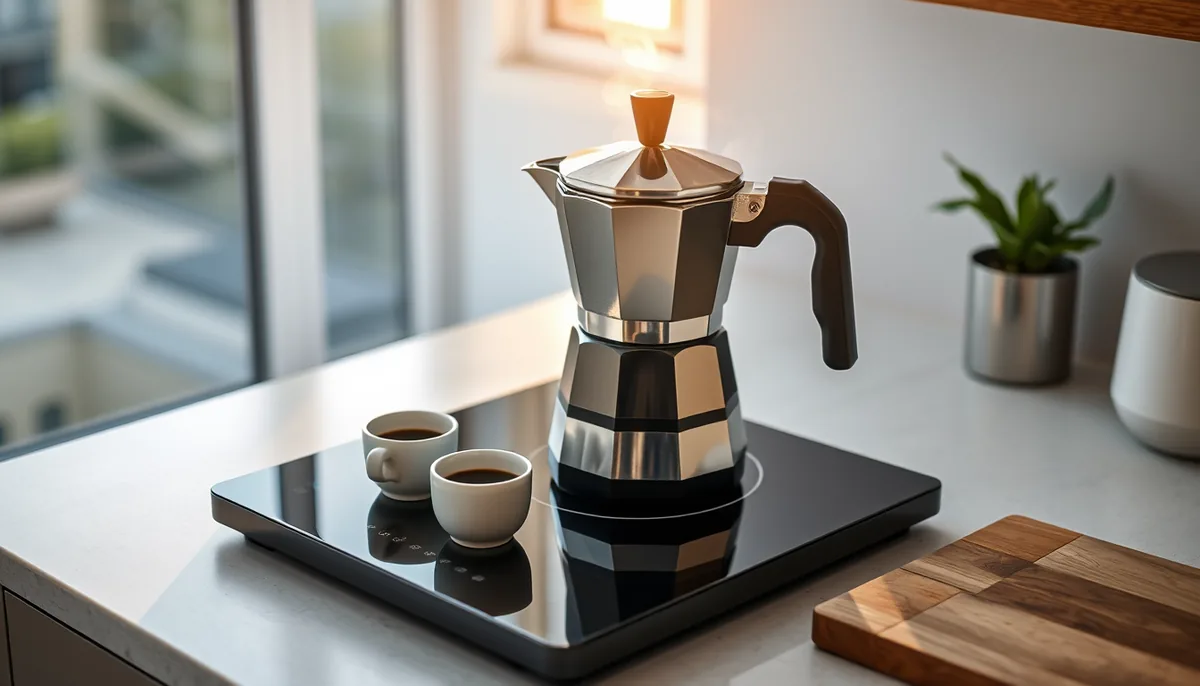
It is a familiar story after a kitchen renovation: the old gas cooker goes, a sleek black induction hob comes in, and the next morning the moka pot you inherited from your grandmother just sits on the cooking zone. The display blinks, the water stays cold and there is no coffee. Do you have to throw the pot away? No. But it is worth understanding why induction "can't see" an aluminium moka pot, and then picking one of three routes: an adapter plate, a moka pot designed for induction or an electric moka pot.
This article deals only with induction and electric brewing. For advice on size and material in general, see our guide to choosing a moka pot, and for the brewing process step by step, read our complete guide to making moka pot coffee.
Why doesn't an aluminium moka pot work on induction?
An induction hob does not get hot by itself. A coil under the glass creates an alternating magnetic field, and the heat is generated directly in the base of the pan. However, this only works with ferromagnetic materials, that is, materials that respond to a magnet: cast iron, steel, enamelled steel and magnetic stainless steel. In its service guide, AEG explicitly lists aluminium, copper, brass, glass and porcelain as unsuitable materials.
The classic Moka Express is made entirely of aluminium, so to the induction hob it is as if it were not there at all. The hob detects this, because it checks whether there is a suitable pan on the zone, and if it finds none, it either won't start the zone or switches off after a short time. MORA induction hobs, for example, switch off automatically one minute after you remove the pan.
Not all stainless steel is the same
A common misconception: "My moka pot is stainless steel, so it will work." Not necessarily. Steel marked 18/10 (18% chromium, 10% nickel) has an austenitic structure and is attracted to a magnet only weakly or not at all. It is excellent for food contact, but on its own an induction hob heats it poorly or not at all. Ferritic stainless steel, often marked 18/0, is magnetic. That is why good induction-ready stainless steel moka pots either have a base made entirely of magnetic steel or have a magnetic layer pressed into the base. Bialetti, for example, states that the Venus is made of 18/10 steel in a way that lets it work on induction too. What counts is always the magnet test, not the label on the box.
Small moka pots and pan detection
The other trap is size. An induction zone needs a certain minimum base diameter, otherwise it won't detect the pan or will deliver only part of its power. MORA specifies a pan base of at least 80 mm for a 145 mm zone, 100 mm for a 180 mm zone and 130 mm for a 210 mm zone. AEG adds that a smaller pan draws only part of the zone's power and efficiency drops.
The base of a 1–2 cup moka pot is small, so even a magnetic two-cup pot can blink with a "no pan" warning on a large zone. The fix is simple: always use the smallest zone and measure the base with a ruler. You will find the exact minimum for your own hob in its user manual, as it varies from model to model.
How to identify an induction moka pot in 10 seconds
- Fridge magnet. Hold it against the bottom of the water chamber (the lower part). If it sticks firmly, induction will heat it. If it slides off or holds only weakly, don't buy it, even if the box says "stainless steel".
- Induction symbol. Look on the base or the packaging for the coil symbol (a horizontal spiral), which AEG mentions as the marking for induction-compatible cookware.
- Flat, sturdy base. According to AEG, the base of the pan should be as flat and thick as possible. Induction "grips" an older moka pot with a dented base less well.
- Base diameter. Measure it and compare it with the smallest zone on your hob.
- Water test. According to AEG, a pan is suitable if a small amount of water heats up in it very quickly on the zone. This is also a good test for a moka pot you already own.
One thing to watch out for: on the Bialetti Moka Induction and Brikka Induction, only the water chamber is magnetic. The upper part remains aluminium. Bialetti lists the material as "aluminium + steel" and describes a two-layer water chamber that distributes heat evenly. So test with the magnet at the bottom, not on the upper jug.
Adapter plate (induction disc): it saves your old moka pot, but at a price
An adapter is a thick steel disc that you place on the induction zone, then stand the moka pot on top. Induction heats the disc, which passes the heat to the aluminium base by conduction. Bialetti's own induction plate is made entirely of steel; according to the manufacturer it suits 1–9 cup moka pots, milk pans and smaller pans, and the version in our range is 13 cm in diameter.
It works, but you have to accept three compromises:
- Slower start. The thick steel disc has to heat through first, and only then the moka pot. You lose the main advantage of induction, its instant response.
- Higher energy use. Some of the heat goes from the disc into the surroundings and the glass of the hob rather than into the water. For one morning coffee this is negligible, but not for several pots a day.
- Risk of overheating. The disc holds heat for a long time. When you turn the power down, the moka pot keeps heating for a while, and the coffee easily tips over into the bitter, "stewed" phase. Never leave an empty disc on a switched-on zone, and after brewing put it on a heat-resistant mat, not on the worktop.
An adapter is worth it if you have a favourite aluminium Moka Express and only brew with it a few times a week. For daily use, a moka pot that works on induction by itself is more convenient.
Comparison: aluminium with an adapter, induction moka pot, electric moka pot
The table is based on manufacturers' data (Bialetti, AEG, MORA) and the physics of induction heating. Times are given in relative terms, because they depend on the power of the zone, the amount of water and the size of the moka pot.
| Criterion | Aluminium moka pot + adapter | Magnetic-base (induction) moka pot | Electric moka pot (Moka Elettrika) |
|---|---|---|---|
| Works on induction | yes, via the steel disc | yes, directly | no hob needed, just a socket |
| Time to first coffee | longest, the disc has to heat through | shortest, induction responds instantly | medium, 210–230 W heating |
| Control over brewing | poorer, the disc keeps heating after you turn it down | best, you can adjust the power instantly | on/off button only |
| Taste | classic, higher risk of burning at the end | classic, most even on a medium setting | classic moka coffee, but you have to switch it off in time yourself |
| Capacity | depends on the moka pot (1–9 cups with the Bialetti disc) | Bialetti Moka Induction 2, 4 and 6 cups | 2 cups |
| Care | rinse with water, no washing-up liquid | rinse with water, no washing-up liquid | rinse with water, do not immerse the base or the jug |
| Dishwasher | no | no (Bialetti) | no (Bialetti) |
| Gasket | wear part, overheating damages it most | wear part, never heat it "dry" on induction | wear part, not covered by the warranty |
| Main weakness | slow, wastes energy | easy to burn the coffee with the booster | small capacity, tied to a socket |
Setting the power on induction: speed is the enemy here
Induction is much faster than gas. With a moka pot that is more of a problem: if the water at the bottom starts boiling too vigorously, it is forced through the coffee too quickly, and at the end the hot steam "burns" it. That is why Bialetti explicitly says for the Brikka Induction that you should not use the highest setting on induction, electric or ceramic hobs, and recommends medium heat for the Moka Induction.
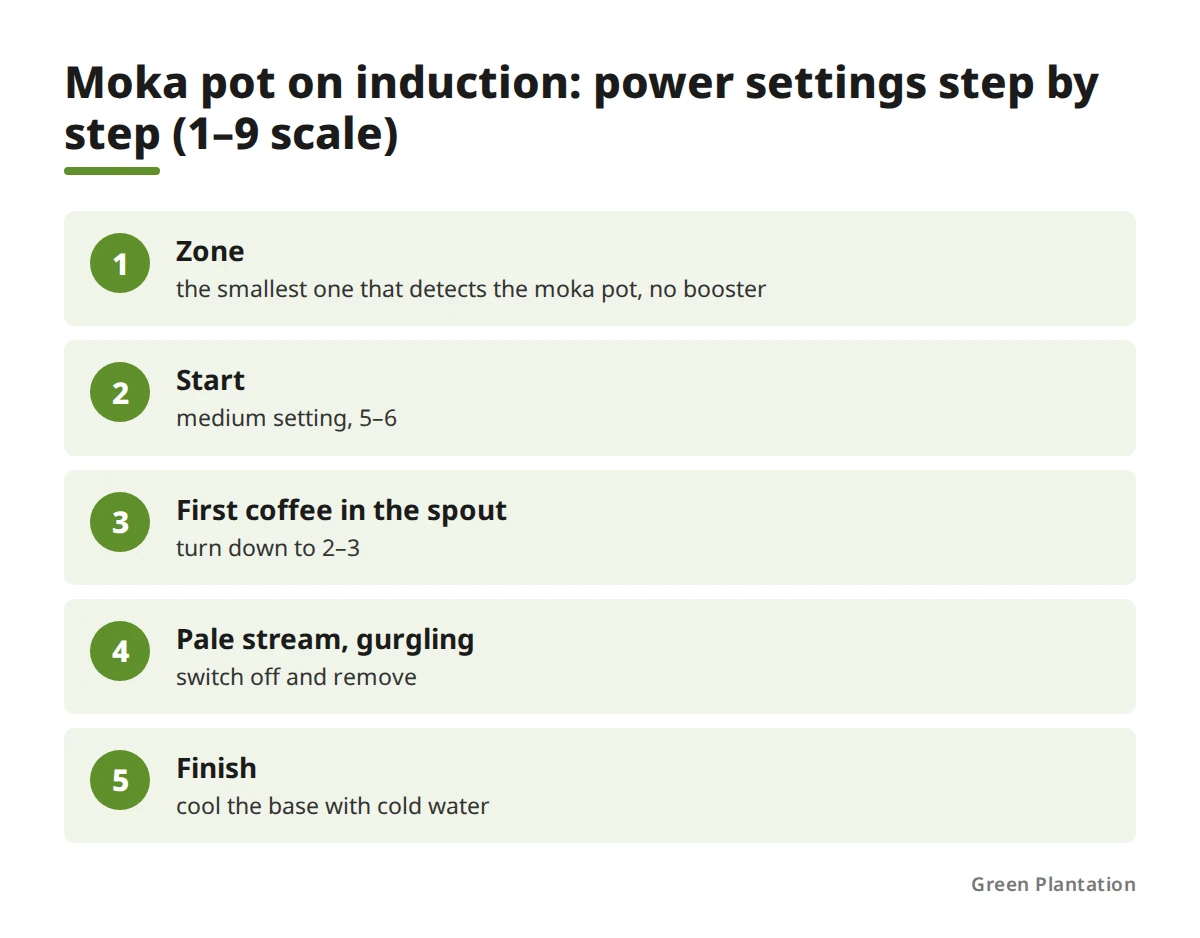
A proven routine step by step (settings refer to a hob with a 1–9 scale; on a different scale, use the same proportion):
- Put the moka pot on the smallest zone that still detects it reliably. Do not switch on the booster or "power" function.
- Set medium power, roughly level 5–6. A higher setting barely shortens the time but spoils the taste.
- Leave the lid open and watch the spout. As soon as the first coffee appears, turn it down to 2–3.
- When the stream turns pale and the pot starts gurgling, switch off the zone and take the pot off. Unlike a ceramic hob, induction has no glowing cooking surface, so it stops heating almost immediately after you switch it off. With an adapter plate, however, take the pot off earlier, as the disc keeps heating.
- Cool the base with a damp tea towel or under cold running water to stop extraction.
With the Brikka the routine is similar, except that instead of gurgling you wait for the valve's characteristic "puff", after which crema forms in the upper part. Then switch off straight away.
Hard water leaves limescale in a moka pot too, especially around the valve and under the filter funnel. You can find out how hard the water is where you live, usually given in mg/l CaCO3 (ppm), from your local water supplier's water quality data. If your water is hard, it is worth using filtered or softer bottled water, because limescale can also block the valve.
Electric moka pot: who it suits and who it doesn't
The Bialetti Moka Elettrika looks like a classic Moka Express, except that it is heated by an element in its base instead of a hob. Bialetti recommends it for the office, travel, caravans or boats, in other words anywhere there is a socket but no hob.
What we know from the manual and the manufacturer:
- it brews 2 cups, and both the upper part and the water chamber are aluminium,
- power supply 110–240 V, output 210–230 W, Schuko plug,
- button with an indicator light; you switch the coffee off by hand as soon as the upper part is full,
- 10 minutes after being switched on, it automatically goes into standby below 0.5 W, even if you haven't brewed any coffee,
- the base stays cool, so it won't damage a delicate table top,
- it is not dishwasher-safe, and the appliance and its parts must not be immersed in water,
- never switch it on with an empty water chamber.
Who it suits: offices without a kitchenette, a holiday cottage or weekend cabin with mains power, a caravan on a campsite with an electric hook-up, and students in halls where cooking is restricted.
Weaknesses that shops rarely mention: only 2 cups, which is not enough for a family. You have to keep an eye on it just like a moka pot on the hob, as it does not switch off by itself the moment the coffee is ready. The ten-minute cut-out protects against forgetfulness, not against burning. And its output of around 220 W is a fraction of the usual kilowatts of an induction zone, so at home, next to an induction hob, a magnetic-base moka pot is usually faster.
What to choose: a quick guide
- You have induction and brew every day: a moka pot with a magnetic water chamber, such as the Bialetti Moka Induction, or an induction-rated stainless steel moka pot such as the Bialetti Venus.
- You have a favourite aluminium moka pot and only brew occasionally: a steel adapter plate, but expect a slower start.
- You want thicker, creamier coffee: the Brikka Induction, which has a special valve.
- You have no hob at all: the Moka Elettrika.
Whatever you choose, the result depends mostly on the coffee itself. For a moka pot, grind finer than for filter coffee but coarser than for espresso, and do not tamp the coffee in the filter funnel. Our article on grind coarseness will help you find the right setting. If you fancy a change from the classic, try one of our recipes for the Bialetti moka pot, such as Bombardino or Viennese coffee.
Frequently asked questions
Can I put an aluminium moka pot on an induction hob?
Not directly. Aluminium is not magnetic, so induction won't heat it. It only works with a steel adapter plate, which heats up itself and passes the heat to the moka pot.
Does the Bialetti Moka Express work on induction?
The classic Moka Express is made of aluminium, so not without an adapter. Bialetti designed the Moka Induction for induction hobs; its water chamber contains steel.
Why doesn't my induction hob detect the moka pot?
There are two possible reasons: the base is not magnetic (aluminium or non-magnetic stainless steel), or it is smaller than the minimum for that zone. Put the moka pot on the smallest zone. MORA specifies a base of at least 80 mm for a 145 mm zone. If that doesn't help, you need an adapter plate or a larger moka pot.
How do I know whether a stainless steel moka pot is suitable for induction?
With a magnet. It should stick firmly to the bottom of the lower chamber. 18/10 steel without a magnetic layer won't work on induction, however high its quality.
Is a moka pot the same as a stovetop espresso maker?
Yes. In English it is called a moka pot or stovetop espresso maker, in Italian a moka or caffettiera. When shopping for the induction version, look for "induction moka pot". Strictly speaking, it does not make true espresso, as it brews at a much lower pressure than an espresso machine.
Can an induction moka pot go in the dishwasher?
No. Bialetti does not recommend the dishwasher for the Moka Induction, the Brikka Induction or the Moka Elettrika, as it would damage the pot and affect the taste of the coffee. A rinse with warm water and no washing-up liquid is enough.
Recommended products
- Bialetti New Moka Induction 4 cups black: the classic Moka Express shape with a magnetic water chamber, the simplest way to brew on induction without an adapter. Also available in 2 and 6 cup sizes.
- Bialetti Brikka Induction 4 cups: for anyone who wants thicker, creamy coffee on induction too, thanks to its special valve.
- Bialetti New Venus 4 cups: a stainless steel alternative to aluminium, which according to the manufacturer also works on induction.
- Bialetti induction plate 13 cm: a steel adapter plate if you don't want to part with your old aluminium moka pot.
- Bialetti Moka Elettrika Standard 2 cups: for the office or travel, wherever there is a socket but no hob.
- Bialetti gasket for 3–4 cup induction moka pots: a spare gasket with filter plate, for when the moka pot starts leaking or the coffee flows slowly.
Sources
- Bialetti: Moka Induction, materials and instructions for use
- Bialetti: Brikka Induction, power recommendation on induction
- Bialetti: Venus, 18/10 steel for induction, 100 mm water chamber base
- AEG: which cookware is suitable for induction cooking zones (in Czech)
- MORA: what you should know about induction hobs (in Czech)
Updated: November 2026
Author: Petra Novotná, editorial name of the Green Plantation.
You might also like
 Filter coffee vs espresso (and moka pot): differences, caffeine and when filter makes sense
Espresso, moka pot and filter coffee compared with real numbers: doses, pressure, dissolved solids and caffeine per cup. Plus when filter coffee makes sense… 26. 11. 2026
 Toddy Pro Series 20 review: yield planning for high-volume cold brew
The Toddy Pro Series 20 makes about 38 litres of cold brew concentrate per batch. Here is how that translates into daily serves, when it beats two smaller… 24. 11. 2026
 Toddy Cold Brew Pro Series 10 review: yield, ratio and daily use in a café
An in-depth look at the Toddy Pro Series 10 for cafés and hotels: batch size, real yield, ratio, dilution, cleaning and the issues owners of large Toddy… 24. 11. 2026