Česky (CZK)
 Slovensky (EUR)
 Magyar (HUF)
 Polski (PLN)
 English (EUR)
 Deutsch (EUR)
 Français (EUR)
 Español (EUR)
 Português (EUR)
 Italiano (EUR)
 Svenska (SEK)
 Suomi (EUR)
 Nederlands (EUR)
 Dansk (EUR)
 Lëtzebuergesch (EUR)
 Eesti (EUR)
 Latviešu (EUR)
 Lietuvių (EUR)
 Slovenščina (EUR)
 Română (RON)
 Български (EUR)
 Hrvatski (EUR)
 Ελληνικά (EUR)
 Українська (EUR)
 Norsk (EUR)
 Srpski (EUR)
 Tiếng Việt (EUR)
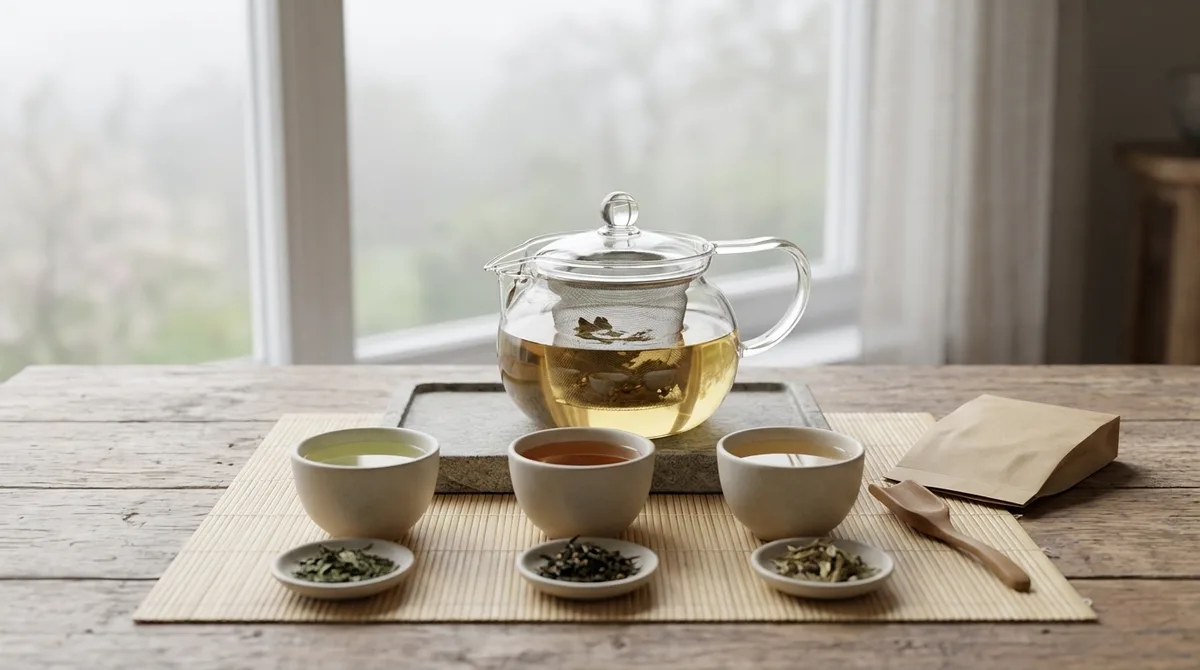



Green vs Black vs White Tea – Complete Guide
One Bush, A Thousand Flavors
Green, black, and white tea all come from the same bush – Camellia sinensis. This evergreen plant native to Southeast Asia is the source of all "true" teas in the world. What distinguishes delicate white tea from robust black tea is not a different plant or variety, but the processing method of the leaves after harvest – above all, the degree of oxidation.
Oxidation is an enzymatic reaction in which polyphenol oxidases in tea leaves react with atmospheric oxygen. This process transforms the color of the leaves from green to brown to black, deeply transforms the flavor profile, and changes the content of bioactive compounds. The analogy is simple: a sliced apple browns in air – with tea, this process is intentional, controlled, and precisely timed.
In the tea section you'll find our complete range of true teas – from delicate whites to intense blacks.
How Oxidation Shapes Tea's Character
White Tea – Minimal Oxidation (0–5%)
White tea is the least processed of all true teas. It is made exclusively from the youngest buds and first leaves of the tea plant, which are dried in air or at low temperature after harvest. There is no intentional rolling or controlled oxidation – the entire process is deliberately minimalist.
The result is a tea with delicate floral notes, pale yellow liquor, and the lowest caffeine content among true teas. This minimal processing allows it to retain the highest concentration of original antioxidants from the fresh leaf.
Discover our white tea collection in the white tea section.
Green Tea – Oxidation Halted (0%)
With green tea, oxidation is deliberately stopped immediately after harvest – either by steaming (Japanese method) or pan-firing (Chinese method). Both processes thermally deactivate the enzymes responsible for oxidation and preserve the green color of the leaves and characteristic flavor profile.
Steaming, typical of Japanese teas like Sencha or Gyokuro, creates a fresh, grassy, almost oceanic taste with pronounced umami. Pan-firing, characteristic of Chinese Longjing or Gunpowder, adds subtle nutty and toasted notes.
Green tea is exceptionally rich in catechins, especially EGCG (epigallocatechin-3-gallate) – the most intensively researched antioxidant in tea. Explore our green teas.
Black Tea – Full Oxidation (85–100%)
Black tea undergoes the most complex processing: withering – rolling – oxidation – drying. Leaves are left to wither after harvest to lose some moisture, then rolled (rupturing cell walls and releasing enzymes), oxidized for several hours under controlled temperature and humidity, and finally dried at high temperature to stop oxidation.
Full oxidation transforms catechins into theaflavins and thearubigins – unique polyphenols responsible for the dark color, full body, and robust flavor of black tea. Among true teas, it has the highest caffeine content.
Explore our black teas – from malty Assam to aromatic Earl Grey.
Oolong – Partial Oxidation (15–85%)
While this article focuses on three main types, oolong deserves mention – a tea standing between green and black. Its oxidation level ranges from 15% (close to green) to 85% (close to black), creating an exceptionally wide spectrum of flavor profiles – from floral and buttery to dark, caramel, and roasted.
Comparison Table
| Property | White Tea | Green Tea | Black Tea |
|---|---|---|---|
| Oxidation | 0–5% | 0% (halted) | 85–100% |
| Liquor Color | Pale yellow to very light | Yellow-green to green | Reddish-brown to dark brown |
| Caffeine (per 240 ml cup) | 15–30 mg | 20–45 mg | 40–70 mg |
| Main Antioxidants | Catechins (high content) | EGCG, catechins | Theaflavins, thearubigins |
| Flavor Profile | Delicate, floral, sweet | Fresh, grassy, umami | Robust, malty, tannic |
| Water Temperature | 70–80 °C | 70–80 °C | 95–100 °C |
| Steeping Time | 4–6 min | 2–3 min | 3–5 min |
| Number of Infusions | 2–3× | 2–3× | 1–2× |
| Best Regions | Fujian (China), Darjeeling | Japan, China, Taiwan | Assam, Ceylon, Kenya |
Caffeine in Tea – Myths and Facts
One of the most widespread myths is the claim that green tea contains no caffeine. It does – just less than black tea. All true teas from Camellia sinensis contain caffeine because it is a natural part of the plant serving as protection against pests.
Factors Affecting Caffeine Content
- Type of tea: Black (40–70 mg) > green (20–45 mg) > white (15–30 mg) per 240 ml cup
- Water temperature: Higher temperature extracts caffeine faster and in greater amounts
- Steeping time: Each additional minute increases caffeine content in the brew
- Leaf size: Smaller particles (fannings, dust) release caffeine faster than whole leaves
- Quality and origin: Teas from young buds (tips) contain more caffeine than older leaves from lower positions
For comparison: a cup of coffee contains 80–120 mg of caffeine, an espresso 60–80 mg per shot. If you're looking for a caffeine-free drink, reach for herbal or fruit teas, or rooibos, which is naturally caffeine-free.
L-Theanine – Caffeine with Natural Brakes
Tea contains the amino acid L-theanine, which works synergistically with caffeine. While caffeine stimulates the central nervous system, L-theanine promotes relaxation and focus without sedation or the drowsiness typical of strong coffee. The result is a state of "calm alertness" – stable energy without the jitteriness. Green tea, and especially matcha, contains L-theanine in the highest concentration of all true teas.
Health Benefits by Type
Green Tea – King of Catechins
Green tea is the most intensively scientifically studied tea in terms of health benefits. Its key bioactive compound is EGCG – a powerful antioxidant credited with the following effects:
- Cardiovascular health – lowering LDL cholesterol and blood pressure levels
- Metabolism – supporting thermogenesis and fat oxidation
- Cognitive function – synergy of EGCG and L-theanine supports memory, concentration, and mental endurance
- Anti-inflammatory action – catechins suppress inflammatory markers in the body
- Cell protection – neutralizing free radicals and slowing oxidative stress
Studies published on NIH suggest that regular green tea consumption (3–5 cups daily) is associated with reduced risk of cardiovascular disease.
Black Tea – Power of Theaflavins
While oxidation transforms catechins into theaflavins, these compounds have their own exceptional biological effects:
- Heart health – theaflavins improve vessel elasticity and help regulate cholesterol
- Digestion – polyphenols in black tea favorably affect intestinal microbiota and support peristalsis
- Glycemia – slowing glucose absorption after meals, which smooths blood sugar spikes
- Energy and focus – higher caffeine content combined with L-theanine provides longer-lasting and more even stimulation
White Tea – Gentle but Effective Protection
Minimal processing of white tea preserves an exceptionally high concentration of original antioxidants:
- Anti-aging effects – polyphenols protect collagen and elastin in the skin from oxidative damage
- Antimicrobial properties – suppressing the growth of certain pathogenic bacteria
- Tooth protection – significant fluoride and catechin content acts preventively against cavities
- Lowest caffeine – suitable choice for those sensitive to caffeine or on a restricted daily dose
Common Benefits of All True Teas
Regardless of type, regular tea consumption is associated with:
- Effective body hydration
- Abundant supply of polyphenolic antioxidants and flavonoids
- Support for the immune system
- Improved mood and cognitive function
- A ritual of slowing down – the very preparation of tea has a demonstrable meditative effect on stress reduction
Brewing Guide – How to Brew the Perfect Cup
White Tea
- Water: 70–80 °C – boiling water would destroy the delicate aromatic compounds in the buds
- Amount: 2–3 g per 200 ml (1–2 teaspoons)
- Steeping: 4–6 minutes for the first infusion
- Re-steeping: 2–3×, extending each subsequent infusion by 1 minute
- Tip: Use a glass or porcelain pot – you'll see the beautiful pale liquor and better judge the intensity
Green Tea
- Water: 70–80 °C – Japanese teas prefer 70 °C, Chinese styles tolerate 80 °C
- Amount: 2–3 g per 200 ml (1 teaspoon)
- Steeping: 2–3 minutes – each additional minute increases bitterness
- Re-steeping: 2–3× with gradually slightly higher temperature
- Tip: If the tea is bitter, the problem is almost always too-hot water or too-long steeping – not tea quality
Black Tea
- Water: 95–100 °C – black tea requires a full boil for optimal extraction
- Amount: 2–3 g per 200 ml (1 teaspoon)
- Steeping: 3–5 minutes depending on desired intensity
- Re-steeping: 1–2× (quality whole leaves can handle a third infusion)
- Tip: For milky tea, steep longer (4–5 min) and with slightly higher amount – milk masks tannin bitterness
Universal Brewing Rules
- Fresh water – always fresh, never re-boiled. Repeated boiling reduces oxygen content, impoverishing flavor
- Pre-heating the vessel – rinse the pot and cup with hot water before brewing so the tea doesn't cool quickly
- Water quality – filtered water without chlorine and mineral deposits. More on water's impact on drink flavor in blog articles
- Loose leaves – always better than bags. Whole or larger leaves have room to unfold and provide a more complex flavor profile
Flavor Profiles and Best Regions
Green Tea – Where and How It Tastes
| Region | Style | Flavor Profile |
|---|---|---|
| Japan (Sencha, Gyokuro) | Steamed | Grassy, oceanic, umami, sweet |
| China (Longjing, Bi Luo Chun) | Pan-fired | Nutty, floral, toasted |
| Taiwan | Mixed | Floral, buttery, sweet |
| Korea (Sejak) | Steamed/pan-fired | Green, gently sweet |
Black Tea – Where and How It Tastes
| Region | Notable Teas | Flavor Profile |
|---|---|---|
| Assam (India) | Assam TGFOP | Malty, strong, full – ideal with milk |
| Darjeeling (India) | First/Second Flush | Muscat, floral, delicate – "champagne of teas" |
| Ceylon (Sri Lanka) | High-grown, Low-grown | Citrusy, fresh (highlands) / malty (lowlands) |
| Kenya | CTC, Purple Tea | Brisk, peachy, bright liquor |
| Yunnan (China) | Dian Hong | Honeyed, chocolatey, smooth |
White Tea – Where and How It Tastes
| Variety | Origin | Flavor Profile |
|---|---|---|
| Bai Hao Yin Zhen (Silver Needle) | Fujian, China | Delicate, honeyed, floral |
| Bai Mu Dan (White Peony) | Fujian, China | Fuller, fruity, sweet |
| Darjeeling White | India | Muscat, delicate, floral |
| Nepal White | Nepal | Sweet, herbal, pale liquor |
How to Choose the Right Tea
By Time of Day
- Morning: Black tea (Assam, English Breakfast) – higher caffeine content reliably starts the day
- Mid-morning: Green tea – synergy of L-theanine and caffeine supports focused work hours without jitteriness
- Afternoon: White tea or gentle oolong – a relaxing break with lower caffeine dose
- Evening: Herbal tea – caffeine-free, for calming and sleep preparation
By Mood and Purpose
- Energy and focus: Green tea or matcha
- Relaxation: White tea or herbal tea
- Digestion after meals: Black tea or pu-erh
- Refreshment in summer: Cold brew green tea or mate
- Social ritual: Chai or black tea with milk
By Experience Level
- Beginners: Start with quality black tea (Darjeeling or Ceylon) – its flavor profile is accessible and brewing forgives minor mistakes
- Intermediate: Explore green teas – Japanese Sencha for those who prefer freshness, Chinese Longjing for subtle nuttiness
- Connoisseurs: White Silver Needle, shaded Gyokuro, or rare single-origin oolongs
Tea Storage
Proper storage determines whether your tea retains its aroma and flavor months later:
- Airtight container – tea readily absorbs foreign odors and atmospheric humidity
- Darkness – direct light degrades catechins and other bioactive compounds, so glass containers are not ideal
- Cool place – room temperature without temperature fluctuations, not near stovetops or radiators
- Dryness – moisture is the greatest enemy of tea and the direct cause of flavor loss and mold growth
- Consumption within 6–12 months – green and white teas lose their fresh character significantly faster than black tea
Green tea is the most sensitive to improper storage of all types. Black tea, thanks to full oxidation, keeps longer without significant quality loss.
Frequently Asked Questions (FAQ)
Is green tea healthier than black tea?
Not definitively. Green tea contains more EGCG and catechins, black tea has unique theaflavins with their own proven health effects. Both varieties are rich in polyphenols and antioxidants. More important than choosing a type is the regularity of consumption – drink the tea you enjoy.
Can I drink green tea on an empty stomach?
Some people experience nausea after drinking green tea on an empty stomach – catechins can irritate the stomach lining. If you're sensitive, drink green tea after a meal or at least with a light snack.
How many cups of tea per day is safe?
Most studies recommend 3–5 cups daily as optimal. With black tea (higher caffeine content) be more cautious if you're sensitive to caffeine. Pregnant women should consult a doctor about total caffeine intake from tea and other sources.
Why is my green tea bitter?
The three most common causes are: water that's too hot (over 80 °C), steeping too long (over 3 minutes), or low-quality tea. Try reducing the temperature to 70–75 °C and steeping only 2 minutes – in most cases this completely eliminates bitterness.
Does white tea really have the least caffeine?
Typically yes – 15–30 mg per cup versus 40–70 mg in black tea. However, it depends on the specific tea, brewing method, and steeping time. Silver Needle made exclusively from young buds can surprisingly have higher caffeine than some green teas made from older, larger leaves.
What's the difference between tea and herbal infusion?
True tea (green, black, white, oolong, pu-erh) comes exclusively from the Camellia sinensis plant. Everything else – herbal, fruit infusions, rooibos – are technically "tisanes" or tea infusions, not true teas, and typically contain no caffeine.
Sources
- Tea Association of the USA – tea classification and standards
- National Institutes of Health (NIH) – studies on EGCG and polyphenols
- Healthline – Green Tea vs. Black Tea: Which Is Healthier?
- ArtfulTea – Tea Brewing Temperature Guide