
 Česky (CZK)
 Slovensky (EUR)
 Magyar (HUF)
 Polski (PLN)
 English (EUR)
 Deutsch (EUR)
 Français (EUR)
 Español (EUR)
 Português (EUR)
 Italiano (EUR)
 Svenska (SEK)
 Suomi (EUR)
 Nederlands (EUR)
 Dansk (EUR)
 Lëtzebuergesch (EUR)
 Eesti (EUR)
 Latviešu (EUR)
 Lietuvių (EUR)
 Slovenščina (EUR)
 Română (RON)
 Български (EUR)
 Hrvatski (EUR)
 Ελληνικά (EUR)
 Українська (EUR)
 Norsk (EUR)
 Srpski (EUR)
 Tiếng Việt (EUR)
Is coffee with milk healthy? What the studies say about polyphenols, digestion and calories

In short: For most healthy adults, coffee with milk is fine. Milk adds protein, calcium and calories, softens bitterness and contains no caffeine. Human studies disagree on whether milk slightly reduces absorption of coffee polyphenols, and none shows it cancels coffee's benefits. Sugar and portion size matter more.



| Is it healthy? | Fine for most healthy adults in moderate amounts |
|---|---|
| Caffeine in milk | None; all caffeine comes from the coffee |
| Polyphenol absorption | One study: no change; another: lower urinary recovery (studies disagree) |
| Lactose | Most people with lactose intolerance tolerate about 12 g at once (EFSA); a large latte has roughly that much |
| Calories | Espresso about 2 kcal, cappuccino about 95 kcal, large whole-milk latte about 160 kcal |
| Caffeine limit (EFSA) | Up to 400 mg a day for healthy adults, 200 mg in pregnancy |

Milk is the most common thing people add to coffee, from a splash in a mug of filter to a 300 ml latte. The questions are always the same: does milk spoil the antioxidants, is it hard on the stomach, does it make you put on weight, and is oat milk any better? Below is what the research actually says, with the uncertainty left in, plus a few practical notes from behind the espresso machine.
Is coffee with milk good or bad for you?
For a healthy adult it is neither a health drink nor a risk. The large observational studies that link moderate coffee drinking with lower risk of type 2 diabetes, liver disease and early death were done on ordinary coffee drinkers, and a big share of them took milk. In the UK Biobank analysis published in Annals of Internal Medicine in 2022 (171,616 adults, seven years of follow-up), people who drank 1.5 to 3.5 cups a day had a lower risk of dying during the study than non-drinkers, both with unsweetened coffee and with coffee that had a little sugar added. These are associations, not proof of cause, but they give no sign that the usual way of drinking coffee wipes out the link.
What changes the picture far more than a splash of milk is how much coffee you drink, how much sugar or syrup goes in, and how big the cup is. A 20 kcal splash of milk and a 450 kcal flavoured iced latte with cream are not the same drink.
Does milk block the antioxidants in coffee?
This is the most searched worry, and the honest answer is: possibly a little, and the studies disagree. Coffee's main polyphenols are chlorogenic acids. Milk proteins, mainly casein, can bind them, which is also one reason milk softens bitterness.
- Renouf et al., 2010 (Journal of Nutrition): nine healthy adults drank instant coffee black, with 10 % whole milk, or with sugar and non-dairy creamer. Milk did not significantly change how much of the coffee phenolic acids appeared in blood plasma. Creamer with sugar delayed and flattened the peak, but the total stayed similar. The study was run by Nestlé researchers.
- Duarte and Farah, 2011 (Journal of Agricultural and Food Chemistry): measuring chlorogenic acids and their metabolites in urine over 24 hours, recovery averaged about 68 % after black coffee and about 40 % after coffee made with whole milk, with large differences between people.
The two studies measured different things (blood versus urine), used small groups and instant coffee, so neither settles the question. A 2023 laboratory study from the University of Copenhagen pointed the other way: polyphenols that had reacted with amino acids, a reaction that also happens in milky coffee, were about twice as effective at damping inflammation in immune cells. That was a cell experiment only, so it says nothing yet about people. The well-known study showing that milk blunted a drink's effect on blood vessel function (Lorenz et al., 2007) was done on black tea, not coffee, and is often misquoted.
Bottom line: if you prefer coffee with milk, the evidence does not give you a strong reason to switch to black.
Calories: how much does milk add?
Black coffee is almost calorie free, about 2 kcal per espresso or mug of filter. The milk is where the energy comes from, so the size of the drink matters more than the type of milk.
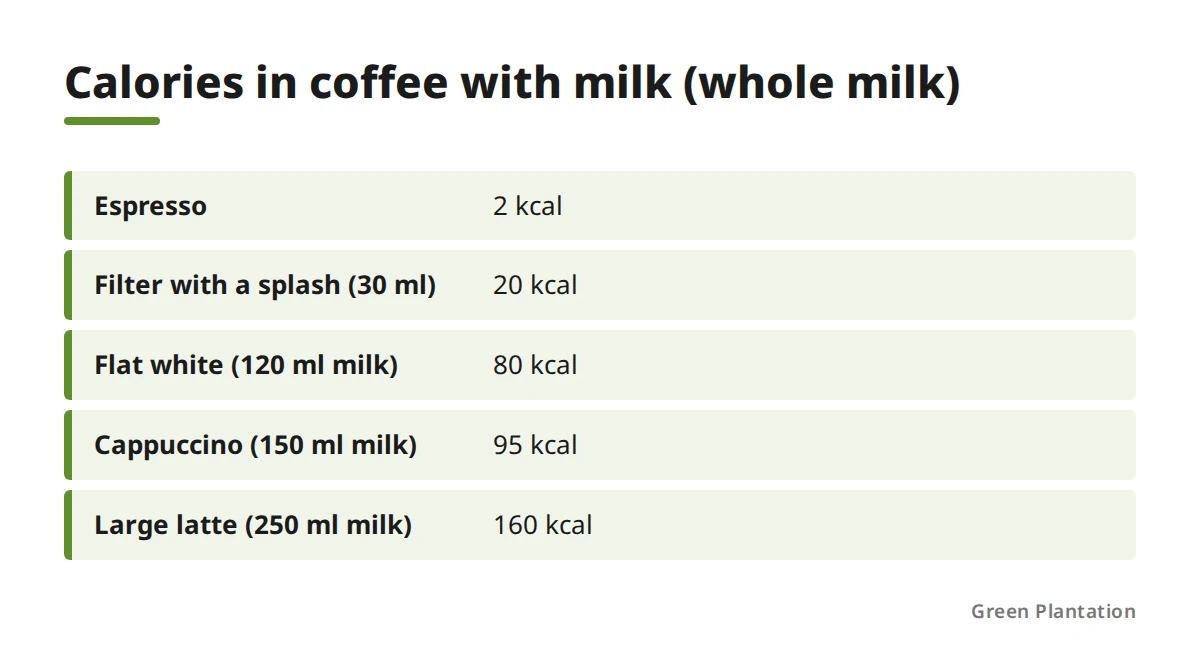
| Drink (typical home size) | Milk | Whole milk | Semi-skimmed | Lactose (approx.) |
|---|---|---|---|---|
| Espresso | 0 ml | 2 kcal | 2 kcal | 0 g |
| Filter coffee with a splash | 30 ml | 20 kcal | 15 kcal | 1.4 g |
| Flat white | 120 ml | 80 kcal | 60 kcal | 5.6 g |
| Cappuccino | 150 ml | 95 kcal | 70 kcal | 7 g |
| Large latte | 250 ml | 160 kcal | 120 kcal | 12 g |
Values are rounded from standard UK and EU nutrition tables (whole milk about 64 kcal and semi-skimmed about 47 kcal per 100 ml) and vary by brand and by how much foam you pour. One teaspoon of sugar adds roughly 16 to 20 kcal; a pump of syrup about 20 to 25 kcal. Two large lattes a day add around 300 kcal, which is a small meal. Does coffee with milk make you fat? Not by itself, but daily large sweetened milk drinks can add up. For more detail see our guide on how many calories are in coffee.
Protein and calcium: the useful part
Cow's milk brings about 3.4 g of protein and 120 mg of calcium per 100 ml. A 250 ml latte therefore gives you roughly 8 g of protein and 300 mg of calcium. EFSA's population reference intake for calcium is 950 mg a day for adults over 25 (1,000 mg for 18 to 24 year olds), so one latte covers close to a third. If you worry about coffee and bones, milk is the part that helps; we cover that in coffee and bone health.
Digestion, the stomach and lactose
Some people say milk makes coffee gentler on the stomach, others say it is exactly what upsets them. Both can be true. Milk dilutes the coffee and adds protein and fat, which some people find easier, especially on an empty stomach. There is no good clinical evidence that milk prevents heartburn, and fat can make reflux worse for some.
When milk is the problem, the usual reason is lactose. EFSA concluded in 2010 that most people with lactose maldigestion tolerate about 12 g of lactose in a single dose with no or minor symptoms, and more when it is spread across the day; a few react to much less. A splash in filter coffee (about 1.4 g) is rarely an issue, a large latte (around 12 g) sits right at the threshold. Lactose-free milk tastes slightly sweeter and steams just like regular milk. A cow's milk protein allergy is different: there is no safe amount, so dairy must be avoided completely.
Iron absorption: drink it between meals
Coffee reduces non-haem iron absorption from food. In a classic study (Morck et al., 1983), a cup of coffee with a hamburger meal reduced iron absorption by 39 %, while coffee drunk an hour before the meal had no effect. Calcium in milk also inhibits iron absorption to some extent. If you have low iron or follow a plant-based diet, have your coffee at least an hour before meals rather than with or straight after them.
Plant milks: are they healthier in coffee?
Not automatically. They suit people who avoid dairy, but they differ a lot nutritionally, and barista versions usually contain added oil and acidity regulators so they do not split in hot coffee.
| Per 100 ml (typical) | Energy | Protein | Calcium | In coffee |
|---|---|---|---|---|
| Whole cow's milk | 64 kcal | 3.4 g | 120 mg | Sweet, creamy, stable microfoam |
| Semi-skimmed milk | 47 kcal | 3.5 g | 120 mg | Lighter, foams well, less silky |
| Oat drink (barista) | 55 to 60 kcal | about 1 g | 120 mg if fortified | Neutral, sweet, best plant foam |
| Soya drink | about 40 kcal | about 3 g | 120 mg if fortified | Most protein, can curdle in acidic coffee |
| Almond drink (unsweetened) | 15 to 25 kcal | about 0.5 g | varies | Thin, nutty, weak foam |
Check the label for added sugar and calcium fortification; organic plant drinks are often not fortified. Soya is closest to milk for protein, oat foams best. More in oat milk in coffee and how to choose milk for frothing.
Caffeine: does milk change it?
Milk has no caffeine and does not neutralise it. A latte contains exactly the caffeine of its espresso, typically 60 to 80 mg for a single shot and 120 to 160 mg for a double. A big milky drink tastes milder, but it is no weaker. EFSA considers up to 400 mg a day (and up to 200 mg in one go) safe for healthy adults, and up to 200 mg a day during pregnancy and breastfeeding.
How to make healthier milk coffee at home
- Start with good, strong coffee. A well-extracted espresso needs no sugar to taste sweet in milk.
- Keep milk at 55 to 65 °C. Above about 70 °C it loses sweetness and starts to taste cooked, which tempts people to add sugar. See perfect milk temperature for cappuccino.
- Choose the size, not just the milk. A cappuccino or flat white instead of a large latte cuts calories and lactose by a third or more.
- Skip syrups or use half a pump. Sugar, not milk, is the less healthy part of most café drinks.
- Clean the steam wand or frother after every use. Milk residue spoils quickly and affects both taste and hygiene.
Frequently asked questions
Is coffee better with or without milk?
Health-wise the difference is small. Black coffee has almost no calories; milk adds protein and calcium but also energy and lactose. Choose the version you enjoy without sugar.
Does coffee with milk make you fat?
Not on its own. A splash adds about 20 kcal, a large whole-milk latte about 160 kcal. Several large sweetened drinks a day can contribute to weight gain, like any extra calories.
Does milk have caffeine?
No. Cow's milk and plant drinks contain no caffeine. All the caffeine in a latte or cappuccino comes from the espresso.
Does adding milk reduce the health benefits of coffee?
It is not proven. One human study found no change in polyphenol uptake with milk, another found lower recovery in urine. Studies linking coffee with lower disease risk include many milk drinkers.
Is coffee with milk bad for the stomach?
It depends on the person. Some find it gentler than black coffee, people with lactose intolerance may get bloating from larger milky drinks. Lactose-free milk or plant drinks are a simple alternative.
What is the healthiest way to drink coffee with milk?
Moderate amounts, little or no sugar, a smaller drink such as a cappuccino or flat white, and coffee between meals if your iron is low.
Equipment for good milk coffee at home
Well-steamed milk tastes sweet on its own, which is the easiest way to cut sugar. These are the tools that make the biggest difference:
- Rancilio Silvia Pro X – dual boiler espresso machine, so you can pull a shot and steam milk at the same time with stable steam pressure; a long-term machine for daily cappuccinos.
- Lelit Anna PL41EM – compact single boiler machine with PID and a proper steam wand, a sensible entry point for learning microfoam.
- Sage BMF600 automatic milk frother – heats and textures dairy or plant milk to a set temperature, useful with filter coffee, moka pot or capsule machines without a steam wand.
- Bialetti electric milk frother – simpler, more affordable one-button frother for a hot milky coffee.
- Fellow Eddy milk pitcher 350 ml – right size for one cappuccino or flat white, which helps you steam only the milk you need.
Want to know which drinks you can build from espresso and milk? See our coffee with milk drinks guide.
Sources
- Duarte G. S., Farah A. (2011): Effect of simultaneous consumption of milk and coffee on chlorogenic acids' bioavailability in humans. J Agric Food Chem.
- University of Copenhagen (2023): Coffee with milk may have an anti-inflammatory effect
- EFSA (2015): Scientific Opinion on the safety of caffeine
- EFSA (2010): Scientific Opinion on lactose thresholds in lactose intolerance and galactosaemia
- Morck T. A., Lynch S. R., Cook J. D. (1983): Inhibition of food iron absorption by coffee. Am J Clin Nutr.
Updated: November 2026
Author: Petra Novotná, editorial name of the Green Plantation.
Recommended products (1)
- Bestseller
- Espresso roast
- Microlot
Brazil - Sancoffee | Espresso
250 g · 46 €/kg
You might also like
 Decaf Coffee: How It's Made, How to Choose and Brew It
How caffeine is removed from coffee, what sets the CO2, Swiss Water and solvent methods apart, what EU rules require, and how to grind and brew decaf so it… 4. 10. 2026
 Essential Oils and Aromatherapy – A Beginner's Guide
Essential oils are highly concentrated aromatic extracts obtained from various parts of plants – flowers, leaves, bark, roots, fruits, or resins. Their… 6. 3. 2026
 CBD Cosmetics – Face Cream, Body Cream, Balm
CBD (cannabidiol) is not just a trendy word on cosmetic packaging. Behind its effects on skin stands real biology – the endocannabinoid system (ECS), which is… 6. 3. 2026