Česky (CZK)
 Slovensky (EUR)
 Magyar (HUF)
 Polski (PLN)
 English (EUR)
 Deutsch (EUR)
 Français (EUR)
 Español (EUR)
 Português (EUR)
 Italiano (EUR)
 Svenska (SEK)
 Suomi (EUR)
 Nederlands (EUR)
 Dansk (EUR)
 Lëtzebuergesch (EUR)
 Eesti (EUR)
 Latviešu (EUR)
 Lietuvių (EUR)
 Slovenščina (EUR)
 Română (RON)
 Български (EUR)
 Hrvatski (EUR)
 Ελληνικά (EUR)
 Українська (EUR)
 Norsk (EUR)
 Srpski (EUR)
 Tiếng Việt (EUR)
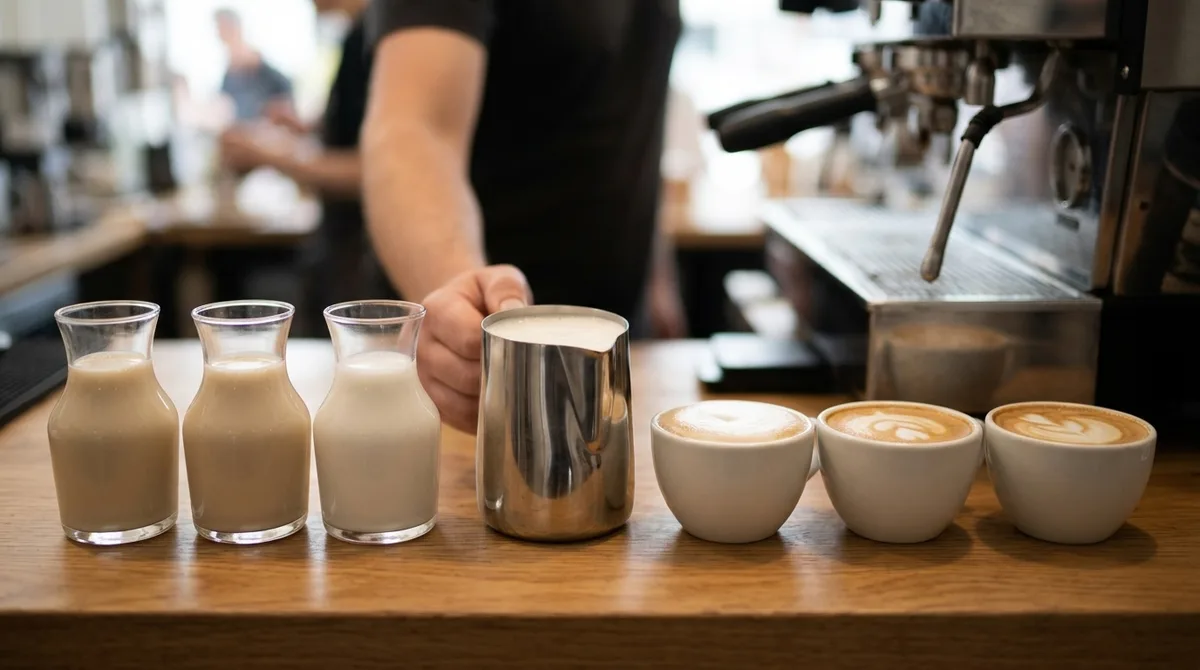



Plant-Based Drinks for Coffee – Oat, Almond, Coconut
Why Barista Editions Exist
Have you ever poured regular almond milk from the supermarket directly into espresso? The result is almost always the same: thin, watery drink with poor foam and clumps of curdled protein on the surface. It's not a mistake in your barista technique – it's a mistake in the milk's composition.
Regular plant-based drinks are formulated for drinking, mixing into cereals, or smoothies. Barista editions, on the other hand, are specially designed for contact with hot, acidic coffee and for frothing with a steam wand. Key differences compared to standard versions:
- Higher fat content – Regular versions contain 1–2% fat, barista versions 3–4%. Fat stabilizes foam and gives the drink a creamy texture
- Added emulsifiers – Lecithin or gellan gum prevent protein curdling when in contact with the acid in coffee
- Higher protein content – Proteins are essential for stable microfoam formation. Barista versions are supplemented with pea or soy proteins
- Regulated pH – Buffer compounds balance the drink's pH and reduce curdling risk when in contact with acidic coffee
- Higher solids content – Less water, more "body" – essential for the final texture of a latte
Explore our plant-based drinks for coffee – we've selected barista editions that actually work in professional and home settings.
Comparison of Plant-Based Drinks
Large Comparison Table
| Type | Calories (100 ml) | Protein | Fats | Frothing | Taste in Coffee | Ecological Footprint |
|---|---|---|---|---|---|---|
| Oat (barista) | 55–65 kcal | 1–1.5 g | 3–3.5 g | Excellent | Mildly sweet, creamy, neutral | Low |
| Almond (barista) | 35–50 kcal | 0.5–1 g | 2.5–3 g | Good | Subtle nutty, light | Higher (water use) |
| Coconut | 20–30 kcal | 0.2 g | 1.5–2 g | Weak | Strong coconut, sweet | Medium |
| Soy (barista) | 45–55 kcal | 3–3.5 g | 2–2.5 g | Very Good | Legume-forward, pronounced | Low |
| Hemp | 40–50 kcal | 1–2 g | 3 g | Weaker | Nutty, earthy | Very Low |
| Rice | 50–60 kcal | 0.1–0.3 g | 1 g | Weak | Sweet, watery | Medium |
Detailed Profile of Each Type
Oat Milk – King of the Barista Scene
Oat milk is the phenomenon of the last decade, and rightfully so. Of all plant-based alternatives, it has come closest to dairy milk in the context of coffee preparation. During production, oats are soaked, ground, and filtered – the enzyme amylase then breaks down starch into simpler sugars, explaining the natural sweetness without added sugar. The result is a drink with full texture and balanced flavor.
Advantages:
- Best microfoam of all plant-based milks – dense, creamy, and stable
- Neutral flavor that doesn't overpower coffee tones or subtle single-origin nuances
- Natural sweetness eliminates the need for additional sweetening
- Excellent for latte art – foam is smooth and glossy, pours well
- Low ecological footprint – oats grow in temperate climates and require minimal irrigation
Disadvantages:
- Higher carbohydrate content due to enzymatic starch breakdown
- Contains gluten – unsuitable for celiac disease unless certified gluten-free
- Some brands add rapeseed oil to improve texture – check the ingredients if this bothers you
Best for: Flat white, latte, cappuccino, latte art.
Almond Milk – Light Elegance
Almond milk was the first plant-based alternative to gain significant traction in coffee shops. It's light, subtly nutty, and calorically the most economical of commonly available options.
Advantages:
- Low calorie content – ideal for those monitoring energy intake
- Subtle nutty flavor that pleasantly complements lighter and brighter roasts
- Barista version froths well – stable foam for basic designs
- Naturally gluten-free and soy-free
Disadvantages:
- Low protein content – foam is less stable and durable than oat milk
- Regular (non-barista) version has a watery texture unsuitable for cappuccino
- High water consumption during cultivation – most of the world's almonds come from drought-stricken California
- Subtle flavor can get completely lost in stronger espresso bases
Best for: Iced lattes, lighter coffee drinks, people with gluten or soy intolerance.
Coconut Milk – Tropical Exoticism
Coconut milk has a pronounced flavor that you either love or don't – it's definitely not a neutral alternative for coffee. It adds tropical sweetness and creaminess, but fundamentally changes the flavor profile of the drink.
Advantages:
- Creamy texture due to high fat content – full-fat version gives the drink interesting body
- Distinctive, recognizable flavor for coconut lovers
- Naturally sweet without need for added sugar
- Naturally free from common allergens – gluten, soy, and tree nuts
Disadvantages:
- Dominant flavor easily overpowers the subtle aromatic tones of single-origin coffees
- Poor frothing – low protein content doesn't allow stable microfoam formation
- "Light" versions are too thin and consequently less flavorful in the end
- Latte art is practically impossible – foam is coarse and unstable
Best for: Iced coffee, cold brew, spiced coffee drinks (pumpkin spice latte, chai latte), Asian-inspired coffee recipes.
Soy Milk – Proven Veteran
Soy milk is the oldest plant-based alternative in coffee shops – it was used long before oat milk became dominant. It has the highest protein content of all plant-based milks and its frothing is closest to dairy milk.
Advantages:
- Highest protein content (3–3.5 g/100 ml) – closest to dairy milk of all alternatives
- Very good microfoam – stable and fine with correct technique
- Quality barista versions have surprisingly neutral flavor
- Low ecological footprint compared to dairy milk
Disadvantages:
- Cheaper versions have a pronounced "beany" flavor that many perceive negatively
- Sensitive to curdling in acidic coffee – soy proteins react to low pH faster than oat proteins
- Soy is a common food allergen
- Ongoing discussion about phytoestrogens, though available research has confirmed their safety in typical consumption amounts
Best for: Cappuccino, latte art (for experienced baristas), people seeking higher plant-based protein intake.
Hemp Milk – Newcomer with Potential
Hemp milk is made from seeds of industrial hemp – it contains no THC or CBD, meaning no psychoactive substances. It offers an interesting nutritional profile and exceptionally low ecological footprint.
Advantages:
- Excellent omega-6 to omega-3 fatty acid ratio (3:1) – favorable for health
- Pleasant nutty-earthy flavor for those who enjoy it
- Ecologically highly sustainable – hemp grows without pesticides and with minimal irrigation needs
- Free from common allergens (gluten, soy, tree nuts)
Disadvantages:
- Weak frothing – unsuitable for espresso drinks with microfoam
- Earthy flavor isn't for everyone – when combined with coffee it can be distracting
- Limited commercial availability in coffee shops
- Higher price compared to oat or soy milk
Best for: Cold brew, filter coffee, people with multiple food allergies.
Rice Milk – The Lightest Alternative
Advantages: Very subtle and sweet flavor without pronounced tones. Free from most allergens – suitable even for children. Most approachable flavor for those unused to plant-based alternatives.
Disadvantages: Minimal protein content makes foam formation impossible. Thin, watery texture unsuitable for espresso drinks. High glycemic index – unsuitable for people with elevated blood sugar levels.
Best for: Iced coffee and cold coffee drinks where foam isn't needed. Not recommended as a primary dairy milk alternative for coffee.
Which Plant-Based Milk is Best for Latte Art?
Latte art requires microfoam – fine, glossy foam without visible bubbles, which pours like liquid paint and holds its shape. To achieve it you need three things:
- Sufficient protein – holds the foam structure together
- Correct fat content – provides creaminess, shine, and viscosity
- Appropriate fluidity – foam must flow smoothly, not collapse in lumps
Ranking for Latte Art
- Oat barista – Closest to dairy milk. Smooth, glossy foam allows drawing hearts, leaves, and even complex tulips
- Soy barista – Very good foam, but dissolves faster – pour immediately after frothing. Suitable for simpler designs
- Almond barista – Foam is thinner and less stable, but basic designs like hearts are achievable
- Coconut – Latte art is practically impossible. Foam is coarse, unstable, and quickly separates
- Hemp, rice – Unsuitable for any foam designs
Practical tip: When frothing plant-based milk, work at a lower temperature than with dairy – target 55–60 °C instead of 60–65 °C. Plant-based proteins denature faster at higher temperatures, foam loses structure, and gains an unwanted bitter taste.
Environmental Comparison
Ecological footprint is among the main reasons people switch from dairy to plant-based alternatives. Below is a comparison per 1 liter of finished drink:
| Type of Milk | CO2 Emissions (kg) | Water Use (l) | Land Use (m²) |
|---|---|---|---|
| Dairy milk | 3.2 | 628 | 8.9 |
| Oat | 0.9 | 48 | 0.8 |
| Soy | 1.0 | 28 | 2.2 |
| Almond | 0.7 | 371 | 0.5 |
| Rice | 1.2 | 270 | 0.3 |
| Coconut | 0.6 | 169 | 0.7 |
Source: Our World in Data, based on Poore & Nemecek (2018) meta-analysis
Key Findings
- All plant-based milks have significantly lower ecological footprint than dairy – the difference is multi-fold, not marginal
- Oat milk is environmentally the most balanced – low emissions, low water consumption, and low land use simultaneously
- Almond milk has low emissions but enormous water consumption – problematic especially because 90% of the world's almonds come from chronically drought-stricken California
- Soy milk excels with the lowest water consumption of all plant-based alternatives
- Coconut has the lowest CO2 emissions but coconut palms grow exclusively in tropical regions, complicating logistics and increasing transportation footprint
How to Properly Froth Plant-Based Milk
Basic Technique Step by Step
- Start with cold milk – from the refrigerator, ideally 4–5 °C. Cold milk gives you more working time before reaching maximum temperature
- Wand just below the surface – create a gentle hissing sound, not vigorous bubbling. The air incorporation phase (stretching) is shorter with plant-based milk – 2–3 seconds instead of 3–5 with dairy
- Submerge the wand deeper – create a rotating whirlpool that breaks larger bubbles into fine microbubbles. This phase takes longer with plant-based milk
- Target 55–60 °C – lower than with dairy milk (60–65 °C). Overheated plant-based milk loses foam structure and gains a bitter taste
- Tap and swirl – after frothing, tap the pitcher on the counter (breaks remaining large bubbles) and gently swirl so the foam becomes smooth and glossy
Tips for Individual Types
- Oat: Froth almost identically to dairy, just at a lower temperature. Of all plant-based milks, it best tolerates slight overheating
- Soy: Add air very carefully and briefly – soy foam breaks down quickly, so pour immediately after frothing without unnecessary delay
- Almond: Froth slowly, with the wand positioned deeper below the surface. Foam is delicate but less durable – account for this when creating designs
- Coconut: Froths with difficulty. Use exclusively full-fat version, add minimal air, and aim for fine creaminess rather than traditional microfoam
Troubleshooting Common Problems
Curdling
Cause: Acids in coffee destabilize proteins in plant-based milk – the same chemical principle as fresh cheese making. Reactivity is higher with cold milk and highly acidic coffees.
Solution:
- Use barista editions – they contain pH stabilizers and emulsifiers specifically designed for this purpose
- Warm the milk before adding to coffee – warm milk curdles significantly less
- Pour milk into coffee, not the other way – slower pH change reduces shock to proteins
- With light roasts and African single-origin coffees (high acidity), choose more resistant oat or almond milk over soy
Thin, Watery Foam
Cause: Insufficient protein and fat content – typical of regular, non-barista plant-based milks.
Solution:
- Switch to barista edition with at least 3% fat content
- Froth at lower temperature – heat above 60 °C accelerates protein structure breakdown
- Shorten the stretching phase – less air but better bubble quality
- Oat or soy barista milk will provide significantly better results than almond or coconut
Foam Collapses Immediately
Cause: Too much air, overheated milk, or low protein stabilizer content.
Solution:
- Shorten the air incorporation phase – less is sometimes more
- Check temperature – above 60 °C plant-based proteins denature and foam collapses
- Pour immediately after frothing – plant-based foam is less stable than dairy and waiting will destroy it
- Maintain smooth pitcher movement without stopping – interrupting the flow destabilizes the structure
Unpleasant Taste
Cause: Wrong type of milk for the drink, overheating, or simply an unsuitable brand.
Solution:
- Try a different brand – differences between manufacturers in taste and behavior when frothing are enormous
- Lower the frothing temperature by 3–5 °C
- Consider a different type of plant-based milk – each coffee has its ideal alternative (see comparison table above)
Frequently Asked Questions (FAQ)
Which plant-based milk tastes most like dairy?
Oat barista milk – it has similar creaminess, natural sweetness, and neutral flavor that doesn't interfere with coffee tones. Soy barista is closest in terms of protein content and foam structure, but may have a more pronounced flavor of its own.
Can I use regular plant-based milk from the store for coffee?
You can, but results will be substantially worse – thin texture, weak or no foam, increased curdling risk. For occasional use it's adequate, but if you make latte or cappuccino every day, investing in barista edition will pay for itself in the quality of every cup.
Why is barista edition more expensive?
Higher fat content, added plant proteins, stabilizers, and emulsifiers increase production costs. It's a specialized product with more precise and costly formulation than a standard beverage drink.
Can you do latte art with plant-based milk?
Yes – with oat barista milk you'll achieve results nearly identical to dairy. Soy barista is also very good. With almond barista, simple designs are achievable. With coconut and rice milk, latte art is practically impossible.
How long does opened plant-based milk last?
In the refrigerator 5–7 days after opening. Barista editions may have slightly shorter shelf life due to higher protein content – check the date on the package. Shake the milk before each use as natural ingredients settle at the bottom.
Is plant-based milk healthier than dairy?
The answer depends on what you're measuring. Dairy milk contains more protein and calcium – unless plant-based alternatives are fortified. Plant-based milks, on the other hand, contain no lactose or cholesterol and have significantly lower ecological footprint. For most people it's a matter of personal preference, lactose intolerance, or ethical stance toward animal agriculture – not a clear-cut health recommendation.
Sources
- Our World in Data – Environmental Impact of Milk Alternatives
- Poore & Nemecek (2018) – Reducing food's environmental impacts through producers and consumers
- Barista Institute – How to Foam Plant-Based Milks
- Journal of Food Science – Physicochemical Properties of Plant-Based Milks