Česky (CZK)
 Slovensky (EUR)
 Magyar (HUF)
 Polski (PLN)
 English (EUR)
 Deutsch (EUR)
 Français (EUR)
 Español (EUR)
 Português (EUR)
 Italiano (EUR)
 Svenska (SEK)
 Suomi (EUR)
 Nederlands (EUR)
 Dansk (EUR)
 Lëtzebuergesch (EUR)
 Eesti (EUR)
 Latviešu (EUR)
 Lietuvių (EUR)
 Slovenščina (EUR)
 Română (RON)
 Български (EUR)
 Hrvatski (EUR)
 Ελληνικά (EUR)
 Українська (EUR)
 Norsk (EUR)
 Srpski (EUR)
 Tiếng Việt (EUR)
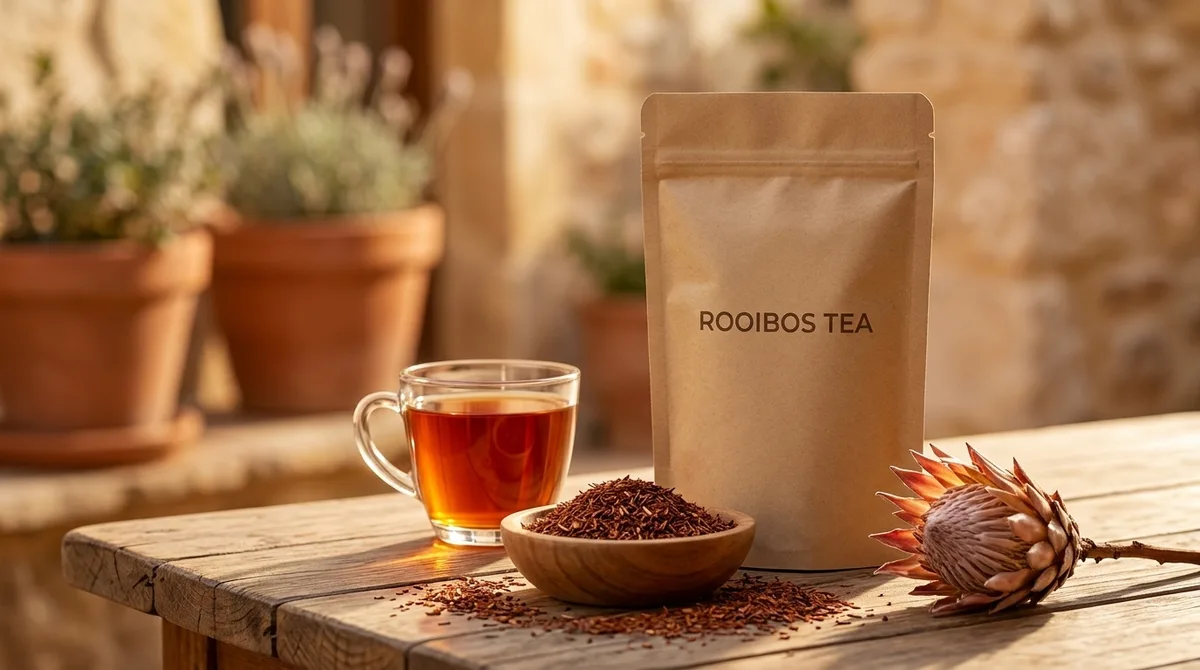



Rooibos – South African caffeine-free tea
A shrub from the Cedar Mountains
In the southwestern tip of Africa, in the Western Cape region of the South African Republic, grows a shrub that you won't find anywhere else in the world. Rooibos (Aspalathus linearis) belongs to the legume family (Fabaceae) and thrives exclusively in the unique fynbos ecosystem – an area with Mediterranean climate, acidic sandy soil, hot dry summers, and humid winters. This particular combination of conditions is irreplaceable, making rooibos a truly unique raw material.
Despite being called "tea" around the world, rooibos is not true tea – it doesn't come from the Camellia sinensis plant. It's a herbal infusion (tisane) with one key advantage: it is naturally caffeine-free and contains significantly lower levels of tannins than any true tea.
You'll find rooibos and other teas in the tea section.
Red vs green rooibos
Both types come from the same Aspalathus linearis shrub. They differ only in processing – the same principle as with green and black tea from Camellia sinensis.
Red rooibos (fermented)
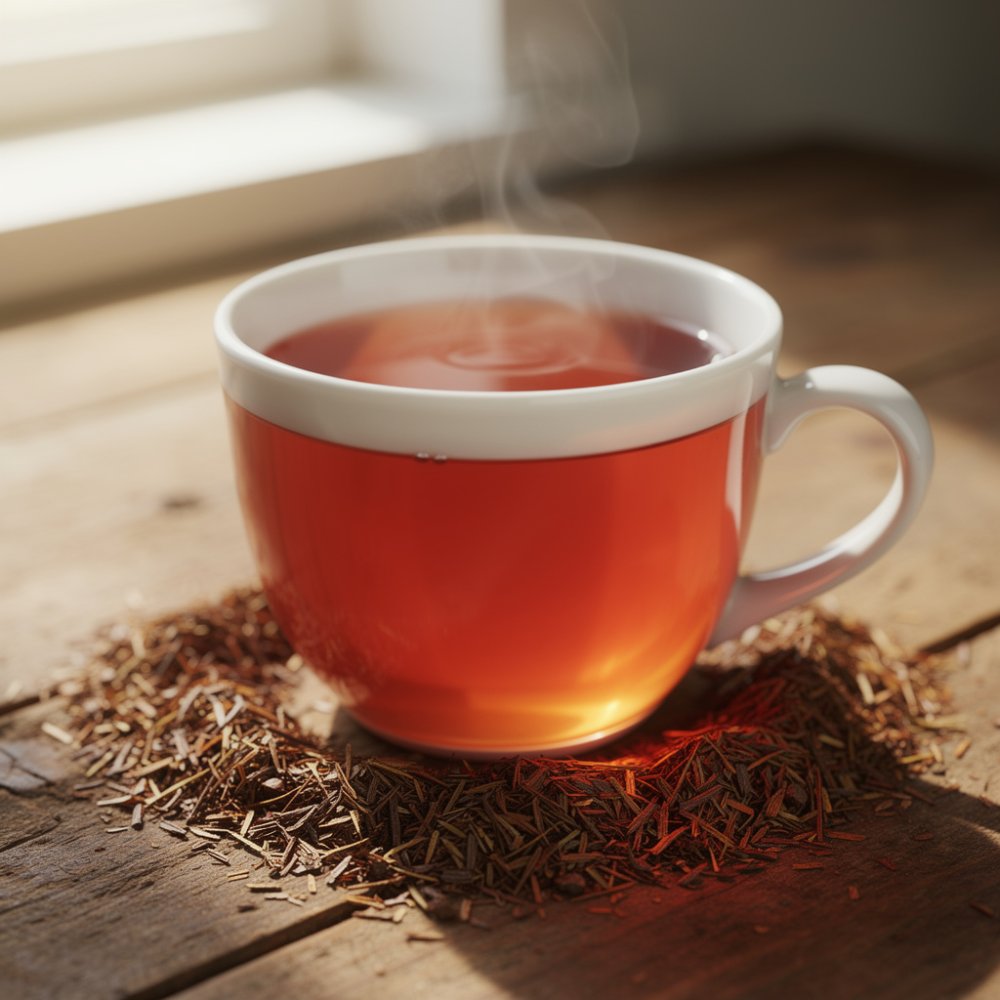
After harvesting, the leaves and twigs are cut, moistened, and left to oxidize in the sun. During this 8–24-hour process, the green plant tissue undergoes a characteristic transformation to a reddish-brown color and develops the typical flavor profile:
- Sweet, nutty taste with notes of vanilla and caramel
- Smooth, full character without any bitterness
- Reddish-brown color of the infusion, which remains stable even with prolonged steeping
Red rooibos accounts for more than 95% of global production and is what most people imagine when they think of "rooibos."
Green rooibos (unfermented)
Green rooibos began to be produced only in the mid-1990s. After harvesting, the leaves are immediately dried, stopping oxidation – the same principle as in green tea production. The result is different both in taste and nutrition:
- Grassy, light taste with mineral and slightly herbal notes
- Light yellowish-green color of the infusion
- Higher antioxidant content – the unfermented process preserves significantly more aspalathin and other polyphenols
Green rooibos is rarer, more expensive, and harder to find. For those who love rooibos and want to discover another dimension of it, however, it's a must-try experience.
Comparison
| Property | Red rooibos | Green rooibos |
|---|---|---|
| Processing | Oxidized (fermented) | Unoxidized |
| Infusion color | Reddish-brown | Light yellowish-green |
| Taste | Sweet, nutty, caramel | Grassy, light, mineral |
| Antioxidants | High | Higher (more aspalathin) |
| Caffeine | 0 mg | 0 mg |
| Tannin | Very low | Very low |
| Availability | Common | Rare, more expensive |
Health benefits of rooibos
Rooibos contains unique flavonoids that don't occur in other plants – particularly aspalathin and nothofagin. A systematic review published in PMC (2024) summarizes growing evidence of their effects on the human body.
Cardiovascular health
Regular rooibos consumption has been associated in clinical studies with reduced blood pressure, favorable effects on cholesterol levels, and overall reduced risk of cardiovascular disease. The flavonoids present in rooibos support blood vessel wall elasticity and reduce inflammatory markers.
Blood sugar regulation
Aspalathin – the main and characteristic flavonoid of rooibos – demonstrates the ability to lower blood glucose levels and improve cell sensitivity to insulin. For this reason, rooibos is an interesting beverage especially for people with prediabetes or type 2 diabetes, of course as part of a balanced diet and under medical supervision.
Antioxidant protection
Rooibos effectively neutralizes free radicals and protects cells from oxidative stress. Green rooibos shows higher antioxidant capacity than red rooibos because oxidation during fermentation converts some polyphenols into other compounds.
Digestion
Unlike true teas, rooibos contains only minimal amounts of tannin – a substance that irritates the stomach lining and slows mineral absorption in more sensitive individuals. Rooibos is therefore suitable even for people with sensitive digestion, reflux, or irritable bowel syndrome.
Skin
Alpha hydroxy acids and zinc contained in rooibos are actively used in cosmetics to soothe irritated and inflamed skin. A rooibos bath is a traditional South African folk remedy for eczema, psoriasis, and sunburns.
Other benefits
- Caffeine-free – suitable at any time of day, including evening hours
- Low oxalate content – unlike black tea, rooibos does not increase the risk of kidney stones
- Trace minerals – calcium, magnesium, zinc, and iron in small but biologically available amounts
- Virtually zero calories – without added sugar or milk
Preparing rooibos
Classic hot rooibos
- Dosage: 1–2 teaspoons of loose rooibos per 200 ml of water
- Temperature: 100 °C – rooibos doesn't fear boiling water; unlike green tea, it won't become bitter
- Steeping: 5–7 minutes, even longer if you like – over-steeping carries minimal risk
- Sweetening: Quality rooibos is pleasantly sweet on its own; if desired, add honey or a touch of agave syrup
Rooibos latte
- Steep 2 teaspoons of rooibos in 100 ml of boiling water for 5–7 minutes
- Strain into a pre-warmed cup and add 100 ml of steamed milk – dairy, oat, or almond all work wonderfully
- Sweeten to taste with vanilla syrup or a teaspoon of honey
- Gently sprinkle with cinnamon or cardamom
Rooibos latte is an elegant caffeine-free alternative to chai latte or matcha latte.
Iced rooibos
- Prepare double concentration – 3 teaspoons per 200 ml of boiling water
- Steep for 7–10 minutes, then strain
- Let cool to room temperature, then pour over ice
- Top with a slice of lemon or orange; optionally add a sprig of mint
- Cold brew variation: 2 tablespoons of rooibos in 500 ml of cold water, 6–8 hours in the refrigerator – the result is gentler and less astringent
Culinary uses
Rooibos is surprisingly versatile beyond the cup:
- Smoothies – strong infusion as a base instead of regular water adds depth of flavor
- Marinades – rooibos tenderizes meat and imparts a gentle earthy sweetness; ideal for venison or pork ribs
- Baking – rooibos infusion in waffles, cakes, or crème brûlée enriches the flavor profile without caffeine
- Cocktails and mocktails – rooibos syrup (infusion + sugar in 1:1 ratio) as a base for non-alcoholic and alcoholic drinks
- Ice cream and sorbet – rooibos with vanilla and honey creates a remarkably harmonious combination
Rooibos vs honeybush
Honeybush (Cyclopia spp.) is another South African plant that sometimes appears on store shelves next to rooibos and is often confused with it. Both are caffeine-free and come from the same part of the world, but their flavor profiles and availability differ significantly:
| Property | Rooibos | Honeybush |
|---|---|---|
| Plant | Aspalathus linearis | Cyclopia spp. |
| Taste | Nutty, vanilla, caramel | Honey, floral, fruity |
| Sweetness | Moderate, natural | More pronounced – hence the name "honey" |
| Infusion color | Reddish-brown | Darker, amber-brown |
| Production | ~20,000 tons/year | ~200 tons/year (100× less) |
| Cultivation | Commercial farms | Mostly semi-wild harvesting |
Honeybush is substantially rarer and harder to find, but rooibos lovers should try it – its honey sweetness and floral complexity are truly unique.
Frequently asked questions (FAQ)
Is rooibos safe for children?
Yes. Caffeine-free, with minimal tannin content and a gentle, naturally sweet taste, rooibos is one of the safest beverages for children of all ages. In South Africa, it's traditionally given to babies for colic and sleep problems.
Can I drink rooibos during pregnancy?
Yes, rooibos is generally considered safe during pregnancy and breastfeeding. It contains no caffeine, is rich in antioxidants, and is well tolerated. If you have any doubts, consult your doctor or midwife.
How long does dried rooibos keep?
With proper storage – airtight container, darkness, dryness, and stable temperature – dried rooibos keeps for 2–3 years. It gradually loses intensity of aroma and flavor, but it doesn't spoil in the true sense. For the best experience, consume it within a year of opening the package.
Why doesn't rooibos become bitter even with prolonged steeping?
The bitterness and astringent sensation when over-steeping black or green tea is caused by tannin, which is released in large quantities during prolonged steeping. Rooibos contains only minimal amounts of tannins, so you can comfortably steep it for 15 or more minutes without any risk of bitterness.
Where is rooibos grown and why can't it be grown elsewhere?
Rooibos grows exclusively in the Cederberg region of the Western Cape in the South African Republic. Attempts to cultivate it in Australia, China, and other countries with similar climates have failed – the plant requires a very specific combination of soil mineral composition, fluctuating climate, and fynbos ecosystem biodiversity that cannot be fully replicated elsewhere.