
 Česky (CZK)
 Slovensky (EUR)
 Magyar (HUF)
 Polski (PLN)
 English (EUR)
 Deutsch (EUR)
 Français (EUR)
 Español (EUR)
 Português (EUR)
 Italiano (EUR)
 Svenska (SEK)
 Suomi (EUR)
 Nederlands (EUR)
 Dansk (EUR)
 Lëtzebuergesch (EUR)
 Eesti (EUR)
 Latviešu (EUR)
 Lietuvių (EUR)
 Slovenščina (EUR)
 Română (RON)
 Български (EUR)
 Hrvatski (EUR)
 Ελληνικά (EUR)
 Українська (EUR)
 Norsk (EUR)
 Srpski (EUR)
 Tiếng Việt (EUR)
2-group commercial espresso machine: how to choose (2026 comparison)
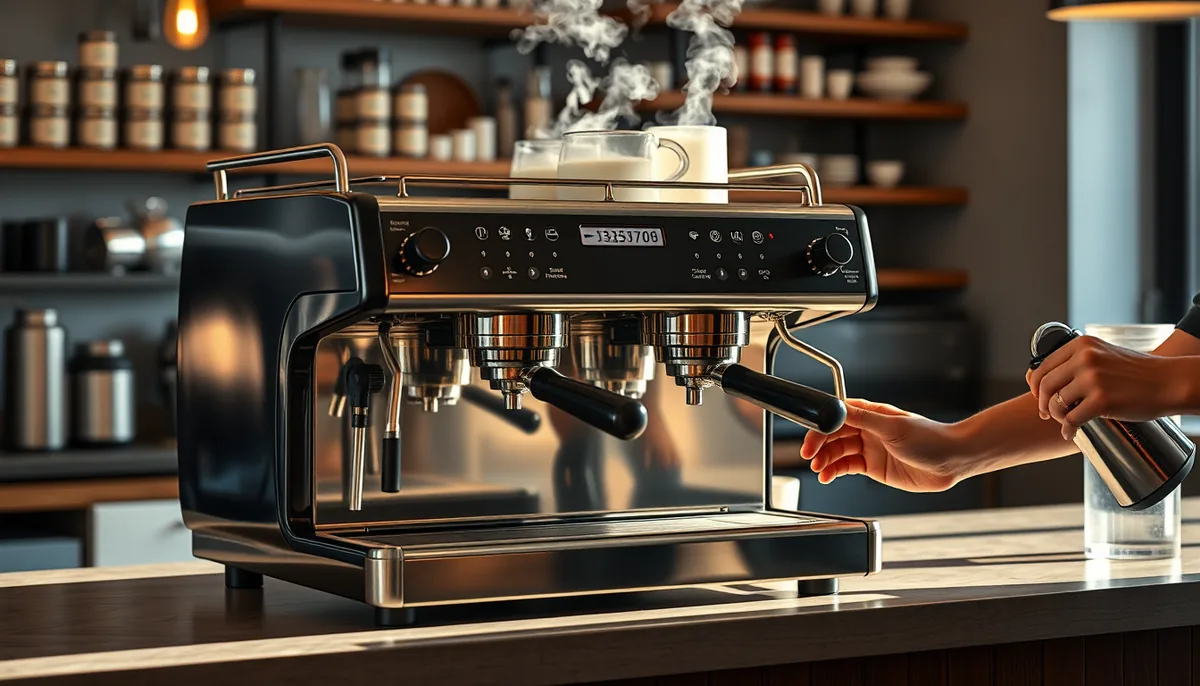
In short: a two-group commercial espresso machine starts to make sense above roughly 40 drinks per hour at peak. Allow 4.5 to 5.7 kW, which means 19.5 to 25 A on a 230 V single-phase supply, a 3/8" water inlet and a drain. Below that, a single group is enough.



| Two-group threshold | from 40 to 60 drinks per hour at peak |
|---|---|
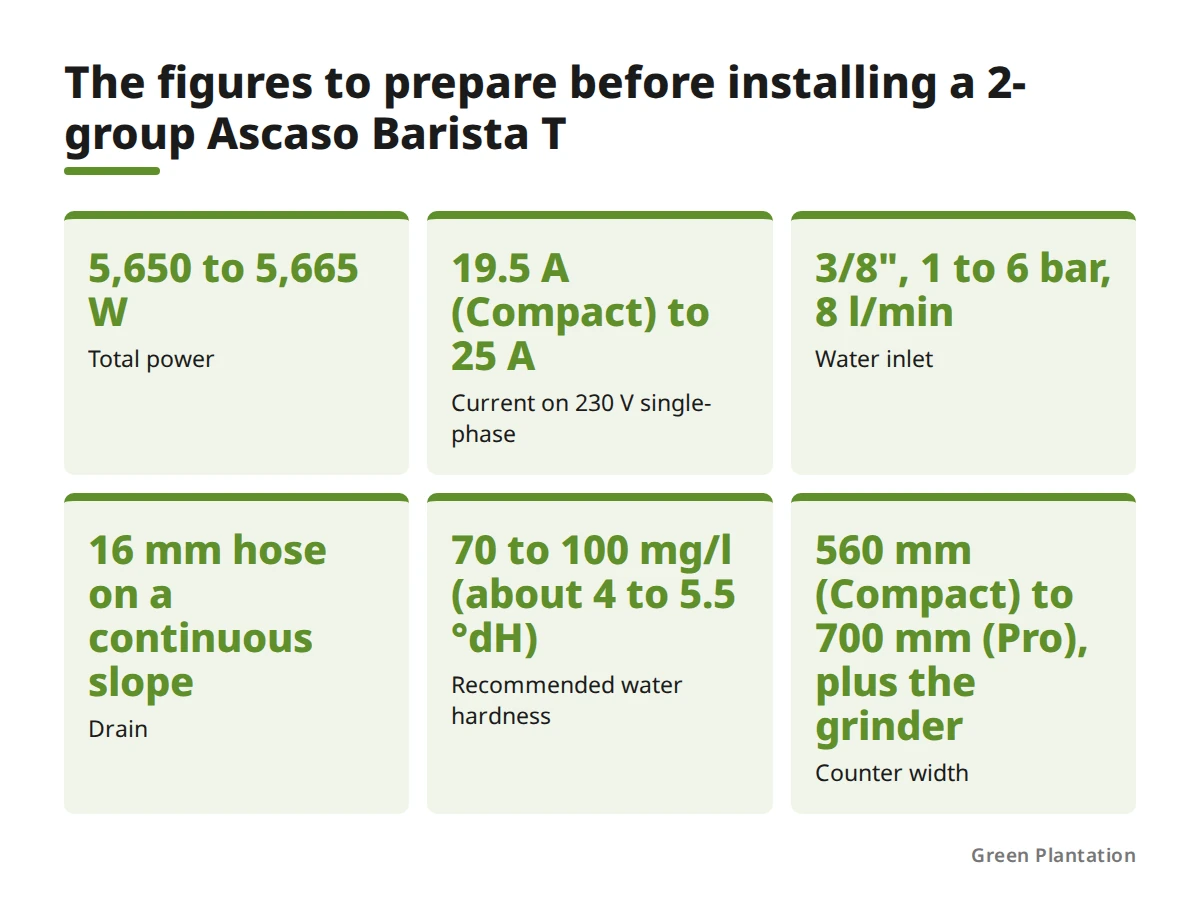
| Power (Ascaso Barista T) | 5,650 to 5,665 W according to the Ascaso brochure |
| Single-phase current | 19.5 A (Compact, previous series) to 25 A (5,650 W, 2024 brochure) |
| Water | 3/8" connection, 1 to 6 bar, recommended hardness 70 to 100 mg/l (about 4 to 5.5 °dH) |
| Steam boiler | 8.5 l (Barista T Pro), groups heated by thermoblocks |
| Key maintenance | automatic rinse every evening, blind-filter backflush every week |
You are opening a coffee shop in the city centre, or taking over a café-bar with a forty-seat terrace. The quote says "2 groups, 6 kW, three-phase", the electrician is talking about cable cross-sections, and you are not sure whether you are buying too big. This guide starts from your real throughput, then moves on to electricity, water, the Ascaso models and maintenance.
How many coffees per hour: size the machine before you choose it
The right yardstick is not coffees per day but the peak. A café serving 250 espressos a day may make 80 of them between 12:45 and 2 pm. That is the hour the machine has to cope with.
A full cycle on one group takes 60 to 75 seconds: 25 to 30 seconds of extraction, then knocking out, dosing, tamping, flushing and locking the portafilter back in. One group therefore tops out at 50 or 60 cycles an hour. In practice the barista is the bottleneck: while steaming milk, they are not preparing the next portafilter. A second group lets you start one extraction while the other finishes, or lets two people work side by side.
| Profile | Coffees per day | Peak (drinks per hour) | Share of milk drinks | Recommended set-up |
|---|---|---|---|---|
| Food truck, kiosk, market stall | 40 to 120 | 20 to 40 | varies | 1 group, ideally with a water tank |
| Bakery with a coffee corner | 80 to 200 | 30 to 60 | medium | 1 group below 40 per hour, otherwise a compact 2-group |
| Café-bar, café-restaurant | 150 to 350 | 60 to 100 | low (espresso, macchiato) | 2 groups |
| Milk-focused coffee shop | 200 to 450 | 80 to 120 | high (latte, flat white) | 2 groups with a large steam boiler, 2 grinders |
| High volume, two baristas non-stop | over 450 | over 120 | any | 3 groups |
These are rule-of-thumb figures from the field. If more than half of your sales contain milk, look at the steam boiler first, before the number of groups.
1 or 2 groups: what really changes
The Ascaso Baby T Plus uses the same heated-group principle as the Barista T range, with a stated stability of ±0.5 °C. Its limit is a 2.5 l, 1,200 W steam boiler with a single steam wand. It is comfortable at 30 drinks an hour and runs out of breath at 60 cappuccinos in a row.
Moving to 2 groups doubles throughput and gives you two steam wands and a boiler more than three times larger. The trade-off: 65 to 71 kg instead of 35, 5.7 kW instead of 2.2, and a mains water and drain connection. For the other criteria (brand, service, design), see our guide on how to choose a professional coffee machine.
A word on terminology: people often search for a "lever espresso machine" when they mean any commercial machine with handles. In the trade, a lever machine is one where a piston driven by a large lever pushes the water through, as on La Pavoni models. The machines covered here are pump-driven portafilter machines with a rotary pump: the handle only locks the portafilter in, and the pressure comes from the pump.
Electricity, water and installation: step by step
The Barista T manual requires installation by a qualified professional. Here is what to prepare, with the manufacturer's figures.
- Check the rating plate. The Barista T comes with its power cable but no plug: it is hard-wired, with an isolating switch on the supply.
- Choose three-phase or single-phase. The machine accepts 380 to 400 V three-phase and 220 to 240 V single-phase. If your premises have three-phase power (common in catering), that is the most comfortable option: the load is spread and the current per phase drops. On single-phase, the previous-series manual gives 24 A for a standard 2-group and 19.5 A for the 2-group Compact (4,500 W); with the 5,650 W in the 2024 brochure you get roughly 25 A (5,650 / 230). You need a dedicated circuit; a 32 A circuit with 6 mm² cable is the usual ballpark, but have your electrician confirm it against local wiring regulations.
- Supply capacity too tight? The software limits how many heating elements run at the same time: 7.5, 15, 19.5 or 24 A for a standard 2-group according to the manual, at the cost of slower steam recovery.
- Prepare the water inlet. A stop valve, the 3/8" braided hose supplied, mains pressure between 1 and 6 bar (fit a pressure reducer above that) and a recommended flow of 8 l/min.
- Test your water. Ascaso recommends a total hardness of 70 to 100 mg/l (about 4 to 5.5 °dH), TDS of 90 to 150 ppm and free chlorine below 0.05 ppm. In many parts of Europe tap water is well above these values, so treatment is almost always needed. Our comparison of filter cartridge vs cabinet water softener explains both options.
- Plan the drain. The supplied hose is 16 mm in diameter. It must run on a continuous downward slope to the trap, with no loop where coffee grounds could settle.
- Choose the location. 5 to 32 °C, humidity below 70%, no hosing down, room for the grinder and service access, and a sturdy counter (65 to 71 kg).
- Commissioning. The pump is factory-set to 9 bar and the expansion valve to 11 bar (12 bar maximum). The technician checks these values with a blind filter.
Additional checklist: how to connect a coffee machine and what to prepare.
The models compared: Baby T Plus, Barista T Compact, Barista T Pro
Ascaso's "T technology" replaces heavy E61-style brass groups with a 1,000 W thermoblock per group, controlled by PID. Mains water is preheated in a circuit running through the steam boiler, then brought up to temperature by the thermoblock, so it never sits in a coffee boiler. Each group can be set from 80 to 110 °C in tenths of a degree, and Ascaso quotes a first espresso in about one minute.
| Specification (manufacturer data) | Baby T Plus | Barista T Compact 2 groups | Barista T Pro 2 groups |
|---|---|---|---|
| Groups | 1 | 2 | 2 |
| Stated stability | ±0.5 °C | ±1.5 °C | ±0.5 °C |
| Steam boiler | 2.5 l, 1,200 W | 9.5 l, 3,500 W * | 8.5 l, 3,500 W, insulated |
| Total power | approx. 2.2 kW | 5,650 W | 5,665 W |
| Current on 230 V single-phase | about 10 A | 19.5 A (4,500 W) to 25 A (5,650 W) * | 24 to 25 A |
| Controls | 2 displays, app | 2 displays per group | 4.2" touchscreen, 2 displays per group |
| Insulated groups and pipes | insulated group | no | yes |
| Maximum cup height | n/a | 9 cm | 9 or 12 cm |
| Dimensions (W x H x D) | 350 x 450 x 430 mm | 560 x 460 x 565 mm | 700 x 475 x 535 mm |
| Weight | 35 kg | 65 kg | 71 kg |
| Water | 2 l tank or mains | mains connection required | mains connection required |
| Lighting, "Power Guard" system | yes | no | yes |
* The Barista T brochure (2024) states 9.5 l and 3,500 W for the Compact. The V15 manual for the previous series lists 4.5 l and 2,000 W for a "2GR Compact". Before sizing your electrical supply, ask for the exact rating plate of the machine being delivered.
The Barista T Compact is 14 cm narrower, which is valuable on a bakery counter. It gives up the touchscreen and group insulation, and has a wider temperature tolerance. The Barista T Pro is the full version: insulation, touchscreen, 18 g baskets, 200 µm shower screens and double-walled steam wands. The intermediate Barista T and Barista T One are not in our range.
Running costs and energy
Installed power is not consumption: full power is only drawn during heat-up and heavy steam demand. Multiply the power by your opening hours and an average load factor. Example: 5.67 kW x 10 h x 20% (assumption) gives about 11 kWh per day; at €0.20 per kWh (replace with your own tariff), that is roughly €2.30 per day.
Thermoblocks bring that figure down: there is no coffee boiler to keep hot, one group can be switched off in quiet hours, and there is a programmable ECO standby. The savings are worked out in our article on the energy-efficient professional coffee machine.
Add to the annual budget group-head detergent, steam wand cleaner, portafilter gaskets (one per group per year under heavy use) and above all water treatment, which protects the machine.
Daily and weekly maintenance
- After every milk drink: purge the steam wand for 5 seconds and wipe it with a damp cloth.
- Every evening: run the automatic cleaning cycle on each group (keys 5 then 1 on the group keypad): 10 rinses of 10 seconds. Clean the wands with a dedicated product, empty and rinse the drip tray.
- Every week: backflush with a blind filter and espresso machine detergent until the water runs clear, then rinse for 30 seconds without the portafilter. Brush the shower screen and group gasket.
- Depending on water hardness: descale the steam boiler with a dedicated product. Rarely needed with properly treated water.
What users say and the weak points
Across 10 Reddit threads (r/barista, r/espresso, 2022 to 2025) and around thirty comments, the sample is small, mostly from the US, and partly concerns older generations (Barista T Plus, Zero, One).
- Positives that come up: faster heat-up than a La Marzocco in the same café, steam described as powerful, and the most upvoted comment: a technician who services several machines installed for more than 4 years without significant problems, given good water filtration.
- The most common complaint: service. Six comments advise checking that a local technician knows the brand.
- Other reported weak points: leaks at the heating elements on older series (fixed with special seals, according to one technician), sensitivity to limescale, an awkward rotary hot water valve, and steam running short when making milk drinks back to back (one user only).
Our take: a well-designed machine that needs treated water and a service partner nearby.
Verdict by profile
- Food truck or kiosk: the Baby T Plus, for its 2 l tank, 2.2 kW and 35 kg.
- Bakery, patisserie, small café: the Barista T Compact, which fits in 56 cm and draws slightly less current.
- Café-restaurant with a heavy rush or a milk-focused coffee shop: the Barista T Pro, for its insulation, touchscreen and 12 cm cup height that takes latte glasses.
- In every case: the grinder matters as much as the machine. With two groups and two different coffees (house blend and decaf, or a single origin), the question of having two grinders in your café soon comes up.
Frequently asked questions
How many coffees a day can a 2-group machine make?
In practice, 150 to 400 coffees a day, depending on the share of milk drinks and the number of baristas. The limit is more often the grinder and the steam than the groups.
Three-phase or single-phase for a commercial coffee machine?
Three-phase is preferable if available, as the current per phase is lower. Single-phase works with a dedicated circuit of 19.5 to 25 A for a 2-group Barista T.
How much power does a 2-group commercial espresso machine need?
The 2-group Barista T models are rated at 5,650 to 5,665 W: 2 x 1,000 W for the groups, 3,500 W for the steam boiler and about 150 W for the pump.
Can a 2-group machine be installed without a mains water supply?
Not a Barista T: the manufacturer requires a connection to the drinking water supply. In a food truck you need a water tank with a booster pump delivering at least 1 bar, or a tank-fed machine such as the Baby T Plus.
Is a water softener essential?
Above 100 mg/l (about 5.5 °dH), yes, or a suitable filter: Ascaso asks for 70 to 100 mg/l.
Our recommended products
- Ascaso Barista T Compact 2 groups, black: the narrowest (56 cm), for tight counters and moderate peaks.
- Ascaso Barista T Pro 2 groups, Black: insulated, touchscreen, cups up to 12 cm, for high volumes.
- Ascaso Baby T Plus Dark Black: one group, tank or mains connection, for food trucks and small outlets.
- Nuova Simonelli MDXS black: on-demand grinder with 65 mm flat burrs; rated at 1.5 kg per day, so plan a second grinder beyond that.
- Puqpress Q2 58.3 mm: free-standing automatic tamper (up to 25 kg per week according to Puqpress), the same tamp from one barista to the next.
- Stillea 6 l automatic water softener: fitted on the water inlet to stay within the hardness Ascaso requires.
Sources
- Ascaso, Barista T page and model comparison table
- Ascaso, Barista T brochure (PDF, 2024)
- Ascaso, Barista T user manual, V15 (ZIP archive)
- Ascaso, Baby T Plus page
- Nuova Simonelli, MDXS data sheet
Updated: November 2026
Author: Petra Novotná, editorial name of the Green Plantation.
You might also like
 Espresso machine for a small café: Ascaso Baby T Plus vs Barista T 2G Compact
One group or two for a small café? Ascaso Baby T Plus and Barista T 2G Compact compared on peak trade, steam, electrics, counter space, water and maintenance,… 24. 11. 2026
 Commercial bean to cup coffee machine: Melitta Cafina XT7 vs Saeco Magic M1 vs Dr. Coffee C12
Melitta Cafina XT7, Saeco Magic M1 and Dr. Coffee C12 compared with manufacturer figures: daily capacity, hourly output, milk system, water and plumbing,… 24. 11. 2026
 Commercial cold brew system: Toddy Pro 10 vs Pro 20 – which size suits your venue?
Pro 10, Pro 20, two Pro 10s or the Commercial: work out your weekly concentrate volume and find the right Toddy size for your coffee shop, bar, hotel or… 24. 11. 2026