
 Česky (CZK)
 Slovensky (EUR)
 Magyar (HUF)
 Polski (PLN)
 English (EUR)
 Deutsch (EUR)
 Français (EUR)
 Español (EUR)
 Português (EUR)
 Italiano (EUR)
 Svenska (SEK)
 Suomi (EUR)
 Nederlands (EUR)
 Dansk (EUR)
 Lëtzebuergesch (EUR)
 Eesti (EUR)
 Latviešu (EUR)
 Lietuvių (EUR)
 Slovenščina (EUR)
 Română (RON)
 Български (EUR)
 Hrvatski (EUR)
 Ελληνικά (EUR)
 Українська (EUR)
 Norsk (EUR)
 Srpski (EUR)
 Tiếng Việt (EUR)
Espresso machine for a small café: Ascaso Baby T Plus vs Barista T 2G Compact
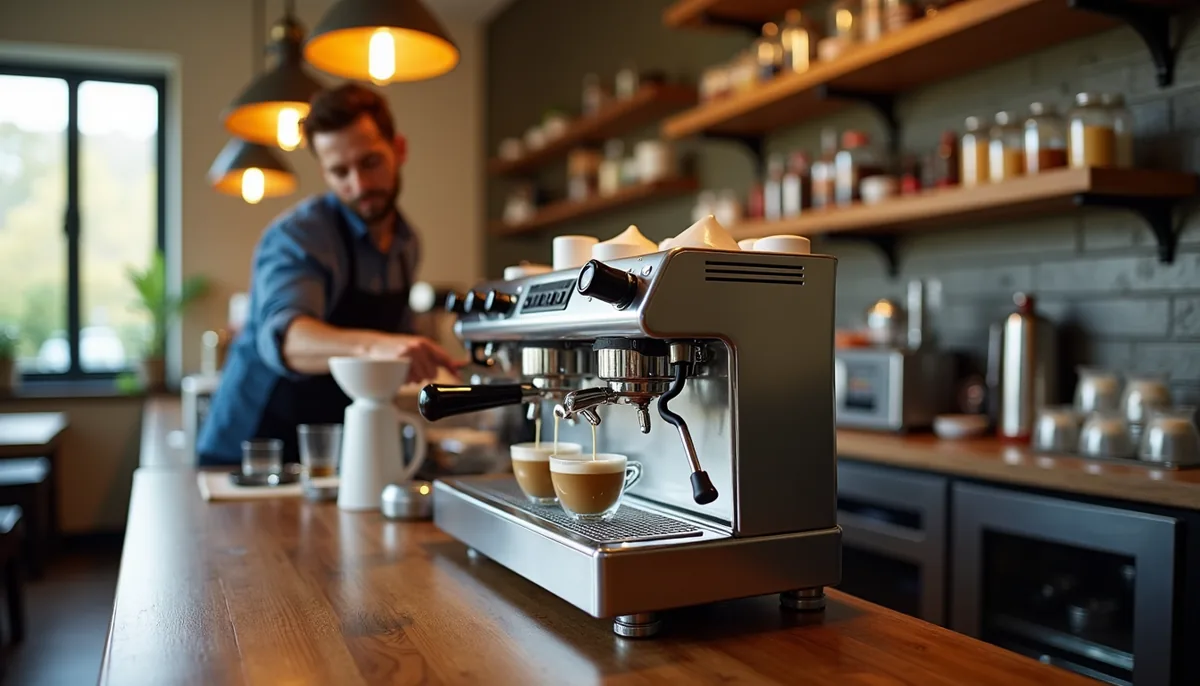
In short: If one person runs the bar and orders come in steadily, the single-group Ascaso Baby T Plus (350 mm wide, 2,400 W, 230 V plug-in) is enough. If two people need the machine at once during the rush, or espresso and milk run in parallel all morning, the two-group Barista T 2G Compact (560 mm, hardwired) is the safer choice.

| Design (both) | PID thermoblock per group plus a separate steam boiler, rotary pump |
|---|---|
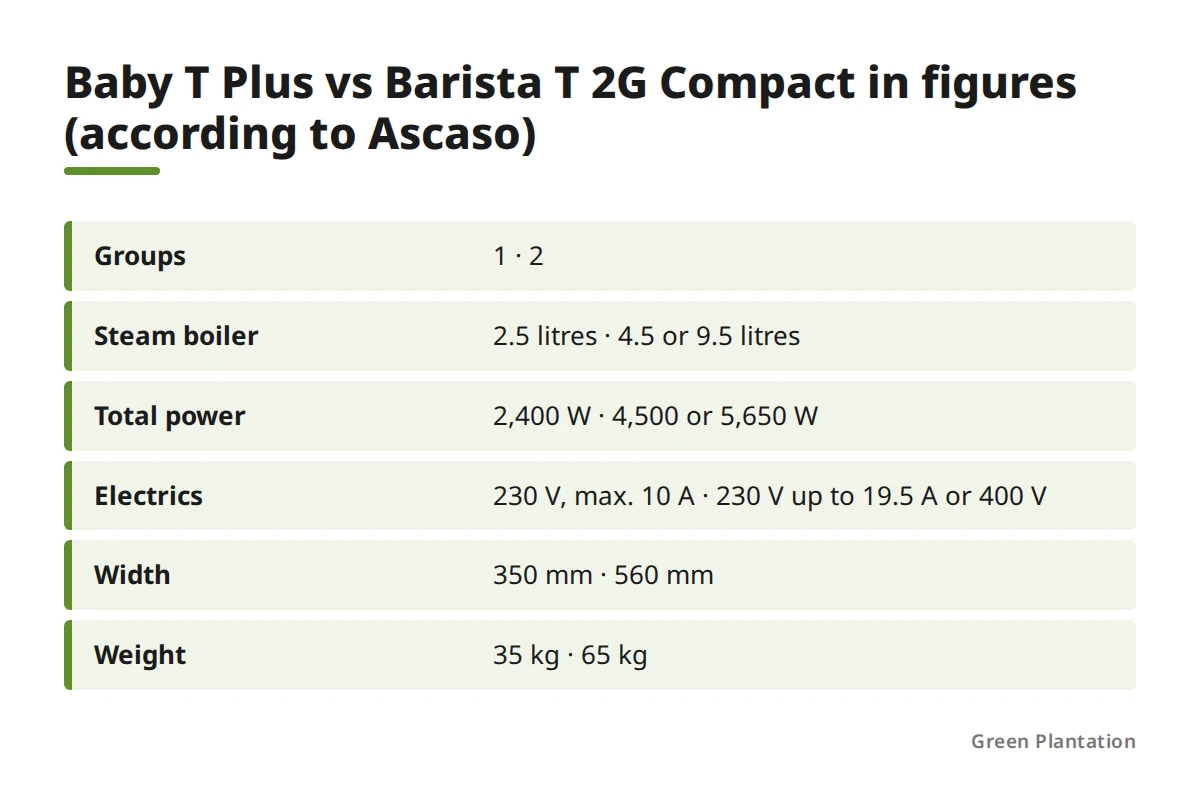
| Groups | Baby T Plus: 1 × 58 mm · Barista T 2G Compact: 2 × 58 mm |
| Steam boiler | 2.5 litres · 4.5 or 9.5 litres (Ascaso documents disagree) |
| Power | 2,400 W at 230 V · 4,500 or 5,650 W, 230 V single phase or 400 V three phase |
| Width / weight | 350 mm / 35 kg · 560 mm / 65 kg |
| Best for | coffee as a side line, coffee van, small café · café with two baristas on the bar |
One group or two: the question that actually matters
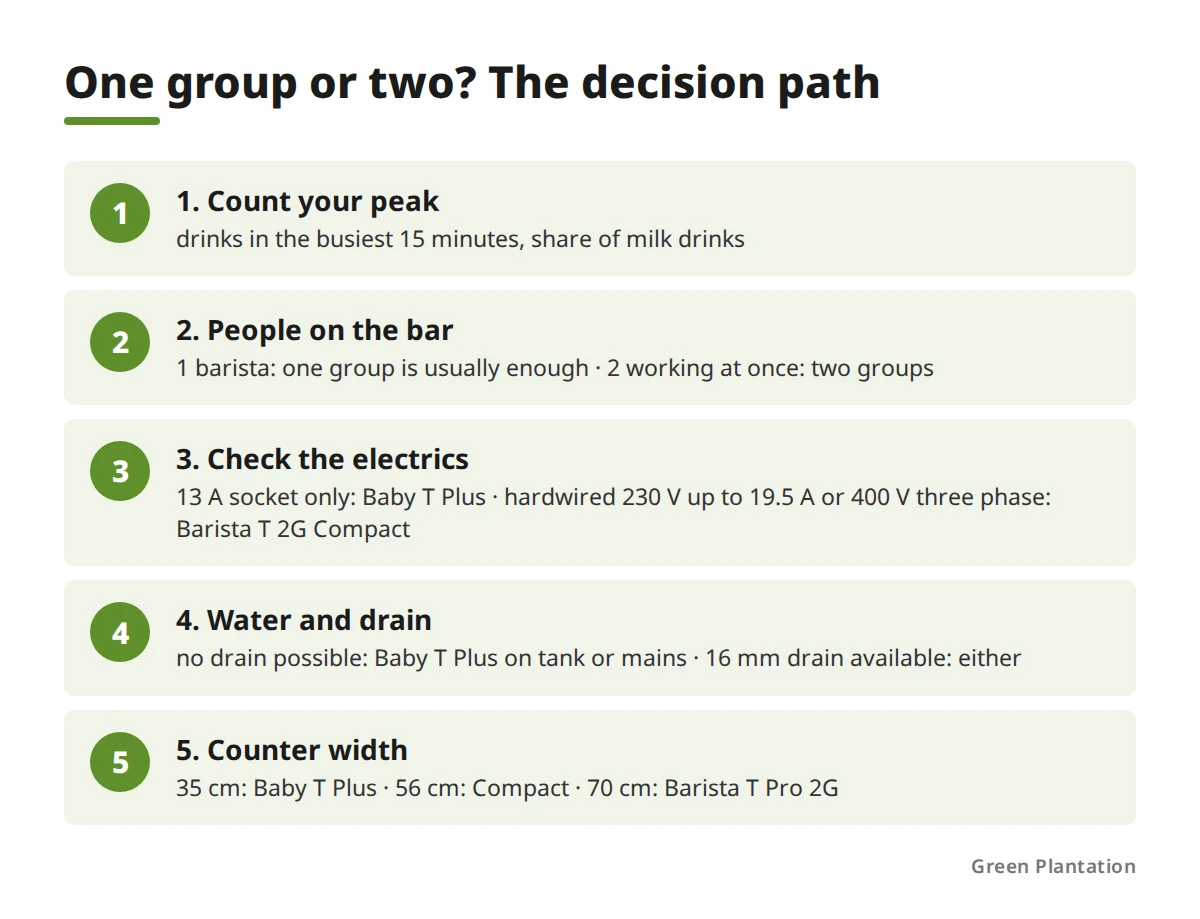
Start with the number of groups, not the brand. A group is the head your portafilter locks into, and adding a second one does not make better coffee. It lets you pull more shots at the same time. So for a small café the deciding figure is not daily sales but the peak: how many espressos, flat whites and lattes go out in your busiest 15 minutes, typically the commuter rush or the post-lunch wave?
Ascaso does not publish a cups-per-day rating for either machine, and any figure you see quoted elsewhere is a guess. For one week, count tickets per quarter hour and note how many are milk drinks; in a British café that is usually most of them.
Ascaso positions the two clearly. The Baby T Plus sits in its Commercial Collection and, according to Ascaso, suits small coffee shops and mobile catering. The Barista T range is aimed at cafés with medium to high footfall, and the Compact is its narrow two-group version. If you are still weighing up machine types in general, start with our guide on how to choose a professional coffee machine.
Inside the machines: same idea, different scale
Both machines use what Ascaso calls T technology. Each group has its own PID-controlled thermoblock, and a separate stainless steel boiler handles steam. Incoming water is preheated through a heat exchanger inside the steam boiler and brought to brew temperature in the thermoblock. It is not a true dual boiler, but you can brew and steam at the same time.
- Brew temperature: 80–110 °C in 0.1 °C steps on both; steam 110–165 °C.
- Pump: rotary pump, factory set to 9 bar.
- Dosing: four programmable volumetric doses per group, plus pre-infusion.
- Temperature stability: ±0.5 °C on the Baby T Plus. The datasheet gives ±1.5 °C for the Compact and ±0.5 °C for the other Barista T models.
The real differences are steam and power. The Baby T Plus has an insulated 2.5-litre boiler rated at 1,200 W and a 1,000 W group, 2,400 W in total at 230 V. The Compact is less clear-cut. The current technical datasheet on Ascaso's website lists a 9.5-litre boiler at 3,500 W and 5,650 W in total. The 2024 user manual and the 2025 manual both list 4.5 litres, 2,000 W and 4,500 W in total. Every document agrees on 2 × 1,000 W for the groups, 560 mm width and 65 kg.
The rating plate on the machine tells you which version you have. Ask your supplier to confirm boiler volume and electrical rating from the rating plate before you order, because both steam reserve and your electrical installation depend on it.
Espresso and milk at the same time: where the limits are
In a café the bottleneck is rarely the espresso; it is the milk. This is where the two machines differ most.
Baby T Plus: one steam wand (12 mm, cool touch, tips with 2, 3 and 4 holes) and one group. Brewing and steaming run in parallel because thermoblock and steam boiler are separate. Steam power is the strength owners mention most often. A German specialist retailer, in a detailed hands-on review, compares it with much larger machines and notes that pressure holds up during long steaming. One owner reports 180–200 ml of milk ready in about 20 seconds.
Barista T 2G Compact: two groups, and according to Ascaso the Barista T range has two steam wands plus a separate hot water outlet. Two people can work side by side without queuing for one wand. The larger boiler, whether 4.5 or 9.5 litres, gives more reserve for a run of cappuccinos.
One point is often missed. Both machines can limit how many heating elements run at once through a software setting (the CE parameter). The Baby T Plus ships at CE=2, which caps current draw at 10 A. On the Compact the manual gives a range from 6.5 A to 19.5 A at 230 V. The lower you set the limit, the fewer elements heat at the same time, and the more likely you are to notice slower recovery at the peak.
Electrics: 13 A plug or hardwired supply
The Baby T Plus runs on 230 V single phase. At the factory setting of 10 A maximum it stays within what a standard 13 A socket is rated for, ideally on its own circuit. The manual rules out extension leads and multi-way adaptors, and RCD protection is standard in any commercial premises anyway. Check with your supplier whether the machine arrives with a UK plug or needs one fitted.
The Barista T 2G Compact comes without a plug and is wired permanently to the supply with a main isolator. According to Ascaso it is available for 230 V single phase or 380/400 V three phase. On single phase the manual gives up to 19.5 A for the Compact, which is beyond any plug-in socket, so it needs a dedicated hardwired circuit installed by a qualified electrician to BS 7671. The standard two-group Barista T draws up to 24 A and needs a 25 A circuit. Many high street units already have three phase at the counter, while converted shops, kiosks and garden centre concessions often do not.
Counter space, cup height and grinders
| Dimension | Baby T Plus | Barista T 2G Compact | Barista T Pro 2G |
|---|---|---|---|
| Width | 350 mm | 560 mm | 700 mm |
| Height × depth | 450 × 430 mm | 460 × 565 mm (datasheet) or 550 × 465 mm (manual) | 475 × 535 mm |
| Weight | 35 kg | 65 kg | 71 kg |
| Max. cup height | not stated by Ascaso | 9 cm | 9 or 12 cm |
Each group needs a grinder within reach, plus a knock box and milk jugs. The Compact saves 14 cm of counter compared with a standard two-group, which is often exactly the space for a second grinder. Whether two grinders are worth it, for example one for the house blend and one for decaf, is covered in to have or not to have two grinders in your café.
Watch the 9 cm cup height on the Compact. Tall latte glasses and many takeaway cups will not fit under the spouts, so measure your cups before you order if takeaway is a big part of your trade. Counter height, workflow and where the customer stands also play a part; see where to place the coffee machine in a café.
Water supply, drainage and hard water
The Baby T Plus has a 2-litre tank and can be switched to mains water in the menu (the EP parameter); a flexible hose is included. A drain only comes with an optional kit (16 mm) and a matching drip tray. For café use, treat both as essential. One owner reports having to empty the tray and refill the tank after 15–20 drinks at a party.
The Barista T 2G Compact must be plumbed in from the start: a 3/8″ cold water supply with a shut-off valve and a 16 mm drain hose. The manual specifies mains pressure between 1 and 6 bar, with a pressure reducing valve above that, and a flow rate of 8 litres per minute.
For both machines Ascaso recommends total hardness of 70–100 ppm (as CaCO3), roughly 5–7 °Clark, with TDS of 90–150 ppm and a pH of 6.5–8. Much of London, the south east and east of England has hard to very hard water, while Scotland, Wales and parts of the north west are generally softer. Your water company publishes hardness by postcode, so check before you choose a filter. Note that, according to the manual, scale damage voids the manufacturer's warranty. A cartridge such as the Brita Purity C300 Quell ST on the mains feed is a requirement, not an extra. Cartridge or cabinet softener? The differences are explained in water softener for a coffee machine: filter cartridge vs cabinet softener.
Cleaning and maintenance during service
Cleaning time grows with the number of groups, not the size of the boiler. Following the Barista T manual, the routine looks like this:
- Daily: purge and wipe the steam wands after every jug and clean them with milk system cleaner at close; clean the drip tray and stainless panels; run the automatic group rinse (10 cycles of 10 seconds).
- Weekly: brush the shower screens and group gaskets, backflush with a blind basket and cleaning powder, then rinse with clean water for 30 seconds; soak portafilters and baskets.
- Depending on water hardness: have the steam boiler descaled and change the filter cartridge according to its litre counter.
The same applies to the Baby T Plus, just for one group. Owners who have used it for one to two years or longer report little work beyond the weekly group clean. One detail from a hands-on review: do not switch the steam boiler off, otherwise the preheated brew water loses 3–4 °C.
Ascaso only provides for repairs through its official service network. Buy from a supplier who can arrange service in the UK, and find out in advance who supplies gaskets and wear parts. The manual does not state the length of the Ascaso warranty; that is set by the seller, and your statutory rights apply regardless.
What owners report
For the Baby T Plus there is a reasonable body of feedback. We reviewed 87 relevant threads from r/espresso (2021–2026), 18 of them in detail, plus 174 comments from three threads and an extensive hands-on review by a German specialist retailer (2022):
- Steam power is praised in 5 sources and is the most frequently mentioned strength.
- Build quality described as tank-like and genuinely commercial: 3 threads.
- Consistent shots thanks to the rotary pump and volumetric dosing: 2 threads.
- Long term: 3 owners have used the machine for one to two years or more without a failure, against 1 case of an electrical fault after about two and a half years.
- Complaints: the app will not connect (4 mentions in 2 threads), a louder pump on earlier units (2 threads), a shallow drip tray, and the tank sensor reporting empty with 15–20 % of water still left (1 mention).
For the Barista T 2G Compact there is almost no independent feedback at all. Of 100 Ascaso posts on r/espresso, only 2 concern the Barista T and none the Compact, and we found no UK forum thread on it. That leaves Ascaso's own documents and the experience with the Baby T Plus, which uses the same technology. That read-across is an approximation, not a substitute for owner reports.
What to watch out for
- Check the rating plate: on the Compact, have boiler volume and power (4.5 litres / 4,500 W or 9.5 litres / 5,650 W) confirmed before you order.
- Baby T generation: the first version (2020–2021) had a smaller drip tray, a louder pump and a slower thermoblock. These still turn up second hand.
- Do not mix up the variants: the Baby T One cannot be plumbed in and the older Baby T Zero has a vibration pump. For a café the Plus (or the Flow with its flow control paddle) is the right version.
- Warm-up time: the Baby T Plus group is ready in about 5 minutes, but the manual gives 20–22 minutes for the steam boiler. For the Barista T, Ascaso quotes espresso readiness in about a minute. Plan your switch-on time before opening or use the programmable standby.
The decision at a glance
| Criterion | Baby T Plus | Barista T 2G Compact |
|---|---|---|
| Groups | 1 × 58 mm | 2 × 58 mm |
| Baristas working at once | 1 | 2 |
| Steam wands | 1 × 12 mm | 2 (Barista T range) |
| Steam boiler | 2.5 litres, 1,200 W | 4.5 litres / 2,000 W (manual) or 9.5 litres / 3,500 W (datasheet) |
| Total power | 2,400 W | 4,500 or 5,650 W |
| Electrics | 230 V, max. 10 A as supplied | 230 V (up to 19.5 A) or 400 V three phase, hardwired |
| Water | 2-litre tank or mains, drain optional | mains only, 3/8″, 16 mm drain |
| Width / weight | 350 mm / 35 kg | 560 mm / 65 kg |
| Independent owner feedback | plenty (87 threads, hands-on review) | very little (none on the Compact) |
| Suits | coffee as a side line, coffee van, farm shop, small café with one barista | small café with real rushes and two people on the bar |
If you are looking beyond the Compact: the Barista T Pro 2G is the full 700 mm two-group with insulated groups and pipework and a 4.2″ touchscreen. Ascaso positions the Pro for speciality cafés, competitions and training rooms. For everything else you need to budget for at opening, see what you need to set up a café.
Verdict
The Baby T Plus is not a home machine with a commercial label. It is a compact professional machine with strong steam that runs from an ordinary 230 V supply. With one barista and manageable peaks, it is the leaner solution. The Barista T 2G Compact earns its place once two people have to work at the same time and the counter will not take 70 cm. In return you need a hardwired supply, a drain, possibly three phase, and you should resolve the conflicting boiler and power figures before you buy.
Frequently asked questions
What is the best commercial coffee machine for a small café?
The one that matches your peak. With one barista, a strong single-group machine such as the Baby T Plus is often enough; with two people on the bar at busy times, a two-group such as the Barista T 2G Compact.
Does a commercial espresso machine need three-phase power?
Not necessarily. The Baby T Plus runs on 230 V single phase. The Barista T 2G Compact is available for 230 V single phase (up to 19.5 A, hardwired) or 400 V three phase.
Is the Ascaso Baby T Plus a dual boiler?
No. It has a PID thermoblock for the group and a separate 2.5-litre steam boiler. In practice it works much like a dual boiler, because you can brew and steam at the same time.
What cup height fits under the machine?
Ascaso gives a maximum of 9 cm for the Barista T 2G Compact and 9 or 12 cm for the Barista T Pro 2G. No figure is published for the Baby T Plus, so measure your tallest cup against the machine.
Can the Baby T Plus be plumbed in?
Yes. The Plus can be switched from tank to mains water in the menu, and the hose is included. A direct drain needs an optional kit with a matching drip tray. The One and Zero versions cannot be plumbed in.
Recommended products
- Ascaso Baby T Plus Dark Black – the single-group option for small businesses, with strong steam on a 230 V supply; also available in Cloud White and Fresh Pistachio.
- Ascaso Barista T 2G Compact Black – two groups in 56 cm when two people need to work at once.
- Ascaso Barista T Pro 2G Black – the full-size two-group with touchscreen and insulation, if your counter has 70 cm to spare.
- Mahlkönig E65S GbW – grind-by-weight espresso grinder built for café volumes, a good match for either machine.
- Brita Purity C300 Quell ST – filter cartridge for the mains feed, to keep hard water out of the boiler.
Sources
- Ascaso: Baby T Plus
- Ascaso: Baby T user manual (MAN.36, 2023)
- Ascaso: Barista T
- Ascaso: Barista T technical datasheet incl. Compact
- Ascaso: Barista T manuals 2024/2025
Updated: November 2026
Author: Petra Novotná, editorial name of the Green Plantation.
You might also like
 Best Espresso Machine Under €1,500: Single Boiler, HX or Dual Boiler?
Single boiler, thermoblock, heat exchanger or dual boiler: which design under €1,500 suits the way you drink coffee, with figures for boilers, warm-up and… 24. 11. 2026
 Bean-to-cup vs espresso machine: which suits your daily routine?
Bean-to-cup or a traditional espresso machine with a portafilter? A practical decision guide based on your daily routine, time per cup, coffee dose and the… 24. 11. 2026
 Manual Espresso Maker: Flair 58 vs 9Barista (plus La Pavoni and Picopresso)
Hand lever with kettle water or steam on the hob: the Flair 58 and 9Barista compared, with the La Pavoni Europiccola and Wacaco Picopresso as alternatives and… 24. 11. 2026