
 Česky (CZK)
 Slovensky (EUR)
 Magyar (HUF)
 Polski (PLN)
 English (EUR)
 Deutsch (EUR)
 Français (EUR)
 Español (EUR)
 Português (EUR)
 Italiano (EUR)
 Svenska (SEK)
 Suomi (EUR)
 Nederlands (EUR)
 Dansk (EUR)
 Lëtzebuergesch (EUR)
 Eesti (EUR)
 Latviešu (EUR)
 Lietuvių (EUR)
 Slovenščina (EUR)
 Română (RON)
 Български (EUR)
 Hrvatski (EUR)
 Ελληνικά (EUR)
 Українська (EUR)
 Norsk (EUR)
 Srpski (EUR)
 Tiếng Việt (EUR)
Ascaso Dream vs Steel DUO: Dream ONE, Dream PID or Steel DUO?
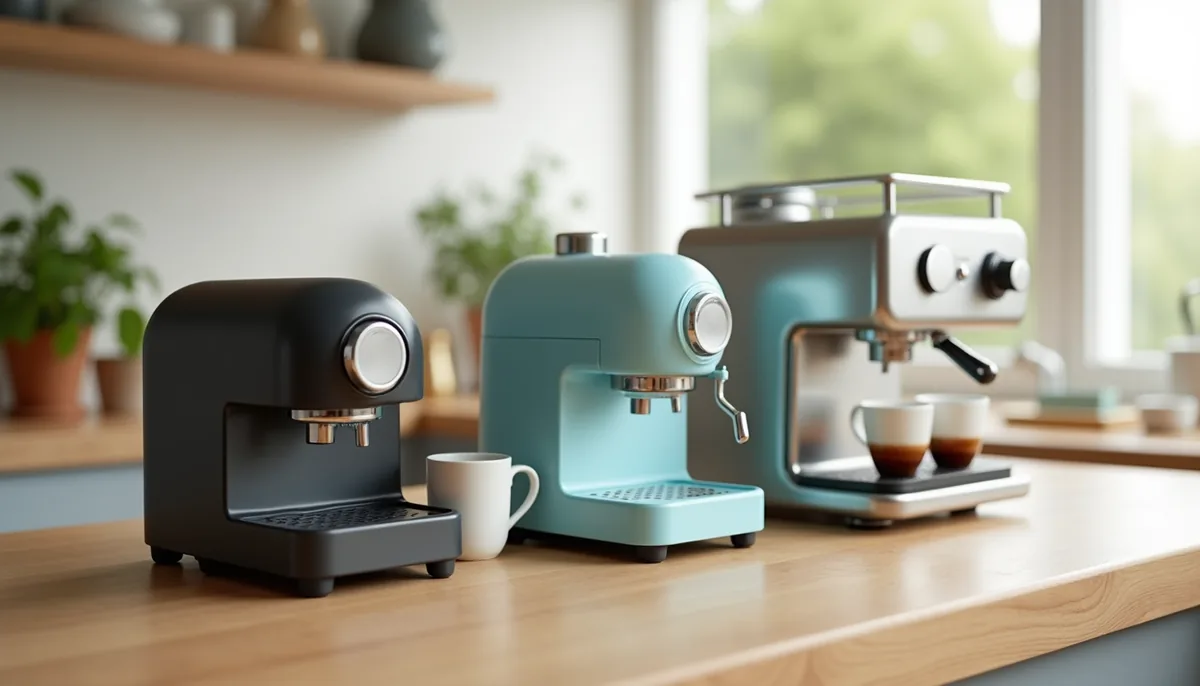
In short: Drink mostly espresso and want it simple? The Dream ONE does the job. Want to tune brew temperature, pre-infusion and shot volume? Choose the Dream PID. Making two or three milk drinks back to back every morning? The Steel DUO, with a separate steam thermoblock, is the one.



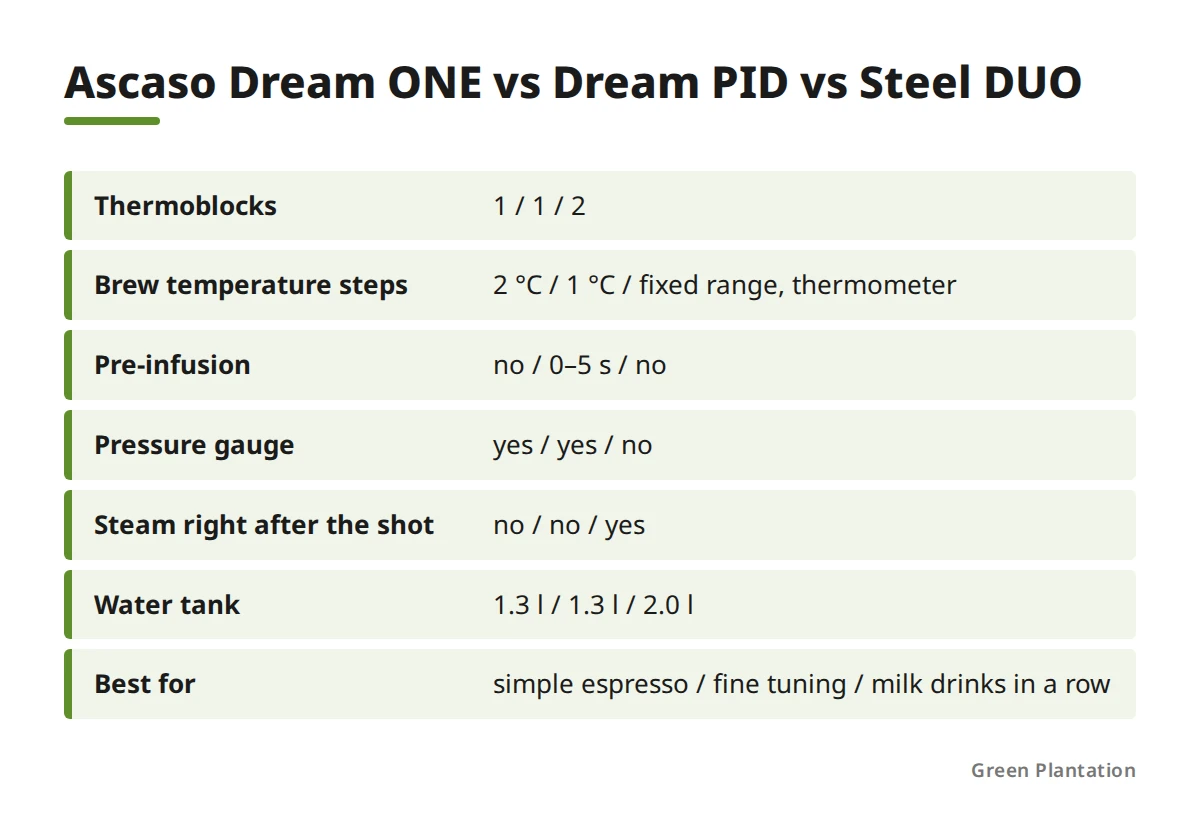
| Dream ONE | 1 thermoblock, brew 90–106 °C in 2 °C steps, steam fixed at 165 °C, pressure gauge, 1.3 l tank, 1,050 W |
|---|---|
| Dream PID | 1 insulated thermoblock, brew 80–110 °C in 1 °C steps, steam 110–165 °C, pre-infusion 0–5 s, 2 volumetric doses, pressure gauge |
| Steel DUO (standard) | 2 thermoblocks (brew and steam separate), electronic control with thermometer, no PID display, 2.0 l tank, 2,068 W |
| All three | Vibration pump, working pressure 9–12 bar set by an adjustable OPV, Ascaso portafilters rather than E61, no plumb-in |
| Biggest difference | On both Dreams you switch between coffee and steam and wait; on the Steel DUO you do not |
Dream or Steel: the question is really about milk
Most "Ascaso Dream vs Steel Duo" results are forum threads or pages about the Steel DUO PID and Plus. Few start with the question that decides it: how many milk drinks do you make in a row?
All three machines come from Ascaso in Barcelona, all three heat water in thermoblocks rather than boilers, and all three use a vibration pump with an over-pressure valve (OPV) you can adjust. Where they differ is control over temperature, and what happens after the shot when you want to steam milk. If you are new to the brand, our piece on Ascaso coffee machines and their colours gives the background.
This comparison covers the three models we sell: the Dream ONE, the Dream PID and the Steel DUO in its standard version without a PID display. Figures come from Ascaso's website, brochures and manuals; where those sources disagree, we say so.
Specifications side by side
| Manufacturer data | Dream ONE | Dream PID | Steel DUO (standard) |
|---|---|---|---|
| Heating | 1 thermoblock | 1 insulated thermoblock, PID | 2 thermoblocks: brew, steam and hot water |
| Brew temperature | 90–106 °C in 2 °C steps, no display | 80–110 °C in 1 °C steps, on display | electronic control, front thermometer (80–110 °C range in coffee mode per manual) |
| Steam | fixed 165 °C | 110–165 °C in 1 °C steps | separate thermoblock, ready in about 1.5 minutes |
| Brew and steam at once | no | no | yes |
| Pre-infusion | no | 0–5 s in 1 s steps | no |
| Volumetric doses, shot timer | no | 2 doses, timer, counters | no |
| Pressure gauge | yes | yes | no (thermometer instead) |
| OPV | adjustable from outside | adjustable from outside | adjustable, with a blind basket |
| Water tank | 1.3 l, side loading | 1.3 l, side loading, illuminated | 2.0 l |
| Power | 1,050 W | 1,100 W | 2,068 W |
| Size (W × H × D) | 24.5 × 34.5 × 28 cm | 24.5 × 34.5 × 28 cm | 27 × 36 × 31.5 cm |
| Weight | 10 kg | 10 kg | 15 kg |
| Auto stand-by | no | 0.5, 1 or 2 h | after 2 h without use |
| Body | aluminium, 9 finishes | aluminium, 9 finishes, walnut handles | steel, stainless water path (AISI 316) |
A few inconsistencies in Ascaso's own documents are worth knowing about. For the Dream, the website speaks of a "single thermoblock", the 2025 brochure of an "insulated dual thermoblock", and the manual of an exchanger with stainless steel ducts. In practice coffee and steam share one circuit on both Dreams, which the manual's switching routine confirms. The website lists a 58 mm portafilter, while the 2022 manual still gives 60 mm, and older Dream generations (Zero, UP, MF) used 57 mm. Ascaso publishes no heat-up time for the Dream; owners call it quick.
One correction to a claim you will see repeated online: the Dream ONE is not a stripped-down machine without a gauge. According to Ascaso's comparison page and the MAN.29 manual, it has the same pressure gauge, the same externally adjustable OPV and the same backflush routine as the Dream PID. What it lacks is the display, the fine temperature steps and the shot tools.
Milk drinks: where the three split
A thermoblock heats water as it flows through. Both Dreams have one heating circuit, so steam is a separate mode: you pull the shot, switch to steam, wait for the light to settle, froth, and then bring the thermoblock back down before the next shot. The manual suggests waiting about five minutes or running water through the steam wand to cool it faster.
The Steel DUO has a second thermoblock just for steam and hot water. You pull the shot, flick the steam switch, and texture milk straight away. For three cappuccinos before school, that is the whole point of the DUO.
| Two flat whites | Dream ONE / Dream PID | Steel DUO |
|---|---|---|
| Shots | pull both shots first | pull a shot |
| Steam | switch to steam, wait for the light | steam switch on, steam side already hot |
| Next shot | switch back, purge water or wait about 5 minutes | straight away |
| Comfortable for | 1–2 milk drinks at a time | several milk drinks in a row |
Steam switches off after three minutes of continuous use, and Ascaso advises not to heat milk above 75 °C. On the Dream PID you can also lower steam temperature to as little as 110 °C, which gives slower, wetter steam and more time to learn latte art in a small jug. Steam power on the Dreams is a split topic among owners: some find it fine for one or two drinks, others call it weaker than a boiler machine and the single-hole tip small.
Temperature control: when the Dream PID earns its keep
For a medium or darker espresso blend, the electronic control of the Dream ONE and the standard Steel DUO is enough. You find a setting that tastes right and leave it. A sensible starting point on any of the three: 18 g of coffee in, 36–40 g out in 25–30 seconds, at around 9 bar on the gauge.
The Dream PID goes further. You set brew water in 1 °C steps from 80 to 110 °C, so you can drop to about 88 °C for a dark Italian blend or go up to 95 °C for a light Nordic roast. Pre-infusion of up to five seconds wets the puck before full pressure arrives and helps against channelling with fine grinds; our article on preinfusion of espresso explains the theory. Two volumetric doses and a built-in timer stop the shot for you once you have dialled in. Note that Ascaso quotes the same ±1.5 °C stability for the ONE and the PID, so the PID's advantage is finer steps and a wider range, not tighter stability. If PID regulation is new to you, read whether a home coffee machine needs PID control.
The Dream ONE has one practical advantage over the standard Steel DUO here: the pressure gauge. You see straight away whether the grind is too coarse or too fine. On the standard DUO you judge by time and taste, and to set the OPV you need a portafilter pressure gauge.
Which Steel DUO? Check the version before you compare
This is the gap in most English comparisons. US retailers and YouTube channels usually compare the Dream PID with the Steel DUO PID (now in its third version) or the Steel DUO Plus. Those machines add a display, PID temperature control, pre-infusion, a shot timer and a pressure gauge.
The Steel DUO on our product page is, according to its listing, the standard version described in Ascaso's manual for the Steel range: the same steel body and two thermoblocks, but electronic temperature control with a thermometer and no PID display. Reviews of the PID versions are useful for build quality, steam and footprint; they do not tell you anything about temperature adjustment or pre-infusion on the standard DUO, because it has neither. If you are not sure which version you will receive, ask us before ordering. US threads about 15 A versus 20 A circuits concern the American Plus model and do not apply in the UK.
Space, power and a UK kitchen
Both Dreams are 24.5 cm wide and 28 cm deep, so they fit on a narrow worktop and under most wall cupboards. The Steel DUO needs 27 × 31.5 cm and weighs 15 kg, which keeps it planted when you lock in the portafilter.
At 2,068 W the DUO draws roughly 9 A at 230 V, so a standard 13 A socket is fine, but avoid sharing an extension lead with a kettle. The Dream PID and the Steel DUO have an automatic stand-by; on the Dream ONE, switch it off yourself.
All three use an audible vibration pump; on the DUO it also pulses while steaming, which the manual describes as normal. None can be plumbed in.
Cleaning, descaling and hard water
The routines are almost identical, which makes the decision easier:
- Backflush weekly with the blind basket: about 10 seconds of pump, twice.
- Clean the shower screen every 80–100 espressos with warm water and a mild detergent.
- Descale monthly at more than 10 coffees a day, every two months at 5–10, every three months at 1–5.
The Steel DUO's steam unit also has its own cleaning mode, started with a switch combination at power-on. Thermoblocks have narrow channels, and owners point to scale as one of the main causes of failures. London and much of the south and east of England have hard water, so use a filter jug, an in-tank filter or low-mineral bottled water from day one. Our guide on how to tell if water is ruining your coffee machine shows the warning signs.
What owners report
UK reviews of these machines are scarce, so we summarised international samples: 79 Reddit threads about the Dream range from 2025 and 2026, and 85 r/espresso threads about the Steel DUO from 2020 to November 2026, plus a smaller German sample. Most Steel DUO posters own the PID version. Forums attract questions and problems, so the counts are indicative, not a survey.
- Both ranges: quick heat-up is the most repeated praise, together with espresso clearly better than from entry machines such as the Sage Bambino or Barista Express.
- Dream: around 38 threads discuss steam and milk, with split opinions; around 30 deal with repairs or leaks, but a large share concern older second-hand MF and UP machines. Small drip tray and tank are the everyday niggles.
- Steel DUO: owners praise strong steam and no waiting between shot and milk. Faults appear in 9 of the 85 English threads: the steam side stops steaming or steams wet, pressure jumps, or a steam thermoblock or relay fails; one steam block was fully blocked by scale. Owners also say the inside is tightly packed.
- Buying advice: 47 of the 85 Steel DUO threads and around 50 of the Dream threads are purchase questions, often weighed against compact dual boilers. Three Dream owners describe moving on to a heat exchanger or dual boiler purely for milk.
Which Ascaso should you buy?
Dream ONE if you drink mostly espresso or one milk drink at a time, stick to one or two blends and want the gauge without menus. Dream PID if you switch between light and dark roasts, want pre-infusion and a timer, and still drink mostly espresso or flat whites one by one. Steel DUO if milk is the centre of your routine and you want brew and steam without switching. If you want both a PID and two circuits, you are looking at the Steel DUO PID or a boiler machine; our comparison of two boilers versus a heat exchanger explains the next step up.
Whichever you choose, budget for an espresso grinder with fine adjustment. On all three, the grinder decides more about flavour than the machine.
Ascaso Dream vs Steel DUO: FAQ
Is the Ascaso Steel DUO better than the Dream?
Not for espresso alone. It is better for milk drinks in a row, because the steam thermoblock is separate. The Dream PID gives more control over the shot itself.
Does the Ascaso Dream ONE have a pressure gauge?
Yes. According to Ascaso, both the Dream ONE and the Dream PID have a pressure gauge and an OPV adjustable from outside, and both can be backflushed.
Can you steam and brew at the same time on the Ascaso Dream?
No. Both Dreams share one heating circuit. After steaming, purge water through the wand or wait about five minutes before the next shot.
Is the Steel DUO a dual boiler?
In use it behaves like one, but technically it has two thermoblocks, not boilers. That is why it heats up quickly and holds little hot water.
Do Dream and Steel DUO accessories fit E61 machines?
No. Ascaso uses its own portafilters and baskets. Measure your basket before buying a tamper or bottomless portafilter; older Dreams use 57 mm, current ones are listed at 58 mm.
Recommended products
- Ascaso Dream ONE Dark Black: the simplest way into Ascaso, with a gauge and adjustable OPV.
- Ascaso Dream ONE Kid Blue: the same machine in one of the Dream's signature colours.
- Ascaso Dream PID Dark Black: 1 °C steps, pre-infusion and volumetric doses for espresso-first home baristas.
- Ascaso Steel DUO: two thermoblocks for milk drinks without waiting.
- Eureka Mignon Specialita 15BL: a quiet stepless espresso grinder that suits any of the three.
Sources
- Ascaso: Dream PID and Dream ONE comparison
- Ascaso: Dream PID / ONE manual MAN.29 V10 (PDF)
- Ascaso: Dream technical brochure 2025 (PDF)
- Ascaso: Steel / Steel PID user manual (PDF)
- Ascaso: Steel range
Updated: November 2026
Author: Petra Novotná, editorial name of the Green Plantation.
You might also like
 Eureka Atom Pro review: experience, tech and limits of the 75 mm filter grinder
The Eureka Atom Pro is a filter grinder with 75 mm brew burrs and a Blow-Up bellows. Who it is worth it for, how to set it up and why it is not an espresso… 26. 11. 2026
 Eureka Costanza Review: HX Machine with PID, Costanza R and Owner Experiences
The Eureka Costanza is a compact E61 heat exchanger machine with PID and a shot timer. We clear up the dual boiler myth, explain how it differs from the… 26. 11. 2026
 Grind-by-Weight Coffee Grinders: Eureka Atom W 65, Atom W 75 or Mahlkönig E65S GbW? 2026 Comparison
Comparison of the Eureka Atom W 65, Atom W 75 and Mahlkönig E65S GbW grind-by-weight grinders: dose accuracy, speed, step-by-step calibration and a calculation… 26. 11. 2026