Česky (CZK)
 Slovensky (EUR)
 Magyar (HUF)
 Polski (PLN)
 English (EUR)
 Deutsch (EUR)
 Français (EUR)
 Español (EUR)
 Português (EUR)
 Italiano (EUR)
 Svenska (SEK)
 Suomi (EUR)
 Nederlands (EUR)
 Dansk (EUR)
 Lëtzebuergesch (EUR)
 Eesti (EUR)
 Latviešu (EUR)
 Lietuvių (EUR)
 Slovenščina (EUR)
 Română (RON)
 Български (EUR)
 Hrvatski (EUR)
 Ελληνικά (EUR)
 Українська (EUR)
 Norsk (EUR)
 Srpski (EUR)
 Tiếng Việt (EUR)



Coffee Lexicon – A to Z
Kávový lexikón – od A do Z
Coffee Lexicon – A to Z
Coffee has its own language. Whether you're browsing a café menu, reading a bag of specialty beans, or calibrating your grinder, you constantly encounter technical terms – from acidity through channeling to yield. This lexicon is your guide through the world of coffee terminology. We've compiled over 100 terms arranged alphabetically with clear explanations for both beginners and experienced baristas.
A
Acidity (acidity)
One of the key evaluation criteria in cupping. It's not an unpleasant sourness – quality acidity evokes lemon, apple, cranberry, or tropical fruit and gives coffee liveliness and complexity. High acidity is typical of light roast filter coffee from high elevations (Ethiopia, Kenya, Colombia). Conversely, darker roasting and lower altitudes mute acidity.
AeroPress
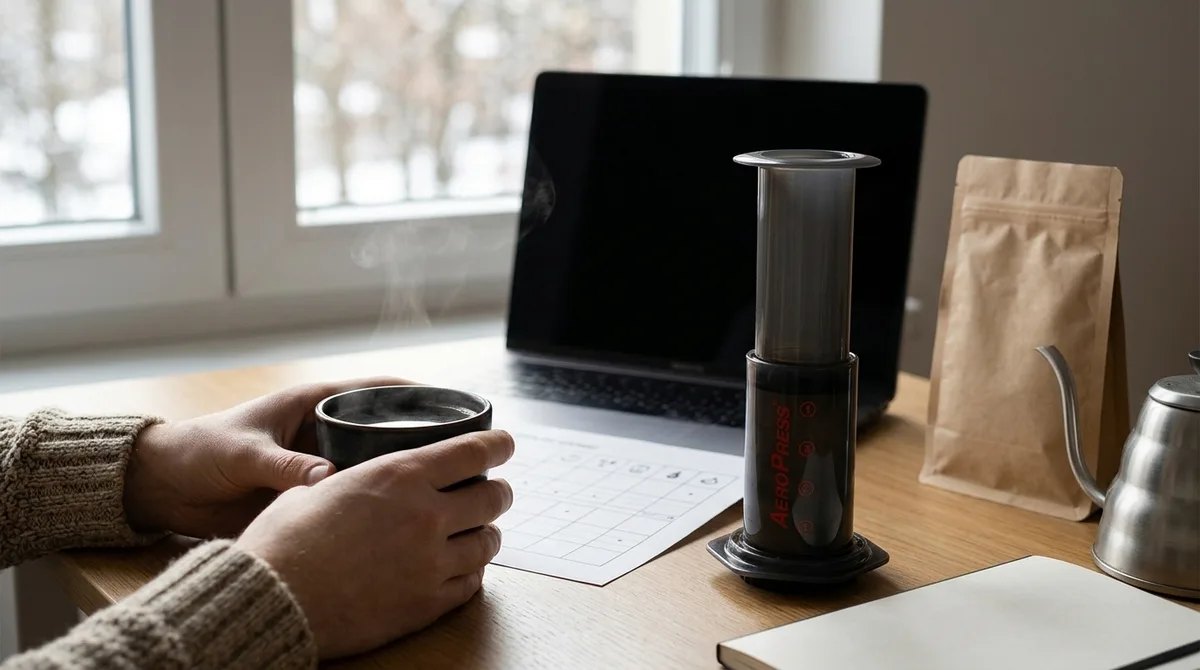
An immersion-pressure coffee maker invented by Alan Adler in 2005. It combines the principle of a French press (steeping) with gentle pressure. Compact, durable, and remarkably versatile – it enables hundreds of recipes from espresso-style to bright filters. A complete guide can be found in the article AeroPress – Brewing Methods.
Affogato
An Italian dessert on the border between drink and sweet – a scoop of vanilla ice cream topped with a single shot of espresso. Hot, concentrated coffee contrasts with cold sweetness. Best flavor results are achieved with intensely roasted arabica.
Americano (Caffè Americano)
Espresso diluted with hot water. According to legend, it was created during World War II when American soldiers in Italy diluted espresso to approximate filter coffee. A typical ratio is 1:3 to 1:5 (espresso : water). Unlike a long black, water is added to the espresso, not vice versa.
Arabica (Coffea arabica)
The most widespread botanical species of coffee plant – comprises approximately 60% of global production. It grows at altitudes of 800–2,200 m a.s.l. in the tropical coffee belt. It's characterized by a finer flavor, higher acidity, and lower caffeine content (1.2–1.5%) compared to robusta. All specialty coffees come from arabica.
Atago
A Japanese manufacturer of refractometers used to measure TDS (Total Dissolved Solids) in coffee. The PAL-COFFEE model is an established standard in commercial cafés and among advanced home baristas.
B
Backflush (backflushing)
An essential cleaning process for lever coffee machines. A blind basket is inserted into the portafilter and the pump is activated – water forced against a closed path flushes the shower screen and three-way solenoid. It's performed with cleaning chemicals (Cafiza, Puly Caff) or water alone. Frequency depends on usage intensity. Details in the article Cleaning and Maintenance of Coffee Machines.
Barista
A coffee preparation specialist – originally an Italian term for a bartender. In the modern sense, a professional skilled in espresso, milk steaming, latte art, and sensory coffee evaluation.
Bloom (blooming)
The first phase in pour-over methods – a small amount of water (two to three times the weight of coffee) moistens the ground coffee and releases CO2 accumulated during roasting. The grounds visibly "bloom" – bubble and swell. Typically wait 30–45 seconds. The fresher the coffee, the more dramatic the bloom and the greater the potential for aroma in the final drink.
Body (body)
The tactile sensation of coffee in the mouth – from light and tea-like (typically washed, light roasts) to full and creamy (natural, darker roasts). Body is determined by dissolved oils, sugars, and colloids. Paper filters trap most oils, metal ones let them through – which is why French press has more pronounced body than V60.
Brew ratio (brew ratio)
The weight ratio of ground coffee to water. For espresso typically 1:2 (e.g., 18 g coffee → 36 g beverage). For filter 1:15 to 1:17 (e.g., 15 g coffee → 250 g water). Consistent results require precise weighing on quality digital scales.
Burr (burr)
The grinding element in quality grinders. Two metal or ceramic disks with sharp teeth grind beans into even particles. Flat burrs produce bimodal distribution and cleaner taste; conical burrs have more pronounced body and are quieter. Detailed information in the grinder guide.
C
Café crème
A larger espresso beverage popular in Switzerland and Germany – a larger volume of water flows through the coffee puck, resulting in approximately 120–150 ml. Gentler than espresso yet still stronger than americano.
Cappuccino
A classic Italian milk drink: 1/3 espresso, 1/3 steamed milk, 1/3 foam. Traditional size is 150–180 ml. Served in a ceramic cup; the foam should be drier and firmer than in latte – allowing for distinctive latte art.
Cascara
The dried husk and flesh of the coffee cherry – a byproduct of wet processing. Steeped in hot water like tea, the result has a sweet, fruity taste with notes of rose hips, cranberries, and tamarind. Popular in Yemen and Ethiopia under the name qishr.
Channeling
An undesirable phenomenon in espresso extraction – water finds its way through cracks or unevenness in the coffee puck and seeps through them instead of flowing evenly through the entire volume. The result is sour, watery, and unbalanced espresso. Causes: uneven tamping, clumps in ground coffee, improper dose. Prevention lies in proper distribution (WDT, distributor) and even tamping. Barista tools effectively help prevent channeling.
Chemex
An iconic glass pour-over coffee maker with a thick paper filter. Invented in 1941 by chemist Peter Schlumbohm and unchanged in design to this day. The thick filter traps virtually all oils – the result is remarkably clean and delicate. Complete guide: Chemex – Step-by-Step Brewing.
Cold brew
Coffee extracted with cold or room-temperature water over 12–24 hours. Slow extraction produces a smooth, sweet concentrate with low acidity and less bitter taste. Recommended ratio for concentrate is 1:5 to 1:8 (coffee : water). Detailed instructions: Cold Brew and Iced Coffee.
Cortado
Espresso with an equal amount of steamed milk (1:1 ratio). Originating from Spain, where it's served in a small glass (4–5 oz). The milk only softens the espresso's acidity without significantly diluting it.
Crema
The golden-brown foam on the surface of espresso. Forms from the emulsification of oils and CO2 under high pressure. Fresh, properly extracted coffee produces dense, stable crema with darker streaks (tiger stripes). Crema, however, is not an automatic quality indicator – dark roasted or robusta coffee produces it abundantly even with problematic extraction.
Cupping
A standardized SCA protocol for sensory coffee evaluation – coarse grinding, hot water infusion, evaluation of fragrance/aroma, taste, acidity, body, aftertaste, and overall impression. Used by Q graders, roasters, and farmers for lot selection and quality control. Details: Cupping – How to Properly Evaluate Coffee.
D
Degassing (degassing)
The process of releasing CO2 from freshly roasted coffee. Most intense during the first 24–72 hours after roasting, but continues for 1–3 weeks. Espresso is optimally prepared 7–21 days after roasting and filter 5–14 days. Too-fresh coffee produces uncontrolled bloom and uneven extraction. A one-way valve on the bag allows CO2 to escape without oxygen entering.
Distribution (distribution)
Even distribution of ground coffee in the portafilter before tamping. Key prevention against channeling – clumps and channels must be broken up before the puck is compressed. Tools: WDT tool (fine needles), rotary distributor, dosing funnel. Available in the barista supplies section.
Dose (dose)
The weight of ground coffee used for one preparation. For a single espresso typically 7–9 g, for double 14–20 g (depends on basket size). For pour-over, the dose depends on desired volume and brew ratio – at 1:16 ratio, it's 15 g per 240 g water.
Drip coffee
Hot water filtration through ground coffee by gravity. The basic principle of drip machines (Moccamaster, Technivorm) as well as manual pour-over methods. Simple, repeatable, and capable of excellent results.
Dry process
See Natural process – a coffee processing method in which the entire cherry is dried in the sun or on raised beds without first removing the fruit.
Dzezva (cezve, ibrik)
A traditional vessel for preparing Turkish coffee – small, conical, with a long handle. Made from copper, brass, or stainless steel. Proper technique involves slow heating in sand or over low flame. Guide: Dzezva and Turkish Coffee.
E
Espresso
A concentrated coffee beverage made by forcing hot water (90–96 °C) through finely ground coffee at 8–10 bar pressure. Standard double shot: 14–20 g coffee → 28–40 g beverage in 25–35 seconds. It's the foundation for cappuccino, latte, americano, and dozens of other drinks. Complete guide: Espresso at Home.
Extraction (extraction)
The process of dissolving aromatic compounds from ground coffee into water. Ideal extraction per SCA is 18–22%. Under-extracted coffee (< 18%) is sour and watery because sweetness and complexity extract later. Over-extracted (> 22%) is bitter and astringent. Extraction is influenced by grind fineness, water temperature, time, brew ratio, and agitation. Measured precisely with a refractometer.
F
Filter coffee
Coffee prepared by gravity flow of hot water through ground coffee and a paper, metal, or cloth filter. Includes pour-over methods (V60, Chemex, Kalita Wave), drip machines (Moccamaster), and lesser-known methods like syphon. For optimal results, choose a lighter roast whole bean coffee for filter.
Flat white
Espresso with smoothly steamed milk and minimal foam layer – less foam than cappuccino but with a more pronounced espresso component. Originated in Australia or New Zealand (1980s). Typical volume 150–180 ml.
Flow rate (flow rate)
The speed of water flowing through the coffee puck during extraction. In espresso, it's determined by grind fineness, tamping, and dose – too fast indicates under-extraction, too slow indicates over-extraction. In pour-over it depends on pouring speed, dripper opening size, and grind coarseness.
French press (cafetière)
An immersion method – ground coffee steeps in hot water for 4 minutes, then a metal mesh piston is slowly pressed down. The metal filter allows oils and fine particles through, resulting in full body and pronounced flavor. Guide: French Press – Complete Instructions.
G
Geisha (Gesha)
A rare arabica variety originally from the Geisha forest in Ethiopia, which became famous on the Panamanian Hacienda La Esmeralda plantation in the early 2000s. Characterized by intense floral and citrus profile – jasmine, bergamot, peaches, ylang-ylang. At auction it reaches prices over $1,000/kg, making it one of the world's most expensive coffees. Selection of Geisha coffee.
Green coffee (green coffee)
Raw, unroasted coffee beans with a greenish to blue-green color and grassy aroma. Chemically stable – with proper storage (dark, dry, stable temperature) they last 6–12 months without significant quality loss. For home roasting enthusiasts: green coffee. More in the article Home Roasting – Coffee Roasting at Home.
Grind size (grind size)
The size of coffee particles after grinding, directly determining extraction speed. From extra fine (Turkish coffee, < 200 µm) through fine (espresso, 200–400 µm) and medium (pour-over, 400–800 µm) to coarse (French press, cold brew, 800–1,200 µm). Uniformity of grind is more decisive than exact size – which is why a quality grinder with burrs is a fundamental investment for any coffee enthusiast.
Grouphead
The part of a lever coffee machine into which the portafilter is inserted. Contains a shower screen, gasket, and thermoblock or boiler. Consistent grouphead temperature is key to reliable espresso – which is why professional machines are warmed before use.
H
Honey process (honey process)
A coffee processing method between washed and natural. After mechanical removal of husk and flesh, some mucilage (sticky layer of sugars) is left on the bean: yellow honey (minimum), red honey (medium), black honey (maximum). The more mucilage, the more pronounced sweetness and fruitiness in the final drink. Details: Coffee Processing – Natural, Washed, Honey.
I
Immersion (immersion method)
A brewing principle where ground coffee remains submerged in water for the entire extraction time. Examples: French press, AeroPress (partially), cold brew, cupping, syphon. Compared to percolation (pour-over), it produces more body and less flavor clarity – extraction slows proportionally to water saturation.
Infusion
A general term for extraction – either gravity drip (percolation) or steeping (immersion). In the espresso context, it denotes the phase before full pressure, i.e., pre-infusion, where water at low bar slowly moistens the puck.
J
Java
An Indonesian island with a long coffee history – the Dutch brought coffee plants there in the 17th century and Java became one of the first major exporters. Today it produces both washed and natural arabica and significant amounts of robusta. In English, "java" became a colloquial synonym for coffee itself.
K
Knock box (knock box)
A container with a transverse metal bar for knocking used coffee grounds from the portafilter. An indispensable accessory for home espresso – the puck holds its shape firmly after extraction and a simple tap releases it. Knock boxes are available in both countertop and drawer models.
L
Latte (Caffè latte)
Espresso with a large amount of finely steamed milk and a thin layer of foam. Typical volume 240–360 ml. The milk should have a silky microfoam texture – without visible bubbles. The most common base for latte art.
Latte art
Patterns created by pouring steamed milk into espresso – hearts, rosettes (leaves), tulips, swans, and more advanced designs. Requires properly frothed microfoam, quality crema, and control of pouring technique. Milk jugs with sharp spouts are essential tools.
Light roast (light roast)
Roasting completed at the first crack or shortly after. The bean retains its original character determined by origin and processing – pronounced acidity, fruity and floral notes, light color. Typical for specialty filter coffees, where terroir shines through.
Long black
An Australian and New Zealand counterpart to americano with an important difference: hot water is poured first, then two espresso shots are poured on top. Reverse order from americano preserves crema on the surface and more pronounced aroma.
Lungo
An extended espresso – same dose of coffee but double to triple the water (ratio approx. 1:3 to 1:4). Larger volume, lighter body, and higher overall extraction. It's not diluted espresso – the longer extraction time changes the flavor profile.
M
Macchiato
Espresso "marked" (Italian macchiato = stain) with a spoonful of milk foam or a short pour of steamed milk. Traditional Italian macchiato (espresso macchiato) has a volume of approx. 40–50 ml and milk only slightly softens the bitterness.
Medium roast (medium roast)
Roasting between first and second crack. Sugar caramelization deepens, but the bean's original tones remain partially preserved. The balance between acidity and sweetness makes medium roast a versatile choice – it works for both espresso and filter.
Microfoam (microfoam)
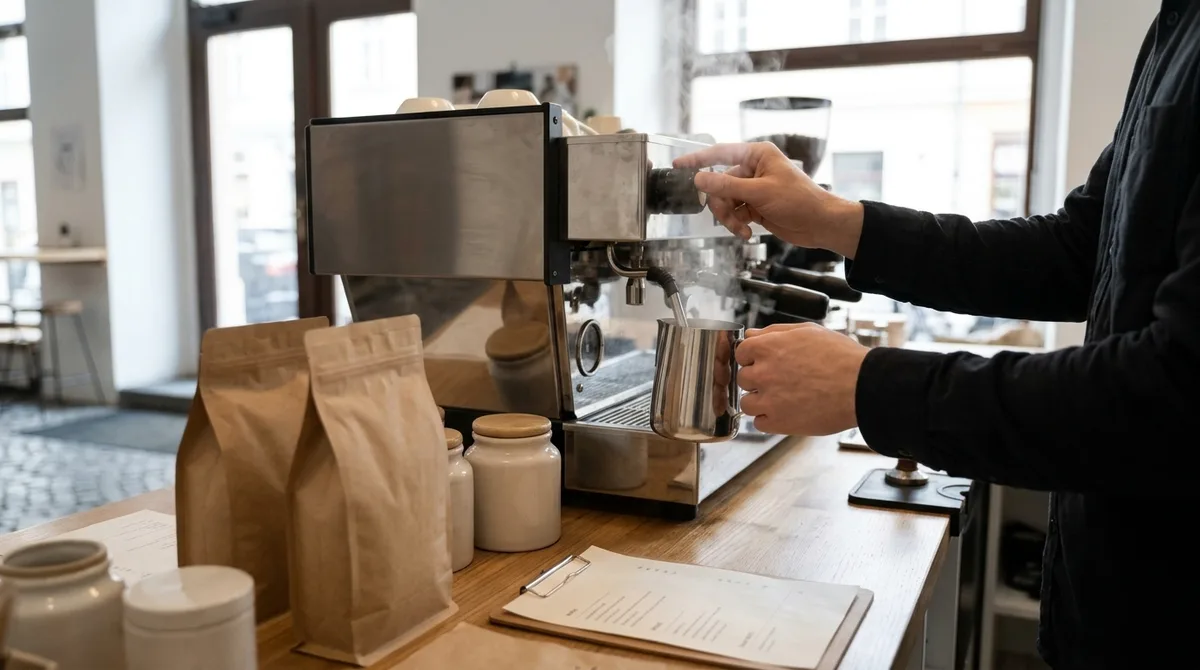
Fine, silky milk foam without visible bubbles – the foundation for latte art and pleasant texture of milk drinks. Created by proper steaming: steam wand just below milk surface, rotation for homogeneous structure, and stopping at 60–65 °C. See Latte Art – Heart, Leaf, and Tulip.
Micro-lot (micro-lot)
A small, separately harvested and processed batch of coffee from a single farm, plot, or harvest – typically 10–50 bags (1 bag = 69 kg). Sold at premium price due to its unique and traceable flavor profile. Micro-lots form the foundation of the specialty segment.
Moka pot (moka pot)
An Italian percolation coffee maker invented by Alfredo Bialetti in 1933. Water in the lower chamber is heated; steam forces water up through ground coffee and the finished beverage rises into the upper chamber. The result is not technically espresso – pressure reaches only 1.5–2 bar – but it's substantial and aromatic. Guide: Moka Pot – Step-by-Step Brewing.
Monsooned
A specific Indian processing method – green coffee is exposed to humid monsoon winds for 3–4 months. The beans swell, turn yellow, and significantly lose acidity. The resulting flavor is earthy, spicy, and full-bodied – characteristic of Monsooned Malabar.
N
Natural process (dry process)
The oldest processing method – the entire coffee cherry, including flesh and mucilage, is dried in the sun or on raised beds. The flesh ferments and transfers sugars to the bean. The result is pronounced sweetness, fruitiness (blueberries, strawberries, tropical fruit), and full body. Typical for Ethiopia and Brazil. Details: Coffee Processing – Natural, Washed, Honey.
Naked portafilter (bottomless portafilter)
A portafilter without a bottom wall – allows visual inspection of espresso flow directly from the basket. Reveals channeling, uneven flow, and distribution issues before tasting. A favorite diagnostic tool. Available in the barista supplies section.
O
Origin (origin)
The country, region, or specific farm where coffee was grown. Major coffee origins: Ethiopia, Kenya, Colombia, Brazil, Guatemala, Honduras, Costa Rica, Panama, Yemen, Indonesia. Origin significantly influences flavor profile – African coffees tend to be floral and fruity, Central American balanced, Indonesian earthy. More: Single Origin vs Blend.
Over-extraction (over-extraction)
A state where too many dissolved solids are extracted from coffee (> 22% per SCA). The result is bitter, astringent, dry, and harsh taste. Most common causes: too fine grind, too long extraction time, or too high water temperature.
P
Peaberry (peaberry)
A natural mutation of the coffee cherry – instead of two flat seeds, one round seed develops. Comprises 5–10% of harvest and is sold separately. Some producers and consumers attribute more intense and sweeter flavor to it, though scientific evidence is inconclusive.
Portafilter (portafilter)
A metal handle with a basket for ground coffee that locks into the grouphead by rotating. Comes in single (7–9 g) and double (14–20 g) sizes. Quality portafilters have precision-machined baskets and accurate spouts – essential for consistent espresso.
Pour over (pour over)
Manual gravity-drip brewing method using a dripper (V60, Chemex, Kalita Wave, Melitta) and hand-poured hot water. Requires control of water temperature, pour rate, and timing – but offers flexibility and excellent flavor clarity. Perfect for specialty coffees.
Pre-infusion (pre-infusion)
An espresso phase before full machine pressure – the pump operates at low pressure (1–2 bar) for a few seconds, slowly moistening the puck without violent extraction. Reduces channeling and produces more even extraction. Many modern machines offer adjustable pre-infusion.
Pressure (pressure)
Measured in bar – the force with which water is forced through the coffee. Espresso machines operate at 9 bar. Moka pots reach only 1.5–2 bar, AeroPress 0.75–1 bar. Higher pressure doesn't automatically mean better espresso – correct extraction comes from the right combination of pressure, grind size, dose, and time.
Puck (puck)
The compressed disk of coffee grounds in the espresso machine's basket during extraction. Proper preparation – even distribution, consistent tamping, correct dose – leads to an even, level puck and prevents channeling.
R
Refractometer (refractometer)
An optical instrument measuring TDS (Total Dissolved Solids) – the percentage of dissolved coffee solids in the beverage. Combined with brew ratio, it calculates extraction percentage. Models like Atago PAL-COFFEE are standard for third-wave cafés and enthusiasts. Available in the refractometer section.
Reservoir (water reservoir)
The water tank in automatic drip machines or espresso machines. Size determines brewing capacity without refilling. Reservoir water should be filtered to prevent mineral buildup and protect the machine.
Ristretto
A "restricted" short espresso – same dose of coffee, but only 0.75–1 oz (20–30 ml) of liquid. Higher concentration, more intense flavor, often used as a base for strong milk drinks.
Robusta (Coffea canephora)
The second most common coffee species – comprises about 40% of global production. Grows at lower altitudes (200–800 m) and in tropical regions with high humidity. Robusta beans are smaller and rounder than arabica, with 2–3 times higher caffeine content (2–3%). Lower price but also lower complexity – earthy, woody, sometimes rubbery notes. Primary use: instant coffee, espresso blends for crema.
Roast level (roast level)
The degree of heat applied during roasting. Light, medium, and dark roasts have different flavor characteristics: light (bright, complex, acidic), medium (balanced, caramel-sweet, moderate acidity), dark (smoky, bold, low acidity). Roast level should match the intended brewing method – light for filter, medium-dark for espresso.
Roaster (roaster)
A machine or professional who roasts green coffee beans at high temperatures (180–220 °C) until they reach the desired roast level. Roasting develops flavors through chemical reactions (Maillard, caramelization) triggered by heat.
S
SCA (Specialty Coffee Association)
An international organization setting standards for specialty coffee – cupping protocols, brewing standards, grading systems. Member-driven, science-based, focused on quality and sustainability.
Shower screen
A perforated metal disk in the grouphead that distributes water evenly across the coffee puck during espresso extraction. Also called "dispersion screen." Over time it becomes clogged with oils and mineral deposits – regular backflushing and cleaning are essential.
Shot (shot)
A single espresso preparation – typically 1 oz (30 ml) for single shot, 2 oz for double.
Siphon (syphon)
A vacuum brewing method using two chambers connected by a tube with a filter. Water in the lower chamber heats and creates pressure that forces water into the upper chamber where coffee steeps. As heat is removed, the pressure drops and brewed coffee filters back down. Dramatic visual presentation and clean, nuanced flavor. Also called vac pot or siphon coffee maker.
Single origin (single origin)
Coffee from one specific country, region, farm, or even microplot – not blended with beans from other origins. Single origins highlight terroir and allow tracking of flavor characteristics to their source. Opposite: blend.
Specialty coffee (specialty coffee)
Coffee that scores 80+ points on the 100-point SCA scale – grown at quality-conscious farms, processed carefully, roasted with precision, and served fresh. Characterized by traceability, unique flavor, and premium price.
Spray pattern (spray pattern)
The visual pattern of water dispersed by the shower screen during espresso extraction. Ideally even and consistent; uneven patterns indicate problems with the screen, group or distribution.
T
Tamping (tamping)
The process of compacting ground coffee in the portafilter basket using a tamper. Proper technique: level and even pressure (typically 30 lbs), parallel to the ground, resulting in a level puck surface. Inconsistent tamping causes uneven extraction and channeling. Quality tampers come in various sizes and materials.
Tamper (tamper)
A tool with a flat or convex base for compacting ground coffee. Available in various sizes (53–58.5 mm) to fit different baskets. Quality tampers are machined stainless steel; some feature spring-loaded handles for consistency.
Terroir (terroir)
The influence of geography, climate, altitude, and soil on coffee flavor – analogous to wine terroir. Ethiopian coffees taste different from Colombian due to different terroirs, even if the same variety grows in both.
TDS (Total Dissolved Solids)
The percentage of dissolved coffee solids (sugars, oils, aromatics) in brewed coffee. Measured with a refractometer. Ideal TDS: 1.2–1.5% for espresso, 1.3–1.6% for filter coffee. Combined with brew ratio, TDS indicates extraction percentage.
Third wave (third wave)
Modern specialty coffee movement (from approx. 2000) emphasizing quality, traceability, direct trade, precision brewing, and origin-focused flavor. Contrast with first wave (instant coffee) and second wave (chains like Starbucks).
Through-and-through channeling
Severe channeling where water finds multiple pathways through the puck, creating several visible streams. Results in very sour, under-extracted espresso.
U
Under-extraction (under-extraction)
A state where insufficient dissolved solids are extracted from coffee (< 18% per SCA). The result is sour, astringent, and underdeveloped flavor. Common causes: too coarse grind, too short extraction time, or too low water temperature.
V
V60
A cone-shaped pour-over dripper with a single large hole and internal spiral ridges. The design encourages faster water flow and vertical movement of grounds. Widely used, affordable, and capable of excellent results. Requires technique and attention to pouring speed. Guide: V60 – Brewing Guide.
W
Washed process (wet process)
A coffee processing method where the cherry fruit is removed before drying. After pulping (removing fruit), the bean is soaked in fermentation tanks to break down remaining mucilage, then washed and dried. Results in brighter acidity and cleaner flavor compared to natural process. Standard method for most specialty coffees.
Water hardness
The concentration of minerals (calcium, magnesium) in water. Too soft water (< 50 ppm) extracts slowly and produces flat flavors. Too hard water (> 250 ppm) extracts too fast and can damage machines. Ideal: 50–150 ppm. Affects espresso and all brewing methods.
Y
Yield
In espresso, the weight ratio of input (ground coffee dose) to output (brewed espresso weight). Example: 18 g dose yields 36 g espresso = 2:1 yield. In other contexts, the total production volume from a farm or region.
Z
Zero retention grinder
A grinder that dispenses ground coffee without retaining particles between uses. Benefits: consistent grind with each dose, no rancid grounds from previous sessions, easy switching between coffees. Premium feature found in high-end grinders.