Česky (CZK)
 Slovensky (EUR)
 Magyar (HUF)
 Polski (PLN)
 English (EUR)
 Deutsch (EUR)
 Français (EUR)
 Español (EUR)
 Português (EUR)
 Italiano (EUR)
 Svenska (SEK)
 Suomi (EUR)
 Nederlands (EUR)
 Dansk (EUR)
 Lëtzebuergesch (EUR)
 Eesti (EUR)
 Latviešu (EUR)
 Lietuvių (EUR)
 Slovenščina (EUR)
 Română (RON)
 Български (EUR)
 Hrvatski (EUR)
 Ελληνικά (EUR)
 Українська (EUR)
 Norsk (EUR)
 Srpski (EUR)
 Tiếng Việt (EUR)



Valves for coffee machines – types and replacement
Valves for coffee machines – types and replacement
The invisible guardians of your espresso
Valves are components that most users don't think about – until one fails. Yet every lever-operated coffee machine contains several valves, each serving an irreplaceable function: regulating water flow, relieving pressure, enabling backflushing, or protecting the hydraulic system from dangerous overpressure.
Understanding the function of individual valves will help you diagnose problems before they become serious failures, and when needed, replace the correct component. Most valves are structurally simple, and their replacement is among the tasks that an advanced home barista can handle with ordinary tools.
Overview of valves in a coffee machine
| Valve type | Function | Location | Typical failure |
|---|---|---|---|
| Two-way (2-way) | Opens/closes water flow | Various positions in the circuit | Won't close, stuck piston |
| Three-way (3-way solenoid) | Directs water and relieves pressure | Behind the group head | Leaking, pressure not relieved |
| Safety (OPV) | Limits maximum system pressure | At pump outlet | Incorrect pressure, leaking |
| Air relief (anti-vacuum) | Prevents vacuum in the boiler | Top of the boiler | Steam leaking, stuck valve |
Two-way valves
How they work
A two-way valve is structurally the simplest – it has an inlet and outlet port and switches between two states: open and closed. In coffee machines, it controls water flow in various sections of the hydraulic circuit, for example when filling the boiler or regulating flow to the group head.
Most two-way valves in coffee machines are solenoid-operated – an electromagnetic coil opens and closes the valve based on an electrical signal from the control board. This is a reliable solution, but both the coil and the seal wear out after years of operation.
When it fails
- Valve doesn't close – water continues to flow even after extraction is complete. Cause: worn seal or foreign matter (coffee grounds, limescale) trapped on the valve seat
- Valve doesn't open – pump runs but water doesn't flow. Cause: stuck piston or burned-out solenoid coil
Replacement two-way valves can be found in the valves section.
Three-way solenoid valve
Key component for backflushing
The three-way valve is the functionally most important valve in every lever-operated coffee machine with an E61 or similar group head. It has three ports:
- Inlet – water from the pump or boiler
- Outlet to group head – water directed to the coffee puck
- Drain – discharge into the drip tray
How it works
During espresso preparation: The valve opens the path from the pump to the group head (port 1 -> port 2), while the drain port remains closed.
After extraction is complete: The inlet from the pump (port 1) closes and the path from the group head to the drain opens (port 2 -> port 3). This relieves residual pressure from the group head – the audible "pssss" sound after stopping extraction confirms correct valve function. The portafilter can be safely removed without risk of being sprayed with hot pressurized water.
During backflushing: After inserting the blind basket into the portafilter and starting the pump cycle, the pump pushes water into the group head with no outlet through the coffee puck. When extraction stops, the three-way valve opens the drain port and water – along with dissolved coffee oils and residues of cleaning agent – flows into the drip tray. Without the three-way valve, backflushing would be physically impossible.
Signs of failure
- No "pssss" sound is heard after stopping extraction – valve is not relieving residual pressure
- Portafilter remains under pressure – attempting to remove it results in water spraying from the group head
- Backflushing doesn't work – water doesn't drain into the drip tray
- Continuous water leaking from the group head – valve doesn't close in the idle position
- Slow flow despite correct grind setting – partially stuck valve restricts water flow
Three-way valve maintenance
The three-way valve sits directly in the path of coffee oils and microscopic coffee particles. Without regular cleaning, these deposits gradually accumulate, reduce valve function, and shorten its lifespan.
- Weekly backflushing with enzymatic cleaning agent effectively loosens coffee oils and keeps the internal valve surfaces clean
- Annual disassembly and mechanical cleaning – disassemble the valve, thoroughly clean the seat and piston, replace worn O-rings
- Coil inspection – with each disassembly, visually inspect the coil condition and measure its resistance with a multimeter; normal values typically range around 3–10 ohms
Replacement three-way valves and their components are available in our range.
Safety valve (OPV – Over-Pressure Valve)
System protection against overpressure
The safety valve – also called bypass valve, expansion valve, or OPV – is located at the outlet of the pump. Its function is simple but critical for system safety: when pressure in the hydraulic circuit exceeds the set value (typically 10–12 bar), the valve opens and excess water is diverted back to the reservoir or into the drip tray.
Why it's important
Vibration pumps typically develop 15–18 bar of pressure – significantly more than needed or safe for espresso extraction (standard 9 bar). Without an OPV, such pressure would damage seals, hoses, and the boiler. The OPV therefore serves two purposes:
- Safety fuse – protects the entire hydraulic system from overpressure
- Upper working pressure limit – limits the pressure at the group head to the required value
OPV adjustment
Most OPV valves are adjustable with a screw or nut. The professional calibration procedure:
- Insert the portafilter with blind basket
- Connect a manometer to the group head, or use a portafilter with an integrated manometer
- Start the pump
- Turn the OPV adjustment screw until the manometer shows the desired pressure – typically 9–10 bar for standard extraction
- After adjustment, verify that the pressure has stabilized and repeat the measurement on the next cycle
Signs of failure
- Manometer pressure is consistently high – OPV doesn't open at the set limit
- Pressure is too low – OPV opens prematurely, pump can't reach working pressure
- Continuous water leaking from the pump drain – worn OPV seal prevents proper closure
Safety valves for the most common coffee machine models are available in our range.
Air relief valve (Anti-vacuum valve)
Boiler protection during cooling
The air relief valve is located on the top of the boiler. When the machine is turned off and the boiler begins to cool, the volume of water and steam inside decreases and a vacuum is created. Without an air relief valve, this vacuum could:
- Draw in air – along with bacteria – through microleaks back into the boiler
- Deform boiler walls with repeated cycles over time
- Make it difficult to refill the boiler after the machine is switched back on
The air relief valve solves this problem by allowing a small amount of air into the boiler when vacuum forms, immediately equalizing the pressure to atmospheric levels.
Signs of failure
- Steam leaking from the top of the machine during operation – valve doesn't close in the working position
- Visible dripping from the valve – worn seal has lost its tightness
- Difficulty filling the boiler after switching on – valve is stuck in the closed position and prevents pressure equalization
Air relief valves are available in the complete range of valves.
Valve replacement guide
Three-way valve in E61 group head
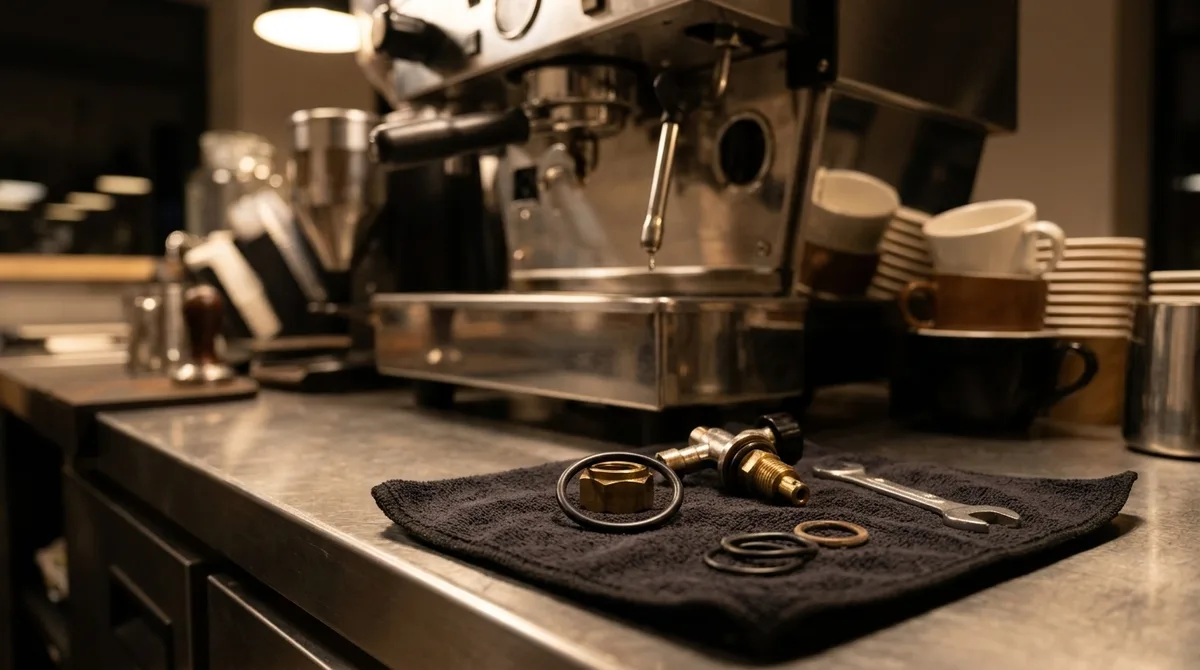
Tools needed: Socket wrench, flat screwdriver, new O-rings, coffee oil cleaner
- Disconnect the machine from power and let it cool completely – at least 30 minutes
- Remove the portafilter and shower screen from the group head
- Unscrew the top of the group head – the valve mechanism with piston and spring is underneath
- Remove the valve piston and spring and store them in the order you removed them
- Clean the valve seat – remove coffee oil deposits and limescale buildup, wipe the seat with a lint-free cloth
- Replace the O-rings on the piston with new ones matching the original size
- Reinsert the piston with spring in the correct order and orientation
- Screw the group head back and tighten to appropriate torque – don't overtighten, brass threads are sensitive
- Test function – run an extraction and after stopping, verify that the characteristic pressure relief sound is heard
Safety valve (OPV)
OPV replacement is typically a simpler task. The valve is mounted at an easily accessible location at the pump outlet and is usually visible after opening the machine's cover. Procedure: disconnect the supply hoses, remove the old valve, install the new one, reconnect the hoses, and calibrate the pressure according to the procedure described above. When connecting the hoses, check the condition of hose connectors and replace them preventatively if needed.
Frequently asked questions
How often should the three-way valve be replaced?
The valve body itself lasts many years with proper maintenance. What regularly wears out are the O-rings and internal seals – the recommended replacement interval is every 2–3 years or immediately at the first signs of failure. Regular weekly backflushing with cleaning chemistry significantly extends the valve's lifespan.
Why don't I hear a "pssss" sound after stopping extraction?
The most common cause is a stuck or dirty three-way valve. Another possibility is that your machine doesn't have a three-way valve at all – some lower-priced models aren't equipped with one and therefore don't allow backflushing.
Can I adjust the OPV to a lower pressure for gentler extraction?
Technically yes – some baristas lower the OPV to 8–8.5 bar. However, it's important to understand that the OPV defines the safety ceiling of the system, not the pressure profile of the extraction. For true pressure profiling, a machine with flow control or native pressure profiling support is more suitable.
Is it normal for the air relief valve to drip during heating?
A small amount of condensation in the first few minutes of heating is normal and doesn't indicate a fault. However, if the valve drips during full operation or visible steam leaks even after reaching working temperature, the seal or entire valve needs to be replaced.
Sources
- E61 Group Head Technical Manual – Faema Engineering, 1961 (reprint 2020)
- Solenoid valve maintenance – Parker Hannifin Application Notes
- Espresso machine hydraulic circuits – James Hoffmann, The World Atlas of Coffee
- Whole Latte Love – E61 maintenance video series, 2024