Česky (CZK)
 Slovensky (EUR)
 Magyar (HUF)
 Polski (PLN)
 English (EUR)
 Deutsch (EUR)
 Français (EUR)
 Español (EUR)
 Português (EUR)
 Italiano (EUR)
 Svenska (SEK)
 Suomi (EUR)
 Nederlands (EUR)
 Dansk (EUR)
 Lëtzebuergesch (EUR)
 Eesti (EUR)
 Latviešu (EUR)
 Lietuvių (EUR)
 Slovenščina (EUR)
 Română (RON)
 Български (EUR)
 Hrvatski (EUR)
 Ελληνικά (EUR)
 Українська (EUR)
 Norsk (EUR)
 Srpski (EUR)
 Tiếng Việt (EUR)



Why Seals Are the Most Important Spare Parts for Your Espresso Machine
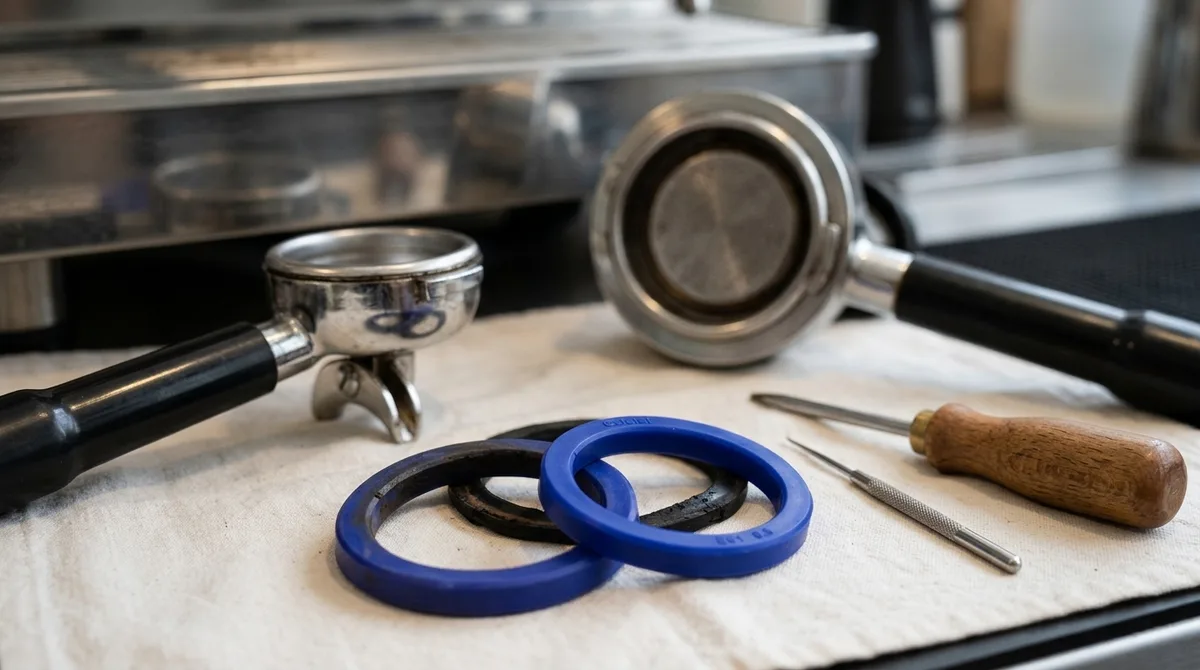
Seals and O-rings are among the cheapest components in an espresso machine – and yet they determine the entire performance of the machine. When a group head seal loses its elasticity, espresso doesn't flow through the coffee puck, but escapes around the portafilter. The result is insufficient extraction pressure, uneven extraction, and a wet work surface.
Most seals in a home lever espresso machine last 6–12 months with regular use. Professional machines in cafes require replacement even more frequently. Nevertheless, it's maintenance that many users put off – until the problem becomes clearly apparent.
This guide will help you recognize signs of wear in time, choose the correct size and material, and handle the replacement yourself without calling a service technician.
Types of Seals in an Espresso Machine
Group Head Seal (Main Seal)
The most important seal in the machine. Located in the group head, it seals the connection between the group head and portafilter. Without a functioning group head seal, it's impossible to maintain the correct extraction pressure of 9 bars – and any deviation directly shows up in the cup.
Common sizes by group head type:
- E61 group: outer diameter 73 mm, inner 57 mm, thickness 8–8.5 mm
- Breville / Sage: inner diameter 54 mm
- La Marzocco: 72 × 56 mm
- Proprietary sizes depending on manufacturer – always check your machine's documentation
Portafilter Seals
O-rings and seals on the portafilter connection with the group head. Smaller than the main group head seal, but equally critical for the tightness of the entire system.
Steam Wand Seals
O-rings in the steam wand valve and on the wand itself. They ensure that steam flows exclusively through the wand and that the valve closes reliably even with prolonged exposure to high temperatures.
OPV Seals (Over-Pressure Valve)
The over-pressure valve protects the hydraulic circuit from exceeding safe pressure. The seals in the OPV must ensure precise valve opening at the set pressure – their failure can lead to unstable extraction or machine damage.
Pump and Hose Seals
O-rings at connections between the pump, hoses, and boiler. When they fail, water leaks into the machine's interior, which can cause corrosion or electronics damage.
Seal Materials – Comparison
| Material | Temperature Resistance | Lifespan | Price | Typical Use |
|---|---|---|---|---|
| Silicone | up to 200 °C | 8–12 months | Low | Group head, steam wand |
| Rubber (EPDM) | up to 150 °C | 6–10 months | Lowest | Group head (OEM in cheaper machines) |
| PTFE (Teflon) | up to 260 °C | 12–24 months | Higher | Group head (upgrade), OPV |
| Viton (Fluoroelastomer) | up to 230 °C | 12–18 months | High | Professional machines, steam wand |
| NBR (Nitrile Rubber) | up to 120 °C | 6–8 months | Low | Cold connections, pump hoses |
Silicone is the most popular choice for home machines – it's elastic, affordable, and withstands the temperature cycles of espresso extraction well. PTFE represents a premium upgrade for E61 group heads: the portafilter is easier to insert and remove, the seal adheres less to the metal, and lasts considerably longer. For steam applications and professional machines, we recommend Viton – its resistance to extreme temperatures has no peer among elastomers.
A complete range of seals and O-rings can be found in the spare parts section.
When to Replace – Signs of Wear
Clear Signals
- Water leaking around the portafilter – espresso drips down the sides of the group head instead of flowing through the portafilter outlet
- Portafilter inserts too easily – seal has lost thickness, the lock doesn't have proper resistance
- Portafilter won't insert at all – swollen or cracked seal physically blocks insertion
- Steam leaking from the steam wand in closed position – O-ring in the valve has lost sealing properties
- Wet spots under the machine cover – internal seals on hose connections or pump are failing
Hidden Signals
- Channeling despite proper preparation – partial pressure loss disrupts even water flow through the puck
- Pressure drop on the manometer – some of the extraction pressure leaks through the worn seal
- Uneven resistance when inserting the portafilter – a deformed seal doesn't adhere symmetrically along the entire circumference
Preventive Replacement
Even in the absence of visible signs, we recommend replacing the group head seal every 12 months with home use and every 3–6 months with commercial use. Preventive replacement costs a fraction of a single service visit and prevents situations where seal failure damages other machine components.
How to Choose the Right Seal – Size Guide
Step 1: Identify Your Group Head Model
- E61 – the most widespread type, used in ECM, Rocket, Lelit, Quick Mill, Profitec, and Bezzera machines
- 58 mm groups of other designs – La Marzocco, Nuova Simonelli, Victoria Arduino
- 54 mm – Breville / Sage, some Lelit models
- Proprietary sizes – some manufacturers use proprietary dimensions that are not interchangeable
Step 2: Measure the Old Seal
If you're unsure of the group head model, remove the old seal and measure three dimensions:
- Outer diameter (e.g., 73 mm for E61)
- Inner diameter (e.g., 57 mm for E61)
- Thickness (e.g., 8 or 8.5 mm for E61)
A difference of just one millimeter in outer diameter can mean the seal either won't fit into the groove or won't adhere properly – this is the most common reason for returns.
Step 3: Choose Your Material
For most home users, silicone is an optimal choice with a good price-to-lifespan ratio. If you prefer longer durability and smoother portafilter operation, go for PTFE. For steam applications and professional machines, Viton is the best choice.
Procedure for Replacing a Group Head Seal (E61)
Required Tools
- Flat screwdriver or special seal removal hook
- New seal of the correct size
- Cleaning brush for group head
- Food-grade lubricant (optional but recommended for PTFE seals)
Steps
- Turn off the machine and let it cool for at least 30 minutes – the group head retains high temperature long after shutdown
- Remove the portafilter and shower screen (usually held by a single screw in the center)
- Remove the old seal – insert a flat screwdriver between the seal and groove, carefully pry it out around the entire circumference to avoid damaging the metal
- Clean the groove – with a brush and cloth, thoroughly remove remains of the old seal and coffee residue; a dirty groove prevents the new seal from sitting properly
- Insert the new seal – press it in evenly around the entire circumference; silicone seals can be soaked in hot water for 30 seconds to soften them, making installation easier
- Reattach the shower screen and tighten the screw – don't overtighten, as you could deform the seal
- Insert the portafilter – the first few insertions will be tighter as the seal fully adapts after 5–10 extractions
The entire process takes less than 10 minutes and requires no special skills or tools. A more detailed maintenance guide can be found in our article on espresso machine cleaning and maintenance.
Most Common Seal Replacement Mistakes
- Buying the wrong size – a 1 mm difference in outer diameter means the seal either won't fit in the groove or won't adhere properly and will leak
- Neglecting the shower screen – if it's clogged or deformed, a new seal won't solve the extraction problem; always check the shower screen as well
- Failing to clean the groove before installation – remains of the old seal and coffee oils prevent the new seal from sitting properly and can cause leaks from the start
- Overtightening the shower screen screw – excessive pressure deforms the seal and significantly shortens its lifespan
- Using unsuitable lubricant – technical vaseline is not food-safe; use only lubricants certified for food contact (food-grade silicone grease)
Frequently Asked Questions
How often should I change the O-rings on the steam wand?
With regular home use, every 12–18 months, or immediately if any steam leaks. Steam wand O-rings are exposed to temperatures exceeding 150 °C, which accelerates their degradation far more than group head seals.
Can I use universal seals from a hardware store?
We don't recommend it. Espresso machine seals must meet food contact standards and withstand prolonged exposure to high temperatures. Regular rubber seals may release unwanted substances, degrade faster, and affect the taste of your coffee.
Is PTFE seal really better than silicone?
PTFE lasts longer and the portafilter inserts more smoothly thanks to lower friction coefficient. Some baristas actually prefer silicone because greater friction contributes to more stable portafilter grip upon insertion. Both materials are fully functional and safe – the choice depends on personal preference and intensity of use.
Do I need to change seals in an automatic espresso machine?
Yes, automatic espresso machines also contain seals on the brew unit that wear over time and affect extraction quality. The replacement is usually technically more demanding than with lever machines and we recommend entrusting it to an authorized service center.
Sources
- Espresso machine maintenance guides – Whole Latte Love, 2024
- E61 Group Head Gasket Replacement – Clive Coffee Technical Notes
- Food-grade gasket materials – DIN EN 1935, FDA 21 CFR 177
- Manufacturers: Cafelat, IMS, La Marzocco – seal technical specifications