Česky (CZK)
 Slovensky (EUR)
 Magyar (HUF)
 Polski (PLN)
 English (EUR)
 Deutsch (EUR)
 Français (EUR)
 Español (EUR)
 Português (EUR)
 Italiano (EUR)
 Svenska (SEK)
 Suomi (EUR)
 Nederlands (EUR)
 Dansk (EUR)
 Lëtzebuergesch (EUR)
 Eesti (EUR)
 Latviešu (EUR)
 Lietuvių (EUR)
 Slovenščina (EUR)
 Română (RON)
 Български (EUR)
 Hrvatski (EUR)
 Ελληνικά (EUR)
 Українська (EUR)
 Norsk (EUR)
 Srpski (EUR)
 Tiếng Việt (EUR)



Coffee Chain – From Plantation to Cup
A Journey Spanning Thousands of Kilometers
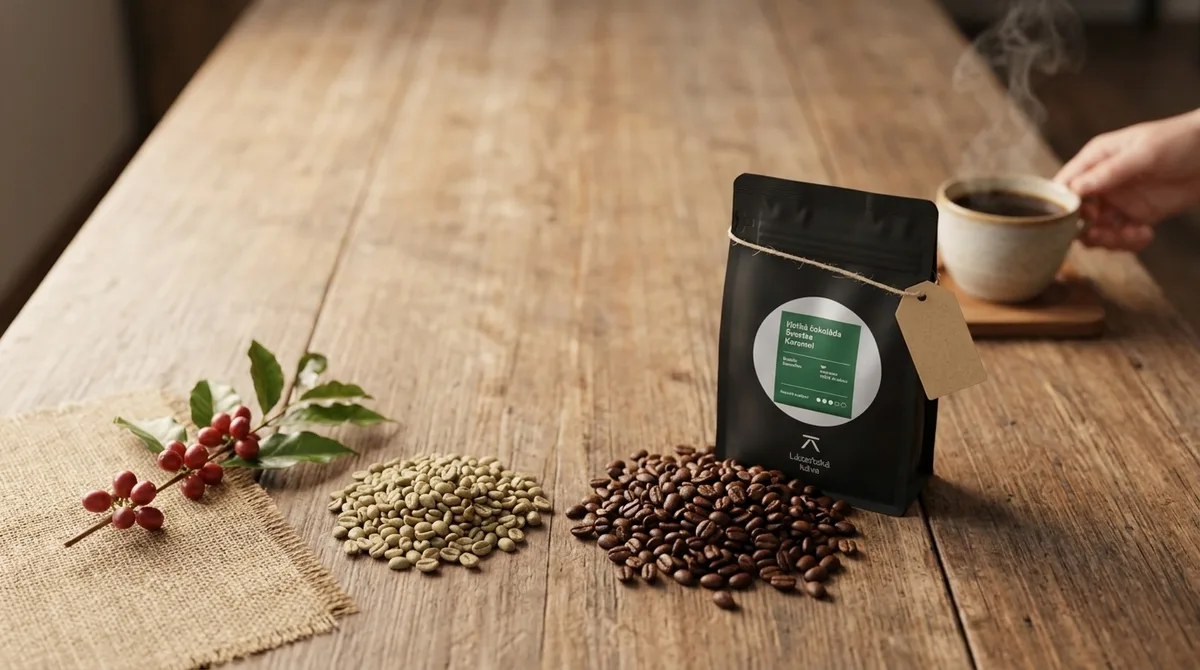
When you brew a cup of coffee in the morning, you're drinking the result of a chain that began months or years earlier – on a plantation in Ethiopia, Colombia, Brazil, or Indonesia. Between the tree and your cup stand more than a dozen steps, dozens of people, and thousands of kilometers. This article maps the entire journey – from coffee seed to the last sip – and explains why every decision along this chain affects the taste in your cup.
The Coffee Belt
Coffee grows exclusively in the tropical zone between the Tropic of Cancer (23.5° N) and the Tropic of Capricorn (23.5° S) – in regions with sufficient rainfall, stable temperature without extreme frost, and elevation typically above 600 meters. The combination of these conditions determines not only the possibility of cultivation but directly shapes the flavor profile of the beans.
Major Production Regions
| Region | Countries | Characteristics |
|---|---|---|
| Central and South America | Brazil, Colombia, Honduras, Guatemala, Costa Rica, Panama, Peru, Mexico | Largest production volume, washed processing dominates, chocolate and nutty profiles. Brazil accounts for approx. 35% of global production |
| Africa | Ethiopia, Kenya, Rwanda, Burundi, Tanzania, Uganda, DRC | Birthplace of Arabica (Ethiopia), floral and fruity profiles, distinctive acidity, both washed and natural processing |
| Asia and Pacific | Vietnam, Indonesia, India, Papua New Guinea, China (Yunnan) | Vietnam is the world's second-largest producer (mostly Robusta), Indonesia known for wet-hulled methodology and earthy profiles |
Conditions for Coffee Plant Growth
| Factor | Arabica | Robusta |
|---|---|---|
| Elevation | 800–2,200 m | 0–800 m |
| Temperature | 15–24 °C | 24–30 °C |
| Rainfall | 1,200–2,200 mm/year | 2,000–3,000 mm/year |
| Soil | Volcanic, mineral-rich | Less demanding, tolerates greater variability |
| Shade | Prefers partial shade | Tolerates full sun |
Arabica grown at higher elevations develops more slowly, allowing the beans to accumulate more sugars and aromatic precursors – which is why high-altitude coffees achieve the highest scores at auctions.
Cultivation and Care
From Seed to First Harvest
| Phase | Duration |
|---|---|
| Germination | 4–8 weeks |
| Nursery | 6–12 months |
| Transplanting to plantation | At 1 year of age |
| First flowering | Year 3 |
| First commercial harvest | Year 4–5 |
| Full production | Year 7–20 |
| End of lifespan | 25–30 years (yields decline thereafter) |
The coffee plant blooms only a few days per year, with flowers emitting a delicate jasmine scent. After pollination, fruit maturation takes 6–9 months – so with each harvest, the farmer works with fruit that was pollinated nearly a year before.
Varieties (Varietals)
Hundreds of Arabica varieties differ in bean size, disease resistance, yield, and flavor profiles. Variety selection is one of the key decisions a farmer makes at the beginning – and lives with the consequences for decades:
| Variety | Origin | Flavor Profile |
|---|---|---|
| Typica | Yemen / Ethiopia | Classic, balanced, delicate sweetness |
| Bourbon | Island of Réunion | Sweet, complex, caramel |
| Caturra | Brazil (Bourbon mutation) | Clear acidity, citrus notes |
| Catuai | Brazil (Mundo Novo × Caturra) | Chocolate, nuts, medium body |
| SL28 / SL34 | Kenya (Scott Laboratories) | Intense, black currant, hint of tomato |
| Gesha / Geisha | Ethiopia (Gesha forest) | Jasmine, bergamot, peach – consistently achieves the highest auction prices |
| Catimor / Sarchimor | Hybrid (Timor × Caturra) | Rust-resistant, but less complex in flavor |
For more detail on varieties and their flavor impact: Single origin vs blend.
Harvesting
The coffee plant blooms once a year (twice in some regions) and fruits mature 6–9 months after flowering. Harvesting occurs using one of three methods, with the choice directly affecting cup quality:
Harvesting Methods
| Method | Description | Quality | Cost |
|---|---|---|---|
| Selective hand picking | Only ripe (red or yellow) cherries are picked; unripe berries are left for the next pass | Highest – only fruit at optimal ripeness | Highest – the season requires 3–4 passes through the same plant |
| Strip picking | All fruit is stripped from the branch at once regardless of ripeness | Lower – a mix of ripe, unripe, and overripe fruit | Medium |
| Machine harvesting | Vibrating machines or harvesters shake fruit loose | Lowest – everything is collected without selection | Lowest – viable only on flat terrain (typically Brazil) |
Specialty coffee comes almost exclusively from selective hand picking. This is where the price difference from commercial beans begins.
Processing
After harvest, cherries must be processed within 24 hours – longer delays allow uncontrolled fermentation that ruins the flavor profile. Processing is the transformation of fresh fruit into stable green beans ready for export.
We describe the three main methods in detail in Coffee Processing – natural, washed, honey. Here is a brief overview:
| Method | Principle | Flavor Profile | Typical Countries |
|---|---|---|---|
| Washed | Skin and mucilage are mechanically removed; bean is dried in parchment | Clean acidity, light tea body, floral and citrus notes | Colombia, Kenya, Ethiopia, Central America |
| Natural | Entire cherry is sun-dried or dried on elevated beds | Intense sweetness, fruitiness, full body | Ethiopia, Brazil, Yemen |
| Honey | Skin is removed, mucilage (honey) remains on the bean during drying | Compromise between natural sweetness and washed clarity | Costa Rica, El Salvador, Brazil |
| Wet-hulled (Giling Basah) | Parchment removed at higher moisture; drying is shortened | Earthiness, spice, heavy full body | Indonesia (Sumatra, Sulawesi) |
| Anaerobic fermentation | Fermentation in a sealed container without oxygen; precisely controlled | Intense fruity, wine-like to yeasty notes | Experimental – Colombia, Costa Rica, Ethiopia |
Dry Milling – Preparation for Export
After processing and drying, when bean moisture reaches 10–12%, dry milling follows – the dry processing of green coffee before shipment. This is a technically demanding phase that determines what green coffee the roastery actually receives.
Dry Milling Steps
- Hulling – removal of the parchment layer (in washed) or entire dried cherry (in natural). Mechanical machines use friction to separate the hull from the bean without damage
- Polishing – optional step removing remnants of the silver skin. Has no proven impact on taste, but the bean looks aesthetically cleaner
- Grading – sorting by parameters: size (screen size), density, color, and defect count
- Sorting – removal of defects. Optical sorters (sorting by color and shape) are combined with manual sorting, where workers remove black, insect-damaged, broken, or immature beans
Grading – How Coffee Is Classified
| Criteria | System | Examples |
|---|---|---|
| Size (screen size) | Screen 14–20 (unit = 1/64 inch) | Kenya AA = screen 17–18, Colombia Supremo = screen 17+ |
| Defect count | SCA grading (0–86 defects per 350 g sample) | Specialty = max. 5 Category 1 defects, 0–5 Category 2 |
| Elevation | SHB, HB, MHB | SHB (Strictly Hard Bean) = above 1,200 m, hardest and typically highest-quality beans |
| Density | Flotation or pneumatic sorting | Denser beans contain more sugars and aromatic compounds – direct indicator of potential quality |
Export and Import
Packaging and Transport
Green coffee is packed in jute bags (60 or 69 kg depending on country of origin) or GrainPro bags – plastic liners that protect beans from moisture and external odors during long transport. Transport is by sea container; shipping from Colombia to Europe takes 2–4 weeks, from Indonesia 5–6 weeks.
C-price – Coffee Exchange Price
Arabica is traded on the ICE (Intercontinental Exchange) in New York under the contract designated as "C". C-price is the reference price in US cents per pound (453 g). In 2024–2026, C-price hovered at historic highs above 300 cents per pound, resulting from climate shocks in Brazil and Vietnam and associated harvest failures.
C-price is merely the market baseline – specialty coffee sells above C-price with a premium reflecting quality, traceability, and direct relationship with the farmer.
International Coffee Organization (ICO)
ICO (International Coffee Organization) is an intergovernmental organization uniting producing and consuming nations. It monitors production, consumption, prices, and trade flows. According to current ICO estimates, approximately 175 million bags (60 kg) of coffee are consumed globally per year.
Trading Models – Fair Trade, Direct Trade, Specialty
Commercial Trade (Commodity)
The traditional model where coffee passes through a series of intermediaries – local traders (coyotes), exporters, importers, wholesalers. The farmer receives a small fraction of the final retail price. Coffee is blended, loses its origin identity, and is sold at a price near C-price regardless of actual quality.
Fair Trade
A certification system guaranteeing a minimum purchase price (currently $1.80 USD/pound for washed Arabica) and a $0.20 USD/pound premium intended for community projects. The system has limitations: the minimum price remains low, the certification process is administratively and financially demanding especially for small farmers, and certification itself is no guarantee of high cup quality.
Direct Trade
The roastery purchases directly from the farmer or cooperative – with no intermediaries. Benefits:
- Higher price for farmer – typically 2–5× C-price
- Full traceability – roastery knows exact origin, farm, plot, and processing method
- Quality influence – personal relationship enables specific requests for variety, processing, or drying
- Long-term partnership – farmer invests in quality with certainty of future season sales
The limitations are real: the model requires travel, language skills, financial guarantees, and sufficient purchase volume that smaller roasteries often cannot afford.
Specialty Coffee Model
Specialty coffee (SCA score 80 and above) combines direct trade principles with strict quality standards. Certified Q graders evaluate green coffee; roasteries pay premiums corresponding to the achieved score, and farmers are economically motivated to invest in better varieties, more precise harvesting, and innovative processing methods. The result is flavor complexity you won't find in commercial coffee.
Roasting
Green coffee is roasted in professional drum or hot-air roasters at temperatures of 180–230 °C for 8–15 minutes. Roasting is a thermal transformation: green, grass-like beans become brown and aromatic – the Maillard reaction and sugar caramelization generate more than 1,000 aromatic compounds.
Roasting Levels
| Level | Color | Character | Typical Use |
|---|---|---|---|
| Light (Cinnamon, City) | Light brown | High acidity, fruity and floral notes, distinctive origin character | Filter, pour over |
| Light-medium (City+) | Medium brown | Balanced acidity and sweetness, caramel, nuts | Filter, espresso |
| Medium (Full City) | Brown | Lower acidity, chocolate notes, fuller body | Espresso, moka |
| Dark (French, Italian) | Dark brown to black | Minimal acidity, smoky bitterness, suppressed origin character | Espresso blend, Turkish coffee |
For more on roasting and home roasting options: Home Roasting – Coffee Roasting at Home.
After roasting comes degassing (7–21 days, during which beans release CO₂) and distribution to the end customer – through cafés, e-shops, or brick-and-mortar retailers. Browse our complete selection in whole bean coffee for espresso and whole bean coffee for filter.
Brewing – The Final Step
Roasted beans are ground in a grinder to a size suited to your chosen method and brewed one of many ways. Each method extracts a different flavor profile – even from beans of the same origin:
| Method | Principle | Detailed Guide |
|---|---|---|
| Espresso | 9 bar pressure, fine grind | Espresso at Home |
| V60 Pour Over | Gravity, medium grind | V60 Guide |
| AeroPress | Immersion + pressure | AeroPress Methods |
| French Press | Immersion, coarse grind | French Press |
| Chemex | Gravity, coarse paper filter | Chemex |
| Moka Pot | Steam and percolation | Moka Pot |
| Cold Brew | Cold immersion, 12–24 hours | Cold Brew |
| Jezva | Direct boiling | Jezva |
The resulting taste depends on bean freshness, grind quality, temperature, and mineral content of water (see Chemistry of Water for Coffee), correct brew ratio, and precise measurement (digital scales, refractometer).
Who Pays for Coffee – and How Much
The distribution of value among supply chain participants is among the most debated topics in the coffee industry. The numbers look like this:
Average Distribution (Commercial Coffee)
| Supply Chain Link | Share of Final Price |
|---|---|
| Farmer | 5–10% |
| Processor / Cooperative | 5–8% |
| Exporter / Importer | 8–12% |
| Roastery | 15–25% |
| Café / Retailer | 50–65% |
Specialty / Direct Trade Model
| Supply Chain Link | Share of Final Price |
|---|---|
| Farmer | 15–30% |
| Processor / Cooperative | 5–10% |
| Exporter / Importer | 5–10% |
| Roastery | 25–35% |
| Café / Retailer | 30–45% |
In the specialty model, the farmer receives a significantly higher share. That's why quality coffee costs more – and why that higher price makes sense.
Challenges in the Coffee Chain
Climate Change
According to research, the area suitable for Arabica cultivation could shrink by 50% by 2050. Rising temperatures, unpredictable rainfall patterns, and the spread of coffee rust (Hemileia vastatrix) threaten production in traditional regions. Some cooperatives are responding by moving cultivation to higher elevations or introducing hardier hybrid varieties.
Low Farmer Income
Many growers earn below subsistence level. Volatility of C-price, rising input costs, and climate risks create economically unsustainable conditions – younger generations are leaving farms for cities, threatening long-term labor availability for hand harvesting.
EUDR (Deforestation Regulation)
EU Regulation 2023/1115 requires full traceability of coffee down to the specific plot level with GPS coordinates. For details: EUDR – What the Deforestation Regulation Means for Your Coffee.
FAQ – Most Frequent Questions
How many people contribute to one cup of coffee?
Approximately 20–30 people: farmers, harvesters, processing station workers, sorters, exporters, maritime logistics workers, customs officials, importers, roasters, packagers, distributors – and finally the barista who prepares the cup.
Why is specialty coffee more expensive?
Selective hand harvesting, more careful and labor-intensive processing, smaller batches, higher premiums for farmers, traceability costs, and precise roasting – each factor raises the price but also directly affects cup quality.
What is "third wave coffee"?
A movement that understands coffee as a craft product emphasizing origin, traceability, light roasting, manual brewing methods, and fair trade with farmers. It followed the first wave (mass production, instant) and the second wave (rise of espresso bars Starbucks-style). More in the Coffee Lexicon.
Is Fair Trade really fair?
Fair Trade certification guarantees a minimum purchase price and development premium, but critics point out that the minimum price remains low, the certification process is bureaucratically demanding and financially burdensome for small farmers, and certification itself offers no guarantee of cup quality. Direct trade and specialty models often deliver higher and more stable farmer income in practice.
How long does it take from farm to cup?
From harvest to first sip typically 3–9 months: processing (1–4 weeks), drying (1–3 weeks), resting in parchment (1–3 months), dry milling, sea shipping (2–6 weeks), roasting and degassing (1–3 weeks). Roasting freshness is therefore important – not harvest freshness.
Conclusion – Every Cup Is the Result of a Chain
Next time you brew an espresso from quality beans or savor a pour over from a single origin filter coffee, remember how much work, decisions, and care stand behind every sip. From the seed in the nursery through hand harvesting, careful processing, sorting, and the ocean journey to roasting and brewing – every step shapes the taste in your cup.
The most effective thing you can do for the entire supply chain? Buy quality, traceable coffee from roasteries that know their farmers by name and pay them prices worth continuing to grow exceptional coffee for.