
 Česky (CZK)
 Slovensky (EUR)
 Magyar (HUF)
 Polski (PLN)
 English (EUR)
 Deutsch (EUR)
 Français (EUR)
 Español (EUR)
 Português (EUR)
 Italiano (EUR)
 Svenska (SEK)
 Suomi (EUR)
 Nederlands (EUR)
 Dansk (EUR)
 Lëtzebuergesch (EUR)
 Eesti (EUR)
 Latviešu (EUR)
 Lietuvių (EUR)
 Slovenščina (EUR)
 Română (RON)
 Български (EUR)
 Hrvatski (EUR)
 Ελληνικά (EUR)
 Українська (EUR)
 Norsk (EUR)
 Srpski (EUR)
 Tiếng Việt (EUR)
Commercial espresso grinder for home or café: Eureka Nadir 65 vs Atom W 65 vs Nuova Simonelli MDXS
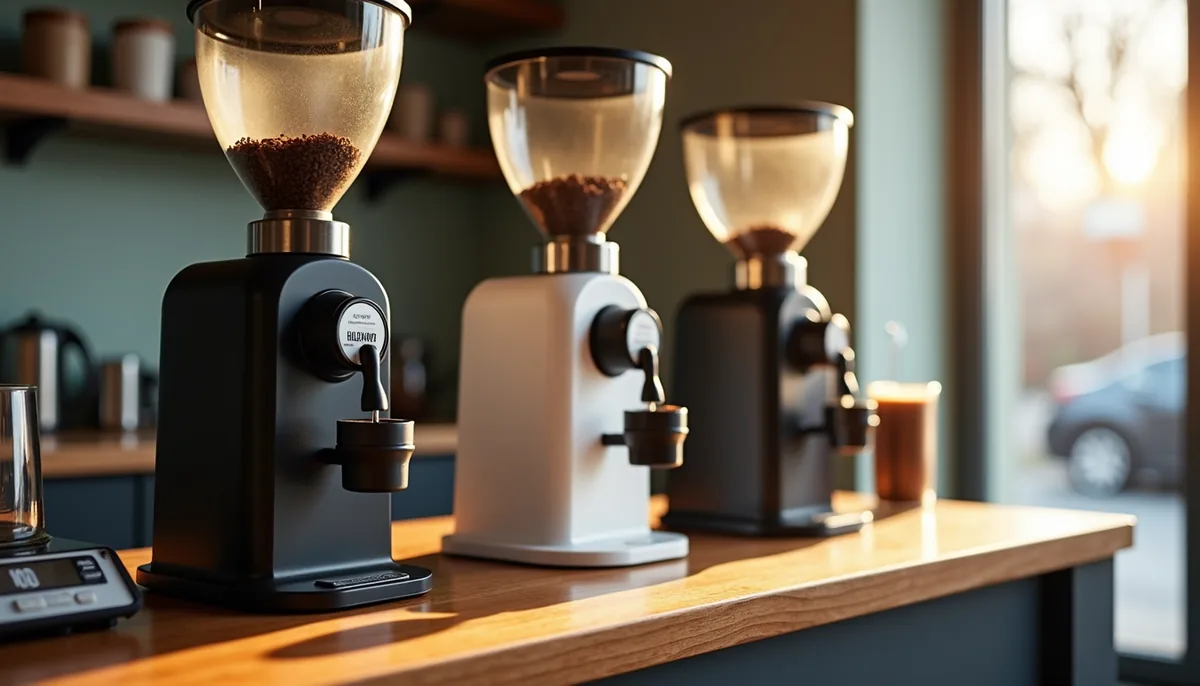
In short: All three are 65 mm flat burr, grind-on-demand espresso grinders with a hopper, not single dosers. Choose the Nadir 65 Touch for a quiet, steady home or office, the Atom W 65 if you want every dose weighed in the fork, and the MDXS for a small café that needs a big hopper and 1.5 kg a day.



| Burrs | All three: 65 mm flat steel burrs, stepless micrometric adjustment |
|---|---|
| Dosing | Nadir 65 Touch: by time · Atom W 65: by weight (scale in the fork) · MDXS: by time |
| Motor speed | Nadir: 1,350 rpm · Atom W: 1,370 rpm · MDXS: 900 rpm |
| Hopper | 1.2 kg · 1.2 kg · 1.6 kg |
| Height | 559 mm · 544 mm · 601 mm |
| Best suited to | Nadir: serious home, office · Atom W: busy home, small café · MDXS: café, second grinder |
Three commercial grinders, one question: who are they actually for?
Once you move past the usual home espresso grinders, the choice changes character. These three machines come from the commercial ranges of Eureka and Nuova Simonelli and sit roughly in the €700–1,700 bracket. They share the same core: 65 mm flat burrs, a hopper of well over a kilo and grind-on-demand straight into the portafilter.
What separates them is not the burr size but how they dose, how hard they can be worked and how they fit into your routine. One weighs every dose, two rely on a timer. One is built for café volumes, the other two are happiest in a demanding kitchen or a small office. That is what this guide is about. If you want the full detail on a single model, our individual reviews go deeper; here we focus on the decision.
A quick word on expectations. None of these is a single dose grinder. You fill the hopper, set the dose and grind as you go. If you weigh beans shot by shot and switch between espresso and filter several times a day, a home single dose grinder will suit you better, and our guide on choosing a home espresso grinder is the place to start.
Decision table: which grinder fits which situation
| Your situation | Nadir 65 Touch | Atom W 65 | MDXS |
|---|---|---|---|
| Home, 2 to 6 shots a day, one bean | Very good fit | Good fit, more than you need | Works, but tall and built for volume |
| Home, several drinkers, you want repeatable doses without a scale | Needs a scale to set the timer | Best fit | Needs a scale to set the timer |
| Office or co-working kitchen, many different users | Good fit, dose times can be locked | Good fit, doses can be password locked | Good fit |
| Small café, main grinder | Light duty only | Good fit, up to 2.3–3.8 kg a day | Good fit, 1.5 kg a day |
| Café, second grinder for decaf or a guest bean | Possible | Possible | Very good fit |
| Low ceiling under wall units | Measure first, 559 mm | Lowest, 544 mm | Tallest, 601 mm |
The table follows from manufacturer specifications. The only figure we have calculated ourselves is shot count per day for the MDXS: 1.5 kg divided by an 18 g double works out at roughly 80 to 100 doubles, depending on dose and how much you purge.
Dosing by time or by weight: the real difference
This is the axis that matters most in day-to-day use.
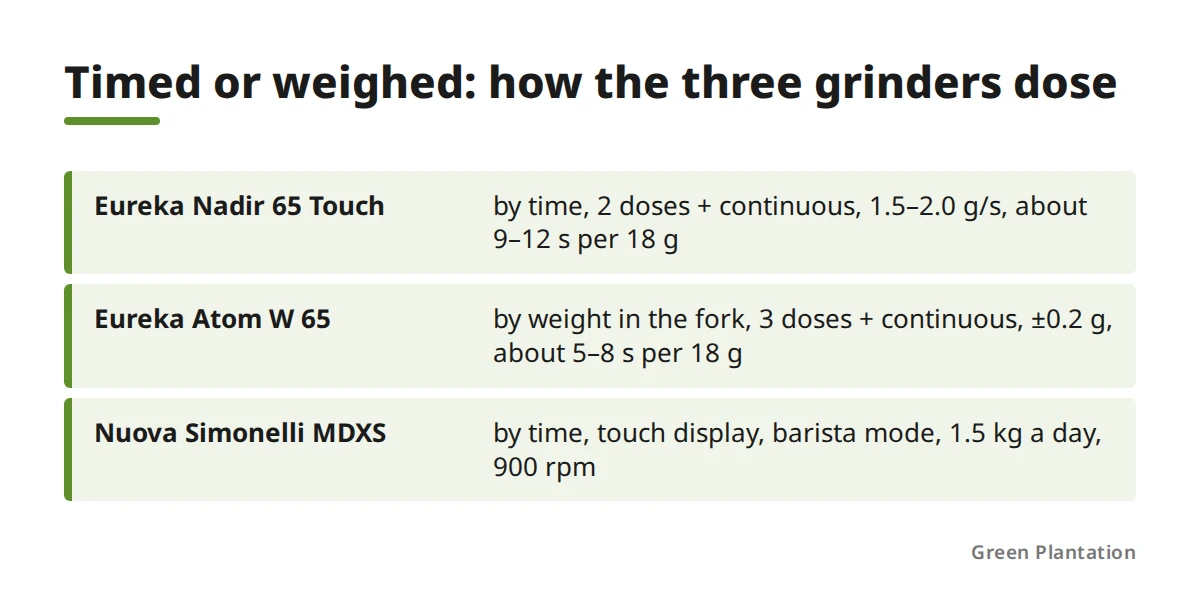
Timed dosing (Nadir 65 Touch, MDXS). You set a grind time per button and the grinder runs for exactly that long. The catch is that the same number of seconds does not always give the same number of grams. Fresher or older beans, a change of roast and every tweak to the grind setting shift the output. In practice you weigh a dose, adjust the time and repeat whenever the bean or grind changes. Both manuals describe exactly this calibration routine, and Eureka suggests its Precisa scale for the job. The Nadir offers two programmable doses plus continuous grinding up to 50 seconds; the MDXS adds a stop function, a manual barista mode, continuous grinding and counters on its touch display.
Weight-based dosing (Atom W 65). The fork that holds the portafilter has a built-in load cell. Eureka calls it Instant Grind Weighing Technology: you set grams, not seconds, and the grinder stops when the target is reached, with a stated accuracy of 0.2 g. There are three programmable doses plus continuous, and you can switch it back to timed dosing if you prefer. The fork is calibrated with a reference weight. One thing to be clear about: the Atom W 65 has no app, no Wi-Fi and no Bluetooth, at least none that Eureka lists. The scale lives in the fork, not on your phone.
What that means for you. If one person makes coffee with one bean, timed dosing is perfectly workable once it is set, and a scale on the drip tray keeps you honest. If several people use the grinder, or you change beans often, weighing in the fork removes a step and a source of argument. Our comparison of barista scales helps if you go the timed route.
Speed, duty cycle and daily capacity
| Specification (manufacturer) | Nadir 65 Touch | Atom W 65 | MDXS |
|---|---|---|---|
| Burrs | 65 mm flat, hardened steel | 65 mm flat, hardened steel | 65 mm flat, steel |
| Motor speed (230 V, 50 Hz) | 1,350 rpm | 1,370 rpm | 900 rpm |
| Power | 320 W | 280 W | 350 W (manual: 575 W) |
| Grind rate | 1.5–2.0 g/s | 2.3–3.8 g/s (manual: 2.8–3.3 g/s) | Not stated in g/s; 13 kg/h theoretical |
| Rated duty cycle (manual) | 60 s on / 1,200 s off | 30 s on / 270 s off | Not stated |
| Daily capacity | Not stated | 2.3–3.8 kg, peak 1 kg/h | 1.5 kg |
| Hopper | 1.2 kg | 1.2 kg | 1.6 kg |
| Dimensions H × W × D | 559 × 232 × 264 mm | 544 × 278 × 204 mm | 601 × 212 × 290 mm |
| Weight | 12 kg | 11.5 kg (manual: 13 kg) | 10 kg (manual: 12 kg) |
| Burr inspection interval | every 500–600 kg | every 500 kg | Not confirmed for MDXS |
Where the website and the manual disagree, we quote the website and give the manual figure in brackets.
From the grind rates, an 18 g double takes roughly 9 to 12 seconds on the Nadir and 5 to 8 seconds on the Atom W. That is our own arithmetic, not a manufacturer claim. For a household it makes little difference. For a queue at 8 am it is the difference between the grinder waiting for the barista and the barista waiting for the grinder.
The MDXS takes a different approach: a slower motor at 900 rpm, which keeps heat in the burrs down over a long shift, and a stated capacity of 1.5 kg a day. Nuova Simonelli pairs it with its Appia Life espresso machine, which tells you the target: a neighbourhood café or a restaurant, not a home counter.
At home, in the office or in a small café
A serious home setup
The Nadir 65 Touch is the calmest choice here. It is matt black, has a die-cast aluminium body with a stainless steel top plate, lights the portafilter, and drops into standby after a minute. Display brightness runs from 1 to 7, which helps in a kitchen that doubles as a living space. Eureka's ACE system is designed to reduce clumping and static, and the hands-free fork lets you grind without holding the portafilter.
The Atom W 65 makes sense at home when more than one person pulls shots or when you change beans weekly. It is also the most compact in depth at 204 mm and the lowest at 544 mm, with Eureka's Silent Technology.
Offices and shared kitchens
Here the deciding factor is people, not beans. The Nadir can lock its dose times, the Atom W can lock its doses with a password, and both count shots. That stops well-meaning colleagues from turning an 18 g double into a 25 g puck.
A small café
For a main grinder on a single-group or compact two-group machine, the Atom W 65 and the MDXS are the realistic options. The Atom W brings speed and weight-based dosing, rated for 2.3–3.8 kg a day. The MDXS brings the larger 1.6 kg hopper, a removable stainless steel chute, a portafilter hook and a redesigned clump crusher. Many cafés run it as a second grinder for decaf or a guest roast next to their main unit, a set-up we discuss in two grinders in your café. For wider background on commercial models, see how to choose a professional espresso grinder.
Grind adjustment, cleaning and burrs
All three use stepless micrometric adjustment. On the Nadir and Atom W (and on the MDX, the MDXS's predecessor) the manuals say the same: turn clockwise to grind finer, change the setting gradually, and grind while adjusting by no more than two marks at a time. Turning a full revolution with the motor stopped can jam the burrs.
Owners of the Atom W also report that after a grind change it takes about two doses before the output settles, which is worth knowing before you pour the first shot down the sink.
For cleaning, the Nadir manual recommends washing the hopper at least once a week in water with a neutral detergent, never in the dishwasher. Burrs are cleaned with a brush or dry cloth, a vacuum, compressed air or grinder cleaning tablets. Servicing is for an authorised technician with original parts. Our general guide to cleaning the coffee machine and grinder covers the routine in more detail.
Burr life is long. Eureka gives an inspection interval of 500 to 600 kg for the Nadir and 500 kg for the Atom W, and the Atom W has an alarm that reminds you. At home that is many years of use; in a café it is a planned maintenance item.
What owners report
Public owner feedback is uneven across the three, and it is fairer to say so than to fill the gap.
Atom W 65. Across 67 live threads in r/espresso (archive checked on 17 November 2026), 31 were purchase decisions. The most common complaint, in 8 threads, was mess and spraying of grounds plus limited space under the chute. 5 threads dealt with the scale overshooting by 0.7–0.9 g and needing recalibration, in rare cases a service visit. 5 mentioned the height or hopper, 2 reported faults that the seller resolved by replacement, and 1 mentioned retention. 7 threads were clearly positive: quiet, robust and a quick workflow.
Nadir 65 Touch and MDXS. We found almost no publicly documented owner experiences, neither on Reddit nor on the usual forums. What we can say is that Nuova Simonelli itself reworked the MDXS clump crusher to improve static and consistency. Beyond that, rely on the specifications rather than on anecdotes.
Weak points to weigh up
- Height. All three are over 54 cm tall with the hopper fitted. Measure the space under your wall units before ordering.
- Timed dosing drifts. Nadir and MDXS need re-checking with a scale after each bean or grind change.
- The Atom W scale needs care. Recalibrating with the reference weight solves most overshoot reports.
- Not for switching brew methods. With a full hopper, moving between espresso and filter several times a day is impractical.
- Size and weight. 10 to 12 kg on paper, more with beans. These are counter fixtures, not appliances you put away.
Verdict
Pick the Nadir 65 Touch for a refined home or office setup where calm operation and a timer you set once a week are enough. Pick the Atom W 65 if weighing in the fork is what you are really paying for: several users, frequent bean changes or a small café that needs speed. Pick the MDXS when the job is volume and robustness: a café, a restaurant or a dedicated second grinder with the largest hopper of the three.
Frequently asked questions
Is a 65 mm flat burr grinder overkill for home?
Not if you drink espresso daily and stick to one or two beans. It is overkill if you mainly brew filter or switch methods often, in which case a home single dose grinder is the better buy.
Is grinding by weight better than grinding by time?
The grounds are the same; the repeatability is not. Weight-based dosing hits the target dose without a separate scale, while timed dosing needs recalibrating when beans or grind change.
Can the Eureka Atom W 65 connect to an app?
No. Eureka lists no app, Wi-Fi or Bluetooth. The scale is built into the portafilter fork.
Are these single dose grinders?
No. All three are grind-on-demand grinders with 1.2 to 1.6 kg hoppers.
How often do the burrs need changing?
Eureka advises inspecting the burrs every 500 kg on the Atom W and every 500 to 600 kg on the Nadir. For the MDXS we have no confirmed interval.
Which is best for a small café?
The Atom W 65 as a fast main grinder with weight-based dosing, or the MDXS for its 1.6 kg hopper and 1.5 kg daily capacity, often as a second grinder.
Recommended products
- Eureka Nadir 65 Touch, black: the quiet, timed 65 mm grinder for a demanding home or office.
- Eureka Atom W 65 white: weight-based dosing in the fork, rated up to 3.8 kg a day.
- Eureka Atom W 65 red: the same grinder in red for a café counter with a bit of colour.
- Nuova Simonelli MDXS black: the volume option with a 1.6 kg hopper, ideal as a café's second grinder.
- Eureka Precisa digital scale 2000 g / 0.1 g: the scale Eureka suggests for setting timed doses.
- Nuova Simonelli clump crusher for MDXS and MDJ: a spare part worth keeping in a café drawer.
Sources
- Eureka: Nadir 65 Touch and user handbook (PDF)
- Eureka: Atom W 65 and user manual (PDF)
- Nuova Simonelli: MDXS
- Nuova Simonelli: MDX On Demand manual (PDF)
Updated: November 2026
Author: Petra Novotná, editorial name of the Green Plantation.
You might also like
 Eureka Atom Pro review: experience, tech and limits of the 75 mm filter grinder
The Eureka Atom Pro is a filter grinder with 75 mm brew burrs and a Blow-Up bellows. Who it is worth it for, how to set it up and why it is not an espresso… 26. 11. 2026
 Eureka Costanza Review: HX Machine with PID, Costanza R and Owner Experiences
The Eureka Costanza is a compact E61 heat exchanger machine with PID and a shot timer. We clear up the dual boiler myth, explain how it differs from the… 26. 11. 2026
 Grind-by-Weight Coffee Grinders: Eureka Atom W 65, Atom W 75 or Mahlkönig E65S GbW? 2026 Comparison
Comparison of the Eureka Atom W 65, Atom W 75 and Mahlkönig E65S GbW grind-by-weight grinders: dose accuracy, speed, step-by-step calibration and a calculation… 26. 11. 2026