
 Česky (CZK)
 Slovensky (EUR)
 Magyar (HUF)
 Polski (PLN)
 English (EUR)
 Deutsch (EUR)
 Français (EUR)
 Español (EUR)
 Português (EUR)
 Italiano (EUR)
 Svenska (SEK)
 Suomi (EUR)
 Nederlands (EUR)
 Dansk (EUR)
 Lëtzebuergesch (EUR)
 Eesti (EUR)
 Latviešu (EUR)
 Lietuvių (EUR)
 Slovenščina (EUR)
 Română (RON)
 Български (EUR)
 Hrvatski (EUR)
 Ελληνικά (EUR)
 Українська (EUR)
 Norsk (EUR)
 Srpski (EUR)
 Tiếng Việt (EUR)
How to brew loose leaf tea: grams, temperature and time for 10 teas in one table
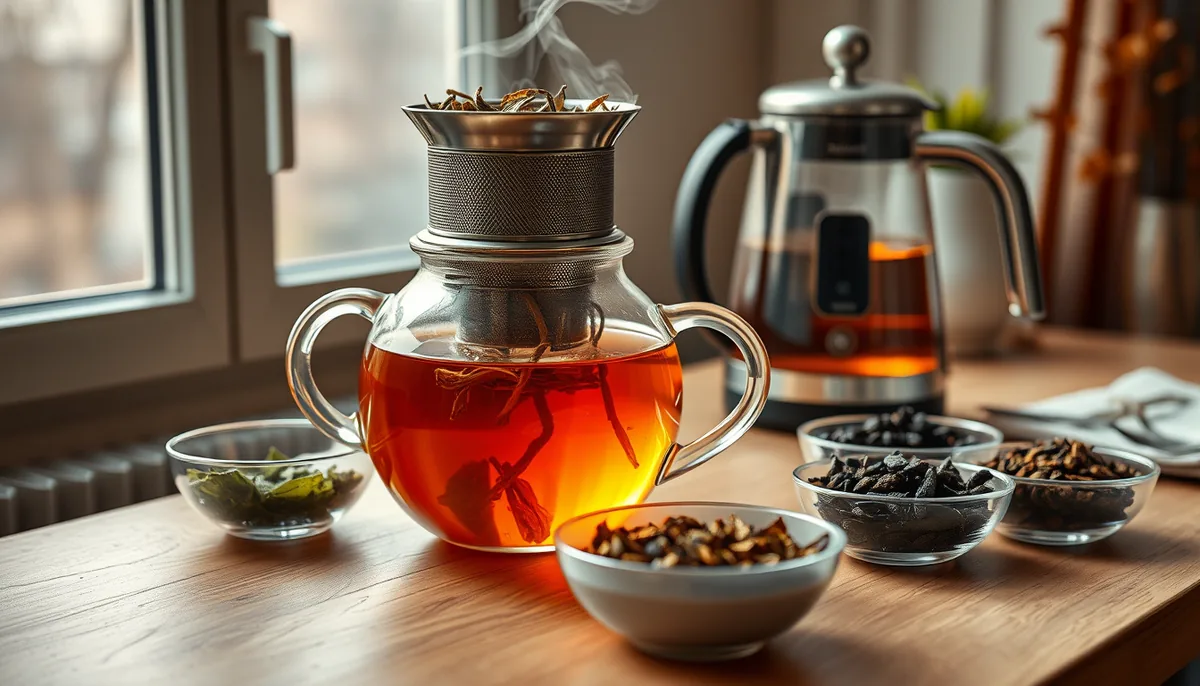
In short: For loose leaf tea, allow roughly 1 g of leaf per 100 ml of water, and 1.5–2 g for white tea, oolong and fruit tea. Black tea wants freshly boiled water for 3–5 minutes, green tea 70–85 °C water for 1–3 minutes. The leaves need room to unfurl, so use a roomy infuser basket or a teapot rather than a tea ball.



| Basic dose | 2.5 g (one heaped teaspoon) for a 250 ml mug |
|---|---|
| Water temperature | 70–80 °C Japanese green, 75–85 °C Chinese green and white, 85–95 °C oolong, 95–100 °C black, pu-erh, fruit and herbal teas, rooibos |
| Steeping time | 1–3 min green, 3–5 min black, 5–10 min herbal and fruit |
| How many infusions | green and white 2–3, oolong 3–5 in a teapot, pu-erh in a gaiwan up to 10–20 |
| How many cups | about 40 mugs from 100 g of black or green tea, more with re-steeping |
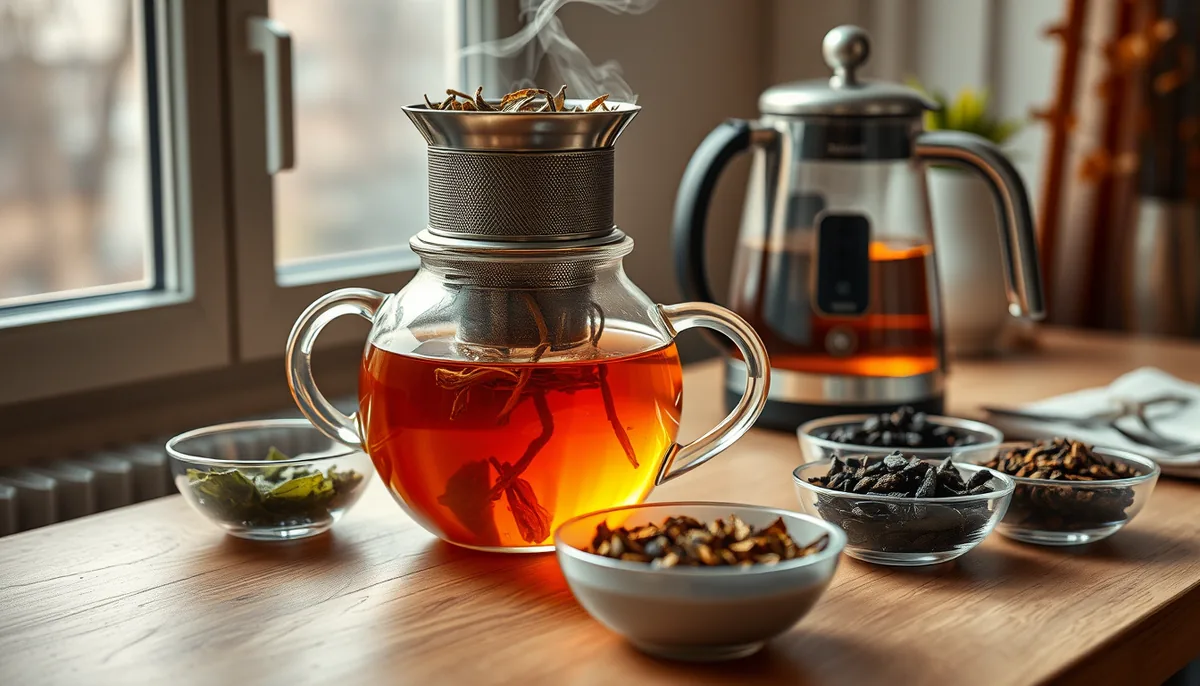
A grey November afternoon, and on the shelf sits a pouch of loose sencha from a tea shop or a Ceylon black tea you were given. You spoon some into a tea ball, pour on water straight off the boil and leave it to steep for "a bit". The result is bitter and harsh, and you start to think the teabags were better after all. We hear the question a lot: "Am I doing something wrong, or is the tea just bad?"
Almost always, the tea is fine. Three numbers decide the cup: how many grams, how hot the water is and how many minutes. Add a brewing vessel that lets the leaves open up, and you are there. Print the table below and stick it on the fridge.
Tea or herbal tea? An important difference
In everyday English, "tea" covers chamomile, rosehip, peppermint and fruit blends too. Strictly speaking, these herbal and fruit teas (tisanes) are not leaves of the tea plant (Camellia sinensis) but infusions of other plants. The difference matters in the kitchen: true tea (white, green, oolong, black, pu-erh) is sensitive to water temperature and timing, while herbal and fruit teas want boiling water and a longer steep, and they contain no caffeine. Rooibos and yerba mate are categories of their own. Neither comes from the tea plant, but mate does contain caffeine.
We have written separately about why to drink herbal teas and how to make warming drinks for winter evenings.
Loose leaf tea vs. teabags
Standard teabags are mostly filled with so-called fannings, the smallest grade left over once the larger leaves have been sorted out. These tiny particles have a huge surface area, so they release colour and tannins within a minute or two. That is why a teabag colours the water so quickly, but it also turns bitter just as fast and the flavour is simpler.
Whole or coarsely broken leaves infuse more slowly, expand several times over and release the more delicate aromas. To do that, they need water around them, not the walls of a bag.
There are practical reasons too. A good loose tea will stand a second and third infusion, a teabag almost never will. The packaging matters as well: research from McGill University in Canada (Hernandez et al., 2019) found that plastic teabags made of nylon and PET release billions of micro- and nanoparticles per cup during steeping. This does not apply to paper teabags. If you want to learn how to spot good leaf, see how to recognise quality loose tea.
Table: how many grams, what temperature, how long
The values are for European-style brewing in a teapot or mug and are starting points: if you like your tea stronger, add more leaf rather than more minutes. If the packet gives its own recommendation, follow that.
| Type | Dose per 100 ml | For a 250 ml mug | Water temperature | 1st infusion time | Number of infusions |
|---|---|---|---|---|---|
| Black (Ceylon, Assam, Darjeeling) | 1–1.2 g | 2.5–3 g | 95–100 °C | 3–5 min | 1–2 |
| Chinese green | 1 g | 2.5 g | 75–85 °C | 2–3 min | 2–3 |
| Japanese green (sencha) | 1–1.5 g | 2.5–3.5 g | 70–80 °C | 1–2 min | 2–3 |
| White (Pai Mu Tan) | 1.5–2 g | 4–5 g | 75–85 °C | 3–5 min | 2–3 |
| Oolong | 1.5 g | 3.5–4 g | 85–95 °C | 2–4 min | 3–5 |
| Pu-erh | 1.5 g | 3.5–4 g | 95–100 °C, rinsed first | 2–4 min | 3–5 |
| Fruit tea | 1.5–2 g | 4–5 g | 100 °C | 8–12 min | 1 |
| Herbal tea (blend) | 1–1.5 g | 2.5–3.5 g | 95–100 °C | 5–10 min | 1 |
| Rooibos | 1–1.5 g | 2.5–3.5 g | 100 °C | 5–8 min | 1–2 |
| Yerba mate | 1.5–2 g | 4–5 g | 80–100 °C | 3–5 min | 2–3 |
For comparison: the international standard ISO 3103, which tasters use to compare samples side by side, specifies 2 g of black tea per 100 ml of boiling water and a 6-minute steep. That is a deliberately strong test brew, roughly double what you need for an everyday cup.
Caffeine also depends on time: the longer the leaf steeps, the more is extracted. A cup of black tea usually contains less caffeine than a cup of coffee, and our article 9 facts about caffeine in your coffee and tea sums up the details. For a caffeine-free evening, rooibos is the easiest choice.
Gaiwan and small teapot: more leaf, shorter time
In Asia, oolong and pu-erh are usually drunk "gongfu style", in many short infusions. Put 4–6 g of leaf into a 100–150 ml gaiwan or small teapot, pour off the first infusion after 10–20 seconds (for pu-erh, this is the rinse), then steep for 15–45 seconds, a little longer with each infusion. According to the tea merchant Yunnan Sourcing, a good pu-erh can take 10–20 infusions this way.
How to brew loose leaf tea step by step
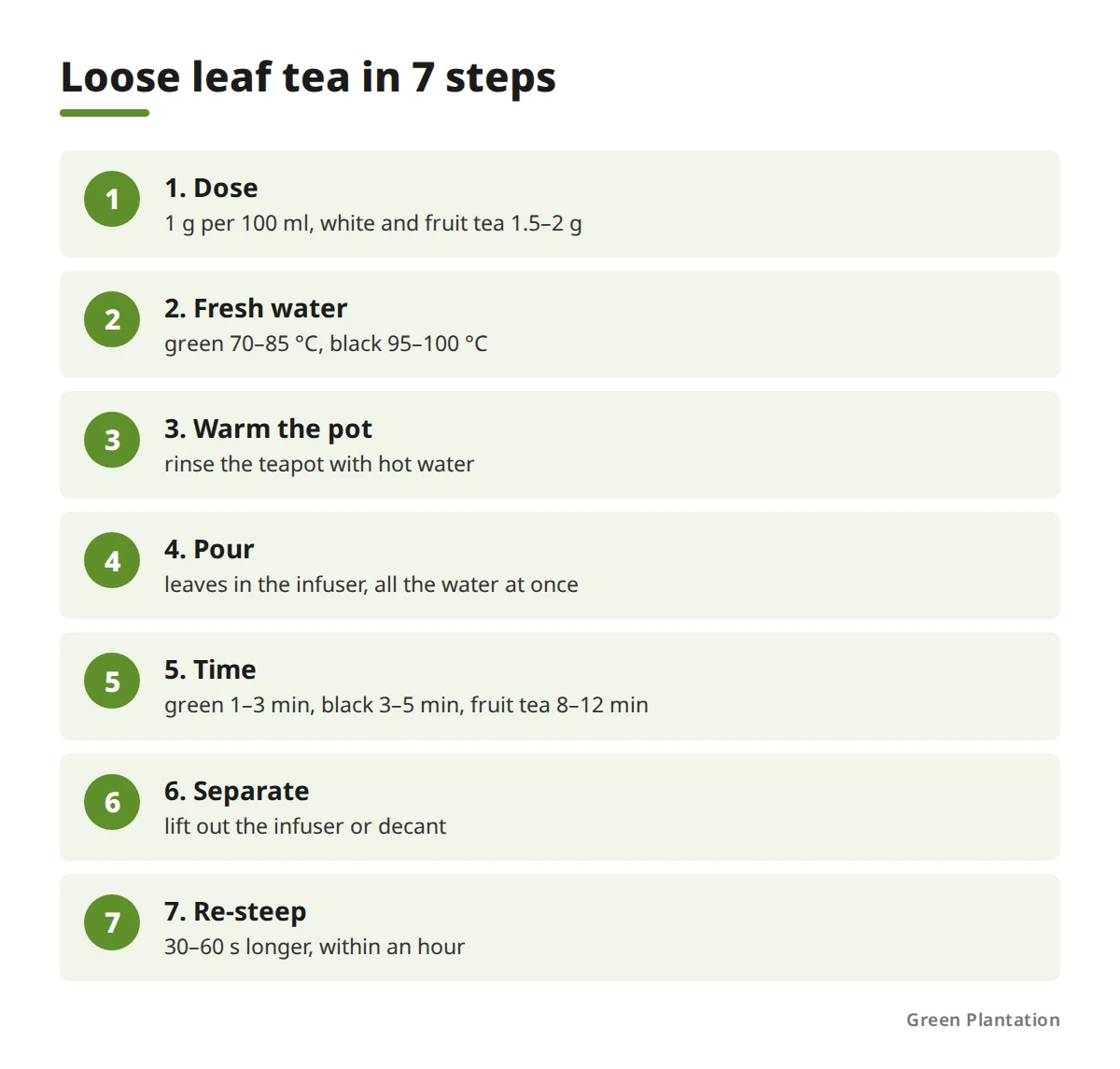
- Weigh it, or at least measure it the same way every time. A teaspoon of black tea is about 2–3 g, while bulky white tea or mate is often only 1–1.5 g. Using kitchen scales for the first week pays off.
- Heat fresh water. Do not reboil what has been sitting in the kettle since the morning. For green and white tea, do not bring the water to a full boil, or let it cool for 3–5 minutes with the lid open.
- Warm the pot or mug. A quick rinse with hot water is enough. Cold china takes a few degrees off the water.
- Leaves in the infuser, water on the leaves. Pour the full amount in one go so that the leaves are submerged.
- Watch the clock. Most ruined cups are over-steeped, not badly bought.
- Remove the leaves. Lift out the infuser or decant the tea into another vessel. Tea left standing on the leaves turns bitter.
- Second infusion within an hour. Leave the wet leaves in the infuser, not sitting in a puddle. Steep the second infusion 30–60 seconds longer.
Equipment: infuser, tea ball or teapot?
Loose tea does not need an expensive ritual. What matters is how much room the leaves have and how easily you can get them out of the water.
| Equipment | Room for the leaves | Good for | Weakness |
|---|---|---|---|
| Tea ball (mesh or perforated) | little, the leaves get squashed | finely broken black tea in a pinch | uneven extraction, large leaves cannot open |
| Large basket infuser that sits in the mug | good, reaches almost to the bottom | any tea in your everyday mug | fine mesh is harder to clean, tiny particles get through |
| Teapot with infuser | plenty | black, green and fruit tea for 2–3 people | if you leave the infuser in, the tea over-steeps |
| Cafetière (French press) | plenty, the leaves float freely | black, fruit and herbal tea, rooibos | after plunging, the leaves stay in the water, so decant straight away; coffee aromas linger in the filter |
| Gaiwan (lidded cup) | plenty | oolong, pu-erh, green tea in short infusions | takes practice, hot on the fingers |
Why not a tea ball? Dry leaves expand to three times their size or more in water. A half-filled tea ball clogs within a minute and the water only flows around the surface. If you have one, fill it no more than a third full and use it for small broken-leaf tea.
One rule applies to the cafetière: keep a separate one for tea, or after coffee really take it apart and wash it thoroughly. Coffee oils easily transfer from the filter into a delicate green tea.
The biggest help is a temperature-controlled kettle. It saves you guessing how many minutes the water needs to cool. Without one, a thermometer or a simple rule will do: boiled water with the lid open cools to around 80 °C in a few minutes, with the exact time depending on the volume and the kettle.
Water: why the same tea tastes different in London and in Scotland
Hard water, rich in calcium and magnesium, makes black tea darker and flatter, with a shiny scum on top. Green tea loses its freshness in hard water. Completely soft, demineralised water, on the other hand, brings out bitterness and makes the tea taste hollow.
In the UK, water hardness is usually given in milligrams of calcium carbonate per litre (mg/l CaCO3); water above about 200 mg/l counts as hard, below about 100 mg/l as soft. Your water supplier publishes the figure for your postcode. For tea, soft to moderately hard water with a neutral pH works best. We cover this in detail, with numbers, in 5 essential properties of water for making tea. In practice: if your kettle furs up quickly, try a filter jug or a bottled water low in minerals. You will taste the difference in the very first cup of green tea. Avoid highly mineralised mineral water for tea.
Common mistakes: bitter, harsh or weak tea
- Bitter green tea: almost always water that is too hot or a steep that is too long. Try 10 °C cooler and a minute shorter, keeping the same dose.
- Harsh black tea that "dries your mouth": tannins from a long steep. With black tea, the flavour does not improve after 5 minutes, it only gets harder. Milk softens it, but shortening the time is better.
- Tasteless white tea: white tea is bulky and a teaspoon is not enough. Allow 2 g per 100 ml and give it a full 5 minutes.
- Cloudy fruit tea with no fruit flavour: too little time or water below boiling point. Fruit teas want boiling water and 8–12 minutes.
- Bitter herbal tea: with some herbs, such as wormwood or yarrow, bitterness is a feature, not a fault.
Storage, and how many cups you get from 50 or 100 g
Tea dislikes light, air, moisture and strong smells. Keep it in an opaque, airtight caddy in a dry cupboard, not above the cooker and not next to coffee or spices, as the leaves readily take on other aromas. Never put a wet spoon into the caddy.
Green and white teas are at their best for a few months after opening, while black tea, rooibos and pu-erh keep longer.
| Type | Dose for a 250 ml mug | Mugs from 50 g | Mugs from 100 g |
|---|---|---|---|
| Black, Chinese green | 2.5 g | 20 | 40 |
| Sencha | 3 g | 16 | 33 |
| Oolong (2 infusions per dose) | 4 g | 25 infusions | 50 infusions |
| White tea | 4.5 g | 11 | 22 |
| Fruit tea | 4.5 g | 11 | 22 |
| Rooibos, herbal tea | 3 g | 16 | 33 |
The calculation is simple: divide the weight of the pack by the dose.
To be honest: the downsides of loose tea
- More work. Measuring, watching the temperature, removing and washing the infuser. For a single cup at the office, a teabag is simply quicker.
- Infusers let fine particles through. A fine sediment appears at the bottom of the mug, especially with rooibos, broken black tea and spiced blends. A finer infuser helps, or just leave the last sip in the mug.
- Infusers stain. Tannins leave a brown deposit. Soak it in warm water with bicarbonate of soda now and then and scrub it with a brush.
- Measuring by the spoon is imprecise. A spoonful of white tea and a spoonful of fruit tea can differ by a factor of two. Without scales, expect a few attempts before you find your own dose.
Frequently asked questions
How many grams of tea do I need for one cup?
About 2.5 g for a 250 ml mug, which is one heaped teaspoon of black or green tea. White tea, oolong and fruit tea need 4–5 g, because they are bulkier or heavier.
What water temperature is right for green tea?
70–80 °C for Japanese green tea (sencha) and 75–85 °C for Chinese green tea. The main cause of bitter green tea is boiling water.
How long should I steep black tea?
3–5 minutes in freshly boiled water. Broken-leaf teas (BOP) need only 3 minutes, whole-leaf teas (OP) can take 4–5 minutes. Steeping longer adds harshness rather than strength.
How many times can I re-steep loose tea?
Green and white tea 2–3 times, oolong 3–5 times in a teapot, pu-erh up to 10–20 times in a gaiwan. Steep the second infusion 30–60 seconds longer. With fruit and herbal teas, and most black teas, the second infusion is noticeably weaker.
How do I make loose tea without an infuser?
Put the leaves straight into the pot or mug and, when the time is up, pour the tea through a kitchen sieve into another vessel. A cafetière works too. The key is to separate the leaves from the tea once it has steeped.
How do I make a good fruit tea?
Be generous with the dose (4–5 g per mug), pour on boiling water and leave it to steep for 8–12 minutes with a lid on. The fruit pieces release their flavour slowly, and too short a steep is the most common reason for weak, sour-tasting fruit tea.
Recommended products
- Hario Chacha Kyusu-Maru 300 ml teapot: heat-resistant glass teapot with a stainless steel infuser for one large mug of tea. You can watch the leaves unfurl, and the infuser gives them plenty of room.
- Espro small tea filter: tea filter insert for the smaller Espro presses. If you also make tea in your press, a separate filter stops coffee oils from getting into the tea (check compatibility on the product page).
- Timemore Fish Smart Pro 900 ml digital kettle: temperature adjustable to the degree, so with green and white tea you do not have to wait for the water to cool.
- China Sencha green tea: a good first green tea for practising water temperature and the second infusion.
- English Breakfast leaf black tea: a loose black tea that is ideal for tasting the difference between a 3- and a 5-minute steep.
- Organic Pu Erh fermented tea: for trying the rinse and many short infusions in a small teapot.
Sources
- ISO 3103: preparing a liquor of tea for sensory tests (2 g per 100 ml, 6 minutes)
- Hernandez et al. (2019): Plastic Teabags Release Billions of Microparticles and Nanoparticles into Tea, Environmental Science & Technology
- Yunnan Sourcing: Brewing guide for green, black, oolong and pu-erh teas
- Tea bag: fannings in teabags
- Hard water: measurement and classification of water hardness
Updated: November 2026
Author: Petra Novotná, editorial name of the Green Plantation.
You might also like
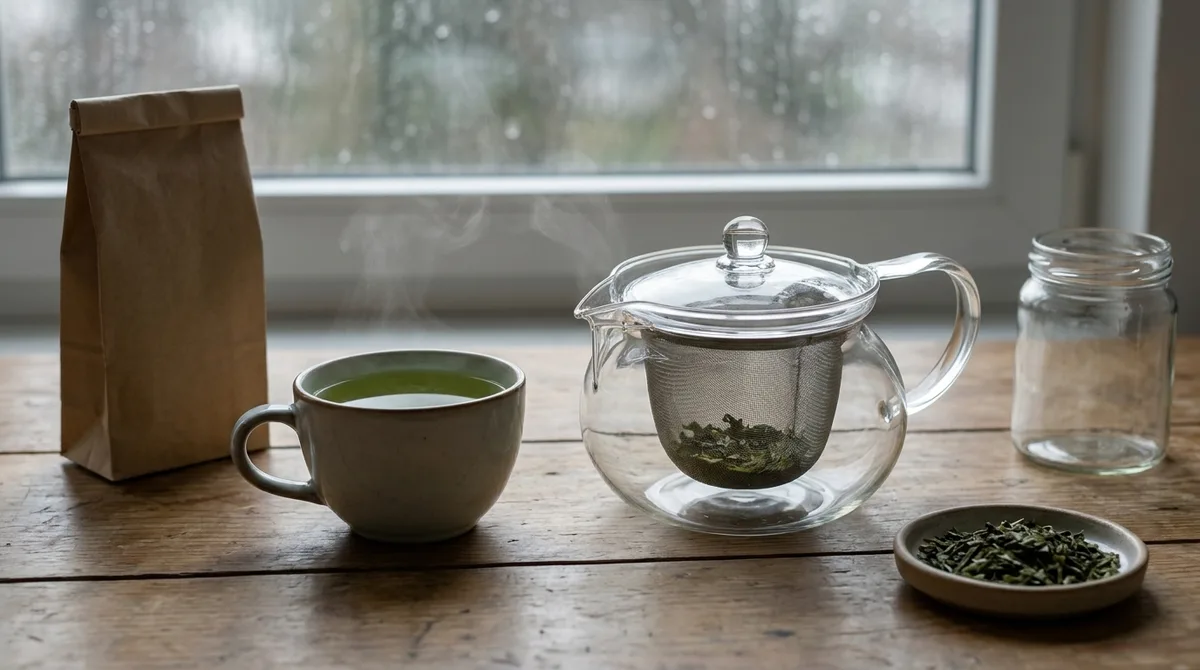 Teapot: How to Choose the Material, Size and Strainer
A good teapot really comes down to material, size and strainer. We’ll help you choose the right one for green, black and herbal tea, and show you how to brew… 4. 10. 2026
 Cascara: The Dried Coffee Cherry Husk, and How to Brew It
The dried coffee cherry husk that tastes like fruit tea: where it comes from, what EU law says about it, and how to brew it hot or cold. 4. 10. 2026
 Chai – authentic masala chai and chai latte
Chai – Authentic Masala Chai and Chai Latte 6. 3. 2026