Česky (CZK)
 Slovensky (EUR)
 Magyar (HUF)
 Polski (PLN)
 English (EUR)
 Deutsch (EUR)
 Français (EUR)
 Español (EUR)
 Português (EUR)
 Italiano (EUR)
 Svenska (SEK)
 Suomi (EUR)
 Nederlands (EUR)
 Dansk (EUR)
 Lëtzebuergesch (EUR)
 Eesti (EUR)
 Latviešu (EUR)
 Lietuvių (EUR)
 Slovenščina (EUR)
 Română (RON)
 Български (EUR)
 Hrvatski (EUR)
 Ελληνικά (EUR)
 Українська (EUR)
 Norsk (EUR)
 Srpski (EUR)
 Tiếng Việt (EUR)
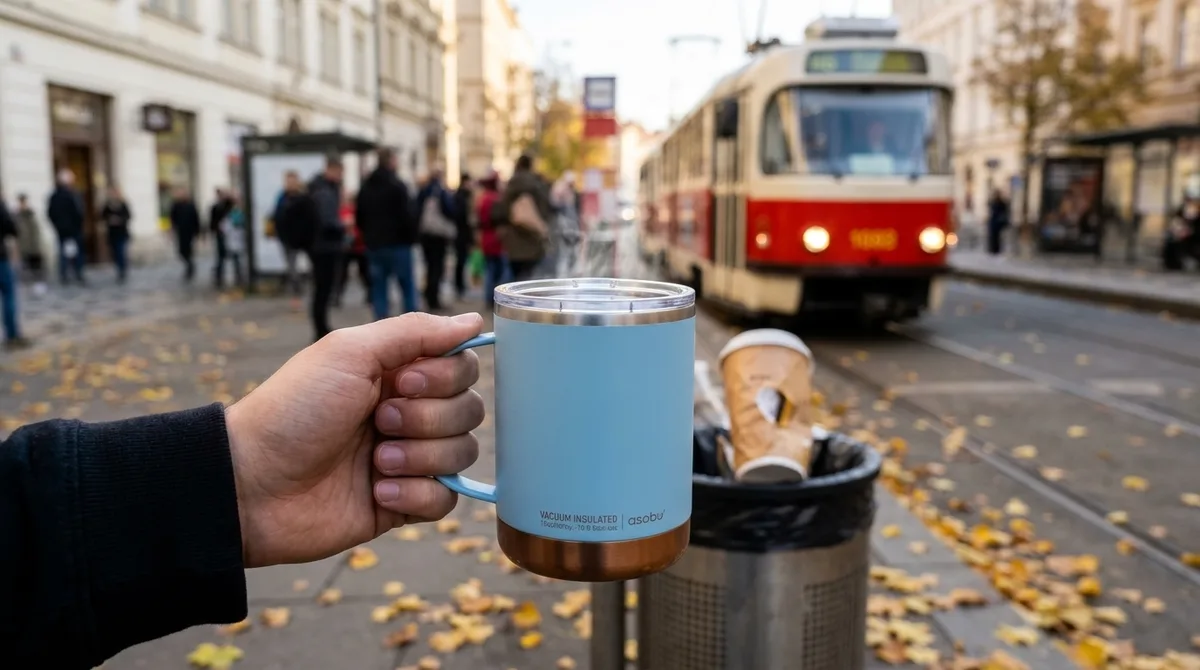
The Problem with Disposable Cups
Every day, an estimated 16 billion paper cups are thrown away worldwide. Not millions – billions. In the European Union alone, it's around 2.5 billion per year. And despite the name "paper" cup, these cups aren't just paper – and that's where the core problem lies.



Why a Paper Cup Isn't Recyclable
A typical "paper" coffee cup contains an inner layer of polyethylene (PE) – a thin plastic film that prevents liquid from seeping through the paper. This PE layer causes three fundamental problems:
- Makes regular recycling impossible – paper and plastic are inseparably bonded and most recycling facilities cannot separate them
- Prevents composting – PE doesn't break down under normal conditions
- Contaminates paper waste – a cup thrown into a blue container reduces the quality of the entire batch of recycled material
Result: more than 99% of paper cups end up in landfills or incinerators. In nature, they take decades to break down – the PE layer even longer.
Lids Are an Even Bigger Problem
Plastic lids made from polystyrene or polypropylene are harder to recycle than the cup itself. They're small, lightweight, easily lost outside containers, and break down for hundreds of years in nature. In the oceans, they rank among the ten most commonly found plastic waste items.
The Carbon Footprint of a Disposable Cup
One paper coffee cup to go passes through an entire chain of environmental impacts:
| Phase | Impact |
|---|---|
| Paper production | Logging, energy and water consumption, bleaching chemicals |
| PE layer | Oil → polyethylene → lamination |
| Printing | Inks, solvents |
| Distribution | Transport from factory to café |
| Use | 15 minutes of drinking |
| Disposal | Landfill or incinerator |
One paper cup is estimated to represent 110 g CO2 equivalent. With 2.5 billion cups per year in the EU, that's 275,000 tons of CO2 – just from coffee cups.
Types of Reusable Cups
Switching to a reusable cup is the simplest and most effective step you can take to reduce coffee waste. Each material has its strengths – it depends on how you drink coffee and what you expect from a cup.
Stainless Steel
Stainless steel travel mugs are the most durable and longest-lasting solution. A quality stainless steel cup can withstand decades of intensive daily use.
Advantages:
- Virtually indestructible – withstands drops, impacts, and pressure
- Excellent thermal insulation (double-walled, vacuum) – keeps coffee hot for 4–8 hours
- Taste-neutral – leaves no odor or flavor in the beverage
- Easy to wash – dishwasher safe
- Fully recyclable at end of life
Disadvantages:
- Heavier than other materials
- Not transparent – you can't see how much beverage is left
- Cheaper versions may develop a metallic taste (poor quality steel)
- Higher initial cost (15–40 €)
Explore our travel mugs and thermoses in stainless steel.
Glass
Glass travel cups, often with a protective silicone sleeve, are popular for their taste purity – glass doesn't affect the flavor or aroma of the beverage.
Advantages:
- Completely taste-neutral – no interaction with the drink
- Transparent – you see the contents and the color of your coffee
- Aesthetically appealing, suitable for specialty coffee
- Recyclable, silicone sleeve is compostable
- Microwave-safe (versions without metal parts)
Disadvantages:
- Fragile – risk of breakage even with protective sleeve if dropped
- Weaker thermal insulation in single-walled variants
- Heavier than plastic or bamboo
- Quality double-walled versions are more expensive (20–35 €)
Bamboo
Bamboo cups enjoy popularity thanks to their natural aesthetic – bamboo is a rapidly renewable material that grows without pesticides. When purchasing, however, increased attention is necessary.
Advantages:
- Light, pleasant natural appearance
- Renewable material with low farming requirements
- Affordable price (8–15 €)
Disadvantages:
- Important warning: Most "bamboo" cups contain melamine resin. At temperatures above 70 °C it can release formaldehyde and melamine into the beverage. The EU banned bamboo-melamine cups for contact with hot food in 2020 – always verify certification and insist on cups without melamine
- Absorb odors and flavors after prolonged use
- Not suitable for dishwashers
- Shorter lifespan (1–2 years)
Silicone
Collapsible silicone cups are the most compact solution for active travelers and people who need a cup to fit in a pocket.
Advantages:
- Collapsible – shrinks to one third of original size
- Very light and unbreakable
- Heat resistant
- Affordable (10–20 €)
Disadvantages:
- Silicone taste in cheaper versions, especially with first uses
- Less aesthetic
- Weaker thermal insulation
- Silicone attracts greasy residues – requires more thorough washing
- Gradual discoloration from coffee with prolonged use
Thermal Insulation Comparison
The ability to maintain beverage temperature is one of the decisive factors when choosing a travel cup – especially for those who drink coffee during a longer journey or work morning.
| Material | Insulation Type | Hot Beverage (above 65 °C) | Cold Beverage (below 10 °C) |
|---|---|---|---|
| Stainless steel double-walled vacuum | Vacuum gap | 6–8 hours | 12–24 hours |
| Stainless steel double-walled | Air gap | 3–4 hours | 6–8 hours |
| Stainless steel single-walled | None | 30–60 minutes | 1–2 hours |
| Double-walled glass | Air gap | 2–3 hours | 4–6 hours |
| Single-walled glass | None | 20–40 minutes | 1 hour |
| Silicone | Material | 30–60 minutes | 1–2 hours |
| Bamboo | Material | 30–45 minutes | 1 hour |
| Paper cup | None | 10–20 minutes | 20–30 minutes |
For maximum insulation throughout the morning, a stainless steel vacuum cup is the choice. If you finish your coffee within an hour, glass or silicone offer a more convenient and lighter compromise.
Discover our thermoses with vacuum insulation – ideal for all day, and travel bottles for cold brew and chilled beverages.
Keep Cup Programs and Shared Cups
How Keep Cup Programs Work
Keep cup programs incentivize customers to bring their own cup instead of using a disposable one. Cafés typically implement them in one of three ways:
- Beverage discount – The most common approach: 0.20–0.50 € off with your own cup
- Bonus loyalty points – Extra points for the eco-friendly choice within a loyalty program
- Surcharge for disposable – Opposite logic: a disposable cup costs 0.20–0.50 € extra. Psychological research confirms that people react more strongly to loss than to an equal gain – a surcharge therefore works more effectively than a discount
Shared Cup Systems
In some European cities, cup-sharing systems operate on a deposit principle. The customer uses the cup and returns it at any participating café. Systems like RECUP in Germany or Again in the UK have hundreds of partner establishments.
How a typical cycle works:
1. Customer buys a beverage in a borrowed cup and pays a deposit of 1–2 €
2. After finishing, returns the cup at any participating café
3. Deposit is refunded or deducted from the next beverage
4. Cup is industrially washed and returned to circulation
Ecological Alternatives to Standard Paper Cups
For situations where a disposable cup is truly necessary – large events, festivals, establishments without washing capacity – there are more meaningful alternatives to the standard PE cup.
Compostable Cups (PLA Inner Layer)
Instead of a PE layer, they use bioplastic PLA (polylactic acid) made from corn starch or sugar cane. PLA breaks down in industrial composting facilities at 58–60 °C under conditions defined by standard EN 13432.
Advantages:
- Compostable in industrial facilities
- Made from renewable resources
- EN 13432 certification – European standard for industrial compostability
Disadvantages:
- Don't break down in home compost – lack sufficient temperature and moisture
- Industrial composting facilities aren't available everywhere
- Visually indistinguishable from standard cups – in practice, many end up in landfills
- PLA production has its own environmental footprint: agriculture, processing, transport
Cups Without PE Layer (Water-Resistant Paper)
Some manufacturers have developed paper with water-resistant coating without plastic film – for example, using mineral coatings or natural waxes. These cups can be recycled via the normal route and under favorable conditions also composted.
Advantages:
- Fully recyclable in paper waste
- Compostable including home compost
- No plastic
Disadvantages:
- Higher price than standard cups
- Limited availability
- Lower moisture resistance with prolonged handling
Cup Carriers
Cup carriers solve the practical problem of transporting multiple beverages at once. Cardboard carriers are disposable but fully recyclable – they're pure cardboard without PE layer. For regular operations, reusable variants in plastic or silicone are also suitable.
Explore our paper cups – you'll find more eco-friendly alternatives for both commercial establishments and home use.
How Cafés Can Reduce Waste
Motivate Customers to Use Their Own Cups
- Visible discount – A clearly placed sign "Your cup = -0.30 €" at the register works better than information hidden in the menu
- Surcharge for disposable – Psychologically more effective tool. People react more strongly to loss than to an equal benefit
- Cup for sale right at the register – If a customer doesn't have their own cup, they can buy one immediately. An impulse purchase with long-term effect
Introduce a Shared Cup System
- Deposit on cup (1–2 €) reduces losses and motivates returns
- Industrial washing ensures hygiene safety
- Collaboration with nearby cafés expands the network of return points and increases the system's attractiveness to customers
Optimize Operations
- Porcelain cups for "here" customers – Many cafés automatically reach for disposable cups even for customers sitting at a table. Investment in cups pays for itself within weeks in normal operation
- Custom sizes – Offering sizes that customers actually finish reduces both the volume of unfinished beverages and cup consumption
- Precise dosing – Consistent coffee preparation reduces complaints and waste from substandard beverages
Compost Coffee Waste
Coffee grounds, paper filters, and tea bags are compostable. Some cafés offer them to customers for garden use – coffee waste makes excellent fertilizer. Larger establishments can cooperate with municipal composting facilities or local farmers.
The Environmental Break-Even Point – When a Reusable Cup Pays Off
A reusable cup has a significantly higher environmental footprint in production than a disposable one. The key question therefore isn't whether it's greener – but after how many uses this initial footprint evens out and the cup begins to provide genuine environmental benefit.
| Material | Break-Even Point (Number of Uses) |
|---|---|
| Stainless steel | 50–100 uses |
| Glass | 15–40 uses |
| Silicone | 20–50 uses |
| Ceramic | 25–50 uses |
| Bamboo (without melamine) | 10–20 uses |
If you drink coffee to go at least three times a week, a stainless steel cup will environmentally "pay for itself" within eight months. A glass one in just three months. Every subsequent use then represents a net ecological gain over the disposable alternative.
Practical Note: These figures assume hand washing. If you load the cup into a partially full dishwasher, water and energy consumption increases and the break-even point shifts. Most efficient is washing with a full load or simply rinsing by hand after each use.
How to Choose the Right Travel Cup
For the Daily Espresso Drinker
- Size: 200–250 ml
- Material: Stainless steel double-walled or glass
- Key: Wide opening for full aroma experience, reliable seal for bag
For the Latte and Cappuccino Lover
- Size: 350–450 ml
- Material: Stainless steel vacuum – larger volume cools faster, so insulation matters more
- Key: Verified compatibility with coffee machine outlet – not all cups fit under the machine arm
For Cold Brew and Iced Coffee
- Size: 500–750 ml
- Material: Stainless steel vacuum or glass with tight seal
- Key: Insulation for cold beverages, spill-resistant lid for backpack
For the Traveler
- Size: 300–400 ml
- Material: Collapsible silicone or lightweight single-walled stainless steel
- Key: Low weight, compact dimensions, resistance to mechanical damage
Browse our travel mugs, thermoses, and travel bottles – you'll find a solution for every type of coffee drinker.
Frequently Asked Questions (FAQ)
Are Paper Cups Really That Bad?
Yes. The PE layer makes them practically non-recyclable and non-compostable, while producing each cup consumes energy, water, and chemicals. With daily consumption, that's 365 cups, 365 plastic lids, and roughly 40 kg of CO2 per year – for a single morning coffee.
Can I Put a Paper Cup in the Blue Paper Recycling Bin?
Technically no – the PE layer contaminates paper waste and reduces the quality of the recycled material. In practice, it happens often, which is a problem for the entire recycling chain. Some cities are introducing special cup collection – check what options are available in your city.
Why Don't Some Cafés Accept Customers' Own Cups?
The reason is hygiene concerns – the café has no control over the cleanliness of the customer's cup. During the COVID-19 pandemic, most cafés rejected customer cups, but today most accept them again. Some establishments compromise by pouring the beverage into a clean cup and letting the customer pour it themselves – the hygiene responsibility then remains with the café.
What's the Best Material for a Travel Cup?
It depends on your priorities. For long insulation, it's stainless steel vacuum. For taste purity and aesthetics, glass. For minimizing weight and size, silicone. For daily home or office use, ceramic. Environmentally, the best cup is the one you'll actually carry with you – any reusable cup left at home doesn't help.
How Often Should a Reusable Cup Be Cleaned?
At least rinse with warm water after each use. Thorough washing with soap and a brush for the bottom is ideal once daily. Wash stainless steel cups once a month with a baking soda and vinegar solution – remove mineral deposits and coffee odor residues that accumulate over time.
Do Compostable Cups Make Sense?
Only if you have real access to an industrial composting facility. In regular municipal waste or home compost, PLA cups won't break down under normal conditions. They're one step better than PE cups, but still not an ideal solution. A reusable cup is always environmentally superior.
Sources
- European Commission – Single-Use Plastics Directive
- Our World in Data – Plastic Pollution
- Zero Waste Europe – Reusable vs Disposable Cups
- University of Bath – Life Cycle Assessment of Coffee Cups
- RECUP – Deposit system for reusable cups