
 Česky (CZK)
 Slovensky (EUR)
 Magyar (HUF)
 Polski (PLN)
 English (EUR)
 Deutsch (EUR)
 Français (EUR)
 Español (EUR)
 Português (EUR)
 Italiano (EUR)
 Svenska (SEK)
 Suomi (EUR)
 Nederlands (EUR)
 Dansk (EUR)
 Lëtzebuergesch (EUR)
 Eesti (EUR)
 Latviešu (EUR)
 Lietuvių (EUR)
 Slovenščina (EUR)
 Română (RON)
 Български (EUR)
 Hrvatski (EUR)
 Ελληνικά (EUR)
 Українська (EUR)
 Norsk (EUR)
 Srpski (EUR)
 Tiếng Việt (EUR)
Profitec GO Review: GO vs GO 2.0, Owner Experience, Water and Milk
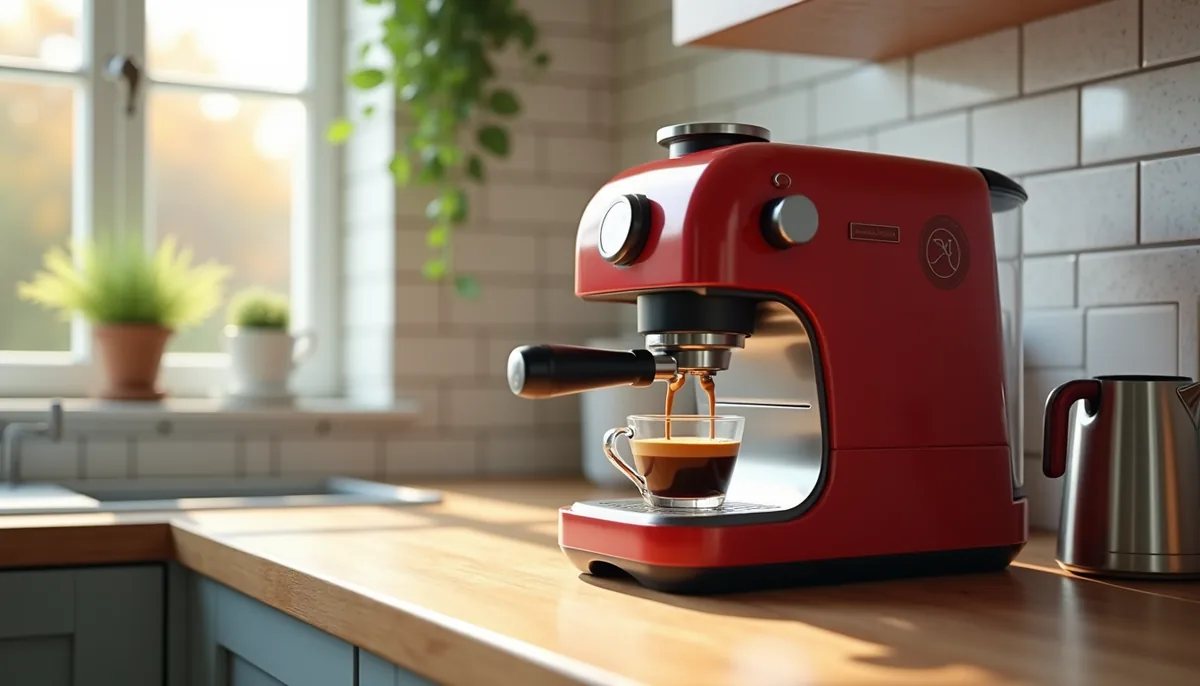
In short: The Profitec GO is a compact single boiler espresso machine with PID, a ring brew group, a 58 mm portafilter and a vibration pump. Since summer 2026 Profitec only makes the GO 2.0, which adds an OLED display, two shot buttons and hot water. Brilliant for espresso and one or two milk drinks, not for rounds of flat whites.



| Type | Single boiler with PID, vibration pump, ring brew group, 58 mm portafilter |
|---|---|
| Boiler | Insulated brass; GO 2.0: 0.3 litres, original GO: 0.4 litres (manufacturer figures) |
| Temperatures | Brew 92 °C out of the box, steam 115–134 °C (GO 2.0) |
| Heat-up | About 7 minutes with fast heat-up, followed by a flush |
| Tank and power | 2.8 litres, 1,300 W, 230 V |
| Best for | Espresso drinkers and households making one or two milk drinks at a time |
GO or GO 2.0: which one are you actually looking at?
This is the bit most UK reviews skip. The popular write-ups that rank for "Profitec GO review" were largely written around the original machine: no hot water, no automatic pre-infusion, a manual workaround for both. That was accurate at the time, but it is no longer the machine Profitec makes. The company, based in Bammental near Heidelberg, now lists only the GO 2.0 on its own site. The original GO lives on as end-of-line stock and on the second-hand market, and listings rarely say which one you are getting.
The most reliable way to tell them apart is the item number on the rating plate, the box or the invoice:
- Original GO: item numbers 10100 (black), 10103 (red), 10105 (yellow), 10107 (blue).
- GO 2.0: item numbers starting CM500014 (-00 black, -01 red, -02 yellow, -03 blue, -04 brushed).
No rating plate to hand? Look at the front panel. The GO 2.0 has a small OLED display with two navigation buttons and two illuminated shot buttons for single and double espresso, and it dispenses hot water through the steam wand. The original has a larger LCD, no dedicated shot buttons and no hot water.
| Feature | Original GO | GO 2.0 |
|---|---|---|
| Boiler (manufacturer) | 0.4 l brass, insulated | 0.3 l brass, insulated |
| Controls | LCD, one brew button | OLED, 2 navigation buttons, 2 shot buttons |
| Pre-infusion | no (manual workaround only) | optional, default 3 s pump + 8 s pause |
| Hot water | no | yes, through the steam wand |
| Cleaning programme | no | yes, 135 s with blind basket |
| Shot dosing | manual | timed (seconds, no flowmeter) |
| Boiler refill after steaming | by hand, with a flush | automatic |
| Weight | 12.9 kg | 12–12.5 kg |
A note on the numbers. Profitec quotes a 0.3 litre boiler for the GO 2.0, while some independent tests still give 400 ml for both versions. We stick to the data sheet and the manual here. Dimensions differ slightly too: the website says 210 × 362 × 381 mm (W × D × H), the manual says 338 mm deep. With the portafilter fitted you need about 410 mm of depth on your worktop.
Our product pages do not state the version explicitly, so if the display, pre-infusion or hot water matter to you, ask us for the item number before you order.
Who the Profitec GO suits, and who it doesn't
The GO is built for people who mostly drink espresso, americano or lungo and make the odd cappuccino or flat white. At 21 cm wide it fits on a narrow worktop next to a grinder.
- A good fit: one- and two-person households, anyone stepping up from a thermoblock machine or a Sage Bambino style appliance, and anyone who wants stable brew temperature without temperature surfing.
- A fit with compromises: households that make three or more milk drinks back to back. It works, but the wait between espresso and steam adds up.
- Not a fit: if you want pressure profiling (that needs a flow paddle) or regularly make cappuccinos for guests. A heat exchanger such as the Profitec PRO 400 or a dual boiler will serve you better.
Check the clearance above the machine, too. The water tank lifts out from the top, and one owner on a German forum reports it only just clears a wall cupboard hung 60 cm above the worktop.
Specification and how it works
At the heart of the GO is an insulated brass boiler controlled by a PID. The ring brew group is heated along with it, which is why the GO warms up far quicker than an E61 machine.
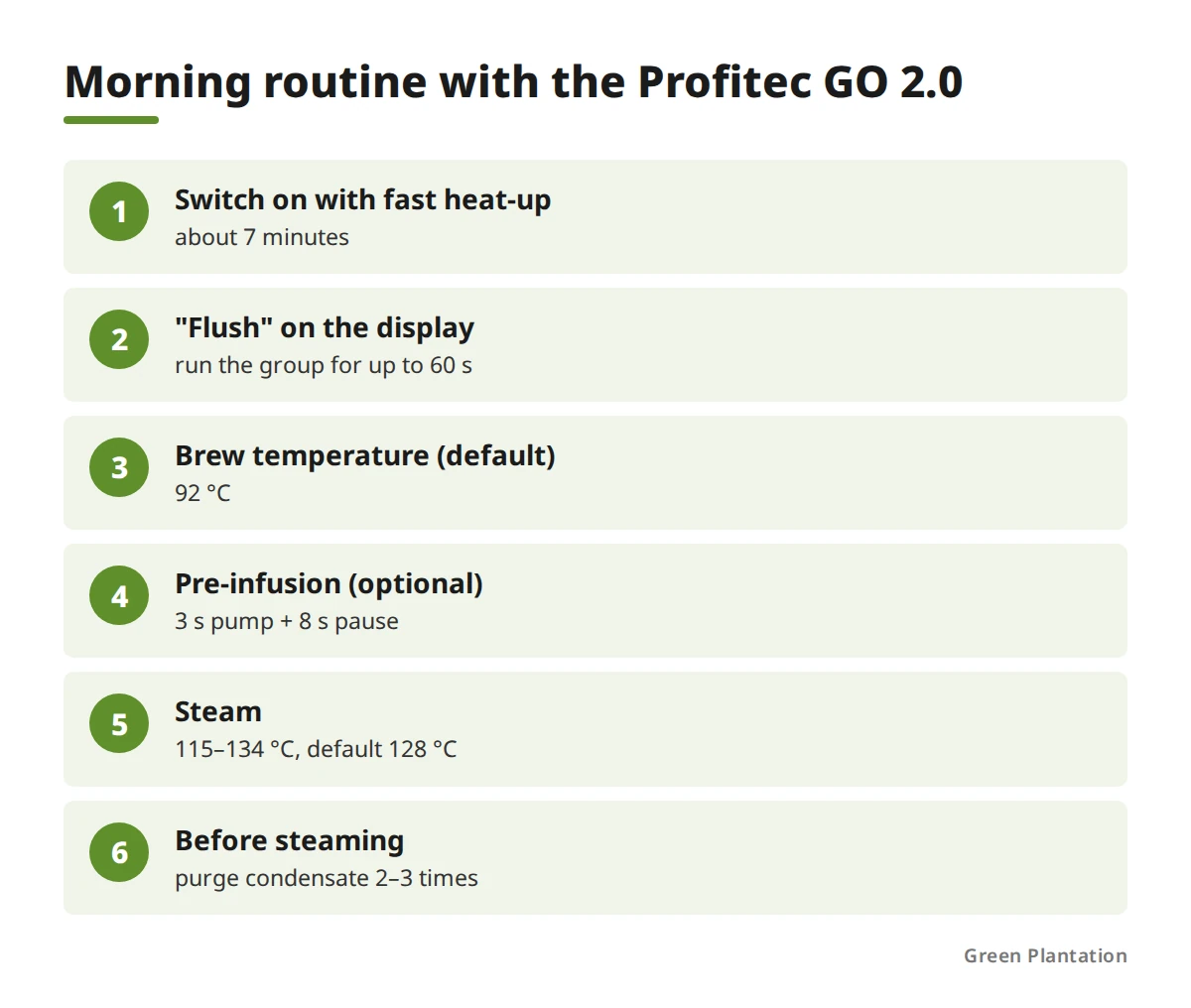
- Brew temperature: 92 °C out of the box, plus an offset of −10 to +10 °C to match the display to the temperature at the puck.
- Steam: 115–134 °C, 128 °C by default, controlled with a rotary valve.
- Brew pressure: the over-pressure valve (OPV) is adjusted with a screw reachable from the top, roughly 8.5–12 bar, set to 9 bar at the factory. The gauge shows pump pressure.
- Fast heat-up: the GO 2.0 heats the boiler to around 120 °C, shows "Flush", and you run water through the group for up to 60 seconds. After that it is ready in about 7 minutes.
- Shots: two timed buttons with a shot timer, manual extraction up to 60 seconds.
- Tank and power: 2.8 litres, 1,300 W, 230 V.
- In the box: a portafilter with single and double spouts that turns into a bottomless portafilter when you remove them, baskets for 1, 2 and 3 cups (up to 21 g), a blind basket, tamper, brush, water filter and carbonate hardness test strip.
Kaffeemacher, a German specialist, measured the GO 2.0 in June 2026: about 8 minutes to the first shot and around 10 minutes to full thermal stability. Energy use was 0.088 kWh for heat-up plus one espresso and 0.044 kWh per hour on standby. That is frugal for an espresso machine with a portafilter.
In practice: espresso and milk on a single boiler
A single boiler machine has one boiler doing two jobs. It sits at around 92 °C for brewing and has to climb to 115–134 °C for steam. That dictates a routine that applies to every single boiler, the GO included.
Espresso
A sensible starting recipe is 18 g of ground coffee in the double basket, 36–40 g in the cup, 25–30 seconds. Because the buttons dose by time rather than volume, put a scale under the cup. The upside of timed dosing is that the cup will not overflow if you get distracted.
Kaffeemacher's measurements show one quirk worth knowing. The first shot after the flush landed almost exactly on target; the following shots ran about 1.5–2 °C hotter. Adjusting the offset brought it back in line. If your second and third shots taste more bitter than the first, have a look at the offset menu.
Cappuccino, step by step
- Pull the espresso.
- Switch to steam. Reviews put the climb at about 30 seconds to a minute.
- Purge the condensate: open the wand two or three times briefly. Up to 25 ml of water comes out, and it does not belong in your milk.
- Steam the milk. 300 ml takes about a minute to reach roughly 60 °C.
- Switch back to brew. The GO 2.0 automatically tops up the boiler with cold water, which cools it faster. Run a short flush through the group before the next espresso.
Allow 2 to 2.5 minutes for a complete cappuccino. For two milk drinks, use the trick every single boiler owner learns: pull both espressos first, then steam the milk for both cups in one go in a 600 ml jug. That way you only switch once.
Water, descaling and maintenance
Profitec recommends a carbonate hardness of 2–6 °dH KH for the GO, which works out at roughly 36–107 mg/l (ppm) as calcium carbonate. Hardness varies hugely across Britain, and much of the country is well above that, so check the figure for your postcode on your water supplier's website or use the test strip in the box.
- Above 6 °dH KH: use the supplied filter in the tank and change it regularly. The GO 2.0 reminds you, with an interval you can set between 5 and 200 litres.
- A filter alone is not full protection: the manual says the filter does not completely prevent scale. The GO 2.0 descaling programme walks you through the process. Never descale a hot machine.
- Water that is too soft makes espresso taste sour and flat. Pure distilled water is not a good idea.
Day to day, the routine is short: flush briefly after every shot, wipe the steam wand straight away and purge it, and run the cleaning programme with the blind basket (135 seconds) once a week. The group gasket (spare part AC100078-00) and the shower screen gasket (DM100021-00) are wear parts you can reorder.
What owners say
To summarise owner experience we looked at two sources: 91 posts about the GO on Reddit's r/espresso (September to November 2026), and 20 threads with "Profitec Go" in the title on Kaffee-Netz, the largest German home espresso forum (last activity October 2025 to October 2026). There is no meaningful UK-only sample, so this is an international picture. The two sources point the same way.
| Topic | r/espresso (91 posts) | Kaffee-Netz (20 threads) |
|---|---|---|
| Buying advice, comparisons with other machines | 66 | 5 |
| GO vs GO 2.0 | 46 | not counted separately |
| Grind, dialling in, inconsistent shots | 57 | 6 |
| Steam and milk | 41 | 0 |
| Temperature and heat-up | 26 | not counted separately |
| Noise and pressure | 12 | 1 |
| Faults, spare parts, modifications | 11 | 3 |
| Water and scale | 6 | 0 |
Recurring themes across both forums (a post can count under several topics):
- Praised: stable temperature thanks to the PID, strong steam for a single boiler, solid build, the compact 21 cm footprint and a generous accessory bundle. Owners of the 2.0 mention the extra room under the portafilter.
- Most common question: shots running too fast or inconsistently. In the German threads, the people answering mostly traced it to the grinder, the beans or puck prep rather than the machine. Supermarket beans without a roast date led to watery shots.
- Criticism: the wait between espresso and steam when making several milk drinks, a steam wand that is not fully articulated, and an audible vibration pump. Some owners later move up to a heat exchanger or a dual boiler.
- New on the GO 2.0: in one thread, owners describe the new group gasket as stiff, so the portafilter needs real force to lock in at first. Some switch to a silicone gasket.
- Tamper: the supplied tamper fits the baskets well; one owner found a 58.00 mm tamper too small for the GO baskets.
Weak points and what to watch for
- Check the version: end-of-line and second-hand machines are often the original GO. It is still a good machine without hot water and pre-infusion, but it should cost less.
- No flowmeter: the 2.0's buttons dose by time. For repeatable shots you need a scale.
- Milk in volume: from the third milk drink in a row, one boiler becomes the bottleneck.
- Vibration pump: louder than a rotary pump. Tests have measured 60–64 dB.
- Budget for the grinder: most forum problems are solved by a proper espresso grinder and fresh beans. Plan for it from day one.
- After steaming: on the original GO, refill the boiler with a short flush after steaming before letting it cool for espresso. The 2.0 does this for you.
Profitec GO vs alternatives
All three alternatives below are also single boilers with vibration pumps in a similar class. Figures are from the manufacturers:
| Model | Boiler | Temperature control | Portafilter | Tank | Notable |
|---|---|---|---|---|---|
| Profitec GO 2.0 | 0.3 l brass | PID, OLED | 58 mm | 2.8 l | Ring brew group, hot water, pre-infusion |
| Lelit Victoria PL91T | 0.3 l brass | PID (LCC), OLED | 58 mm | 2.5 l | Backlit gauge, multi-directional steam wand |
| Rancilio Silvia E | 0.3 l | Thermostat | 58 mm | 2 l | Very robust, 14 kg, needs temperature surfing |
| Lelit Anna PL41TEM | 0.25 l | PID | 57 mm | 2.7 l | Entry-level, fewer basket and tamper options |
The Lelit Victoria is the direct rival, with similar features and a slightly deeper menu. The Silvia E is simpler and famously durable but asks more of you on temperature. The Anna is the cheaper way in, though its 57 mm portafilter limits your choice of baskets and tampers. If you are unsure what fits what, our guide to portafilter types and how to choose one explains why 57 and 58 mm are not interchangeable.
Verdict
The Profitec GO is one of the most refined single boilers in its class. PID, a fast heat-up, a ring brew group and a box that includes a bottomless portafilter make it a complete first serious espresso machine. The GO 2.0 mainly improves day-to-day use: display, hot water, pre-infusion, a cleaning programme and automatic boiler refill after steaming.
Its limits are the limits of the design: one boiler, one job at a time. If you mostly drink espresso and make one or two cappuccinos in the morning, the GO is an excellent choice. If you make several milk drinks for guests every day, a heat exchanger is the better buy. And if you plan to adjust the OPV yourself, read our piece on the right pressure for espresso first.
FAQ
Is the Profitec GO a good machine?
Yes, for its purpose. Owners and reviewers consistently praise the temperature stability, steam power and build. Its limits are those of any single boiler: you cannot brew and steam at the same time.
What is the difference between the Profitec GO and the GO 2.0?
The GO 2.0 adds an OLED display, two timed shot buttons, hot water, programmable pre-infusion, a cleaning programme and automatic boiler refill after steaming. According to Profitec its boiler is smaller, 0.3 litres against 0.4 litres on the original.
Profitec GO or Sage Barista Express: which is better?
They are different approaches. The Barista Express has a built-in grinder, which is convenient but ties you to it; the GO needs a separate burr grinder and gives you a PID-controlled brass boiler and a standard 58 mm portafilter. Most forum advice favours a separate machine and grinder if you want to grow with the hobby.
Profitec GO or Rancilio Silvia?
Both are single boilers with 58 mm portafilters. The GO has a PID, a faster heat-up and, as the 2.0, hot water and pre-infusion. The Silvia E uses a thermostat, so you will be temperature surfing, but it is a simple, long-lived machine.
How long does the Profitec GO take to heat up?
About 7 minutes with fast heat-up and the flush, according to Profitec. Independent measurements came in at around 8 minutes to the first shot.
Which water should I use in the Profitec GO?
Profitec recommends 2–6 °dH carbonate hardness, roughly 36–107 mg/l. Filter harder tap water with the tank filter. Very soft or distilled water makes espresso taste sour.
Recommended products
- Profitec GO Red: the compact single boiler espresso machine with PID reviewed here. Ask for the item number before you order to confirm the version.
- Profitec GO red: the same machine in red via a second supply route, also made to order.
- Eureka Mignon Specialita 15BL: a quiet espresso grinder that several GO owners use, and it suits the GO's footprint.
- Eureka Mignon Zero BL: a single-dose grinder for anyone who switches beans often.
- Rhinowares Pro 600 ml milk jug: big enough to steam milk for two cappuccinos in one go.
- BWT Testkit water hardness tester: shows whether your tap water sits within 2–6 °dH.
Further reading: how to pick the right grinder in choosing a professional espresso grinder, why hardness and pH change the taste in water for the coffee machine, and what you need to keep the group clean in accessories for cleaning an espresso machine.
Sources
- Profitec: GO 2.0, technical data
- Profitec: GO 2.0 user manual (PDF)
- Profitec: GO 2.0 product card (PDF)
- Profitec: original GO, archived page 6/2024
- Lelit: Victoria PL91T
Updated: November 2026
Author: Petra Novotná, editorial name of the Green Plantation.
You might also like
 Eureka Atom Pro review: experience, tech and limits of the 75 mm filter grinder
The Eureka Atom Pro is a filter grinder with 75 mm brew burrs and a Blow-Up bellows. Who it is worth it for, how to set it up and why it is not an espresso… 26. 11. 2026
 Eureka Costanza Review: HX Machine with PID, Costanza R and Owner Experiences
The Eureka Costanza is a compact E61 heat exchanger machine with PID and a shot timer. We clear up the dual boiler myth, explain how it differs from the… 26. 11. 2026
 Grind-by-Weight Coffee Grinders: Eureka Atom W 65, Atom W 75 or Mahlkönig E65S GbW? 2026 Comparison
Comparison of the Eureka Atom W 65, Atom W 75 and Mahlkönig E65S GbW grind-by-weight grinders: dose accuracy, speed, step-by-step calibration and a calculation… 26. 11. 2026