Česky (CZK)
 Slovensky (EUR)
 Magyar (HUF)
 Polski (PLN)
 English (EUR)
 Deutsch (EUR)
 Français (EUR)
 Español (EUR)
 Português (EUR)
 Italiano (EUR)
 Svenska (SEK)
 Suomi (EUR)
 Nederlands (EUR)
 Dansk (EUR)
 Lëtzebuergesch (EUR)
 Eesti (EUR)
 Latviešu (EUR)
 Lietuvių (EUR)
 Slovenščina (EUR)
 Română (RON)
 Български (EUR)
 Hrvatski (EUR)
 Ελληνικά (EUR)
 Українська (EUR)
 Norsk (EUR)
 Srpski (EUR)
 Tiếng Việt (EUR)
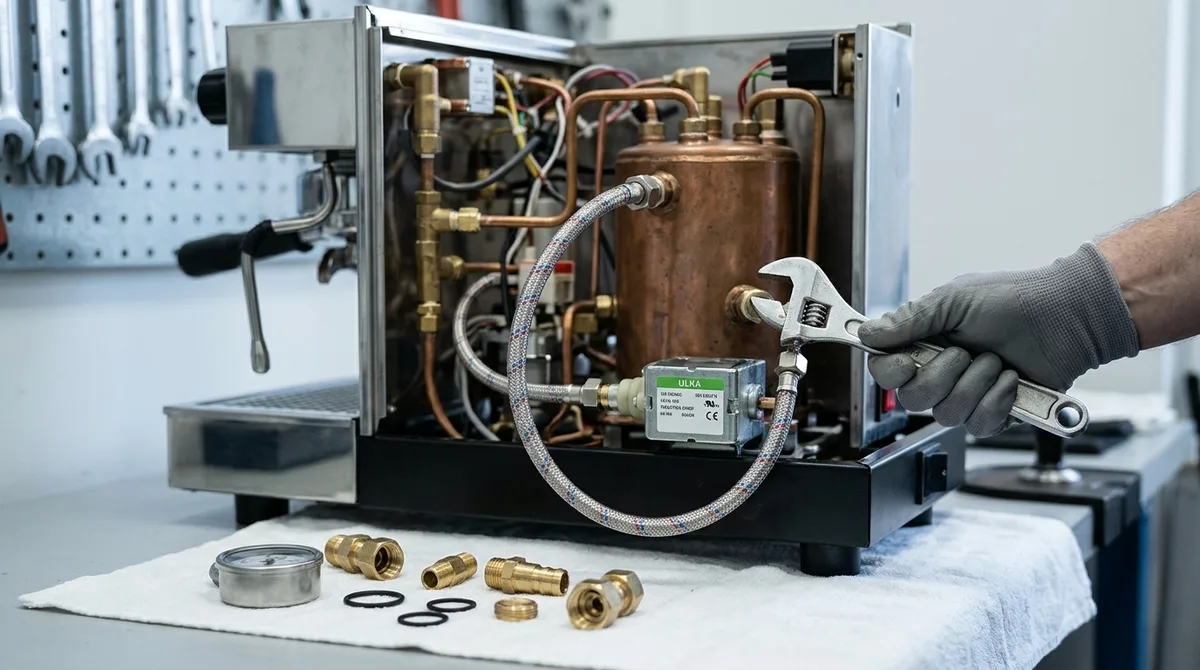
The Heart and Lungs of Your Espresso Machine
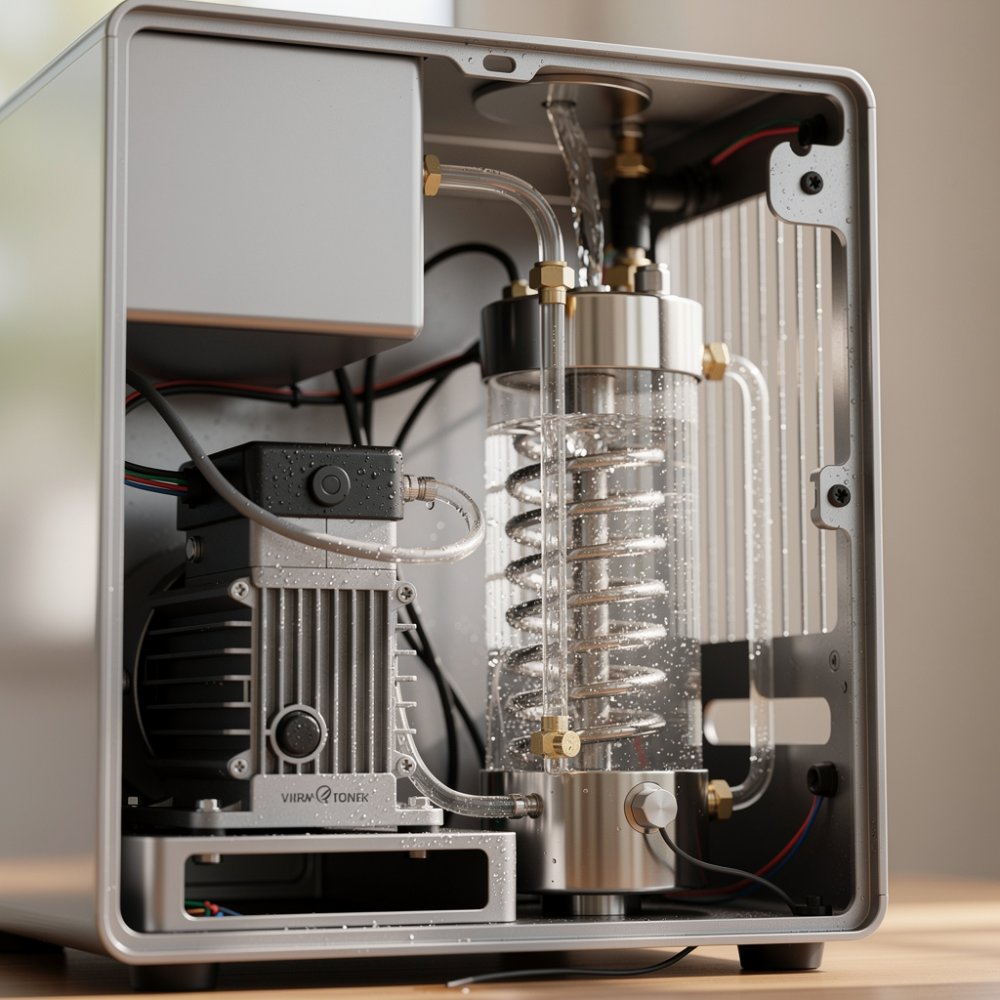
If seals are the joints of an espresso machine, the pump is its heart and the boiler its lungs. The pump creates the pressure necessary for espresso extraction, while the boiler heats water to precise temperatures and produces steam. When one of these components fails, your machine stops working – regardless of the quality of your beans or the precision of your grinder.



Good news: most pumps and many boiler components are standardized parts with reasonable availability. This guide will help you understand what's inside your machine, recognize problem symptoms in time, and decide what you can repair yourself – and when it's wiser to call a service technician.
Pumps – Vibratory vs. Rotary
Vibratory Pump
The vibratory pump is the most common type in home lever espresso machines and most automatic machines. It works on the principle of electromagnetic vibration of a piston – oscillating 50–60 times per second and pushing water toward the grouphead. The design is intentionally simple: minimum moving parts, easy replacement, low cost.
Main manufacturers: Ulka (Italy), OLAB (Italy), Fluid-o-Tech (smaller models)
Advantages:
- Low purchase price (15–40 €)
- Compact size suitable for smaller machines
- DIY replacement (two screws, two hose connections, 10–20 minutes)
- No direct water line connection required
Disadvantages:
- Audible operation (40–65 dB) – vibrations transfer to the machine casing
- Pressure naturally fluctuates during extraction
- Limited lifespan with intensive use (3–5 years)
- Unsuitable for continuous commercial operation
Common models:
- Ulka EP5 / EP5 GW – 48 W, max. 15 bar, most widespread model on the market
- Ulka EX5 / EX5 GW – 48 W, brass outlet for better connection durability
- OLAB 22000-04 – functional alternative to Ulka, used by Breville / Sage
Rotary Pump
You'll find the rotary pump in premium home machines (ECM Synchronika, Rocket R60V, Profitec Pro 700) and in all professional lever espresso machines. A motor with rotating vanes creates constant, smooth pressure without pulsations – which directly translates to more consistent extraction.
Main manufacturers: Fluid-o-Tech (Italy), Procon (USA), Rotoflow
Advantages:
- Significantly quieter operation (20–40 dB)
- Stable pressure throughout extraction
- Long lifespan with proper maintenance (5–15 years)
- Direct plumb-in capability
- Engineered for continuous operation
Disadvantages:
- Higher price (80–250 €)
- Larger size and weight
- Replacement more time-consuming and skill-intensive (motor disassembly, pressure adjustment)
- Requires regular inspection of vanes and lubrication
Comparison Table
| Parameter | Vibratory | Rotary |
|---|---|---|
| Pump price | 15–40 € | 80–250 € |
| Noise | 40–65 dB (audible) | 20–40 dB (quiet) |
| Pressure stability | Fluctuating | Constant |
| Lifespan | 3–5 years | 5–15 years |
| Direct plumb | No | Yes |
| Replacement | DIY (10–20 min) | DIY/service (30–60 min) |
| Typical machines | Lelit Anna, Rancilio Silvia, Sage | ECM Synchronika, Rocket R60V, La Marzocco |
A complete selection of pumps can be found in the spare parts section.
Signs of Pump Failure
Early diagnosis will save you not only money but also frustrating mornings without espresso.
Vibratory Pump
- Pump runs but no water flows – worn or stuck piston, clogged check valve
- Noticeably louder operation – worn damping elements or loose mounting on frame
- Low pressure on gauge – pump not reaching rated output, piston losing effectiveness
- Pulsing or interrupted flow – uneven piston stroke, sometimes air bubble in line
- Pump won't start at all – electrical fault (capacitor, electromagnetic coil)
Rotary Pump
- Distinct noise or grinding sound – worn vanes or motor bearings
- Water leaking around pump – failed shaft seals
- Unstable or declining pressure – vanes not sealing adequately to cylinder
- Motor overheating – bearing problems or electrical overload
Boilers – Types and Construction
The type of boiler system fundamentally affects how quickly you can alternate between extraction and steaming, what temperature stability you can achieve, and how many components in your machine are potentially susceptible to wear.
Single Boiler
One boiler provides heating for both brewing and steaming. Typical capacity 200–400 ml. Before switching from brewing to steaming, the machine needs time to reach higher temperature – an acceptable compromise for home use with lower drink volume. Material: brass, copper, or stainless steel.
Heat Exchanger
One large steam boiler (1–2 liters) with an internal heat exchanger tube for brew water. The boiler runs permanently at steam temperature (around 125 °C), brew water heats up by passing through the exchanger. Allows simultaneous extraction and steaming without waiting; brew water temperature stability depends on proper flush before extraction.
Dual Boiler
Separate, smaller boiler for extraction (precise PID temperature control) and separate, larger boiler for steam (higher pressure). The most flexible system for demanding home baristas – but also the most expensive to manufacture, maintain, and repair.
Boiler Materials
| Material | Advantages | Disadvantages | Typical use |
|---|---|---|---|
| Brass | Excellent thermal conductivity, proven durability | Higher weight, gradual oxidation | ECM, Rocket, Profitec |
| Copper | Best thermal conductivity, rapid stabilization | High cost, susceptible to scale | La Marzocco, premium machines |
| Stainless steel | Corrosion resistant, hygienic, durable | Slower heating, difficult manufacturing | Lelit Bianca, Breville / Sage |
| Aluminum (thermobloc) | Very rapid heating, compact, inexpensive | Lower temperature stability, scale susceptibility | Entry-level machines, automatics |
New boilers for the most common espresso machine models are available in our selection.
Heating Elements – When the Boiler Won't Heat
A heating element (heating element) is a resistive element immersed or attached to the boiler that converts electrical energy to heat. When it fails, the boiler won't reach the required temperature – and the machine becomes unusable regardless of the condition of other components.
Failure Signs
- Machine won't heat up – the most obvious sign, often accompanied by unresponsive temperature indicator
- Extremely slow heating – element only partially working (micro-cracks in resistive wire)
- Repeated circuit breaker trips – short circuit in heating element requires immediate diagnosis
- Error code on display – modern machines identify temperature faults and block operation
Types of Heating Elements
- Immersion – element in direct contact with water in the boiler. Efficient heat transfer, but scales faster with hard water
- Band heater – wrapped around the outer shell of the boiler. Less susceptible to deposits, but indirect heat transfer and slower
- Thermobloc – water flows through a heated aluminum block. Fast heating from cold state, compact – typical for automatic machines and entry-level models
Heating Element Replacement
Replacing an immersion element requires:
1. Complete disconnect from power supply and boiler drainage
2. Disassembly of the element flange plate
3. Replacement of the flange seal (always use a new seal)
4. Installation of the new element with specified torque and refilling the boiler
Warning: Working with heating elements involves 230 V electrical installation. If you lack demonstrated electrical installation experience, entrust this repair to a service technician.
Replacement heating elements by machine model are available in our selection.
Control Boards and Electronics
Modern machines – especially those with PID temperature control, pressure profiling, or touchscreen displays – contain electronic control boards (PCB) that coordinate the function of the pump, boiler, valves, and user interface. Their failure manifests in a variety of and sometimes mysterious symptoms.
When Control Board Fails
- Erratic behavior – machine randomly turns on or off, changes temperature without user intervention
- Error codes on display – specific messages per manufacturer documentation; always note them before contacting service
- Non-functioning buttons or display – fault in input/output circuit
- No response after power-on – exclude fuses, breakers, and power cord before suspecting the board
DIY vs. Service
Physical replacement of a control board is usually a matter of disconnecting and reconnecting connectors, but precise diagnosis of the cause requires measuring instruments and electronics knowledge. Recommended approach:
- Exclude mechanical causes – loose connectors, blown fuse, tripped breaker
- Consult manufacturer or authorized service – many brands provide phone diagnostic support
- Compare costs – control board may cost 100–300 €; for older machines consider repair-to-value ratio
Replacement control boards for selected models are available in our selection.
When to Repair Yourself vs. Call Service
DIY – You Can Handle This
| Task | Difficulty | Time | Tools |
|---|---|---|---|
| Replace grouphead seal | Simple | 10 min | Flat screwdriver |
| Replace vibratory pump | Moderate | 20 min | Phillips screwdriver, wrenches |
| Replace O-rings on steam wand | Simple | 10 min | Flat screwdriver, wrench |
| Descale boiler | Simple | 30 min | Descaler |
| Adjust OPV pressure | Moderate | 15 min | Flat screwdriver, pressure gauge |
Service – Call a Professional
| Task | Reason |
|---|---|
| Replace heating element | Work with 230 V electrical installation |
| Diagnose control board | Requires measuring instruments and expert interpretation |
| Replace rotary pump | Complex disassembly, subsequent pressure adjustment |
| Repair boiler leak | Pressurized system, safety hazards |
| Replace flowmeter | Requires calibration after installation |
Spare Parts by Espresso Machine Brand
E61 Grouphead (ECM, Rocket, Lelit, Profitec, Bezzera, Quick Mill)
Machines with E61 grouphead share many parts – one of the practical advantages of this proven design. Grouphead seal, shower screen, three-way solenoid valve, and springs are largely interchangeable. Pumps and boiler components, conversely, differ by specific model and power rating.
Breville / Sage
Proprietary solutions – most parts tied to specific model (Barista Express, Dual Boiler, Oracle). Pumps are typically OLAB; for other components, verify compatibility by model number.
La Marzocco (Linea Mini, GS3)
Premium parts matching the machine price category. Grouphead seals and baskets are standard 58 mm and easily available. Boilers and electronics are proprietary – provide exact serial number when ordering parts.
Nuova Simonelli / Victoria Arduino
Established players in the commercial segment. Parts for professional machines are largely standardized, with good availability through authorized distributors across Europe.
Preventive Maintenance – How to Extend Component Lifespan
- Use filtered water – scale is the number one enemy of boilers and heating elements. Investment in water filtration pays off quickly in avoided repairs and extended machine lifespan
- Descale regularly – even filtered water leaves mineral deposits over time; frequency depends on your local water hardness
- Follow maintenance schedule – cleaning and maintaining your espresso machine directly extends the lifespan of all mechanical and electronic components
- Let machine cool gradually – rapid temperature changes stress seals, connections, and boiler metal
- Keep spare parts on hand – one replacement grouphead seal and a set of O-rings will save you days of waiting if a routine failure occurs
Frequently Asked Questions
How long does a vibratory pump last?
With home use at 2–5 drinks per day, typically 3–5 years. The more cumulative daily runtime, the faster it wears – vibratory pumps aren't engineered for continuous operation. The first sign of approaching end-of-life is increased noise or pressure drop on the gauge.
Can I upgrade from a vibratory to a rotary pump?
Theoretically yes, but it's a non-trivial modification: requires frame adjustments, electrical installation changes, and water line modifications. Most manufacturers don't recommend such changes and it may void warranty. If a rotary pump is a priority, it's more sensible to invest in a machine engineered for one from the start.
Why does scale build up even with filtered water?
No filter removes minerals completely – nor should it. Fully demineralized water is corrosive to metal surfaces and lacks substances that contribute to coffee flavor. The goal of filtration is optimal water hardness (50–75 ppm CaCO₃), not complete demineralization. Some descaling remains part of regular maintenance even with properly filtered water.
How do I know which heating element I need?
Look up your machine model in the manufacturer's catalog or note the number directly from the old element. Key parameters: wattage (W), voltage (V), mounting type (flange or threaded), and physical dimensions. When in doubt, contact our customer service with a photo of the original element.
Is it worth repairing an old espresso machine or should I buy new?
Rule of thumb: if repair costs exceed 40–50% of a comparable new machine's price, replacement is worth considering. The exception is quality lever machines from ECM, Rocket, La Marzocco, and similar manufacturers – they're engineered for multi-decade lifespans and component replacement is a natural part of their philosophy and value.
Sources
- Ulka Pumps – technical specifications for vibratory pumps
- Fluid-o-Tech – catalog of rotary pumps for espresso machines
- Whole Latte Love, Seattle Coffee Gear – espresso machine repair guides
- ECM, Rocket Espresso, Lelit – service manuals and spare parts catalogs