
 Česky (CZK)
 Slovensky (EUR)
 Magyar (HUF)
 Polski (PLN)
 English (EUR)
 Deutsch (EUR)
 Français (EUR)
 Español (EUR)
 Português (EUR)
 Italiano (EUR)
 Svenska (SEK)
 Suomi (EUR)
 Nederlands (EUR)
 Dansk (EUR)
 Lëtzebuergesch (EUR)
 Eesti (EUR)
 Latviešu (EUR)
 Lietuvių (EUR)
 Slovenščina (EUR)
 Română (RON)
 Български (EUR)
 Hrvatski (EUR)
 Ελληνικά (EUR)
 Українська (EUR)
 Norsk (EUR)
 Srpski (EUR)
 Tiếng Việt (EUR)
E61 Group Head: The Complete Guide – How It Works, Maintenance and Modifications (Flow Control, Thermometer, Pressure Gauge)
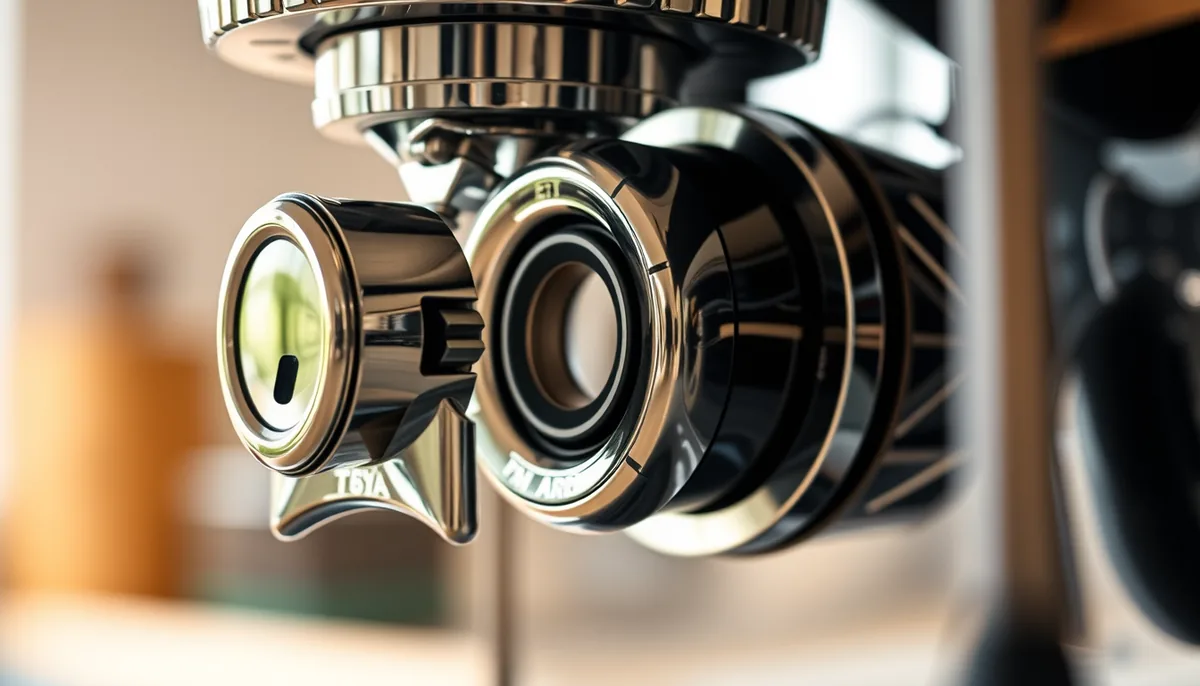
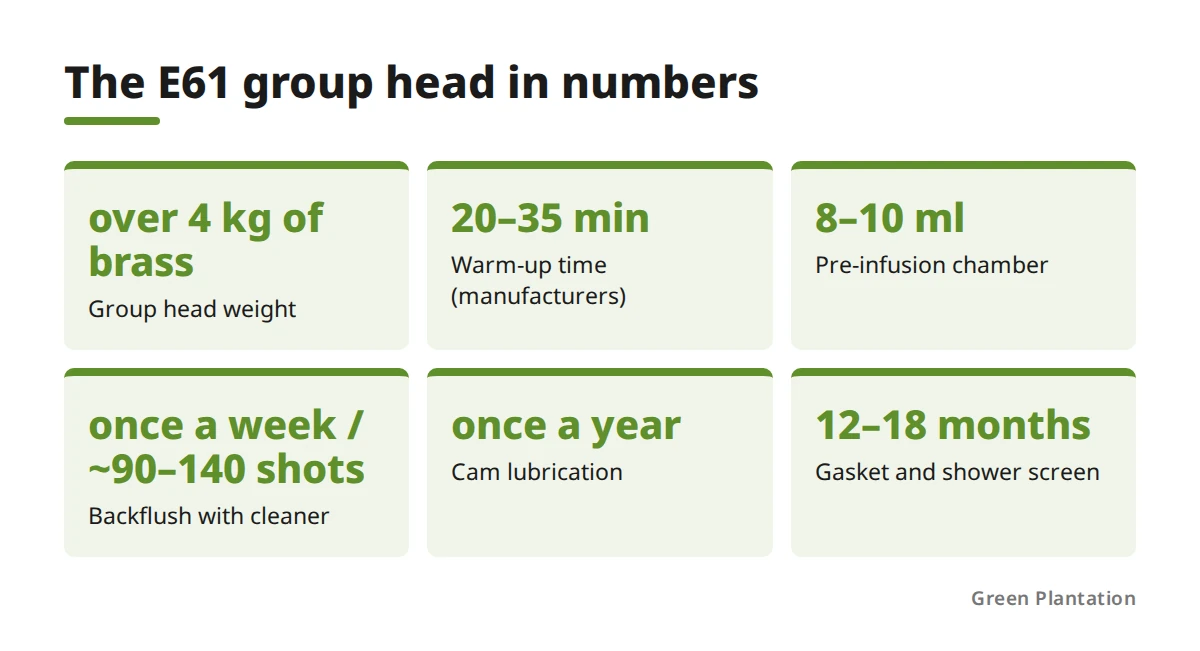
In short: The E61 is a heavy chrome-plated brass brew group heated by a thermosiphon loop from the boiler or heat exchanger, which is why it takes 20–35 minutes to warm up. Maintenance: a backflush with cleaner once a week (roughly every 90–140 shots), lubricate the cam once a year, and replace the group gasket and shower screen every 12–18 months.



| Origin | Faema, 1961 (Ernesto Valente) |
|---|---|
| Group head weight | over 4 kg of chrome-plated brass |
| Warm-up time | 20–30 min (Lelit Mara X around 24 min, ECM without fast heat-up 30–35 min) |
| Pre-infusion chamber | approx. 8–10 ml |
| Backflush with cleaner | once a week / every ~90–140 shots |
| Group gasket | replace every 12–18 months, ECM 73 × 57 × 8.5 mm |
Saturday morning in a terraced house in Bristol. The E61 espresso machine has been on for twelve minutes. The boiler light went out ages ago and the gauge is sitting at working pressure, so everything looks ready. Yet the first espresso comes out sour and thin. The second, a quarter of an hour later, suddenly tastes full and rounded. The coffee and the grinder had nothing to do with it. What mattered was the four kilos of brass above the portafilter that simply had not warmed through yet.
Below is a complete guide: how the E61 group head works inside, why it needs time, what to service and how often, how to replace the gasket yourself, and which modifications genuinely make a difference in the cup.
How the E61 group head works: thermosiphon, cam and pre-infusion
Faema introduced this group in 1961, and today ECM, Profitec, Rocket, Lelit, Bezzera, Quick Mill and many other manufacturers use it in one form or another. All of its maintenance follows from the way it is built.
Thermosiphon
Two pipes connect the group head to the boiler (in single boiler and dual boiler machines) or to the heat exchanger (in HX machines). Hot water rises through the upper pipe into the group, gives up its heat to the brass, cools and sinks back down through the lower pipe. The loop runs by itself, with no pump, the whole time the machine is switched on. The group therefore heats up passively and slowly: there are more than 4 kg of metal to bring up to temperature.
Cam and valves
The lever on the side of the group turns a cam that presses on the valve stems. At rest (lever down) the inlet valve is closed and the exhaust valve is open: residual pressure from the puck vents through a pipe into the drip tray. That is why the puck stays fairly dry after extraction. When you raise the lever, the cam closes the exhaust, fully opens the inlet valve and triggers the pump microswitch.
Mechanical pre-infusion
Inside the group there is a small expansion chamber holding around 8–10 ml. Water has to fill it first, so the full pressure of about 9 bar does not hit the coffee immediately but builds over a few seconds. The coffee soaks first and only then receives full pressure. On plumbed-in machines or those with a rotary pump, you can leave the lever in the middle position so that only mains pressure acts on the coffee. On a typical home machine with a vibration pump and water tank, the middle position makes little difference.
At the inlet to the group there is also a small jet (gicleur) that restricts flow. In hard water areas it scales up, and this is exactly the part a flow control kit replaces with an adjustable needle valve.
How long does an E61 take to heat up: 20–45 minutes
The boiler is hot within a few minutes. The group head needs far longer, because the thermosiphon moves heat only through natural circulation. Figures from manufacturers and their distributors:
- Lelit Mara X (HX): retailers, citing the manufacturer, quote up to 24 minutes to full temperature.
- ECM Technika VI (HX): 11–13 minutes with the fast heat-up function, 30–35 minutes without it, depending on room temperature.
- ECM Mechanika V Slim: at least 15 minutes. The manual points out that even once the boiler is up to temperature, the group is not yet thermally stable.
Owners who measure with a group head thermometer agree that it takes 20–30 minutes to reach a stable temperature. If you want to be certain and are not in a hurry, wait 30–45 minutes. The "ready" light refers to the boiler, not the group. At home, a plug-in timer switch that turns the machine on half an hour before you get up works best. Just watch out for models whose manual does not permit switching on via a timer.
HX machines have the opposite problem: after sitting idle, the water in the heat exchanger overheats and the first water from the shower screen hisses and spits. The fix is a short cooling flush until the hissing stops. A group head thermometer turns this into a routine based on a number rather than on sound.
E61 group head maintenance: what and how often
| Frequency | Task | Notes |
|---|---|---|
| after every espresso | short flush, wipe the gasket and shower screen | removes coffee grounds from the gasket edge |
| daily | water-only backflush with a blind basket, 5 cycles | cleans the exhaust channel without washing out the grease |
| once a week / ~90–140 shots | backflush with cleaner: 5–10 cycles of 2–3 s, then rinse with clean water | no more often, as the cleaner strips grease from the cam and dries out the seals |
| once a month | remove the shower screen (if possible without replacing the gasket) and soak it in cleaning solution | on the E61 the screen is usually held in by the gasket alone |
| once a year | lubricate the cam with food-grade silicone grease | sooner if the lever squeaks or feels stiff |
| 12–18 months | replace the group gasket and shower screen | with hard water and more than 3 espressos a day, closer to a year |
| 1–2 years | service kit: cam and valve seals, clean the valve seats | when the exhaust drips or water seeps from the group |
Backflushing step by step
- Fit a blind basket in the portafilter, or a rubber blind insert in your normal basket.
- Add a dose of powder as directed on the cleaner, or one tablet. Skip this step for a water-only backflush.
- Lock in the portafilter and raise the group lever for a few seconds (Kaffeemacher recommends 2–3 s, machine manuals often up to 10 s). The pump builds pressure and the water and cleaner are forced back up into the group.
- Lower the lever. The exhaust valve dumps the dirty water into the drip tray. Repeat 5–10 times.
- Remove the portafilter, rinse it, and repeat the same cycle 5–10 times with plain water so no cleaner is left in the group.
- Finally, flush the group without the portafilter and wipe the gasket.
Why not every day with cleaner: ECM warns that backflushing with detergent too often dries out the seals and washes the grease off the cam. The lever then starts to squeak. If your machine has a flow control kit, check the manual for how the manufacturer recommends backflushing (some flow regulators need to be fully opened during cleaning).
Lubricating the cam
The cam is the metal shaft the lever acts on. When the lever squeaks, grinds or feels stiff, the grease has gone. Always work on a cooled machine unplugged from the mains: undo the nut or screw holding the lever (depending on the model), remove the lever and pull out the cam. Wipe off the old grease and coffee, inspect the O-rings on the cam and replace them if they are flattened or cracked. Apply a thin layer of food-grade silicone grease (NSF H1) and reassemble. Vaseline and mineral oil have no place in a group head: they degrade rubber and are not approved for food contact.
Replacing the E61 gasket and shower screen step by step
Over time the group gasket hardens and flattens. A typical sign: a portafilter that used to lock in at roughly "six o'clock" (handle pointing towards you) swings further and further to the right, or water leaks around the sides of the portafilter. Anyone with a screwdriver can do the job in under half an hour.
Dimensions: the E61 does not have a single gasket size. ECM specifies 73 × 57 × 8.5 mm, and the 8.5 mm thickness is standard on ECM and Profitec. There are also 8 mm and thinner gaskets on the market. Fit an 8 mm gasket in an ECM and, as owners report, the portafilter will swing far to the right. Before buying, measure the old gasket with callipers or check the exploded view of your model. The E61 shower screen is 60 mm in diameter.
- Switch off and let it cool. Unplug the machine and leave it to cool for at least an hour. The boiler is under pressure and the water inside is above 100 °C. A group at room temperature is also easier to work on and you will not scratch it.
- Remove the old gasket. Using a narrow flat-head screwdriver or an awl, pierce the gasket in two or three places and lever it out piece by piece. Lever against the gasket, not the brass. A hard old gasket often comes out together with the shower screen.
- Take out the shower screen. On most E61 machines it is held in by the gasket itself. If there is a screw in the centre, undo it.
- Clean the groove. With a brush and a cloth dampened with cleaning solution, remove coffee residue and bits of old rubber from the groove and the seating surface. On a clean surface the new gasket will sit evenly.
- Fit the shower screen into the new gasket. Push the edge of the screen into the gasket. If the gasket has a bevelled edge or a ribbed face, orient it as the manufacturer recommends, usually bevel up, towards the group.
- Press it into the group. Offer the assembly up to the group and press it home with an empty portafilter and basket: lock it in and slowly turn it until the gasket seats all the way round. Do not use sharp tools, as silicone tears easily.
- Test. Switch the machine on, let it heat up and do a water-only backflush with a blind basket. A new gasket is stiffer at first, so the portafilter will lock in to the left of "six o'clock". After a few days the gasket beds in.
A silicone gasket copes with high temperatures for longer and does not harden as quickly as an EPDM rubber one. It is softer, though, so once bedded in the portafilter will lock slightly further to the right. If you are replacing the gasket for the first time, the original part from your machine's manufacturer is the safest bet.
Symptom → cause → fix
| Symptom | Likely cause | Fix |
|---|---|---|
| Water leaks around the sides of the portafilter | hardened or flattened gasket, coffee on the basket rim | wipe the basket rim; if that does not help, replace the gasket |
| Portafilter swings well past "six o'clock" | flattened gasket, or one thinner than the machine is designed for | new gasket of the correct thickness (8.5 mm on ECM) |
| Group lever squeaks or feels stiff | grease washed off the cam by cleaner | lubricate the cam with food-grade silicone grease; backflush with cleaner only once a week |
| Exhaust drips into the tray even with the lever down | scale or a worn exhaust valve seal | backflush with cleaner; if that fails, a valve service kit |
| No hiss from the exhaust when lowering the lever, wet puck | blocked exhaust channel | backflush with cleaner, then rinse |
| Water seeps from the top of the group or around the cam | worn cam or valve O-rings | E61 service kit or a professional service |
| Uneven flow from the shower screen, some holes not running | clogged shower screen, scale in the jet | soak the screen in cleaner, replace it in hard water areas; consider softening your water |
| First water from the screen hisses and spits (HX) | overheated water in the heat exchanger | cooling flush; with a group head thermometer, to an exact number |
| Group still lukewarm after 30 min | not enough time, or a scaled-up thermosiphon | wait longer; if it keeps getting worse, a service with descaling as recommended by the manufacturer |
E61 group head modifications: which are worth it
In a sample of 100 r/espresso threads for the query "E61 flow control" (December 2025 to November 2026, international sample), 98 dealt with flow adjustment and 31 with temperature and warm-up. Group head modifications are therefore, alongside choosing the machine itself, the most common topic among E61 owners.
| Modification | What it does | Difficulty | Who it suits |
|---|---|---|---|
| Flow control kit | a needle valve instead of the fixed jet; slow pre-infusion, flow and pressure profiling during extraction; according to retailers, the ECM kit includes a 0–16 bar group gauge and a new spring in place of the original pre-infusion | medium: replaces the top section of the group, the manufacturer recommends fitting by a technician | light roast drinkers and keen tinkerers |
| Group head thermometer | shows the group temperature: you know when the machine is warmed up and, on an HX, how long to cooling flush | low: replaces the M6 screw on top of the group, fitted cold with a copper washer | every HX owner and anyone after a repeatable routine |
| Group pressure gauge | pressure directly at the coffee, not in the boiler; reveals a badly set over-pressure valve (OPV) | low to medium | anyone adjusting the OPV or without a flow control kit with a gauge |
| Bottomless (naked) portafilter | shows the flow under the basket, channelling and spurting; diagnoses grind and tamping | none: just a different portafilter | anyone learning; the cheapest and most effective upgrade |
| Precision shower screen (IMS) | more even water distribution over the coffee, easier cleaning (nano coating) | low: fit when you change the gasket | whenever you replace the gasket |
The thermometer measures the temperature of the brass at the top of the group, not of the water hitting the coffee. Retailers quote an accuracy of ±2 °C over 80–120 °C for the Coffee Sensor. Treat it as an indicator of trend and repeatability, not a laboratory instrument. A flow control kit makes no sense without a good burr grinder and the patience to dial in. If you mostly drink cappuccinos made with medium or dark roasts, you will notice little difference in the cup.
It is also worth mentioning the E61's weaknesses: long warm-up, higher electricity use if left on all day, and a hot chrome group that is easy to touch by accident. Modern machines such as the Lelit Mara X or ECMs with fast heat-up soften these drawbacks, but the thermosiphon principle stays the same.
Frequently asked questions
How often should I backflush an E61?
With water alone, daily if you like; with cleaner once a week or, according to ECM, roughly every 90–140 espressos. Backflushing with detergent more often dries out the seals and washes the grease off the cam.
Which E61 group gasket should I buy, 8 or 8.5 mm?
It depends on the machine. ECM and Profitec use 8.5 mm as standard (73 × 57 × 8.5 mm). Measure the old gasket or check the exploded view. If the portafilter still swings far to the right even with a new gasket, the seat is worn or the gasket is too thin.
Can I use Vaseline to lubricate the cam?
No. Use only a food-grade silicone grease (NSF H1) that withstands high temperatures. Vaseline and oils degrade rubber O-rings.
Does a flow control kit fit every E61 group head?
Most kits are designed for the standard E61, but manufacturers only guarantee compatibility with their own machines. ECM states that it cannot guarantee correct function on other brands. Check your group model before buying.
Is an E61 group head thermometer worth it?
On HX machines, yes: guessing "by the hiss" becomes a repeatable routine. On dual boiler machines with a PID, it mainly gives you confidence that the group is fully warmed up.
Recommended products
- ECM E61 group gasket 73 × 57 × 8.5 mm – the original size for ECM and Profitec, no guessing the thickness.
- JoeFrex Universal rubber blind filter 50.5–58.5 mm – a blind insert for your normal basket for daily and weekly backflushing.
- Cafetto Evo 1 kg – powder for the weekly backflush with cleaner.
- OKS 1110 food-grade silicone grease NSF 10 g – silicone grease for the cam and O-rings; a small tube lasts for years.
- Coffee Sensor E61 group head thermometer – the simplest way to monitor warm-up and cooling flushes on an HX.
- ECM E61 flow control kit – flow adjustment with a gauge for ECM machines, for those who want to profile.
Other parts and upgrades: E61 silicone group gasket, E61 service kit, IMS E61200NT precision shower screen ø 60 mm, Coffee Sensor E61 flow control kit, Lelit E61 group pressure gauge and the Bezzera E61 bottomless portafilter.
More on related parts: how to tell it is time for replacing seals and O-rings, caring for the shower screen and baskets, complete coffee machine cleaning and maintenance, types of espresso machine valves and how to replace them and how water hardness affects espresso and scale in the group.
Sources
- Clive Coffee: ECM Technika VI User Manual (warm-up, backflush frequency), support.clivecoffee.com
- ECM: Mechanika V Slim Setup Guide (group warm-up time), support.clivecoffee.com
- Kaffeemacher: Faema E61 Brühgruppe (design, pre-infusion chamber, maintenance frequency), kaffeemacher.ch
- Wikipedia: E-61 (history, group head weight)
- Reddit r/espresso via Arctic Shift: 200 threads for the queries "E61 gasket" and "E61 flow control" (international sample)
Updated: November 2026
Author: Petra Novotná, editorial name of the Green Plantation.
You might also like
 Eureka Costanza Review: HX Machine with PID, Costanza R and Owner Experiences
The Eureka Costanza is a compact E61 heat exchanger machine with PID and a shot timer. We clear up the dual boiler myth, explain how it differs from the… 26. 11. 2026
 Eureka Pura and Pura R review: experience, tech and an honest verdict on the E61 heat exchanger
The Eureka Pura is an E61 heat exchanger machine with a pressurestat; the Pura R is the same machine with a rotary pump. Here are the official specs, the… 26. 11. 2026
 Single boiler espresso machine: temperature surfing, steaming and purging step by step
How to hit espresso temperature on a single boiler machine, switch to steam, purge the condensate, refill the boiler and get back to the next shot.… 26. 11. 2026