Česky (CZK)
 Slovensky (EUR)
 Magyar (HUF)
 Polski (PLN)
 English (EUR)
 Deutsch (EUR)
 Français (EUR)
 Español (EUR)
 Português (EUR)
 Italiano (EUR)
 Svenska (SEK)
 Suomi (EUR)
 Nederlands (EUR)
 Dansk (EUR)
 Lëtzebuergesch (EUR)
 Eesti (EUR)
 Latviešu (EUR)
 Lietuvių (EUR)
 Slovenščina (EUR)
 Română (RON)
 Български (EUR)
 Hrvatski (EUR)
 Ελληνικά (EUR)
 Українська (EUR)
 Norsk (EUR)
 Srpski (EUR)
 Tiếng Việt (EUR)
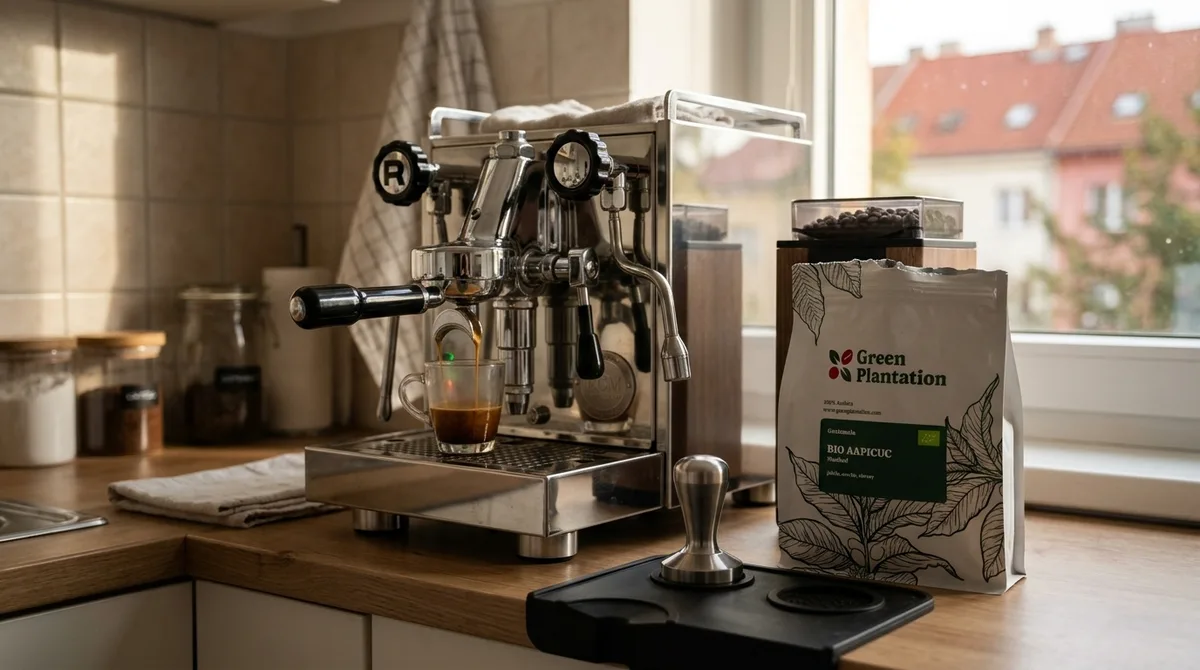



Lever Espresso Machine – A Guide for Home Baristas
Why a Lever Espresso Machine
A lever (semi-automatic) espresso machine is a tool that gives you full control over espresso preparation. Unlike automatic machines where you press a button and wait for the result, here you decide: what dose, what grind, what pressure, what timing. This means greater responsibility – but also incomparably higher quality potential.
Modern home lever machines in 2026 offer features that were available only in commercial equipment ten years ago: PID temperature regulation accurate to a degree, programmable pressure profiles, flow control, rapid heat-up, and precise milk steaming. Prices have also shifted so that a quality prosumer machine costs less than a year's worth of coffee shop expenses.
If you're prepared to invest both time and money and want espresso that stands up to the best cafes, a lever machine is the right path. This guide will help you choose one that fits you perfectly.
Types of Lever Machines
Lever machines are classified by their water heating system. This is the most important technical parameter, directly affecting workflow, temperature stability, and overall machine cost.
Single Boiler
Principle: One boiler provides heat for both brewing and steam generation. Want to steam milk? You must switch modes – the boiler heats to steam mode (approximately 140 °C), then you cool it back to brew temperature (typically 90–95 °C).
Advantages:
- Lowest price in the category
- Compact size suitable for smaller kitchens
- Simple maintenance and servicing
- Low energy consumption
Disadvantages:
- Brewing and milk steaming cannot happen simultaneously
- 20–60 second wait between shot and steaming
- Lower temperature stability compared to dual boiler machines
Ideal for: Espresso purists or beginners who want to understand extraction fundamentals at a reasonable price. If you drink cappuccino every morning, expect workflow slowdowns.
Heat Exchanger (HX)
Principle: One large steam boiler through which a thin tube (heat exchanger) with fresh brew water passes. The steam boiler maintains constant temperature for steam while water passing through the exchanger heats to brew temperature. Brewing and steaming happen simultaneously.
Advantages:
- Seamless workflow – brewing and steaming without pause
- Strong steam thanks to large steam boiler
- Mid-range price with premium operational feel
- Most HX machines use the iconic E61 group head
Disadvantages:
- Requires "cooling flush" – before each shot you must briefly run water to flush overheated water from the exchanger
- Brew temperature is less precise than dual boilers
- Longer heat-up time (15–30 minutes)
Ideal for: Home baristas preparing mainly milk-based drinks (cappuccino, latte, flat white) who want seamless workflow without dual boiler price compromise.
Dual Boiler
Principle: Two independent boilers – smaller (typically 0.3–0.8 l) for brewing espresso and larger (1–2 l) for steam. Each has its own heating and PID regulation. Both circuits work completely independently.
Advantages:
- Highest temperature stability – PID control accurate to a degree
- Simultaneous brewing and steaming without any compromises
- No cooling flush – brew water is always at set temperature
- Best shot-to-shot consistency
Disadvantages:
- Highest acquisition cost
- Larger dimensions and heavier weight
- Higher energy consumption (two continuously operating boilers)
- Longer heat-up time (20–30 minutes)
Ideal for: Serious home baristas who want maximum control and repeatability. If you enjoy precise dialing in and want to extract everything from your beans, a dual boiler is an investment that pays off.
Type Comparison
| Feature | Single Boiler | Heat Exchanger | Dual Boiler |
|---|---|---|---|
| Simultaneous brew and steam | No | Yes | Yes |
| Temperature stability | Low–mid | Mid | High |
| PID regulation | Only in expensive models | Rarely | Standard |
| Cooling flush | No | Yes | No |
| Heat-up time | 5–15 min | 15–30 min | 20–30 min |
| Price | 200–600 EUR | 500–1500 EUR | 800–3500 EUR |
| Maintenance | Simple | Mid | Mid–complex |
| Ideal for | Espresso, beginners | Milk drinks | Maximum control |
What to Focus On When Choosing
PID Temperature Regulation
PID (Proportional-Integral-Derivative) is an electronic controller that maintains boiler temperature with ±1 °C precision. Without PID, temperature fluctuates according to thermostat in the ±5–10 °C range, which directly manifests in inconsistent shots – same coffee, same dose, different result.
Practical note: By 2026, PID is standard in machines over 400 EUR. If you're considering a machine without PID (e.g., Gaggia Classic Pro), verify if an aftermarket PID kit is available – for this model it exists and installation is relatively straightforward.
Portafilter Size
- 58 mm – industry standard. Largest selection of baskets, tampers and accessories. Most prosumer and commercial machines.
- 54 mm – Sage/Breville and some compact machines. Narrower accessory selection but fully sufficient for home use.
- 51 mm – older or cheaper machines. Limited accessories, smaller coffee dose.
Recommendation: If possible, choose a machine with 58 mm portafilter. You'll get the widest compatibility with barista supplies – tampers, distributors, precision baskets and puck screens.
Pressure Gauge
A gauge displays pressure in real time during extraction. Ideal espresso extracts at 9 bars. The gauge immediately tells you if coffee bed resistance is set correctly:
- Pressure below 7 bar – grind too coarse or dose too low
- Pressure above 11 bar – grind too fine or dose too high
Some machines have two gauges – one for pump pressure and one for steam circuit. For recipe dialing, a gauge is invaluable.
E61 Head vs. Modern Alternatives
E61 is a legend – designed in 1961 by Faema, still used in hundreds of models today. Massive chromium construction accumulates heat and ensures stable temperature throughout extraction. The lever mechanism simultaneously provides automatic pre-infusion.
Modern alternatives (Sage/Breville, Lelit) use proprietary group heads with faster heat-up and integrated PID sensor directly on the head. E61 is proven classic with long lifespan and available spare parts; modern heads offer faster workflow and higher regulation precision.
Flow Control
Flow control allows manual regulation of water flow through the coffee bed in real time during extraction. In practice you can start with slow pre-infusion (2–3 bar), smoothly increase to full pressure (9 bar), and reduce pressure again before extraction ends. Result: more complex extraction profiles, more precise taste control and significantly more room to experiment with single origin coffees.
Machines with flow control: Lelit Bianca V3 (paddle directly on E61 head), ECM Synchronika (optional flow control kit).
Pump Type
The pump generates the pressure needed to push water through the coffee bed. Two basic types exist:
Vibratory Pump:
An electromagnet drives a piston with rapid vibrations. Advantages: low price, compact size, reliability. Disadvantages: higher noise, slight pressure fluctuation, lifespan 5–10 years. Found in most machines from 200 to 2,000 EUR.
Rotary Pump:
A motor drives rotating blades creating smooth and stable pressure. Advantages: quiet operation, consistent pressure, long lifespan (15–25 years), possibility of direct water line connection. Disadvantages: higher price, larger dimensions. Found in premium prosumer machines – Lelit Bianca, ECM Synchronika, La Marzocco Linea Mini.
For home use: Vibratory pump is absolutely sufficient. You'll appreciate rotary pump if quiet operation is key or you want to connect the machine directly to the water line.
Water – The Critical Overlooked Factor
Espresso is more than 90% water. Its quality dramatically affects the taste of every shot and the long-term lifespan of the machine.
Mineralization (TDS): Ideal value is 75–150 ppm. Water too soft (under 50 ppm) produces flat, undistinguished espresso. Water too hard (over 200 ppm) scales the boiler and suppresses the delicate flavor nuances of coffee.
Home Solutions:
- Filter pitcher (BWT, Brita) – basic solution, reduces hardness and eliminates chlorine
- Inline water filter – connected directly to machine reservoir or water line
- Reverse osmosis + remineralization – most controlled solution for advanced users; requires mineral addition (e.g., Third Wave Water)
- Bottled water with suitable mineralization – quick solution without installation (e.g., Volvic with TDS ~130 ppm)
Regular descaling is essential regardless of chosen filtration type. More in the maintenance section below.
Recommendations by Budget
Up to 500 EUR – Entry into the World of Espresso
| Model | Type | Boiler | Portafilter | PID | Note |
|---|---|---|---|---|---|
| Sage Bambino Plus | Thermojet | – | 54 mm | Yes | Heat-up in 3 seconds, automatic steaming |
| Gaggia Classic Pro | Single boiler | 0.3 l | 58 mm | No (PID mod) | Classic, 58 mm portafilter, extensive modding community |
| DeLonghi Dedica Deluxe | Thermoblock | – | 51 mm | No | Compact, fast, lowest price in category |
Tip: At this price point, the grinder is equally important as the machine. Split 450 EUR into 200 EUR for machine and 250 EUR for grinder will give consistently better results than spending 400 EUR on machine and 50 EUR on cheap grinder.
500–1,000 EUR – Serious Home Setup
| Model | Type | Boiler | Portafilter | PID | Note |
|---|---|---|---|---|---|
| Lelit Anna PL41TEM | Single boiler | 0.25 l | 57 mm | Yes | Compact, PID, integrated manometer |
| Sage Barista Express Impress | Single boiler + grinder | – | 54 mm | Yes | Built-in grinder, automatic tamping |
| Sage Dual Boiler | Dual boiler | 2× | 54 mm | Yes | Dual boiler at HX machine price, exceptional value |
| Rancilio Silvia Pro X | Dual boiler | 0.3 + 1.0 l | 58 mm | Yes | Dual PID, 58 mm portafilter, professional build quality |
1,000–2,000 EUR – Prosumer
| Model | Type | Boiler | Portafilter | PID | Note |
|---|---|---|---|---|---|
| Lelit MaraX | HX | 1.8 l | 58 mm | Smart HX | Automatically regulates HX temperature, practically eliminates need for cooling flush |
| Rocket Appartamento | HX | 1.8 l | 58 mm | No | Iconic design, E61 head, strong steam, Italian craftsmanship |
| Lelit Elizabeth | Dual boiler | 0.3 + 0.7 l | 58 mm | Yes | Compact dual boiler with LCD and programmable pre-infusion |
| ECM Classika | Single boiler | 0.75 l | 58 mm | Yes | German manufacturing quality, E61, long lifespan – ideal for purists |
2,000+ EUR – Home Use Excellence
| Model | Type | Boiler | Portafilter | PID | Note |
|---|---|---|---|---|---|
| Lelit Bianca V3 | Dual boiler | 0.8 + 1.5 l | 58 mm | Yes | Flow control paddle, four power modes, reference machine of category |
| ECM Synchronika | Dual boiler | 0.7 + 2.0 l | 58 mm | Yes | German precision, E61 head, massive construction for decades |
| La Marzocco Linea Mini | Dual boiler | 0.5 + 3.5 l | 58 mm | Yes | Cafe legend in home format, rotary pump standard |
Browse our full selection of home lever machines in home lever machines. For commercial settings, see professional lever machines.
Accessories – What Goes With Your Lever Machine
A lever machine without proper accessories gets you only part of its potential. Here's an overview from essential to nice-to-have:
Essential
- Quality grinder – most important investment in your entire setup. Detailed selection guide in grinder selection guide
- Digital scale with 0.1 g precision – for weighing input dose and output yield
- Tamper of correct diameter – 51, 54 or 58 mm depending on your machine's portafilter
- Fresh whole bean coffee – ideally 7–28 days from roasting
Strongly Recommended
- WDT tool (Weiss Distribution Technique) – fine needle disturbance of ground coffee before tamping dramatically reduces clumping and improves consistency
- Coffee distributor – even distribution of grounds in basket before tamping
- Puck screen – mesh on coffee bed ensures even water distribution from shower and eases cleaning
- Knock box – for hygienic removal of used puck
- Barista towel – for immediate wipe of steam wand after steaming
Nice-to-Have
- Bottomless portafilter – allows visual tracking of extraction and reveals channeling before drinking the shot
- Calibrated tamper (e.g., Normcore, Decent) – internal spring ensures constant pressure with each tamp
- Precision espresso baskets (IMS, VST) – holes with higher manufacturing precision for more even water distribution
- Tamping station – stable base ensures perpendicular tamping without unnecessary wrist strain
- Dosing funnel – funnel on portafilter eliminates spillage when transferring grounds
Find everything in barista supplies.
First Steps After Purchase
Your new lever machine requires several steps before your first espresso.
1. System Flush
Before first use, flush the entire system – run the pump 2–3 times for 10–15 seconds with no coffee in the portafilter. Removes manufacturing residues, lubricants and possible dust from pipes and boiler.
2. Heat-Up
E61 heads need 15–30 minutes to reach stable operating temperature – the boiler itself heats faster but the massive chromium head absorbs heat slowly. Thermoblock and thermojet machines are ready in 3–30 seconds. While heating, run one "blank" shot with no coffee – preheats the portafilter and flushes the group head.
Tip: Set a smart outlet with timer. Machine turns on 30 minutes before your alarm and when you wake up, it's fully heated and ready.
3. Grinder Calibration
Your first shot with a new grinder will be experimental – expect it. Start with medium espresso zone setting, grind 18 g and monitor extraction time. Goal: 36 g yield in 25–30 seconds (1:2 ratio). If shot flows too fast, grind finer. If too slow, grind coarser. The first 5–10 shots are necessary calibration – not wasted doses but investment in understanding your setup.
4. Establish Maintenance Routine
Start from day one. Wipe the steam wand immediately after steaming, flush the group head after each shot, remove the puck. These habits must become automatic – problems ignored for weeks accumulate and eventually manifest as reduced taste and machine failure.
Machine Maintenance
Regular maintenance is the prerequisite for long machine lifespan and consistent espresso quality. Coffee oils oxidize, minerals settle in the boiler and milk dries in the steam wand – without regular cleaning, this manifests in taste and reliability.
Daily Maintenance
| Task | When | Why |
|---|---|---|
| Flush group head | After each shot | Remove coffee residue from shower |
| Wipe steam wand | Immediately after steaming | Prevent milk from drying on wand |
| Purge steam wand | After each steaming | Expel milk residue from internal channel |
| Backflush with water | End of day | Flush circuit of coffee oils |
Weekly Maintenance
| Task | When | Why |
|---|---|---|
| Backflush with detergent (Cafiza, Puly Caff) | 1× weekly | Dissolve accumulated coffee oils in group circuit |
| Soak portafilter and baskets | 1× weekly | Remove coffee oil deposits from filter baskets |
| Clean shower screen | 1× weekly | Disassemble and mechanically clean screen from buildup |
Monthly and Quarterly Maintenance
| Task | When | Why |
|---|---|---|
| Descaling | Every 2–6 months | Remove mineral deposits from boiler; frequency depends on water hardness |
| Water filter replacement | Every 2–3 months | Protect boiler from scale buildup |
| Check seals and O-rings | Annually | Replace at first signs of leaking or deteriorated sealing |
| Lubricate E61 mechanism | Every 3–6 months | Smooth lever operation and prevent sticking |
Important: E61 head machines cannot be descaled with standard commercial descalers – aggressive acids damage seals and brass components. Use only manufacturer-recommended products and procedures.
Selection – Decision Process
- What drink do you have most often?
- Pure espresso or americano → single boiler is fully sufficient
-
Cappuccino or latte daily → HX or dual boiler for seamless workflow
-
How much total investment are you willing to make (machine + grinder)?
- Up to 500 EUR → Sage Bambino Plus + hand grinder (e.g., 1Zpresso Q2)
- 500–1,000 EUR → Gaggia Classic Pro / Lelit Anna + Eureka Mignon or 1Zpresso JX-Pro
- 1,000–2,000 EUR → Lelit MaraX / Elizabeth + Eureka Specialita / DF64
-
2,000+ EUR → Lelit Bianca V3 / ECM Synchronika + Mahlkönig X54 / DF64 Gen 2
-
How much counter space do you have?
- Limited space → Sage Bambino Plus, Lelit Anna (compact)
-
Plenty of space → E61 machines are bulkier but visually dominant and impressive
-
How quickly do you want espresso after turning on the machine?
- Immediately → thermojet machines (Sage Bambino – heat-up in 3 seconds)
-
Can wait → E61 machines (15–30 minutes); smart outlet with timer practically solves this
-
Do you want to experiment with pressure profiles?
- Yes → machines with flow control (Lelit Bianca V3, ECM Synchronika with FC kit)
- No, prefer consistency → classic 9-bar profile on any quality machine
Pressure Profiling – Next Level Espresso
Pressure profiling is manual or electronic pressure change during extraction. Traditional espresso uses constant 9 bar from start to finish. Pressure profiling changes this simple curve:
Typical three-phase profile:
1. Pre-infusion (0–10 s): 2–3 bar – slow coffee bed wetting without structure disruption; minimizes channeling
2. Main extraction (10–25 s): 6–9 bar – full extraction of soluble aromatic compounds
3. Pressure ramp down (25–30 s): 4–6 bar – gentle extraction finish without overextraction of bitter notes
Why profile: Light single origin coffees with complex acidity and fruity aromas respond to profiling far better than flat 9 bar. Slow pre-infusion ensures even saturation even of unevenly ground beds. Lower end pressure reduces bitterness and prolongs fruit perception.
Machines with profiling:
- Manual (Lelit Bianca V3 with flow paddle, Rancilio Silvia Pro X with lever) – you control pressure curve with hand movements
- Programmable (Lelit Elizabeth, newer Profitec models with electronic flow control) – machine executes pre-programmed profiles automatically
For light roasts and complex coffees, profiling is the difference between "good espresso" and "wow."