
 Česky (CZK)
 Slovensky (EUR)
 Magyar (HUF)
 Polski (PLN)
 English (EUR)
 Deutsch (EUR)
 Français (EUR)
 Español (EUR)
 Português (EUR)
 Italiano (EUR)
 Svenska (SEK)
 Suomi (EUR)
 Nederlands (EUR)
 Dansk (EUR)
 Lëtzebuergesch (EUR)
 Eesti (EUR)
 Latviešu (EUR)
 Lietuvių (EUR)
 Slovenščina (EUR)
 Română (RON)
 Български (EUR)
 Hrvatski (EUR)
 Ελληνικά (EUR)
 Українська (EUR)
 Norsk (EUR)
 Srpski (EUR)
 Tiếng Việt (EUR)
Single boiler espresso machine: temperature surfing, steaming and purging step by step
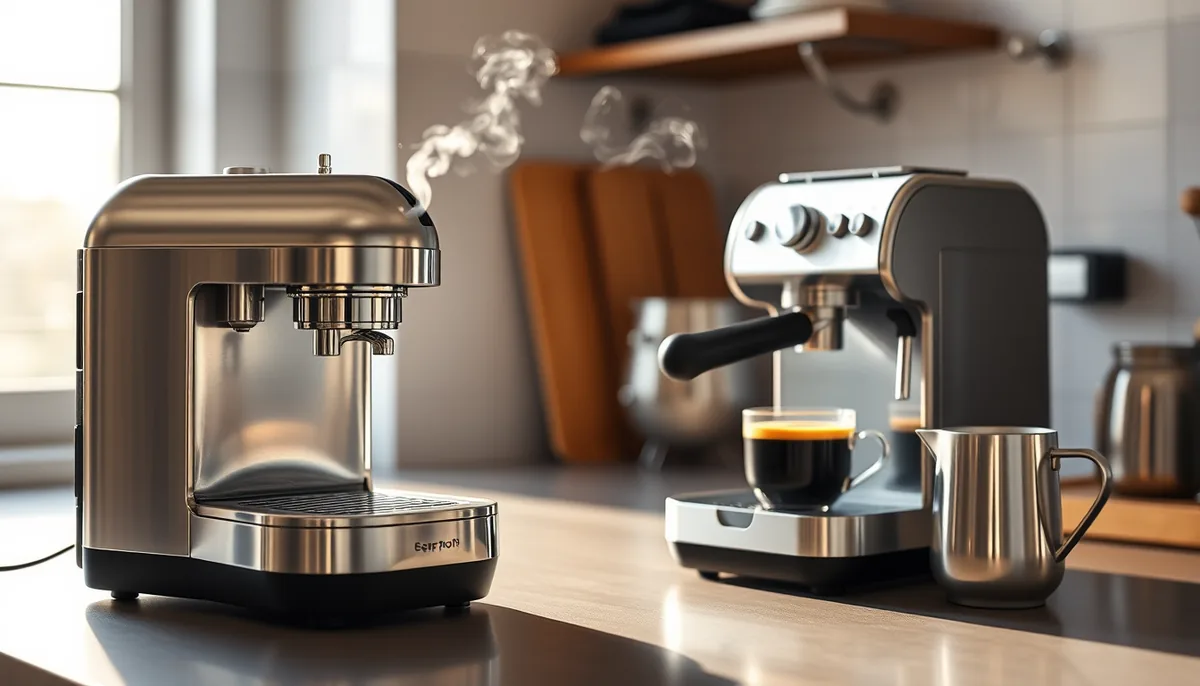
In short: On a single boiler espresso machine one small boiler handles both brewing and steaming, so you control temperature through the order of your steps. Without a PID, a group head flush followed by waiting for the heating light to go out does the job; with a PID, you simply wait for the display. After steaming milk, purge the condensate, refill the boiler through the steam wand and cool it down with a flush.



| Boiler capacity | from 0.25 l (Lelit Anna) to 0.4 l (Profitec GO); the Ascaso Dream uses a thermoblock instead of a boiler |
|---|---|
| Temperature control | Rancilio Silvia E: thermostat; every other model in the table: PID |
| Refilling the boiler after steaming | spelled out in the Rancilio Silvia and Lelit Anna manuals (hot water through the steam wand) |
| Back to brewing after steaming | Ascaso: wait 5 minutes or run water until the light stops flashing |
| Milk temperature | 55–70 °C, never above 75 °C (Ascaso manual) |
| Realistic capacity | 1–2 milk drinks per steam cycle, then refill the boiler and cool it down |
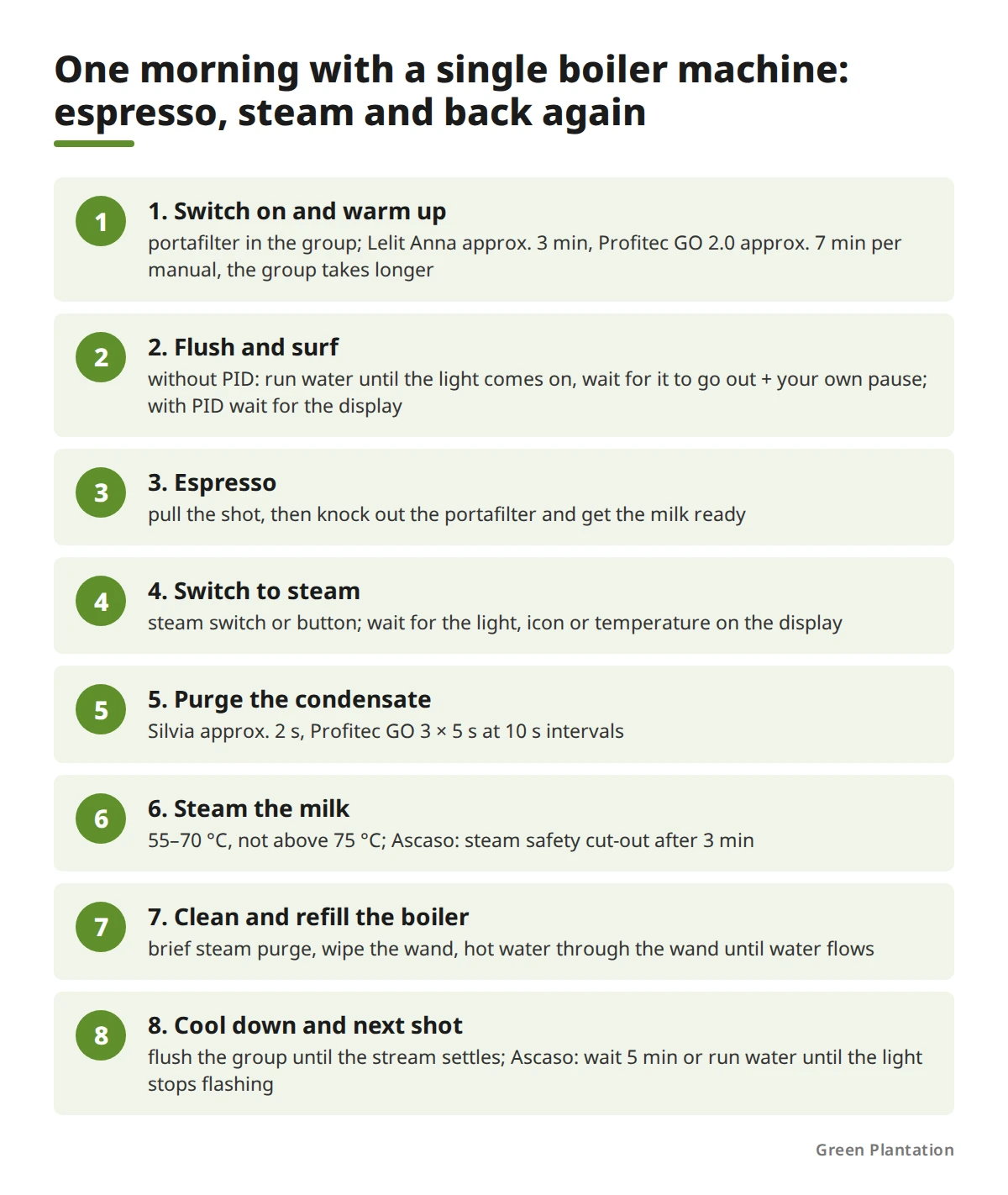
Saturday morning, a flat in Leeds. The Silvia has been on for twenty minutes, the portafilter is warming up in the group, two cups sit on the counter and there is enough milk in the fridge for two cappuccinos. In ten minutes both drinks should be ready: no scorched espresso and no milk that has already separated in the jug. On a single boiler machine that comes down to sequence and timing, not steaming skill. This guide is about technique. If you are still choosing a machine, this is not the article for you.
Why temperature swings on a single boiler espresso machine
A single boiler espresso machine has one small boiler that supplies both brew water and steam. Espresso brews at roughly 90–96 °C, while steaming needs the boiler above 115 °C. The machine therefore switches between two modes, and every switch means heating up or cooling down the whole boiler together with the brass group head.
A thermostat (Rancilio Silvia E) works like an on/off switch: when the water drops below the lower threshold, the element switches on; once it passes the upper threshold, it switches off. The gap between those two points is called hysteresis. The water in the boiler is constantly "breathing" up and down, and the result in the cup depends on which part of the cycle you press the brew switch in. The orange "boiler heating" light on the Silvia shows when the element is on.
A PID (Lelit Anna, Victoria, Profitec GO, Ascaso Dream PID) heats in short pulses and holds temperature within a much narrower band. Even a PID cannot change the physics, though: in the Anna manual Lelit states that during heat-up and while dispensing coffee or water, the temperature may deviate by 10–12 °C above and below the set value. A 250 ml boiler simply feels every slug of cold water coming in from the tank.
That is where temperature surfing comes in: your own routine for getting a repeatable brew temperature out of a thermostat machine. You are not chasing an exact number, you are hitting the same point in the heating cycle every time.
Temperature surfing without a PID: Rancilio Silvia E step by step
For espresso, the Rancilio manual says just one thing: wait until the orange light goes out. The whole surfing routine is built on that.
- Warm-up. Leave the portafilter locked into the group so it heats up with the machine. The light goes out well before the brass group is fully hot, so give the machine extra time.
- Flush. Without the portafilter, run water through the group head. It may hiss and spit at first; that is superheated water. Keep flushing until the light comes on, which forces the thermostat to switch the element on.
- Wait for the light to go out. The element is now heating. The moment the light goes out, the boiler is at the top of its cycle.
- Your own pause. After the light goes out, always count the same number of seconds before starting the shot. The manufacturer does not give a figure, and the numbers on forums vary with the individual machine, the age of the thermostat and scale in the boiler. Find your pause yourself: start short and lengthen it according to taste (sour, sharp espresso means it was too cool, bitter and dry means too hot).
- Write it down. Once you find a pause that tastes right, stick with it. Repeatability is the whole point of surfing.
The same routine works on other thermostat machines, including the popular Gaggia Classic: force the element on with a flush, wait for the end of the heating cycle and count a fixed pause. Just check your model's manual for what exactly the light indicates.
PID machines make it easier: wait until the display shows the set temperature (the Anna also has a ready light, on the Victoria the heating indicator disappears). A short flush before the shot is still useful here to even out the group head temperature.
Switching to steam and purging the condensate
While the boiler is heating up to steam temperature, the water in the wand and the pipework is still cooler and condenses. Plunge the wand straight into the milk and the first thing going into it is water. That is wet steam. This is why you purge the condensate before steaming: point the steam wand over the drip tray and open the valve briefly. What the manufacturers recommend:
- Rancilio Silvia E: turn on the steam switch, wait for the orange light to go out, purge the condensate for about 2 seconds, submerge the wand and open the valve slowly. The E version switches itself off 30 minutes after the last coffee or water dispense, so the manual advises flicking the brew switch on for a few seconds before steaming to stop the machine shutting down mid-steam.
- Lelit Anna PL41TEM: move the lever to steam, wait for the light, open the valve. The manual warns that a little water comes out first, then steam follows.
- Lelit Victoria PL91T: press the steam button, the display shows the rising temperature, then the steam icon appears. Release a little steam over the grille first, close the valve, submerge the wand and open it again.
- Profitec GO (GO 2.0 manual): open the valve for about 5 seconds and close it, repeat twice at intervals of about 10 seconds, then wait for the set steam temperature (128 °C by default, adjustable from 115 to 134 °C).
- Ascaso Dream PID: a thermoblock instead of a boiler. After switching on steam, run the wand until water comes out intermittently and wait for the light to stay solid. When the pump starts pulsing, open the steam. A safety cut-out stops steam after 3 minutes of continuous use.
Why does my steam wand spit? Most often because the condensate was not purged or the boiler has not reached steam temperature yet. For uneven steam, the Silvia manual says to check that the holes in the steam tip are clear. Sputtering towards the end of steaming means the small boiler is running out of steam.
Which order: espresso first or milk first?
Both are valid; the difference is what you sacrifice. Steamed milk separates within a few minutes, while espresso is less time-critical. In an r/espresso thread on milk drinks with a single boiler (41 comments, 2026), around 17 people said "brew first, then steam" and only 4 said "milk first". It is a small sample, but the trend is clear.
| Order | Advantage | Drawback | Best for |
|---|---|---|---|
| Espresso, then steam | fresh milk, the machine naturally goes from lower to higher temperature, you can fill the wait by knocking out and cleaning the portafilter | the espresso waits from several tens of seconds to a few minutes | 1–2 cappuccinos, most owners |
| Steam, then espresso | the espresso is completely fresh | after steaming the boiler is overheated, it has to be refilled and cooled, and the milk loses texture in the meantime | people who drink espresso with a dash of milk, or pour latte art and can keep swirling the milk in the jug |
| All shots first, then all the steaming | only one mode switch | a small boiler may not cope with a large jug | 2 drinks with a 350–600 ml jug |
Manufacturers do not give a figure in seconds for how long steam takes. Silvia and Profitec GO owners describe anything from several tens of seconds to about a minute in forum threads, roughly the time it takes to knock out the puck and pour milk into the jug. Treat that as a guide, not manufacturer data.
Refilling the boiler after steaming: the step people forget
Steam leaves the boiler as water. The pump does not run while you steam, so the water level in the boiler drops. That is why Rancilio and Lelit tell you in their manuals to refill the boiler after steaming:
- Turn off the steam switch and briefly release steam over the drip tray to clear the wand.
- Wipe the wand with a damp cloth.
- Switch on hot water (Silvia: hot water switch; Anna: hot water lever and pump switch) and open the valve slowly.
- When water starts flowing from the wand, close the valve and switch off the pump.
For the Anna, Lelit says this is necessary to restore water circulation in the machine's pipework. Rancilio gives no reason. Technically, the point is to keep the element fully submerged after steaming so it does not overheat in a half-empty boiler. As a bonus, this step immediately cools the boiler, because cold water flows in from the tank.
The Profitec GO 2.0 manual requires you to switch off steam mode after steaming and flush the group until water comes out. For its thermoblock, Ascaso recommends "priming": run a cup of water through the wand, for example after steaming or after the tank has run dry. For the Victoria PL91T, the 2016 manual does not describe a separate refill, only the return to brew mode. One owner who has had both the GO and the Victoria reports that the Victoria refills the boiler and flushes the wand by itself after steaming.
Getting back to espresso temperature and the second drink
After steaming, the boiler is several tens of degrees hotter than espresso needs. Brew straight away and the shot will be scorched and bitter. Cooling down is the same trick as surfing, just in reverse:
- Silvia and other non-PID machines: after refilling the boiler, run water from the group into the drip tray or a jug. It hisses and spits at first; that is steam and superheated water. Keep going until the stream settles and the heating light comes on, then continue surfing from step 3.
- Anna, Victoria, GO: switch to brew and run water through the group until the display drops to the set value. The Victoria returns to brew mode by itself after a while without steaming.
- Ascaso Dream PID: the manual offers two options: wait 5 minutes, or run water through the wand until the temperature light stops flashing.
How many cappuccinos in a row? A 0.25–0.4 l boiler is a small steam reserve. The Ascaso manual explicitly mentions "more than three cappuccinos in a row" and points you to priming and cooling between them. A Silvia owner describes on Reddit that with 400 ml of milk for two large cappuccinos, steam loses power at about 80 % and the heating light comes back on. In practice: one jug for one or two drinks, then refill the boiler, cool it and start again. Four cappuccinos for the whole household in the morning are doable, but it will take more than a quarter of an hour.
Comparison: how popular single boiler machines behave
| Model | Heating | Power | Control | How you know steam is ready | Notable feature per manufacturer |
|---|---|---|---|---|---|
| Rancilio Silvia E | 0.3 l brass boiler | 1150 W | thermostat | orange light goes out | boiler refill via hot water switch, auto-off after 30 min idle |
| Lelit Anna PL41TEM | 0.25 l brass boiler | 1050 W | PID 80–130 °C, factory set to 95 °C | ready light on | heat-up approx. 3 min, display flashes above 108 °C, boiler refill after steaming |
| Lelit Victoria PL91T | 0.3 l brass boiler | 1200 W | PID via LCC with OLED display | indicator disappears, steam icon appears | brew and steam temperature set on the display, automatic return to brew mode |
| Profitec GO | 0.4 l brass boiler (GO 2.0: 0.3 l) | 1300 W | PID | display shows the set steam temperature | GO 2.0: steam 115–134 °C, heat-up approx. 7 min, Fast Heating function |
| Ascaso Dream PID | thermoblock | 1100 W | PID, brew 80–110 °C, steam 110–165 °C | steam light stays solid, pump pulses | steam safety cut-out after 3 min, wait 5 min after steaming |
To be honest: when one boiler is not enough
- Several milk drinks in a row. Every extra drink is a full cycle: steam, boiler refill, cool-down, surfing. For a household making four cappuccinos every morning, a heat exchanger (HX) or dual boiler machine will be more convenient.
- Steam power. A small boiler holds less steam than a large dedicated steam boiler. A 600 ml jug steamed in one go is already at the limit.
- Thermostat without a PID. Surfing works, but it takes patience. On the Silvia, thermostat behaviour drifts with age and scale, so you will occasionally need to reset your pause.
- Scale. Frequent heating up to steam temperature and refilling with cold water put the boiler under stress, so regular descaling is a must. Rancilio gives a target water hardness of about 89 mg/l CaCO3 (89 ppm, roughly 5 °dH) and recommends filtering harder water. Tap water hardness across the UK and Europe varies enormously from place to place, so measure it with a test strip or check your local water supplier's report.
- Forgetting the refill. Skip refilling the boiler after steaming and you risk overheating the element, and your next espresso is brewed from an overheated boiler.
Frequently asked questions
How do you steam milk on a single boiler espresso machine?
Switch to steam, wait for the ready signal, purge the condensate over the drip tray, place the steam wand tip just below the surface of the milk, stretch it by drawing in air first, then submerge the wand deeper and bring the milk up to temperature. Ascaso recommends 55–70 °C, never above 75 °C. You can read more about how hot milk should be in our guide to the perfect milk temperature for cappuccino.
Do I need to temperature surf a machine with a PID?
Not in the original sense. The PID holds the boiler temperature, so you just wait for the display and do a short group head flush. Surfing is mainly needed on the Silvia and other thermostat machines, and after steaming when the boiler has to be cooled down. Whether a PID is worth it on an espresso machine at all is covered in our article on home coffee machines with PID control.
How do you temperature surf a Gaggia Classic?
The principle is the same as on the Silvia: force the element on with a group head flush, wait for the end of the heating cycle and count the same pause every time. Check your version's manual for what exactly the light means, and tune the length of the pause by taste.
Why is my steam wand spitting water?
Because of condensate in the wand, a boiler that is not up to temperature yet, or blocked holes in the steam tip. Purge steam over the drip tray, wait for the light and clean the steam tip. Constant sputtering with every drink is a sign that it is time to descale or have the machine serviced.
What is the most common mistake with a single boiler machine?
Skipping the boiler refill after steaming and pulling the next shot straight from an overheated boiler. The result is a scorched, bitter espresso and unnecessary stress on the element. Refill through the steam wand as the Rancilio and Lelit manuals describe, then flush the group until the temperature drops.
What does purging or priming an espresso machine mean?
In everyday use it covers two things: purging condensate from the steam wand before steaming, and filling the boiler with water on first start-up or after the tank has run dry (Ascaso calls this "priming"). The manuals recommend both so that the wand delivers steam rather than water and the element never heats dry.
How do you steam milk on a Rancilio Silvia?
As above: steam switch on, wait for the orange light to go out, purge the condensate for 2 seconds and open the valve slowly. After steaming, do not forget to refill the boiler using the hot water switch and cool it down with a group head flush.
Do I really need a dual boiler espresso machine?
Not for one or two milk drinks at a time. With the routine above, a single boiler handles a morning cappuccino or two comfortably. If you regularly make four or more milk drinks back to back, the refill and cool-down cycle becomes tedious and an HX or dual boiler machine starts to make sense.
Recommended products
- Rancilio Silvia E – the thermostat classic and the best machine to learn surfing on, with a solid 0.3 l boiler.
- Lelit Anna PL41TEM – the smallest boiler in this line-up, with a PID, fast heat-up and easy mode switching.
- Lelit Victoria PL91T – the most convenient in the line-up; set brew and steam temperature on the LCC display.
- Profitec GO Red – the largest boiler at 0.4 l and 1300 W for a quicker switch to steam.
- Ascaso Dream PID – a thermoblock with PID, a wide steam temperature range and a 3 minute safety cut-out.
- Rhinowares Pro 360 ml milk jug – a small jug that a small boiler handles with ease.
- Rhinowares digital thermometer – until you can judge it by hand, it keeps your milk under the 70 °C mark.
What next: regular steam wand cleaning and descaling are covered in our complete guide to cleaning and maintaining your coffee machine, why water hardness matters so much is explained in the article on water for your coffee machine, hardness and pH, and with your milk steamed you can move straight on to latte art for beginners.
Sources
- Rancilio: Silvia / Silvia E user manual (2024)
- Lelit: Anna PL41TEM user manual
- Lelit: Victoria PL91T specifications
- Profitec: GO 2.0 user manual
- Ascaso: Dream PID / ONE user manual
Updated: November 2026
Author: Petra Novotná, editorial name of the Green Plantation.
You might also like
 Eureka Costanza Review: HX Machine with PID, Costanza R and Owner Experiences
The Eureka Costanza is a compact E61 heat exchanger machine with PID and a shot timer. We clear up the dual boiler myth, explain how it differs from the… 26. 11. 2026
 Eureka Pura and Pura R review: experience, tech and an honest verdict on the E61 heat exchanger
The Eureka Pura is an E61 heat exchanger machine with a pressurestat; the Pura R is the same machine with a rotary pump. Here are the official specs, the… 26. 11. 2026
 E61 Group Head: The Complete Guide – How It Works, Maintenance and Modifications (Flow Control, Thermometer, Pressure Gauge)
How the E61 group head works (thermosiphon, cam, pre-infusion), how often to backflush and grease the cam, how to replace the gasket and shower screen, and… 26. 11. 2026