
 Česky (CZK)
 Slovensky (EUR)
 Magyar (HUF)
 Polski (PLN)
 English (EUR)
 Deutsch (EUR)
 Français (EUR)
 Español (EUR)
 Português (EUR)
 Italiano (EUR)
 Svenska (SEK)
 Suomi (EUR)
 Nederlands (EUR)
 Dansk (EUR)
 Lëtzebuergesch (EUR)
 Eesti (EUR)
 Latviešu (EUR)
 Lietuvių (EUR)
 Slovenščina (EUR)
 Română (RON)
 Български (EUR)
 Hrvatski (EUR)
 Ελληνικά (EUR)
 Українська (EUR)
 Norsk (EUR)
 Srpski (EUR)
 Tiếng Việt (EUR)
Ascaso Barista T 2G Compact review: specs, installation and life behind the bar
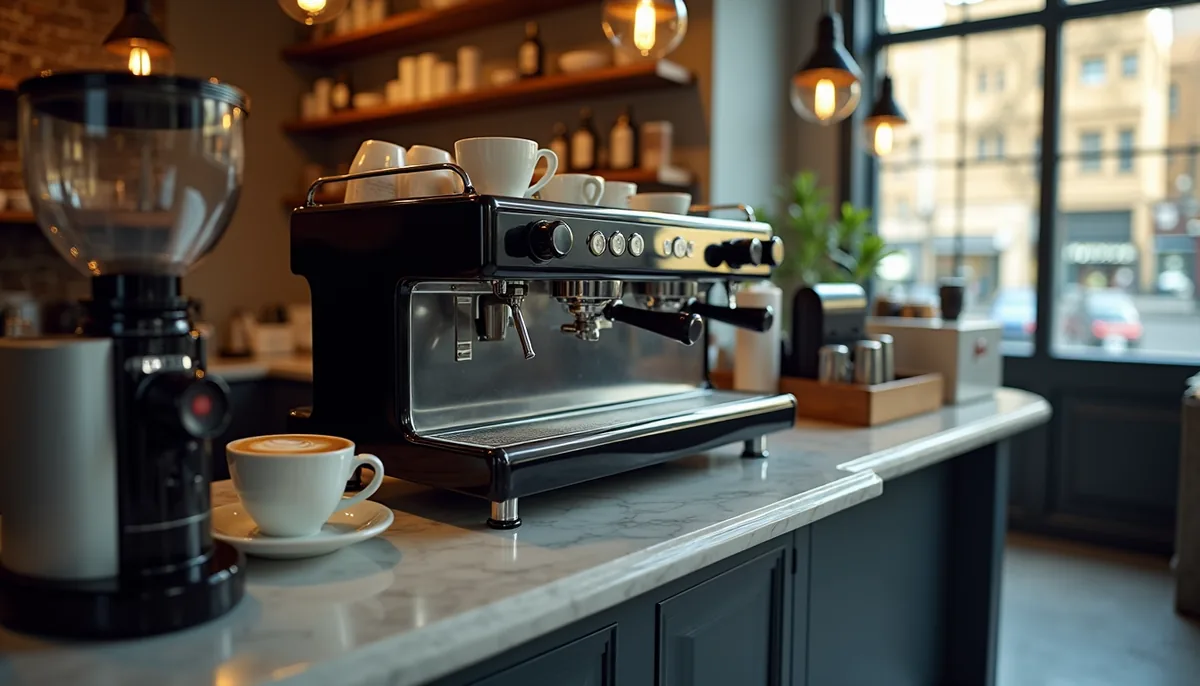
In short: The Ascaso Barista T 2G Compact is a two-group commercial espresso machine squeezed into 560 mm of counter. Each group has its own PID-controlled thermoblock, fed through a separate stainless steam boiler. It suits small cafés and bistros short on bar space, but Ascaso's own documents disagree on boiler size and total power.

| Design | T Technology: thermoblock per group + separate steam boiler |
|---|---|
| Groups | 2 × 58 mm, 1000 W each, PID, 4 volumetric doses |
| Width / weight | 560 mm / 65 kg (standard 2G: 700 mm / 71 kg) |
| Steam boiler | 4.5 l or 9.5 l depending on the document (see below) |
| Power supply | 230 V single phase or 380/400 V three phase, hardwired |
| Best for | small café, bistro, hotel bar, staffed office coffee point |
Who is the Barista T 2G Compact for?
Ascaso pitches the Barista T range at cafés with medium to high volume. The Compact is the narrow version: two groups in 560 mm instead of 700 mm. That frees up 14 cm of bar for a grinder, a knock box or the till, and on a tight counter that is the whole point of the machine.
Where it makes sense:
- Small café or bistro where two baristas want to pull shots side by side but the counter cannot spare 70 cm for the machine.
- Hotel bar and breakfast service with a sharp morning rush and quiet hours in between.
- Office or co-working space with a barista, where people want proper espresso rather than a bean-to-cup machine.
- Bakery or patisserie running coffee as a second line of business.
Ascaso does not publish a cups-per-day figure. Size the machine against your busiest quarter of an hour instead: how many shots you need, and how much of that is milk. If you are still weighing up the bigger picture, our guide on how to choose a professional coffee machine walks through group count, boiler type and service. For home use the Compact is plainly overkill: it needs hardwiring, a mains water feed and a drain.
How the T Technology works: thermoblocks, steam boiler, PID
The Barista T is not a classic heat exchanger, and it is not a multi-boiler either. Ascaso calls the concept T Technology. A volumetric rotary pump pushes water through a pre-heating circuit inside the steam boiler, then each group's thermoblock brings it up to the set brew temperature. There is no large coffee boiler kept hot all day.
- Temperature: brew water 80 to 110 °C in 0.1 °C steps, steam 110 to 165 °C in 1 °C steps, each on its own PID.
- Pump: stainless rotary pump, set to 9 bar at the factory, expansion valve at 11 bar.
- Dosing: four programmable volumetric doses per group, two digital displays per group.
- Pre-infusion: programmable, to 0.1 s according to Ascaso.
- Steam and hot water: two cool-touch steam wands and a separate hot water outlet. The steam boiler runs at 1 to 1.5 bar in service.
- Warm-up: Ascaso says the first espresso is possible after about a minute. Allow longer for full steam pressure.
What that means behind the bar: each group can be set independently. You could run the house blend at 93 °C on the left and a light single origin at 94.5 °C on the right, which a heat exchanger machine simply cannot do.
Compact vs standard 2G: the spec sheet and the manual disagree
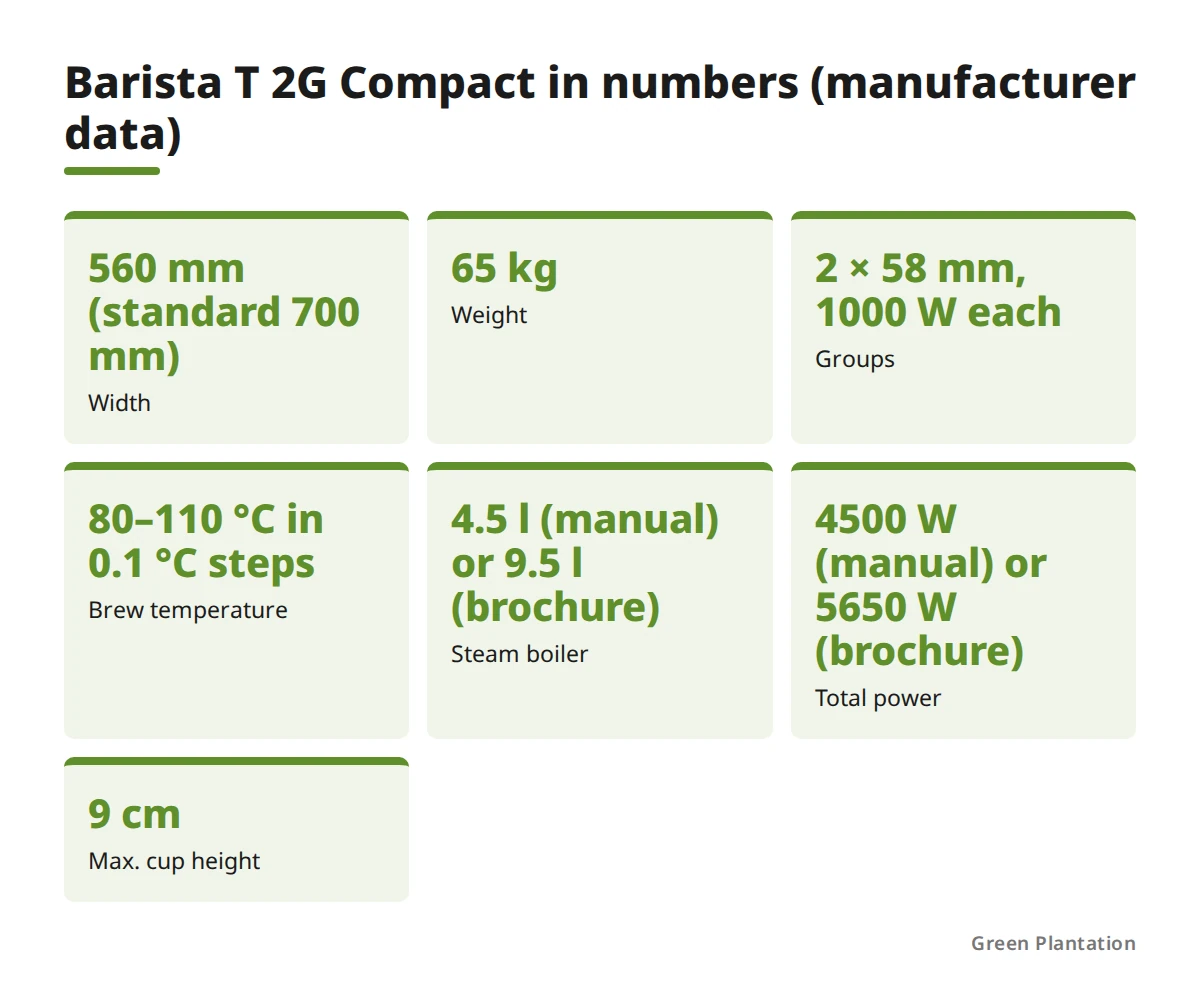
This is where you need to read carefully. The Compact no longer appears among the current models on Ascaso's website (Pro, Barista T, One). It does appear in the technical brochure linked from that site and in the 2024 and 2025 user manuals, and those documents contradict each other on key figures:
| Spec | Technical brochure | User manual 2024/2025 |
|---|---|---|
| Steam boiler | 9.5 l | 4.5 l |
| Steam boiler element | 3500 W | 2000 W |
| Groups | 2 × 1000 W | 2 × 1000 W |
| Total power | 5650 W | 4500 W |
| Dimensions W × H × D | 560 × 460 × 565 mm | 560 × 550 × 465 mm |
| Weight | 65 kg | 65 kg |
| Max. current at 230 V | not stated | 19.5 A |
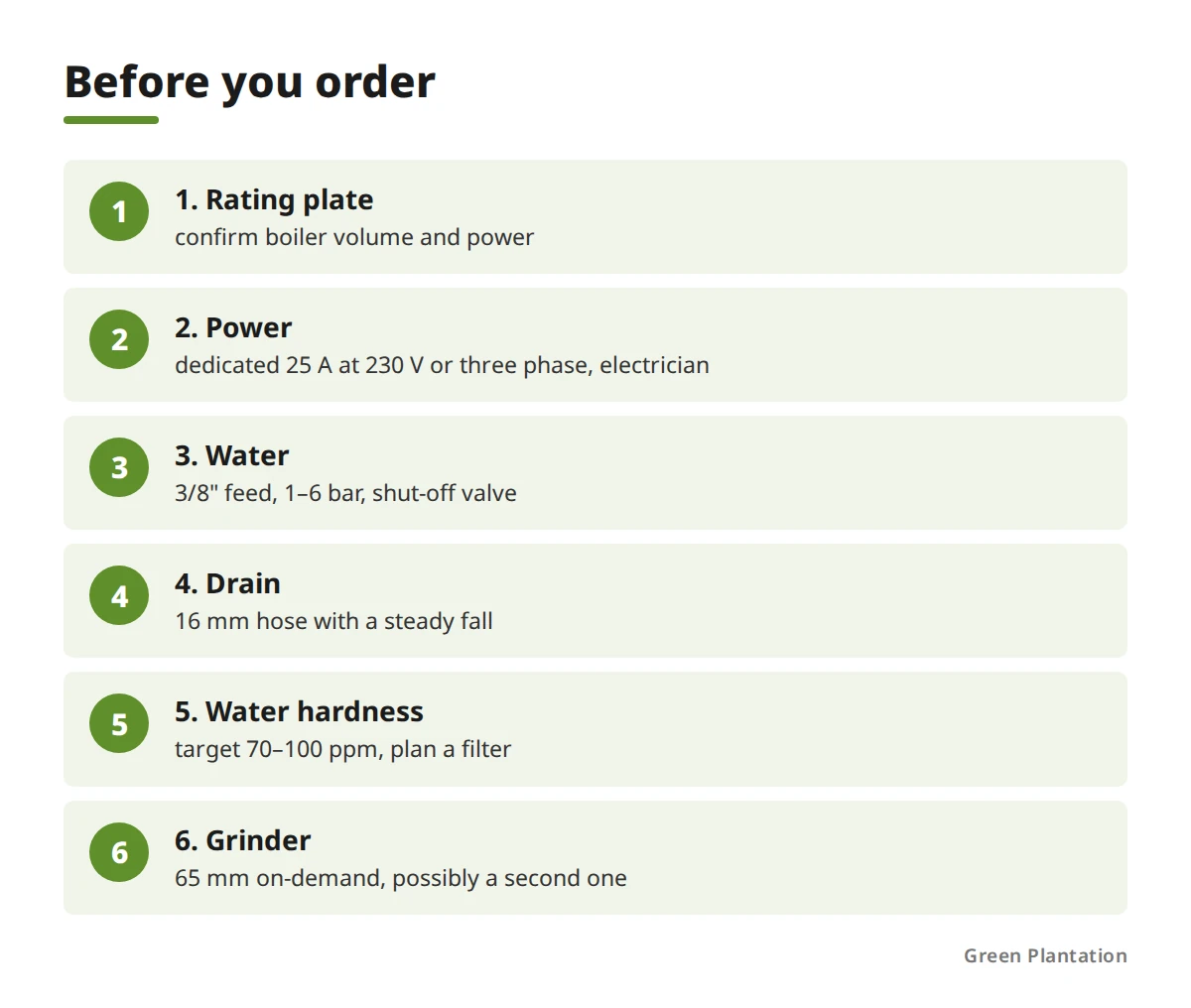
The only figures all sources agree on are the width, the weight, the two 1000 W groups and the choice of single or three phase supply. From the public paperwork alone you cannot tell which build our K07544 in black actually is. Our advice: before you order, ask to see the rating plate or the declaration of conformity with power ratings, either from us or from an Ascaso service partner. For your electrician, the gap between 4500 and 5650 W is not a footnote.
According to the brochure, the Compact also drops several features of the full-width Barista T 2G: the 4.2 inch touchscreen, insulated pipework and groups, heating elements in the groups, the insulated steam boiler, barista lights and the Power Guard energy saving system. Ascaso quotes temperature stability of ±1.5 °C (standard models ±0.5 °C) and a maximum cup height of 9 cm. Tall latte glasses and takeaway cups will not fit under the spouts.
Installation: power, water feed and drain
The Barista T ships without a plug. Ascaso specifies a fixed connection with a main isolator, and installation and servicing by qualified technicians only. Sort out four things before the delivery date:
- Power: 230 V single phase or 380/400 V three phase. On 230 V, the manual calls for a dedicated 25 A circuit for a two-group machine, so a standard 13 A socket is out of the question. A service menu setting limits how many elements heat at once; on the Compact this puts the draw anywhere between 6.5 and 19.5 A. Less current means slower steam recovery, though. If the site has three phase, use it.
- Water feed: cold drinking water through a 3/8" connection with a shut-off valve. Mains pressure should sit between 1 and 6 bar; above that, fit a pressure reducing valve. Ascaso specifies a flow rate of 8 l/min.
- Drain: 16 mm drain hose with a steady fall to the waste.
- Environment: 5 to 32 °C, no more than 70 % humidity, frost free. Leave room at the side for the grinder and behind for pipework and servicing. Bar layout and working height are covered in where to place the coffee machine in the café.
Water hardness, filtration and descaling
Ascaso's recommended water for the Barista T: total hardness 70 to 100 ppm, TDS 90 to 150 ppm, pH 6.5 to 8, alkalinity 40 to 80 ppm and chloride no higher than 30 ppm. Tap water in many parts of the UK and Europe is considerably harder than that. Without a filter or softener, scale in the steam boiler and thermoblocks is only a matter of time.
In practice: check the hardness with your water supplier or a test strip, fit a suitable filter cartridge ahead of the machine and log the litres between changes. It matters for warranty claims too. Ascaso's manual excludes damage caused by scale, poor cleaning or work carried out outside its official technical assistance network. More on hardness, alkalinity and flavour in what baristas should know about water quality.
On bar: espresso, milk and cleaning
A sensible starting recipe: 18 g in a double basket, roughly 36 g in the cup, 25 to 30 seconds, 93 °C. Because dosing is volumetric, set the four doses on each group once with a scale and recheck them whenever you change beans. Pre-infusion earns its keep mainly with lighter roasts.
For milk drinks the separate steam side helps. How much headroom you have in a rush, though, comes down to boiler volume and element power, which are exactly the figures that differ between brochure and manual. If most of your sales are flat whites, cappuccinos and lattes, settle that question first.
Cleaning routine according to the manual:
- After every milk drink: purge the steam wand and wipe it.
- Daily: run the automatic group cleaning cycle (10 flushes of 10 s), clean the wands with milk system cleaner, wash the drip tray and wipe down the stainless steel.
- Weekly: brush the shower screens and group gaskets, backflush with a blind basket and cleaning powder, then flush for 30 s with clean water. Soak portafilters and baskets in cleaning solution.
- As needed: descale the steam boiler depending on water hardness and volume, ideally via a service technician.
Ascaso gives no replacement interval for gaskets. Treat them as wear parts and check them at every service. The manufacturer makes a point of the modular build, which is meant to make repairs easier.
What owners say
To be straight about it: independent owner reviews of the Barista T 2G Compact are practically non-existent, and there is not much more on the Barista T range as a whole. Of 100 posts on r/espresso matching "ascaso barista", around 29 were about Ascaso, but only 2 about a Barista T. Searches of Home-Barista and the big German forum kaffee-netz.de turned up no Barista T threads, and the only in-depth hands-on reviews cover the single-group sibling, the Baby T Plus.
What the two threads suggest, with caution:
- One poster knew the Barista T Plus from a café where the espresso had impressed them. Replies called it too big for home use and described it as a flat-pressure machine with limited pressure profiling, but quick to heat up.
- The second thread dealt with sour espresso on an older Barista T Zero from 2018. It was solved through recipe and grind, not a fault, though people noted that this old model allowed only short pre-infusion.
Owners of the Baby T Plus, which uses the same technology, mostly praise its steam power; earlier units had a noisier pump. That is a single-group machine for coffee corners and small venues, though, not evidence about the Compact. For a commercial purchase, the service partner near you matters more than any forum thread.
Weak points and what to check
- Conflicting specs: steam boiler 4.5 or 9.5 l, total power 4500 or 5650 W. Get the rating plate checked before you buy.
- Stripped-back kit: no insulation, no touchscreen, no Power Guard. The energy saving claims in older Ascaso brochures (up to 50 % against a traditional machine) do not explicitly cover the Compact.
- 9 cm cup height: fine for espresso, flat white and cappuccino cups, too tight for tall glasses and takeaway cups.
- Electrics: on 230 V with power limited, steam reserve drops.
- Little owner data: long-term experience is missing. Ask about spare parts and service response times up front.
How it compares
The two Barista T models are currently the only two-group machines in our range. The Baby T Plus is included because it is the same technology in a smaller package.
| Machine | Groups | Width | Steam boiler | Power | Best for |
|---|---|---|---|---|---|
| Barista T 2G Compact | 2 | 560 mm | 4.5 or 9.5 l (by document) | 4500 or 5650 W | small café with limited bar space |
| Barista T Pro 2G | 2 | 700 mm | 8.5 l, insulated | 5665 W | speciality café, training, competition |
| Baby T Plus | 1 | 350 mm | 2.5 l, insulated | 2400 W | coffee corner, catering, very small café |
The Pro adds the 4.2 inch touchscreen, insulated groups and pipework, ±0.5 °C stability and, depending on the version, 9 or 12 cm cup clearance. If your counter can take the extra 14 cm, it is the steadier choice. The Baby T Plus is enough when one person works the bar and rushes are rare.
Choosing the grinder
Two groups need a grinder with headroom. The Nuova Simonelli MDXS with 65 mm burrs is rated by its maker for about 1.5 kg of coffee a day and doses by time. The Mahlkönig E65S GbW doses by weight, which saves time when you switch beans often. If you serve decaf or a guest espresso, a second grinder is worth considering; we cover the pros and cons in to have or not to have two grinders in your café. For the basics, see how to choose a professional espresso grinder.
Verdict
The Barista T 2G Compact puts T Technology with independently controlled groups into 560 mm and solves a real space problem. In return you give up insulation, the touchscreen and Power Guard, and accept ±1.5 °C and a 9 cm cup height. Its biggest issue, though, is Ascaso's own conflicting figures on steam boiler and power. Settle those before ordering, plan for three phase or a dedicated 25 A circuit, a water feed and a filter, and it is a sensible machine for a small café. If you have the width, go for the Pro.
FAQ
Is the Ascaso Barista T a dual boiler?
No. Each group has its own PID-controlled thermoblock, plus a separate steam boiler. Brew water is pre-heated through the steam boiler and then fine-tuned in the thermoblock.
What is the difference between the Barista T Compact and the Pro?
The Compact is 560 mm wide rather than 700 mm and, according to the brochure, has no insulation, no touchscreen, no Power Guard and only 9 cm cup height. The Pro offers ±0.5 °C stability and PEEK tips on the steam wands.
Does the Barista T 2G Compact need three phase power?
Not necessarily. It runs on 230 V from a dedicated 25 A circuit, and power draw can be limited in the menu. Three phase gives you more steam reserve. Either way, the connection is a job for an electrician.
How quickly is it ready?
Ascaso quotes about a minute to the first espresso. The steam boiler takes longer to reach full pressure; the manual gives no figure for that.
What water hardness does the Barista T need?
Ascaso recommends 70 to 100 ppm total hardness. If your water is harder, a filter or softener is essential.
Is the Barista T worth it for home?
Hardly. Hardwiring, a mains water feed, a drain and 65 kg put it firmly in commercial territory. For home the Baby T Plus is a much better fit.
Recommended products
- Ascaso Barista T 2G Compact Black: two independent groups in 560 mm for small cafés; confirm the build from the rating plate before ordering.
- Ascaso Barista T Pro 2G Black: full width with insulation, touchscreen and ±0.5 °C, if you have the room.
- Nuova Simonelli MDXS black: 65 mm on-demand grinder for about 1.5 kg a day, a solid main grinder for a small café.
- Mahlkönig E65S GbW: grind-by-weight for venues that want consistency without weighing every dose.
- Brita Purity C300 Quell ST: filter cartridge against scale, fitted ahead of the water inlet.
- Urnex Cafiza 2, 900 g: cleaning powder for the weekly backflush with a blind basket.
Sources
- Ascaso: Barista T (model page)
- Ascaso: Barista T technical brochure incl. Compact (PDF)
- Ascaso: Barista T user manuals 2024/2025 (ZIP)
- Ascaso: The Barista T range, technology and design
- Reddit r/espresso: Baby T Plus or Barista T Plus
Updated: November 2026
Author: Petra Novotná, editorial name of the Green Plantation.
You might also like
 Ascaso Baby T Plus review: thermoblock, steam boiler and who it suits
An in-depth look at the Ascaso Baby T Plus: how its thermoblock and steam boiler work, what owners praise and complain about, and how it compares with dual… 24. 11. 2026
 9Barista Review: Stovetop Espresso Without Electricity
The 9Barista makes real espresso on the hob. We explain how it works, how to brew and clean it, and sum up what owners praise and criticise. 24. 11. 2026
HACCP Record Sheets – free template (Malta)
Free template (Malta): A temperatures · B goods in · C cleaning · D corrective actions · E training · F pests. PDF + Word. 24. 10. 2026