
 Česky (CZK)
 Slovensky (EUR)
 Magyar (HUF)
 Polski (PLN)
 English (EUR)
 Deutsch (EUR)
 Français (EUR)
 Español (EUR)
 Português (EUR)
 Italiano (EUR)
 Svenska (SEK)
 Suomi (EUR)
 Nederlands (EUR)
 Dansk (EUR)
 Lëtzebuergesch (EUR)
 Eesti (EUR)
 Latviešu (EUR)
 Lietuvių (EUR)
 Slovenščina (EUR)
 Română (RON)
 Български (EUR)
 Hrvatski (EUR)
 Ελληνικά (EUR)
 Українська (EUR)
 Norsk (EUR)
 Srpski (EUR)
 Tiếng Việt (EUR)
9Barista Review: Stovetop Espresso Without Electricity
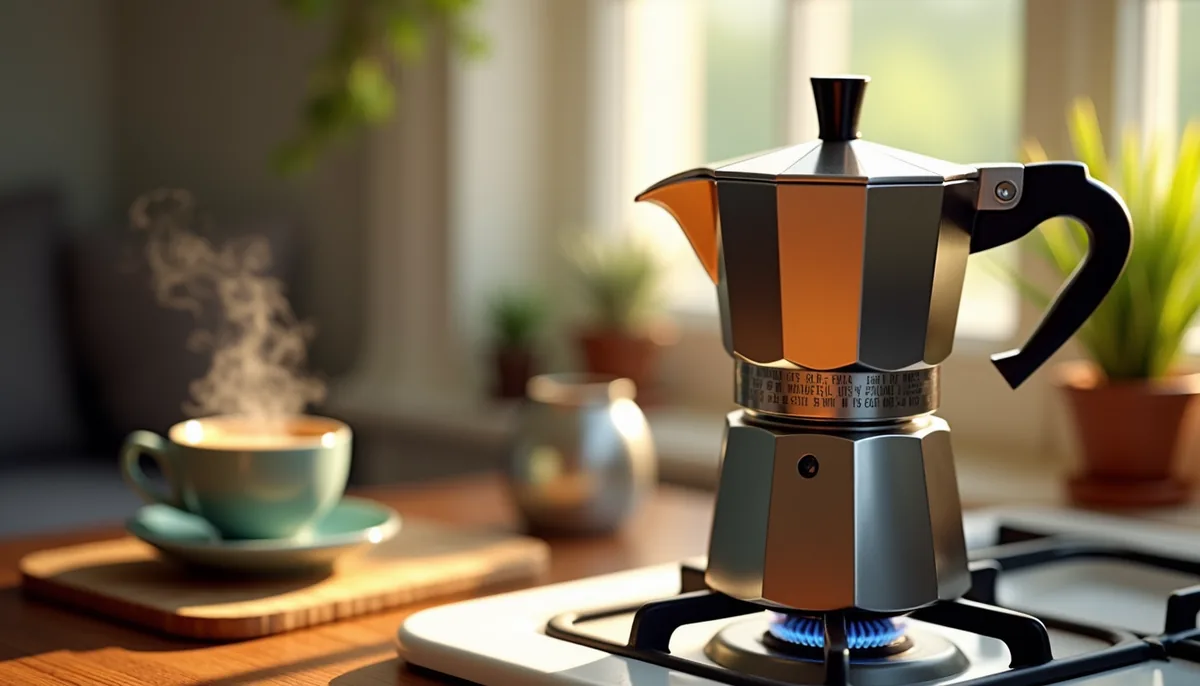
In short: The 9Barista is not a moka pot but a stovetop espresso machine: a twin-chamber system builds around 9 bar and cools the brew water to roughly 93 °C. It suits people who drink one or two straight espressos a day and have little space or no mains power. For milk drinks and back-to-back shots it is the wrong tool.

| Type | Stovetop espresso machine with no pump and no electronics, two chambers with heat exchangers |
|---|---|
| Brew pressure / temperature | approx. 9 bar / approx. 93 °C (manufacturer's figures) |
| Water / dose / yield | 120 g water, start with 18 g coffee, around 35–40 g espresso |
| Time from cold | 3–6 minutes, then 25–30 seconds of extraction |
| Weight / height | approx. 1.7 kg / 18 cm |
| Heat source | gas (with heat transfer plate), electric, ceramic, induction (only with the induction pad), camping stove |
Who the 9Barista is for, and who should skip it
The 9Barista was designed by William Playford, a British jet engine engineer, and is made in Cambridge. The first generation (Mk.1) launched in 2019; the reworked Mk.2 followed in 2025 in Standard and Pro versions. The principle is identical across all of them, and that principle decides whether the machine fits the way you drink coffee.
A good fit if you
- mostly drink straight espresso or an Americano, one or two shots a day,
- have a small kitchen, a campervan, a narrowboat or a cabin without reliable power,
- like medium to dark roasts (more on that below),
- want a machine with no electronics that can be kept going for years with spare parts.
Probably not for you if you
- make cappuccinos for two or three people every morning: there is no steam wand, and every extra shot needs a fresh cycle,
- enjoy playing with brew ratio, temperature or pressure profiles,
- want to pull very light, filter-style roasts as espresso.
How it works, explained simply
Water in the lower chamber is heated on the hob to about 179 °C, which raises the pressure to around 9 bar. Just before that point a spring-loaded valve opens and the water travels through a heat exchanger coil sitting in boiling water in the upper chamber. There it drops to about 100 °C, and a second, finned heat exchanger brings it down to roughly 93 °C. Only then does it flow up through the coffee in the 53 mm basket and into the portafilter cup on top.
So the difference from a moka pot is not cosmetic. According to the manufacturer, a moka pot works at about 0.5 bar with water above 100 °C, while the 9Barista works at espresso pressure and espresso temperature. Both are fixed mechanically. That keeps the routine simple, but it also means there is nothing to adjust.
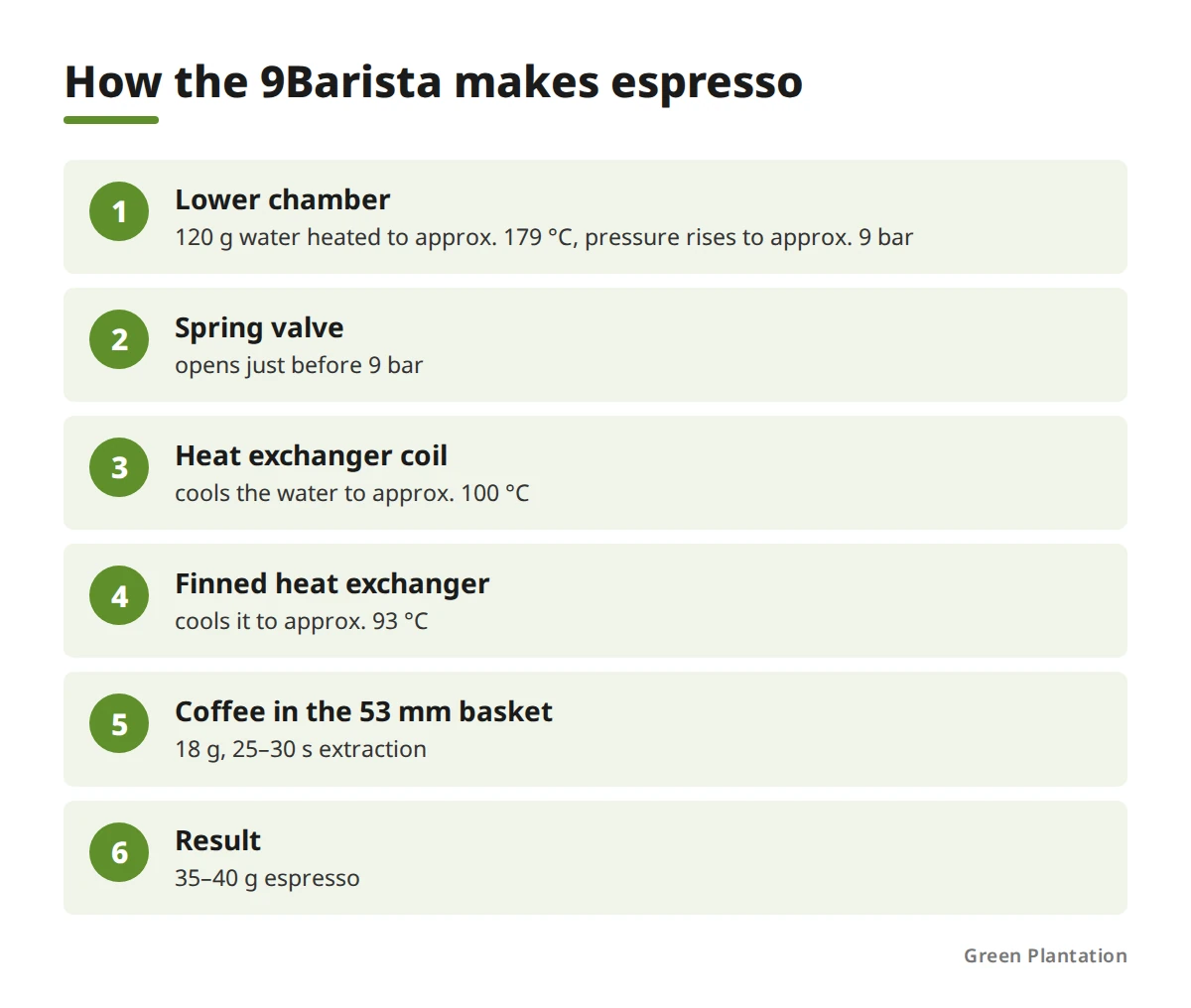
Making espresso: step by step
- Water: 120 g of filtered water into the boiler, never above the fill line. Overfilling makes water spit out of the chimney later. If you live in a hard-water area, which covers much of England, filtered water is worth it twice over, because limescale can upset the valve.
- Coffee: The manufacturer recommends starting with 18 g. Our product page mentions 20 g for a double espresso; treat that as the upper limit and work up from 18 g.
- Distribute and tamp: Level the coffee in the basket, tamp evenly with roughly 5 kg of pressure and fit the basket cap carefully.
- Attach the portafilter: It is sealed when the two handles sit at right angles to each other. It feels stiff at first.
- On the hob: Medium to high on gas and electric, medium on induction. Aim for 3–6 minutes to the first drops. If it comes faster, turn the heat down; if it takes longer, turn it up. If nothing has appeared after 8 minutes, take it off the heat.
- Extraction: From first drop to finish should take 25–30 seconds. Faster means grind finer, slower means grind coarser.
The biggest adjustment for anyone coming from a pump machine: you cannot stop the shot on the scales. The machine pushes the water from the lower chamber through and stops by itself, and the manufacturer puts the yield at 35–40 g. Your only levers on flavour are grind size and dose. If the shot tastes sour and thin, grind finer first and only then change the dose.
Which beans?
At around 93 °C and a fixed ratio of roughly 1:2, the 9Barista is in its element with classic espresso roasts. Several owners report that very light roasts stay sour, because the temperature cannot be raised. If light roasts are your thing, a manual lever machine such as the Flair 58, with its preheatable brew head, gives you more room to manoeuvre.
What about milk?
There is no steam wand. If you drink cappuccino or flat white, you will need a separate milk frother. In the discussions we went through, the handheld NanoFoamer is the one owners mention most often; latte art is possible with it, but it is harder than with steam.
Cleaning, care and spare parts
Cleaning is quick: cool the machine under the cold tap, unscrew the portafilter, lift off the basket cap and knock out the puck. Only once everything is cold, lift the lever on the safety valve to release the remaining pressure, then unscrew the boiler. Skip that step and you strain the boiler seal and struggle to open it. Rinse everything, leave it to dry, done.
With no pump and no circuit board, wear is limited to seals, the safety valve and, on the Mk.1, the wooden handles. We stock the 9Barista spare parts set with seals, plus individual parts such as the safety valve, chimney and heat exchanger. On gas hobs use the heat transfer plate; on induction you need the induction pad, because the hob will not detect the brass on its own. The heat transfer plate does not work on induction, a point several buyers say they only realised after ordering.
One important warning from real-world use: overheating can melt the plug in the safety ring, after which the boiler leaks and the machine cannot be used until the ring is replaced. An owner of a Mk.2 Pro reported exactly this, and a long-term review by Tom's Guide describes the same weak point, adding that the manufacturer supplies a replacement ring with the machine. Stick to the 3–6 minutes and use the plate on gas rather than turning the flame up.
What owners say
We have not tested the 9Barista ourselves. For this section we analysed 133 Reddit posts mentioning “9Barista” in the title or text from r/espresso and r/Coffee (2019 to November 2026) and 209 comments from four large threads, along with published reviews and the manufacturer's FAQ. The figures below are mentions across those 342 texts, not a survey. UK owners form only part of this international sample.
- Price is the most common topic (around 80 mentions). The consensus: technically impressive, but expensive for a one-cup brewer. At the same time many praise the build quality (around 20 mentions) and expect it to last for a very long time, because there is nothing electrical to fail.
- The grinder comes up in around 60 posts, and opinion is almost unanimous: without a proper espresso grinder the machine achieves little. Hand grinders such as Comandante, Kinu and 1Zpresso are named most often.
- Travel and camping (around 35 mentions): boats, campervans, fly-in camping; one user says he has pulled two shots a day from the same machine for more than three years. The criticism comes from backpackers: 1.7 kg is too heavy for lightweight packing.
- Milk (around 40 mentions): almost always the question of which separate frother to buy.
- No way to weigh the shot, no control (around 25 mentions) and slow follow-up shots (around 15 mentions) are the main reasons owners later move to a pump espresso machine.
- Roast level: several owners write that medium to dark roasts work very well, light roasts often do not.
- Stock basket: some users report clearly better results with a precision basket. The Mk.2 Pro already comes with an IMS basket.
The bottom line: the coffee itself is rarely criticised. Owners who are disappointed usually struggle with the workflow or expected something else, such as milk drinks or several cups in a row.
Weak points and what to watch out for
- One shot per cycle. For a second espresso you have to cool it, open it, rinse it and refill it. Allow a good ten minutes for two cups.
- Hot metal. The handles stay cool, the rest does not. Keep children away, and never leave the machine empty or on the heat for more than 8 minutes.
- Finding the right hob setting takes a few attempts, especially on gas. Make a note of the setting that gives you 3–6 minutes.
- Check the version. The Mk.1 (nickel-plated brass, wooden handles), Mk.2 Standard (ECOBrass and stainless steel, wooden handles, conventional portafilter) and Mk.2 Pro (bottomless portafilter, IMS basket, laser-drilled stainless steel basket cap, anodised aluminium handles) differ in equipment and in the manufacturer's warranty. Check the product page for the version we supply, and if in doubt, ask before you order.
- Altitude. The manufacturer says the machine works anywhere, but above roughly 1,500 m the lower boiling point tends to make espresso more sour. If so, grind finer and aim for 30–35 seconds.
How it compares with the alternatives
| Criterion | 9Barista | Flair 58 | Bialetti Moka Express |
|---|---|---|---|
| Principle | stovetop, twin-chamber system | manual lever, water from the kettle | stovetop, steam pressure |
| Brew pressure | approx. 9 bar, fixed | set by hand with the lever, pressure gauge | approx. 0.5 bar |
| Brew temperature | approx. 93 °C, fixed | controlled via water and heated brew head | above 100 °C |
| Weigh the shot | no | yes, straight onto the scales | no |
| Needs electricity | no | kettle and electric preheating of the brew head | no |
| Footprint | approx. 8 cm across, 18 cm tall | wide base with lever | very small |
| True espresso | yes | yes | no, strong stovetop coffee |
| Best for | purists short on space, campers | tinkerers, light roasts | small budgets, stovetop coffee |
If control appeals to you, read our comparison of Flair manual lever machines. If what you really enjoy is classic stovetop coffee, a moka pot will do; our guide moka pot: stovetop espresso step by step shows how to get the best from it. Why 9 bar matters in the first place is explained in what the right pressure for espresso is, and our first introduction to the machine is in the article 9Barista: real espresso from the hob.
The right grinder
The 9Barista uses a standard, non-pressurised basket, so pre-ground supermarket coffee runs through far too fast. You need a grinder that goes fine enough for espresso and adjusts in small steps. If the machine travels with you, a hand grinder is the obvious choice: the Comandante C40 MK4 is the companion owners mention most, and the Kinu M47 Classic has 47 mm conical burrs with fine adjustment for espresso. What to look for is covered in how to choose a manual coffee grinder; at home, an electric espresso burr grinder works just as well.
Verdict
The 9Barista does what it promises: real espresso at 9 bar and around 93 °C, with no electricity, no pump and on any hob. It is very solidly built and can be kept running for years with spare parts. The price is high for a one-cup device, and it asks for patience in finding the right heat setting and for a good grinder. For the espresso purist with a small kitchen, a campervan or a boat, it is one of the best solutions there is. If you make milk drinks for several people every day, a pump espresso machine will serve you better.
FAQ
Is the 9Barista just a moka pot?
No. It sits on the hob and pushes coffee upwards, but it works at around 9 bar and about 93 °C, which are espresso conditions. A moka pot reaches roughly 0.5 bar with water above 100 °C.
Does the 9Barista work on an induction hob?
Yes, but only with the induction pad, because the hob cannot detect the machine on its own. On gas the manufacturer recommends the heat transfer plate; on camping stoves, no plate and a low to medium flame.
How much espresso does the 9Barista make?
According to the manufacturer, each cycle produces 35–40 g of espresso from 120 g of water and about 18 g of coffee. The amount is fixed by the design.
Can you froth milk with the 9Barista?
No, it has no steam wand. For a cappuccino you need a separate milk frother, for example a handheld NanoFoamer.
What is the difference between the Mk.2 Standard and the Pro?
The brewing system is the same. The Pro has a bottomless portafilter, an IMS precision basket, a laser-drilled stainless steel basket cap and anodised aluminium handles instead of walnut.
Is the 9Barista good for beginners?
For beginners who only drink straight espresso, yes: pressure and temperature are fixed, so you only need to find the grind and the hob setting. If you want to experiment a lot or steam milk, start with a pump espresso machine instead.
Recommended products
- 9Barista Espresso Machine: the machine reviewed here, for espresso without electricity.
- Comandante C40 MK4 Nitro Blade: the hand grinder owners pair with the 9Barista most often.
- Kinu M47 Classic: a hand grinder for espresso with fine adjustment.
- 9Barista induction pad: essential if you brew on induction.
- Subminimal NanoFoamer V2: frothed milk without a steam wand.
- Flair 58: the alternative with full control over pressure and shot weight.
Sources
- 9Barista: FAQ (materials, yield, altitude, glossary)
- 9Barista: Getting started with your 9Barista (user guide)
- 9Barista: How the 9Barista Mk.2 works (Standard and Pro)
- Tom's Guide: 9Barista Espresso Machine Mk.2 review (safety ring)
- Arctic Shift: archive of Reddit discussions in r/espresso and r/Coffee
Updated: November 2026
Author: Petra Novotná, editorial name of the Green Plantation.
You might also like
 Ascaso Barista T 2G Compact review: specs, installation and life behind the bar
The Ascaso Barista T 2G Compact fits two independent groups into 560 mm. Here is what the technology does, what installation demands and which manufacturer… 24. 11. 2026
 Ascaso Baby T Plus review: thermoblock, steam boiler and who it suits
An in-depth look at the Ascaso Baby T Plus: how its thermoblock and steam boiler work, what owners praise and complain about, and how it compares with dual… 24. 11. 2026
HACCP Record Sheets – free template (Malta)
Free template (Malta): A temperatures · B goods in · C cleaning · D corrective actions · E training · F pests. PDF + Word. 24. 10. 2026