
 Česky (CZK)
 Slovensky (EUR)
 Magyar (HUF)
 Polski (PLN)
 English (EUR)
 Deutsch (EUR)
 Français (EUR)
 Español (EUR)
 Português (EUR)
 Italiano (EUR)
 Svenska (SEK)
 Suomi (EUR)
 Nederlands (EUR)
 Dansk (EUR)
 Lëtzebuergesch (EUR)
 Eesti (EUR)
 Latviešu (EUR)
 Lietuvių (EUR)
 Slovenščina (EUR)
 Română (RON)
 Български (EUR)
 Hrvatski (EUR)
 Ελληνικά (EUR)
 Українська (EUR)
 Norsk (EUR)
 Srpski (EUR)
 Tiếng Việt (EUR)
Ascaso Baby T Plus review: thermoblock, steam boiler and who it suits
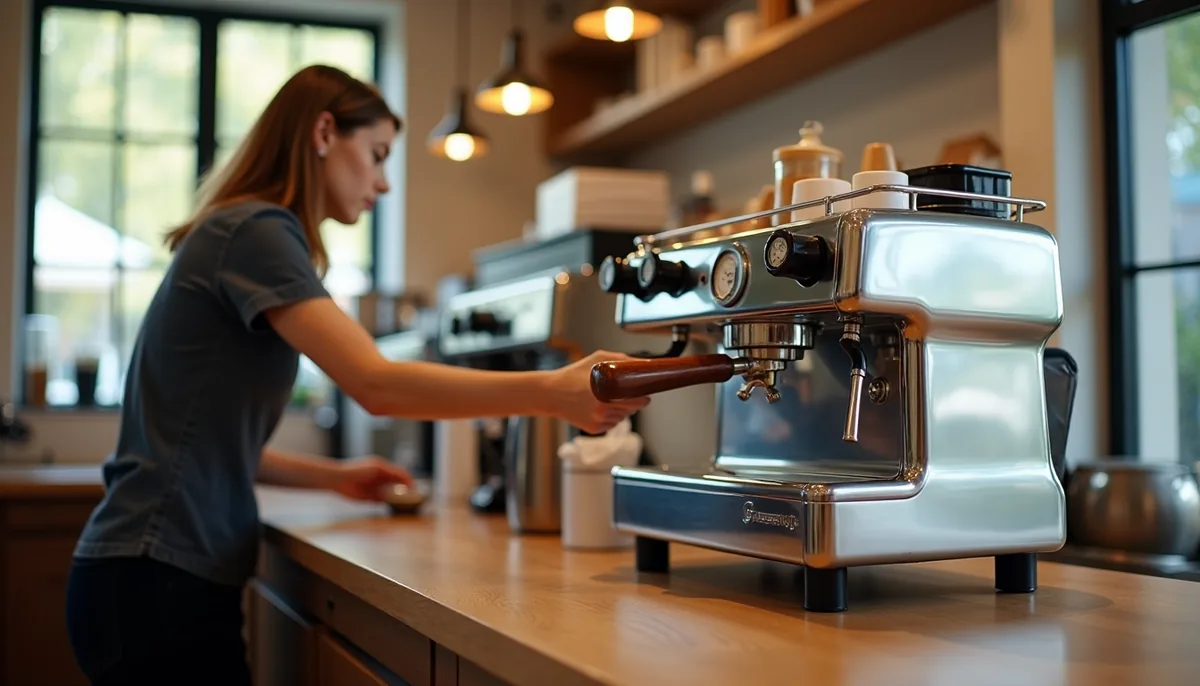
In short: The Ascaso Baby T Plus is a one-group machine with a PID-controlled thermoblock for the group and a separate insulated 2.5 l steam boiler, a rotary pump and volumetric dosing. It suits demanding home baristas and very small cafés that want commercial steam without a full two-group machine.

| Heating system | Thermoblock for the group + insulated 2.5 l steam boiler (not a classic dual boiler) |
|---|---|
| Group | 58 mm, independent and isolated, brew temperature 80–110 °C in 0.1 °C steps |
| Pump | Rotary, set to 9 bar at the factory, adjustable |
| Water | 2 l tank or mains connection (switchable in the menu) |
| Power and weight | 2,400 W at 230 V, 35 kg, 350 × 450 × 430 mm (W × H × D) |
| Best for | Prosumers, offices, small coffee bars and mobile catering |
Who the Baby T Plus is really for
Ascaso files the Baby T Plus under its commercial collection, ideal for small coffee shops and mobile catering. It is a single-group derivative of the two-group Barista T. That suits three types of buyer:
- The serious home barista who makes several milk drinks in a row and is tired of waiting for steam pressure to recover on a smaller machine.
- The office or small bar that needs repeatable shots from people who are not trained baristas. Volumetric dosing does most of the thinking for them.
- Pop-up and event catering, where a 35 kg one-group machine on a single socket is easier to move than a full commercial setup.
If you drink one espresso a day and rarely steam milk, its big advantage, the steam boiler, would sit idle; a smaller Ascaso makes more sense. If you want to see where the Baby T sits within the brand, our overview of Ascaso espresso machines and their colour ranges covers the wider line-up.
How it works: thermoblock group plus steam boiler
Many listings get this wrong: the Baby T Plus is not a classic dual boiler. Ascaso describes a professional thermoblock for the group plus a separate stainless steel steam boiler. The water path explains how it works:
- Fresh water leaves the tank or the mains line.
- It runs through a heat exchanger inside the steam boiler, which preheats it. Ascaso calls this dynamic preheating; the manual confirms it is a feature of the Plus version only.
- The thermoblock then brings it to your target brew temperature right before the group.
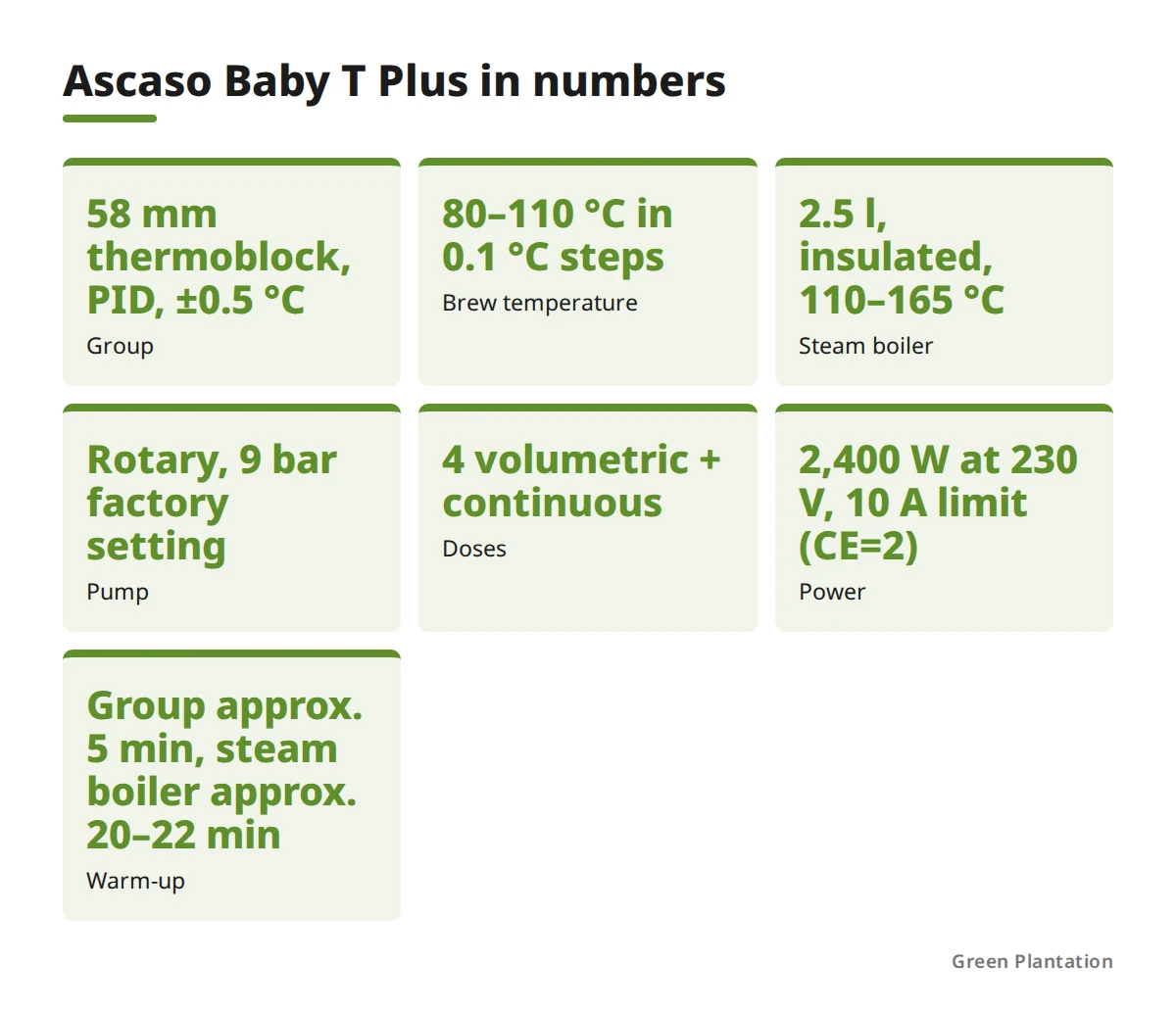
Each circuit has its own PID controller. Ascaso quotes stability of ±0.5 °C, brew temperature from 80 to 110 °C in 0.1 °C steps and steam from 110 to 165 °C in 1 °C steps. The upside of the thermoblock is that every shot uses fresh water rather than water that has sat in a boiler for hours. The trade-off is that the system depends on the steam boiler being on: the German retailer and tester Kaffeemacher measured a drop of 3–4 °C when the steam boiler was switched off, so leave it on even if you only pull espresso.
Key specifications at a glance
Figures come from Ascaso's product page and 2025 brochure, installation details from the manual (MAN.36, 2023).
| Parameter | Ascaso Baby T Plus |
|---|---|
| Group | 58 mm, independent thermoblock, PID |
| Steam boiler | 2.5 l, stainless steel, insulated, PID |
| Temperature stability | ±0.5 °C (manufacturer) |
| Pump | Rotary, volumetric, 9 bar factory setting |
| Pre-infusion | Programmable: P1–P4 = 0–5 s pump on, then 3 s pause |
| Doses | 4 programmable volumetric doses + continuous (XL) |
| Displays and gauges | 2 digital displays, 2 pressure gauges, shot timer, shot counter |
| App | iOS and Android via Bluetooth |
| Water | 2 l tank with level sensor, or mains connection (1/8" flexible hose included) |
| Power | Group 1,000 W, steam boiler 1,200 W, 2,400 W total at 230 V |
| Steam wand | 12 mm cool-touch, tips with 2, 3 and 4 holes |
| Dimensions and weight | 350 × 450 × 430 mm, 35 kg |
| Noise | Below 70 dBA (manual) |
Sources differ slightly: the 2023 manual lists the boiler at 2.3 l and one German tester quotes 40 kg. We use the manufacturer's current figures. In the box: single and double spouted portafilters, a bottomless portafilter, 7, 14, 18 and 21 g baskets, a blind basket, a tamper and a brush.
Day-to-day use: espresso and milk
Warm-up
The group is quick. Kaffeemacher reports it is up to temperature in around five minutes on the revised version, ideally after eight to ten minutes or a flush. The steam boiler is a different story: the manual quotes roughly 20–22 minutes before it is fully ready. If milk drinks are your first job of the morning, use the programmable stand-by or a smart plug so the machine is warm when you come down.
Pulling shots
A sensible starting recipe for a medium roast is 18 g in, 36–40 g out in 25–30 seconds at 93 °C. Set that as dose 2 and let the flowmeter end the shot. The rotary pump is set to 9 bar at the factory; the adjusting screw sits under a side cap. Pre-infusion programmes P1 to P4 run the pump for 0 to 5 seconds, then pause for 3 seconds, which helps lighter roasts and fine grinds settle before full pressure. If you are curious why 9 bar is the reference point, our article on 9, 15 or 19 bar in a coffee machine explains it.
The machine will only ever be as good as your grinder. With a Baby T on the counter, a capable flat or conical burr grinder should be part of the budget; see how to choose a professional espresso grinder.
Steaming
This is the Baby T's party piece. Kaffeemacher compares the steam power to a La Marzocco GS3 or a Victoria Arduino Prima and found the pressure did not drop during continuous steaming. Owners agree: steam power is the single most praised point in the threads we read. One owner notes it textures 6–7 oz of milk (roughly 180–200 ml) in about 20 seconds, which is brilliant for a small café but can feel rushed if you are still learning latte art. Start with the 2 hole tip and move up to 3 or 4 holes once your technique is steady.
Hot water comes from the steam boiler, so it is very hot; let it cool slightly for green tea.
Installation: power, water and drainage
At 2,400 W the Baby T Plus is a serious appliance. The manual includes a power limiter (parameter CE 1–3) that stops both heating elements drawing full power at the same time. At the factory setting, CE=2, the 230 V machine limits its draw to 10 A. That fits a standard UK 13 A socket (our reading of the manual, not a UK statement from Ascaso). No extension leads or adaptors; use an earthed socket with RCD protection. If you read American reviews mentioning a 20 A circuit, that applies to the 120 V version only.
For plumbing in, the Plus accepts mains water: switch the EP parameter in the menu from reservoir to mains. The manual asks for:
- mains pressure between 0.1 and 1.0 MPa (one chapter states 0.1–0.6 MPa, so aim for the lower range), with a pressure reducer if supply exceeds 10 bar;
- a shut-off valve between the mains and the machine;
- backflow protection on the supply line.
Drainage needs the optional drain kit (KIT.368) and a different drip tray. Our guide to connecting water filtration under the sink covers the basics of a filtered supply line.
Cleaning, water and descaling
Ascaso is blunt in the manual: limescale damage and inadequate cleaning void the warranty. Large parts of southern and eastern England have hard water, so this matters more in the UK than in many other markets.
The manual's recommended water profile is:
- total hardness 70–100 ppm;
- TDS 90–150 ppm;
- pH 6.5–8;
- alkalinity 40–80 ppm.
In a hard water area, a filter cartridge or softener on the supply line is the cheapest insurance you can buy. Our comparison of filter cartridges versus cabinet softeners helps you choose. For routine care, owners who have used the machine for one to two years describe a simple routine: rinse the group after each session and backflush with a blind basket and detergent once a week. Wipe and purge the steam wand after every jug.
What owners say
There are few UK owner reports, so this summary uses an international sample: 87 relevant r/espresso threads from 2021 to 2026 (18 read in full, plus 174 comments in three threads), the Kaffeemacher test and an EspressoPool article. Many threads are purchase questions, so treat the counts as indicative.
Praised:
- Steam power, mentioned in five sources, including Kaffeemacher.
- Build quality, described as tank-like and commercial in three threads.
- Shot consistency from the rotary pump and volumetric dosing. Two owners who moved up from an Ascaso Steel DUO said they pull noticeably better shots.
- Easy for the household: in two threads, partners and family members simply press a dose button.
- Coping with a crowd: one owner served 15–20 drinks at a party before needing to empty the tray and refill the tank.
Complaints:
- The app: four mentions across two threads of it failing to connect, for example after an Android update. Everything can be set on the machine itself, but the menu feels dated.
- Pump noise and vibration, mostly on early units. One owner says a revised version with a new pump, drip tray and software fixed it; that is a single claim.
- Shallow drip tray, raised twice in one thread and by Kaffeemacher.
- Low water warning triggering with 15–20 % still in the tank (one mention), and a short steam wand (one thread).
Weak points and what to check before buying
- First version versus revision. Machines from 2020–2021 had a slower thermoblock, a smaller drip tray and a noisier pump. Ascaso revised the design in 2021–2022. Kaffeemacher warns that older units are still sold off cheaply; you can recognise them by the drip tray and water tank.
- Variant confusion. Baby T Plus has the rotary pump, mains connection, preheating, app and cup warmer. Baby T Flow adds a manual flow control lever. Baby T One is the newer base model without the app, mains connection or dynamic preheating, with an uninsulated boiler. The older Baby T Zero used a vibration pump and tank only.
- Minor temperature overshoot. Kaffeemacher measured up to +0.5 °C at the very start of a shot, and the loss of 3–4 °C mentioned above if the steam boiler is off.
- Service. The manual requires repairs within Ascaso's official technical assistance network. Owners who imported from abroad reported weaker after-sales support. Opinions on reliability vary: three owners report two or more years without faults, one reports a burnt relay and tripped breaker after about two and a half years, and one sold the machine after repeated service visits.
- Commercial wording. The manual describes use by trained staff, not in kitchens. That is standard for commercial equipment and shows where Ascaso positions the machine.
Baby T Plus versus the alternatives
All machines below are in our range; data from each manufacturer's product page.
| Machine | Heating | Pump | Steam capacity | Flow control | Weight | Best for |
|---|---|---|---|---|---|---|
| Ascaso Baby T Plus | Thermoblock (group) + steam boiler, 2 PID | Rotary | 2.5 l boiler | No (Flow version has it) | 35 kg | Heavy milk use, small café |
| Ascaso Steel DUO PID | 2 thermoblocks (coffee and steam), PID | Vibration | Thermoblock | No | 15 kg | Compact home setup |
| Lelit Bianca PL162T | Dual boiler: 0.8 l coffee + 1.5 l steam | Not stated by Lelit | 1.5 l boiler | Yes, paddle | 27.2 kg | Flow profiling at home |
| ECM Synchronika II | Dual boiler: approx. 0.75 l coffee + 2 l steam, PID | Rotary | Approx. 2 l boiler | No | 30 kg | Classic E61 style, plumbable |
| Ascaso Barista T 2G | Thermoblock per group + 8.5 l steam boiler | Rotary | 8.5 l boiler | No | 71 kg | Café with two baristas |
The Bianca and the Synchronika are true dual boilers and suit those who enjoy a classic, hands-on workflow; we compare these brands in Lelit vs ECM vs Rocket Espresso. The Baby T Plus wins on steam power and on volumetric programming for several users. The Barista T 2G figures refer to the standard model; Ascaso does not publish separate figures for the Compact version.
Verdict
The Baby T Plus is one of the few one-group machines that feels genuinely commercial for milk: fresh water for every shot, stable temperature and steam that keeps up with a queue. Its weak points are an unreliable app, a small drip tray and the need to buy a revised unit from a seller with local service. For daily milk drinks, events or a small coffee corner it is a strong choice; for straight espresso, a dual boiler with flow control or a smaller Ascaso will do just as well.
Frequently asked questions
Is the Ascaso Baby T Plus a dual boiler?
No. It uses a PID-controlled thermoblock for the group and a separate 2.5 l steam boiler. Incoming water is preheated through the steam boiler before the thermoblock finishes heating it.
How long does the Baby T Plus take to heat up?
The group is ready in roughly five minutes according to Kaffeemacher, ideally after a flush. The manual gives about 20–22 minutes for the steam boiler to be fully ready.
What is the difference between Baby T Plus, Flow and One?
Flow is the Plus with a manual flow control lever. One is a simpler model without the app, mains connection, dynamic preheating or insulated boiler, and it is lower at 380 mm.
Can the Baby T Plus be plumbed in?
Yes. It switches between tank and mains in the menu and comes with a flexible hose. A drain connection needs an optional kit and a different drip tray.
Will it run on a normal UK socket?
At the factory setting the 230 V model draws at most 10 A, within a 13 A socket. Use an earthed socket with RCD protection, no extension lead.
Recommended products
- Ascaso Baby T Plus Dark Black: the classic colour for a café counter or a dark kitchen.
- Ascaso Baby T Plus Cloud White: the same machine in white, for lighter interiors.
- Ascaso Steel DUO: a much smaller thermoblock machine if you rarely steam large volumes of milk.
- Lelit Bianca PL162T: a true dual boiler with paddle flow control for those who want to profile shots.
- ECM Synchronika II: a plumbable dual boiler with a rotary pump and classic E61 group.
- Ascaso Barista T 2G Compact: the two-group step up when one group is no longer enough.
Sources
- Ascaso: Baby T Plus product page and specification table
- Ascaso: Baby T user manual MAN.36 (2023, PDF)
- Ascaso: Baby T brochure 2025 (PDF)
- Kaffeemacher: Ascaso Baby T Plus test (revised 2022)
- Specialty Coffee Association: Coffee Standards
Updated: November 2026
Author: Petra Novotná, editorial name of the Green Plantation.
You might also like
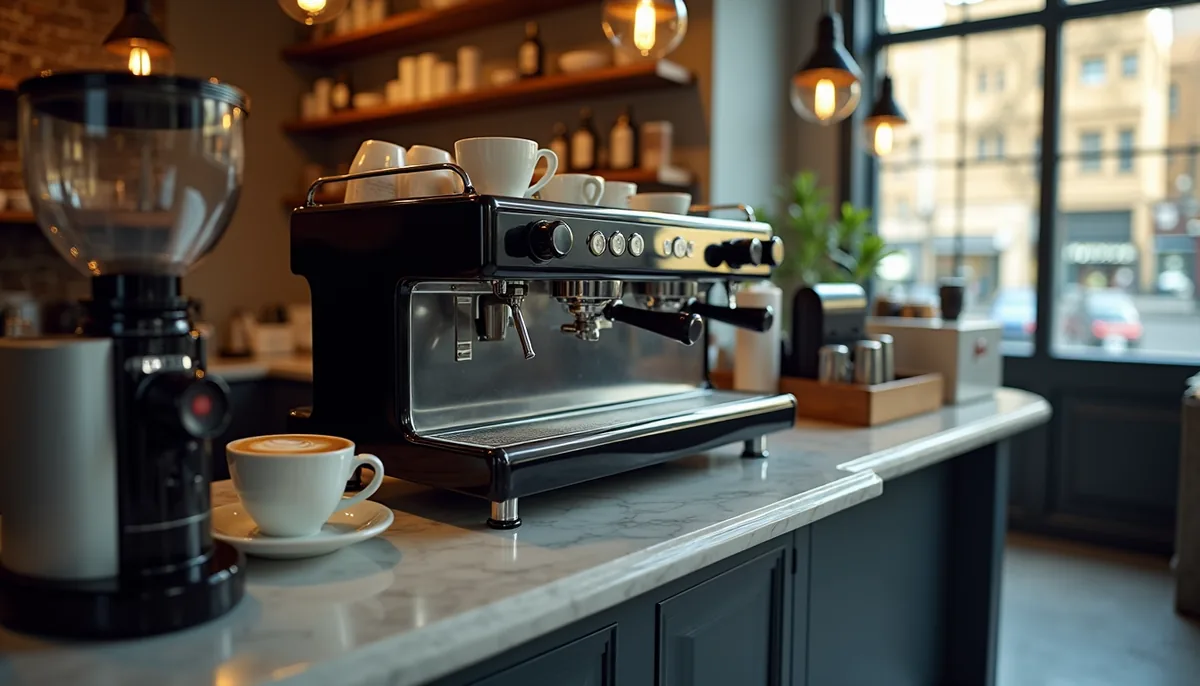 Ascaso Barista T 2G Compact review: specs, installation and life behind the bar
The Ascaso Barista T 2G Compact fits two independent groups into 560 mm. Here is what the technology does, what installation demands and which manufacturer… 24. 11. 2026
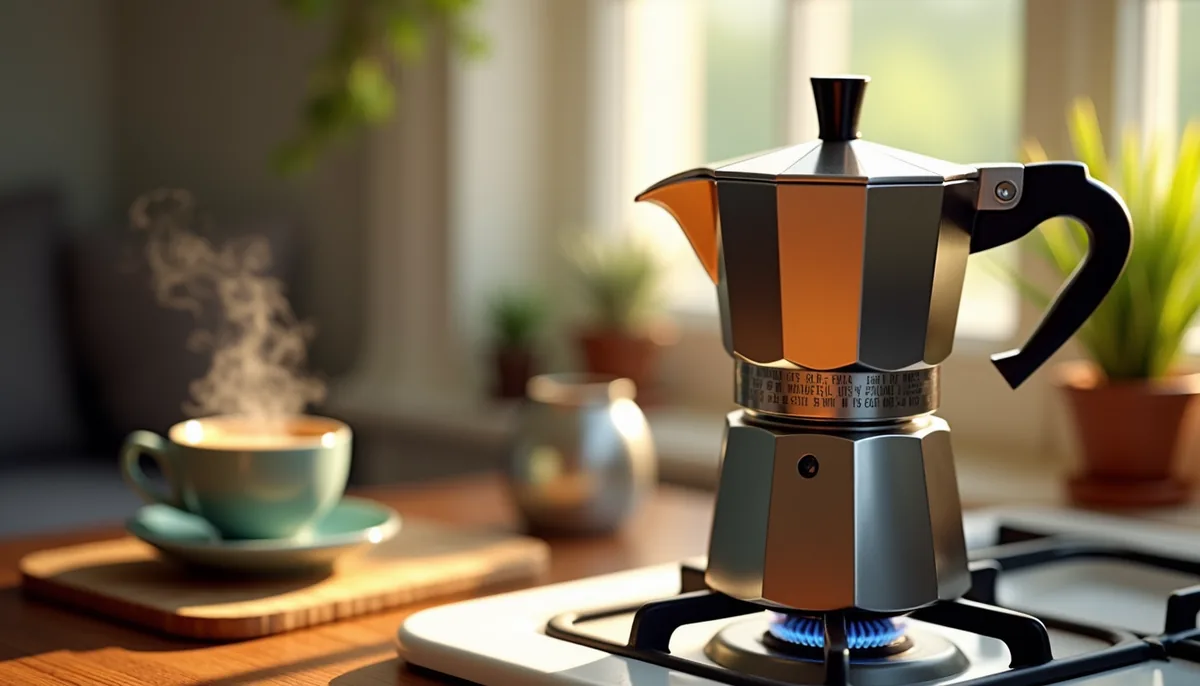 9Barista Review: Stovetop Espresso Without Electricity
The 9Barista makes real espresso on the hob. We explain how it works, how to brew and clean it, and sum up what owners praise and criticise. 24. 11. 2026
HACCP Record Sheets – free template (Malta)
Free template (Malta): A temperatures · B goods in · C cleaning · D corrective actions · E training · F pests. PDF + Word. 24. 10. 2026