Česky (CZK)
 Slovensky (EUR)
 Magyar (HUF)
 Polski (PLN)
 English (EUR)
 Deutsch (EUR)
 Français (EUR)
 Español (EUR)
 Português (EUR)
 Italiano (EUR)
 Svenska (SEK)
 Suomi (EUR)
 Nederlands (EUR)
 Dansk (EUR)
 Lëtzebuergesch (EUR)
 Eesti (EUR)
 Latviešu (EUR)
 Lietuvių (EUR)
 Slovenščina (EUR)
 Română (RON)
 Български (EUR)
 Hrvatski (EUR)
 Ελληνικά (EUR)
 Українська (EUR)
 Norsk (EUR)
 Srpski (EUR)
 Tiếng Việt (EUR)



Who Is an Automatic Coffee Machine For
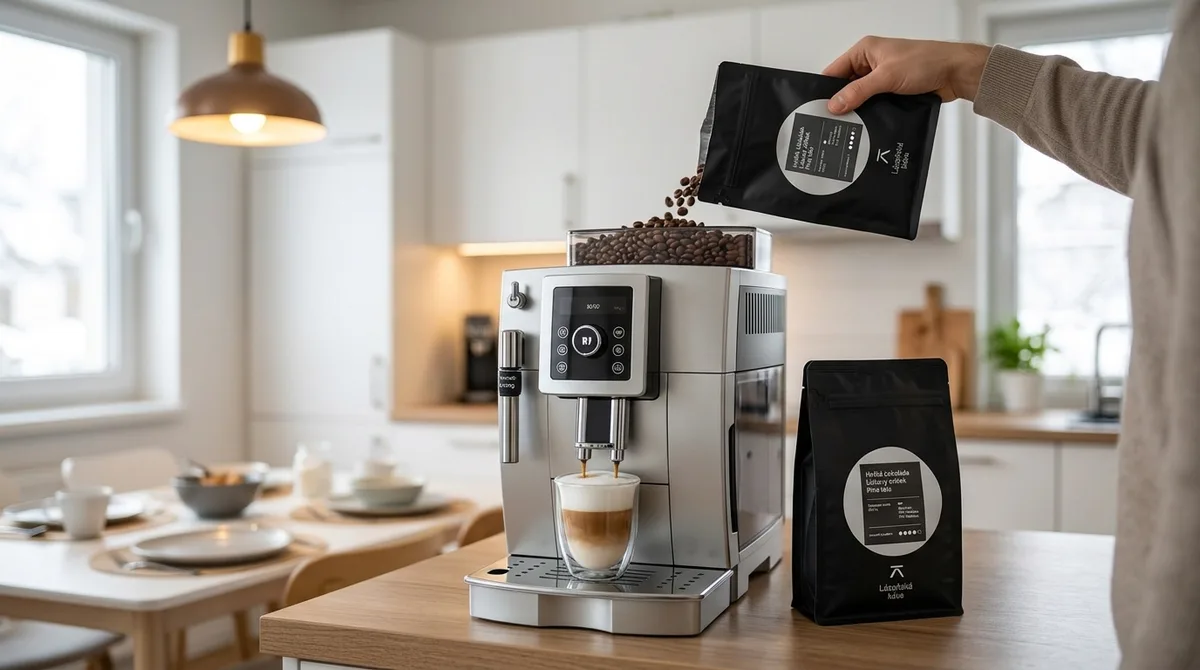
An automatic (super-automatic) coffee machine does the entire coffee workflow for you: it grinds beans, measures the dose, extracts espresso, and depending on the model, automatically froths milk – all at the push of a button. No tamping, no weighing, no WDT. You pour beans into the hopper, fill the water tank, and press "cappuccino."
An automatic coffee machine makes sense if:
- You want quality coffee without the ritual – there's no time for a five-minute espresso workflow before work
- Multiple people in your household drink coffee with different preferences (espresso, lungo, cappuccino, latte macchiato)
- You value consistent results without needing to develop barista skills
- You prepare 3–10 or more cups daily and want high volume without effort
- You're looking for a solution for an office where any employee must be able to operate it
An automatic coffee machine is not ideal if:
- You want full control over extraction and want to experiment with pressure profiles
- You're seeking the absolute ceiling of espresso quality – a lever machine with a quality grinder still outperforms it
- You brew exclusively light roast single origins on espresso, where micro-adjustments of each dose matter
In practice: an automatic coffee machine in the 500–1,500 euro price category will prepare espresso better than the vast majority of ordinary cafes. For most households, it represents the most sensible investment in home coffee.
Key Features – What to Focus On
Grinder
The grinder is the heart of every automatic coffee machine – it directly determines the quality of grinding and thus the result in your cup.
| Feature | Ceramic Burrs | Steel Burrs |
|---|---|---|
| Lifespan | 10,000+ cycles | 5,000–8,000 cycles |
| Noise | Quieter | Louder |
| Heat During Grinding | Less | More |
| Grinding Consistency | Good | Very good |
| Typical Brands | Jura, Philips, Melitta | DeLonghi, Nivona, Siemens |
Number of grind settings: Most automatic machines offer 5–13 settings. More settings mean finer tuning. If you alternate between espresso and lungo, focus on models with at least 8 adjustment levels.
Important: The grinder in an automatic coffee machine cannot be replaced by an external one – the machine is constructed exclusively for its own grinding system. If you're not satisfied with the result, the first step is to change the grind level and try a different coffee, not resort to an external grinder.
Milk System
The milk system is a decisive factor for many buyers. There are three main concepts:
1. Steam Wand (Manual)
A classic steam wand – you froth milk manually, just like on a lever machine. You'll find it on basic models, such as DeLonghi Magnifica Start or Nivona NICR 520.
Advantages: Maximum control over milk texture, possibility of latte art
Disadvantages: Requires skill and practice, not a one-touch solution
2. Automatic Tube from Container
The machine sucks milk through a tube from an external container or directly from a carton and automatically froths it. This approach is used by, for example, Jura models with the Fine Foam system.
Advantages: One-touch milk drinks, milk stays stored in the fridge
Disadvantages: The tube must be rinsed after each use, lower control over foam texture
3. Integrated Carafe
A removable milk container with an integrated frothing system. This approach is used by DeLonghi LatteCrema, Philips LatteGo, or Melitta Latte Perfection.
Advantages: Most comfortable one-touch drinks, easy cleaning (LatteGo: 2 parts washed in 10 seconds)
Disadvantages: Higher purchase price, milk in the carafe heats up quickly with prolonged standing
| System Type | One-touch | Latte Art | Cleaning Difficulty | Typical Brands |
|---|---|---|---|---|
| Steam Wand | No | Yes | Simple | DeLonghi, Nivona (basic) |
| Tube + Container | Yes | No | Moderate | Jura, Nivona (premium) |
| Integrated Carafe | Yes | No | Easy | DeLonghi LatteCrema, Philips LatteGo |
Programs and Drinks
Modern automatic machines offer 5–20 or more pre-programmed drinks:
- Basic: Espresso, coffee (lungo), hot water
- Milk-based: Cappuccino, latte macchiato, flat white, macchiato
- Specialty: Americano, ristretto, doppio
- Cold: Iced coffee, cold foam (on higher models)
User profiles: Premium models allow you to save individual settings for each household member – volume, strength, temperature, and milk quantity. For a multi-person household, this is a significant practical advantage.
Other Features
- Height-adjustable outlet – accommodation of various cup sizes from espresso cup to latte glass
- Quiet mode – reduced grinder speed, appreciated in early morning hours
- WiFi / Bluetooth – app-based control (Jura J.O.E., DeLonghi Coffee Link)
- Dual bean hopper – two types of coffee with one-button switching
- Hot water – for tea or americano without additional equipment
- Display – color touchscreen, buttons, or rotary dial; ease of operation varies significantly
Brand Comparison
Jura – Swiss Precision
Jura is synonymous with premium automatic coffee machines. This Swiss brand focuses on espresso quality, quiet operation, and refined design.
Strengths:
- Best espresso quality among automatic machines in this class
- Patented P.E.P. (Pulse Extraction Process) – pulse extraction simulating professional preparation
- Consistently lowest noise in the category
- Premium construction and timeless design
Weaknesses:
- Highest price in the segment
- Proprietary accessories and service network
- Limited customization options for milk drinks on basic models
Key Models:
- Jura E8 – best price-to-performance ratio in Jura's portfolio; 17 drinks, P.E.P., color display
- Jura Z10 – premium line with hot and cold drinks and Product Recognising Grinder system
- Jura GIGA 10 – dual grinders, dual hoppers; ideal for demanding home users or small offices
DeLonghi – Best Value for Money
DeLonghi offers the widest portfolio of automatic coffee machines on the market – from entry-level models around 300 euros to premium machines with the LatteCrema system.
Strengths:
- Best price-to-performance ratio in the category
- LatteCrema system produces thick and consistent milk foam
- Portfolio covers every budget and user type
- Intuitive operation and undemanding daily maintenance
Weaknesses:
- Espresso from basic models lags behind Jura in nuance
- Steel burrs are louder during grinding
Key Models:
- DeLonghi Magnifica Start – entry-level model with surprisingly good results for a low price
- DeLonghi Dinamica Plus – overall best mid-range automatic machine; LatteCrema, 18 drinks, color display
- DeLonghi Eletta Explore – 50+ drinks including cold coffee, premium touchscreen display
Nivona – German Reliability
Nivona is a German brand with a long tradition, popular in Central Europe including Slovakia and the Czech Republic. It offers well-equipped machines with excellent price-to-performance ratio. Green Plantation offers Nivona coffee machines with full warranty and expert support.
Strengths:
- Excellent price-to-performance ratio with emphasis on extractable quality
- Aromatica system – adjustable aroma intensity according to preferences
- NICR 7'90 – winner of Stiftung Warentest (12/2025, rating 2.0)
- Bluetooth control via MyCoffee app
Weaknesses:
- Lower brand visibility compared to Jura or DeLonghi
- Design is functional, not premium
Key Models:
- Nivona NICR 7'90 – winner of independent tests; excellent extraction and milk drinks
- Nivona NICR 860 – user-friendly model with consistent results
- Nivona NICR 970 – premium model with complete equipment
Comparison Table – Top Models
| Feature | Jura E8 | DeLonghi Dinamica Plus | Nivona NICR 7'90 | Philips 3300 LatteGo |
|---|---|---|---|---|
| Price (Approx.) | 1,200–1,500 EUR | 600–800 EUR | 700–900 EUR | 500–650 EUR |
| Number of Drinks | 17 | 18 | 15 | 6 |
| Grinder | Ceramic | Steel | Steel | Ceramic |
| Milk System | Tube + Container | LatteCrema Carafe | Tube + Container | LatteGo Carafe |
| Grind Settings | 8 | 13 | 5 | 12 |
| Display | Color | Color Touchscreen | Color | Touchscreen |
| Quiet Mode | Yes | No | No | No |
| App Control | J.O.E. | Coffee Link | MyCoffee | – |
| Special Extraction | P.E.P. | – | – | – |
| Water Tank Volume | 1.9 l | 1.8 l | 2.2 l | 1.8 l |
Maintenance of an Automatic Coffee Machine
An automatic coffee machine requires regular maintenance – and most modern machines will alert you via the display. Neglecting care will result in deteriorated taste, malfunctions, and shortened machine lifespan.
Daily Maintenance
- Rinse – most automatic machines automatically rinse when turned on and off. Don't skip this step or shorten it.
- Clean milk system – after each use. Most machines offer automatic milk line flushing; with integrated carafes, rinse all parts.
- Empty grounds container – whenever the machine alerts of fullness; don't wait until it's nearly overflowing.
- Empty drip tray – pour out and rinse with water
Weekly Maintenance
- Cleaning program with tablet – run the automatic cycle with a cleaning tablet according to manufacturer instructions
- Wash brew unit – if removable (DeLonghi, Nivona), remove and rinse under running water. Don't use soap. Let dry thoroughly before reinserting.
- Clean milk carafe – complete disassembly and washing of all parts with warm water
Monthly Maintenance
- Descaling – at normal water hardness every 1–3 months. The machine will automatically alert you. Use the descaler recommended by the manufacturer or proven universal tablets.
- Clean bean hopper – empty the hopper and wipe with a dry cloth; this removes accumulated coffee oils that can become stale and affect taste.
- Lubricate brew unit – some manufacturers (DeLonghi) recommend applying a thin film of silicone lubricant to brew unit O-rings. Use only food-grade silicone lubricant.
Cleaning Products
| Product | Purpose | Recommended Frequency |
|---|---|---|
| Cleaning Tablets | Remove coffee oils from brew circuits | Every 200–250 cups or once weekly |
| Descaling Tablets / Liquid | Remove limescale from boiler and lines | Every 1–3 months depending on water hardness |
| Milk System Cleaner | Dissolve milk residue in tubes and nozzles | After each use (quick rinse) + weekly (thorough cleaning) |
Proper cleaning products can be found in the coffee machine cleaning section. Investment in regular care is several times lower than the cost of repairing a clogged machine.
Water Hardness: Set the correct hardness level on the machine according to the included test strip. Soft water allows longer intervals between descaling; with hard water, descale more frequently and consider installing a water filter directly in the tank.
How to Choose – Decision Guide
1. What's Your Budget?
| Budget | What You Get | Recommended Models |
|---|---|---|
| Up to 400 EUR | Basic espresso, manual steam wand | DeLonghi Magnifica Start |
| 400–700 EUR | One-touch milk drinks, multiple programs | Philips 3300 LatteGo, Nivona NICR 5'20 |
| 700–1,000 EUR | Premium milk system, extended programs, app | Nivona NICR 7'90, DeLonghi Dinamica Plus |
| 1,000–1,500 EUR | Top-tier extraction, maximum equipment | Jura E8, DeLonghi Eletta Explore |
| 1,500+ EUR | Professional quality, dual grinder, cold drinks | Jura Z10, Jura GIGA 10 |
2. How Many Drinks Daily?
- 1–5 drinks – practically any model will work
- 5–15 drinks – choose a larger water tank and grounds container with higher capacity
- 15+ drinks – consider a professional automatic coffee machine sized for commercial use
3. What Drinks Do You Have?
- Espresso and lungo only – a basic model without a milk system is fully sufficient and saves on price and maintenance
- Cappuccino and latte macchiato – a milk system is necessary; LatteCrema or LatteGo are among the most convenient solutions
- Various drinks for the whole family – prioritize maximum number of programs and support for user profiles
4. Is Grinding Noise a Problem?
Jura is consistently the quietest brand thanks to a combination of ceramic burrs and special dampening. If you grind at 5:30 AM and don't want to wake the household, Jura is the clear choice. DeLonghi and Nivona with steel burrs are louder during grinding, but more affordable – a compromise most users accept.
Automatic vs. Lever – When to Choose What
| Aspect | Automatic | Lever |
|---|---|---|
| Preparation Time | 30–60 seconds (press button) | 3–5 minutes (grinding, dosing, tamping, extraction) |
| Quality Ceiling | Very good (beats most cafes) | Exceptional (top-tier cafes) |
| Required Skills | None | Requires learning, practice, and desire to experiment |
| Consistency | High (machine repeats same process) | Depends on operator and their current form |
| Maintenance | Mostly automated (cleaning programs) | Manual (backflush, shower screen cleaning) |
| Setting Flexibility | Limited by machine parameters | Virtually unlimited (grinding, dose, temperature, pressure, profile) |
| Price for Comparable Result | 500–1,000 EUR (one machine) | 600–1,200 EUR (machine + standalone grinder) |
| Joy of Process | Minimal – result without process | High – ritual, skill, daily experimentation |
Both approaches are fully valid choices. If you enjoy the espresso preparation process and want to squeeze maximum from each cup, a lever coffee machine is your path. If you want excellent coffee quickly without compromising on time, an automatic coffee machine is the most sensible investment.
Frequently Asked Questions (FAQ)
What Coffee Is Best for an Automatic Machine?
Medium roast whole bean coffee, ideally 7–28 days from the roasting date. Too dark roasting produces bitter and flat taste; too light beans can be sour and difficult to extract in an automatic. An automatic machine cannot compensate for extraction errors the way a skilled barista can on a lever machine, so medium roasting is the most reliable choice. Absolutely avoid oily beans – oils clog the grinder and brew circuits faster than you'd expect.
How Often to Descale?
It depends on water hardness in your area. Most machines track cycle count and alert you automatically. As a guideline: soft water (up to 100 ppm) every 3–6 months; medium (100–200 ppm) every 1–3 months; hard water (above 200 ppm) monthly or at first machine alert. Use descaling products approved for coffee machines – vinegar or citric acid won't provide the correct concentration and may damage seals.
Can I Use Pre-Ground Coffee?
Most automatic machines have a pre-ground coffee chute (bypass chute). It works, but goes against the machine's philosophy – the main advantage of an automatic is grinding fresh coffee before each cup. Pre-ground coffee loses aromatic compounds within minutes of grinding. Use the bypass chute only exceptionally, for example for decaffeinated coffee in the evening when you don't want to grind a full batch.
What's the Difference Between Jura and DeLonghi?
Jura is a premium brand focused on espresso quality, quiet operation, and design – at the corresponding price. DeLonghi offers the best price-to-performance ratio in the category, a wider portfolio of models, and an excellent milk system with LatteCrema. For pure espresso without compromise, Jura is the better choice. For milk drinks at reasonable investment, DeLonghi is hard to beat. Nivona stands in the middle – solid espresso quality, well-designed milk system, and strong position in the Central European market.
Does an Automatic Machine Last as Long as a Lever Machine?
Typical lifespan of an automatic coffee machine with normal home use and diligent maintenance is 5–10 years. A quality lever machine lasts 15–25 years. An automatic machine contains significantly more moving components – grinder, brew unit, milk system, complex control electronics – which increases the probability of failure and service costs. Regular maintenance extends this lifespan most effectively.
Is WiFi and App Control Worth It?
For most users, it's a pleasant bonus, not a necessity. The app allows finer tuning of drinks than physical buttons on the machine, remote preheating, or maintenance history overview. If you regularly adjust individual drink settings and prepare various drinks for multiple people with different preferences, the app will genuinely make your life easier. If you press "cappuccino" every morning and are happy with the result – you don't need it.
Summary
An automatic coffee machine represents the most convenient path to quality home coffee without needing to invest time in learning barista skills. Narrow your choice based on three main parameters: what you drink (espresso vs. milk drinks), how much you're willing to invest, and what type of milk system suits you. For long-term best results, use fresh medium roast beans, adhere to maintenance intervals, and adjust the machine according to your water hardness.
Browse the selection: home automatic coffee machines | professional automatic coffee machines | coffee machine cleaning
Sources
- Coffeeness. "Best Super Automatic Espresso Machine 2026" – coffeeness.de
- Coffeeness. "Best Jura Coffee Machine 2026" – coffeeness.de
- Coffeeness. "Jura vs DeLonghi" – coffeeness.de
- Coffeeness. "Best DeLonghi Espresso Machine 2026" – coffeeness.de
- Coffeeness. "Cleaning Tablets and Descaling Agents" – coffeeness.de
- Home Coffee Expert. "Best Super Automatic Espresso Machine 2026" – homecoffeeexpert.com
- Tom's Guide. "Jura vs DeLonghi" – tomsguide.com
- Green Plantation. "Cleaning and Descaling the Automatic Coffee Machine" – greenplantation.com
- Drop of Drink. "Best Nivona Coffee Machine 2026" – dropofdrink.com