
 Česky (CZK)
 Slovensky (EUR)
 Magyar (HUF)
 Polski (PLN)
 English (EUR)
 Deutsch (EUR)
 Français (EUR)
 Español (EUR)
 Português (EUR)
 Italiano (EUR)
 Svenska (SEK)
 Suomi (EUR)
 Nederlands (EUR)
 Dansk (EUR)
 Lëtzebuergesch (EUR)
 Eesti (EUR)
 Latviešu (EUR)
 Lietuvių (EUR)
 Slovenščina (EUR)
 Română (RON)
 Български (EUR)
 Hrvatski (EUR)
 Ελληνικά (EUR)
 Українська (EUR)
 Norsk (EUR)
 Srpski (EUR)
 Tiếng Việt (EUR)
Best Espresso Machine Under €1,500: Single Boiler, HX or Dual Boiler?
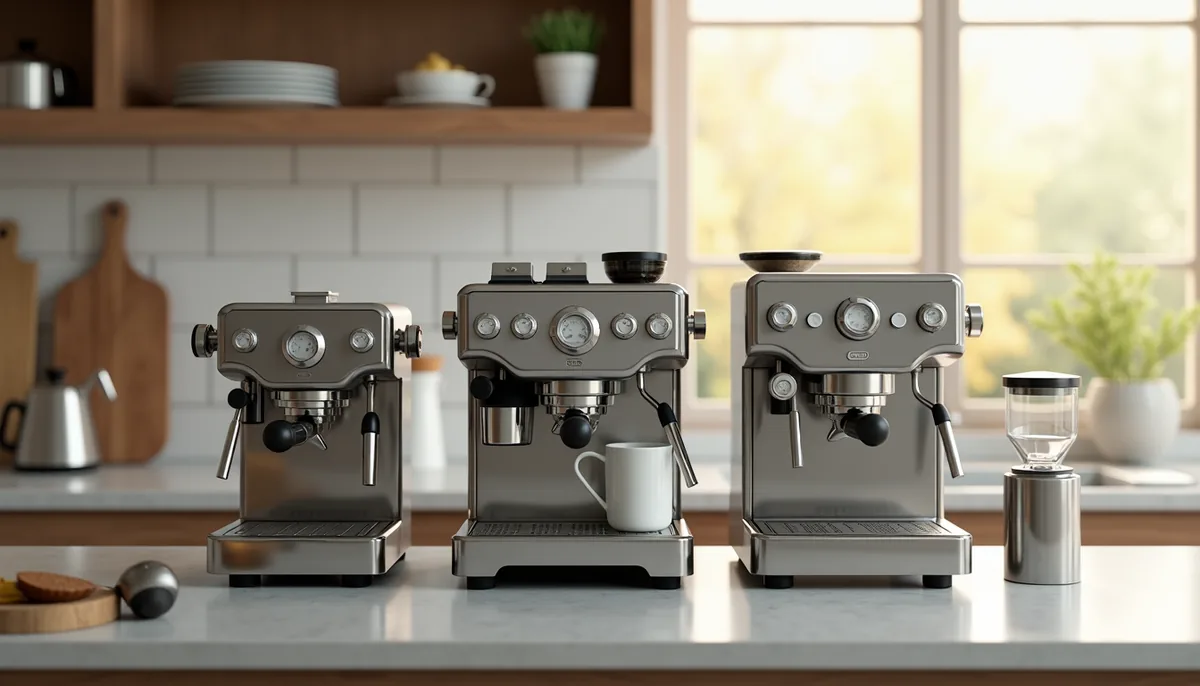
In short: Under €1,500 you are choosing between three designs: single boilers (classic or thermoblock), heat exchangers (HX) and compact dual boilers. If you mostly drink espresso, a single boiler with PID is enough. If you make two or more milk drinks back to back, go HX or dual boiler.

| Single boiler | one boiler (roughly 0.1 to 0.75 l), brew and steam one after the other |
|---|---|
| Thermoblock | no boiler, ready in about 1.5 minutes according to Ascaso, steam after switching over |
| Heat exchanger (HX) | 1.8 l steam boiler with a heat exchanger, brew and steam at the same time |
| Dual boiler | separate boilers, e.g. 0.3 l brew + 0.6 l steam (Lelit Elizabeth) |
| Group head | almost always 58 mm in this bracket, so baskets and tampers are widely compatible |
| Rule of thumb | one milk drink per round: single boiler; two or more: HX or dual boiler |
Why the boiler design matters more than the badge
Around €1,500 is where the home espresso market splits. Below that line you will find plenty of very good single boilers, a handful of heat exchangers and surprisingly few genuine dual boilers. So at this budget you are not really choosing between brands. You are choosing how the machine heats water.
The question behind it is simple: how often do you want to steam milk straight after pulling a shot? One boiler can only hold one temperature at a time. Espresso wants water at around 92 to 94 °C, steam needs well over 100 °C. Each design solves that conflict differently, and you will feel the difference every single morning. If you are still weighing up whether a proper espresso machine makes sense for you at all, start with whether a home espresso machine is worth it.
The four designs, by the numbers
Single boiler: one boiler does both jobs. You pull the shot, flick the steam switch, wait for the boiler to climb, steam, then purge water through the wand until it drops back to brew temperature. Boilers are small: around 109 ml in the Gaggia Classic E24 (measured by Whole Latte Love), 0.3 l in the Lelit Victoria and Profitec GO 2.0, and roughly 0.75 l in the ECM Classika PID. With PID you hold brew temperature to the degree. Without it, a thermostat does the job and you learn a flushing routine, often called temperature surfing.
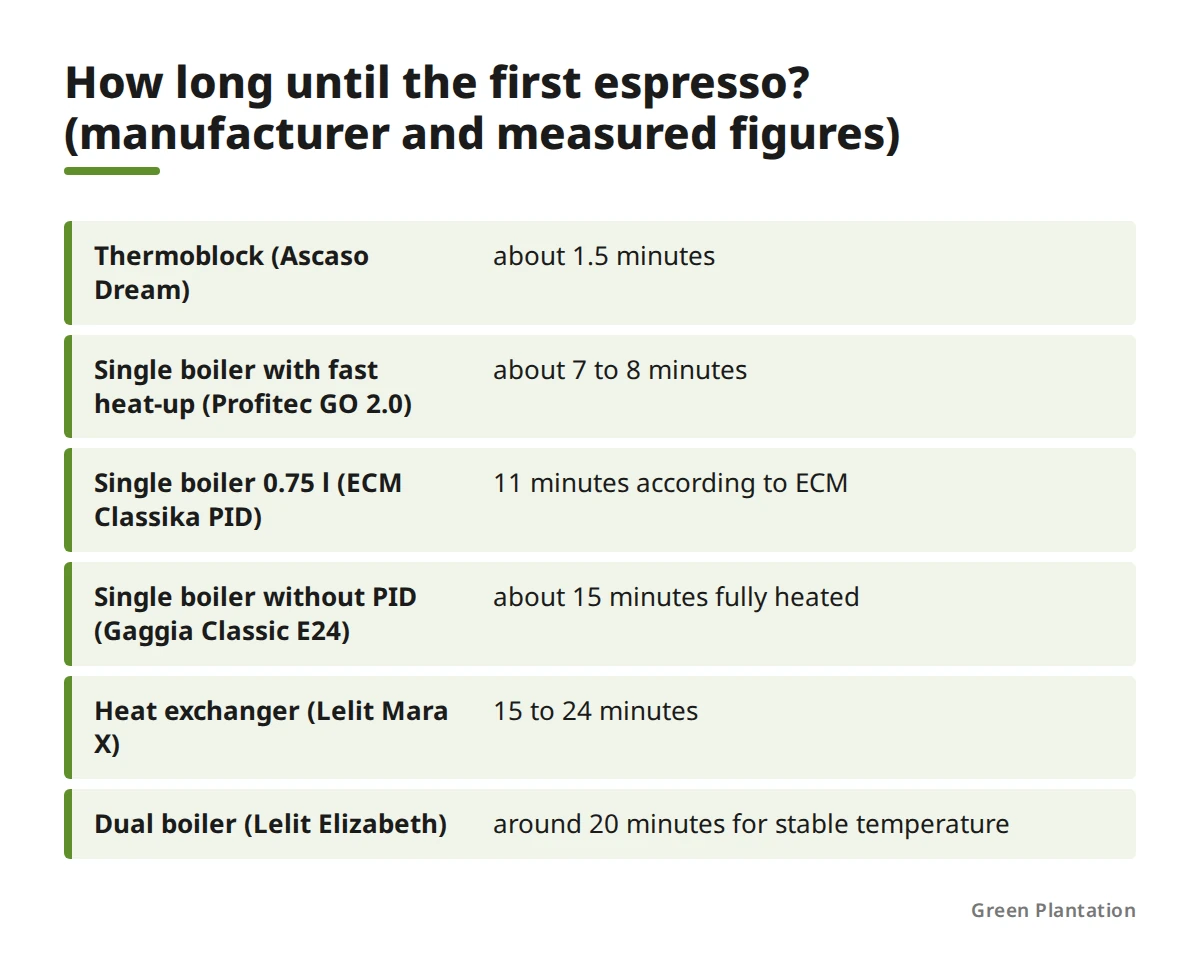
Thermoblock: instead of a boiler, a heated block with stainless steel channels warms the water as it flows through. It is fast: according to the manual, the Ascaso Dream is ready in about 1.5 minutes. Brewing and steaming still happen one after the other, and Ascaso suggests waiting about 5 minutes after steaming, or running water through the wand, before the next shot.
Heat exchanger (HX): a large steam boiler (1.8 l on the Lelit Mara X) sits permanently at steam pressure. Fresh brew water runs through a tube inside that boiler and picks up heat on the way to the group. That means you can pull a shot and steam milk at the same time. The catch is that a traditional HX overheats when idle and needs a cooling flush before each shot. The Mara X gets round this with a second temperature probe and a dedicated coffee mode.
Dual boiler: two separate boilers, one for brewing and one for steam. The Lelit Elizabeth uses 0.3 l of brass for coffee and 0.6 l of stainless steel for steam, with 1,200 W and 1,000 W elements according to the manual. For more on the engineering behind boilers and heat exchangers, read our piece on two boilers versus a heat exchanger.
| Feature | Single boiler | Thermoblock | Heat exchanger | Dual boiler (compact) |
|---|---|---|---|---|
| Example | Lelit Victoria, Profitec GO | Ascaso Dream ONE / PID | Lelit Mara X | Lelit Elizabeth |
| Boiler | 0.1 to 0.75 l | none | 1.8 l steam boiler + heat exchanger | 0.3 l brew + 0.6 l steam |
| Ready to brew (maker / measured) | about 7 to 15 minutes | about 1.5 minutes | 15 to 24 minutes | stable after about 20 minutes (kaffeemacher.de) |
| Brew and steam at once | no | no | yes | yes |
| Temperature control | PID or thermostat | electronic, 1 °C steps on the PID model | via steam pressure, modes on the Mara X | electronic, per boiler |
| Typical bottleneck | waiting between shot and steam | weaker steam, small tank | long warm-up | long warm-up, small steam boiler |
Our machines under €1,500 compared
The table covers machines from our range that sit in the up to €1,500 bracket on the wider market. Figures come from the manufacturers unless stated otherwise.
| Model | Design | Boiler | Power | PID | Tank | Best for |
|---|---|---|---|---|---|---|
| Gaggia Classic E24 | single boiler | brass, about 109 ml | 1,200 W | no | 2.1 l | first machine, tinkerers, straight espresso |
| Rancilio Silvia E | single boiler | 0.3 l | 1,150 W | no | 2 l | long-lived classic, EU version with auto switch-off |
| Profitec GO | single boiler | 0.3 l (GO 2.0) | 1,300 W | yes | 2.8 l | espresso plus one or two milk drinks |
| Lelit Victoria PL91T | single boiler | 300 ml brass | 1,200 W | yes (LCC) | 2.5 l | tight spaces, handy extras |
| ECM Classika PID | single boiler | about 0.75 l stainless | 1,200 W (retailer figure) | yes | about 2.8 l | biggest single boiler here, ready in 11 minutes according to ECM |
| Ascaso Dream ONE | thermoblock | none | 1,050 W | no (90 to 106 °C in 2 °C steps) | 1.3 l | quick start, retro looks, pressure gauge and adjustable OPV |
| Ascaso Dream PID | insulated thermoblock | none | 1,100 W | yes (80 to 110 °C) | 1.3 l | fine-tuning, pre-infusion, volumetric dosing |
| Lelit Mara X PL62X | heat exchanger | 1.8 l | about 1,400 W (retailer figure) | temperature modes rather than a PID display | 2.5 l | cappuccino households, E61-style group |
| Lelit Elizabeth PL92T | dual boiler | 0.3 l + 0.6 l | 1,200 W + 1,000 W | electronic (LCC) | 2.5 l | separate brew and steam temperatures |
Two machines sit just above this bracket and turn up in the same shortlists: the Ascaso Steel DUO, which uses two separate thermoblocks (2,068 W, steam-ready in around a minute and a half according to Ascaso), and the Rocket Appartamento, a heat exchanger with a 1.8 l boiler. If you never drink milk, a manual lever such as the Flair 58 works without a pump or boiler, and the money you save can go into a better grinder.
Which design suits your routine?
Forget hunting for a single winner and count your drinks instead. What matters is how many milk drinks you make back to back, not how many you have per day.
- Espresso, ristretto or americano only: a single boiler with PID. The Victoria, the Profitec GO or the Dream PID hold temperature well, heat up quickly and use little electricity. An HX would mostly be heating steam you never use.
- One flat white in the morning, two at the weekend: a single boiler or thermoblock will do. Allow roughly 2 to 2.5 minutes per cappuccino including the switch-over (measured by kaffeemacher.de on the Profitec GO 2.0). The GO 2.0 and the Victoria refill the boiler automatically after steaming.
- Two to four milk drinks in a row, guests, family: heat exchanger or dual boiler. Mara X owners on Reddit repeatedly give the same advice: if you regularly make more than two or three milk drinks in a row, two boilers will serve you better than one.
- Light roasts and playing with temperature: a dual boiler or a single boiler with PID. On an HX you only set brew temperature indirectly, through steam pressure or preset modes.
Whether you really need PID depends on how precise you want to be. Our guide on PID control for home machines goes into the detail.
Warm-up, electricity and descaling: the running costs
The design shapes more than your morning routine. It also decides how much power you use and how much looking after the machine needs. The more water a machine keeps hot, the longer it takes to warm up and the more energy it loses while idling.
- Small single boilers are frugal: kaffeemacher.de measured 0.067 kWh for warm-up plus a double shot on the Gaggia Classic E24, and 0.088 kWh for warm-up plus an espresso on the Profitec GO 2.0, with 0.044 kWh per hour to keep it hot.
- Thermoblocks are the quickest: there is no boiler to keep hot. The trade-off is gentler steam, and on the Dream the steam function cuts out after 3 minutes of continuous use.
- HX and dual boilers need a head start: Lelit quotes 24 minutes for the Mara X to reach ideal coffee temperature, while owners report 15 to 16 minutes. For the Elizabeth, kaffeemacher.de recommends at least 20 minutes. A smart plug or built-in timer pays off here.
Descaling depends mostly on your tap water, and hardness varies a lot from region to region, so check the figure published by your water supplier. Profitec recommends 2 to 6 °dH carbonate hardness for the GO. Ascaso bases descaling on use: monthly above 10 shots a day, every two months at 5 to 10, every three months at 1 to 5. To spot the warning signs early, see our article on how to tell if water is ruining your coffee machine.
| Task | Single boiler / thermoblock | HX / dual boiler |
|---|---|---|
| Backflush with a blind basket | weekly (if fitted with a three-way valve) | weekly |
| Water | filter from medium hardness upwards | always filter, more water in the system |
| After steaming | purge water, let the boiler cool | just purge and wipe the wand |
| Typical wear parts | group gasket, shower screen | group gasket, shower screen |
What owners report
For this comparison we went through discussions on the r/espresso subreddit. The sample is international, posts were grouped by title and some overlap is possible.
- “Single boiler” in the title: 56 posts from 44 authors between November 2025 and November 2026. 36 are buying advice, 28 explicitly compare against HX, dual boiler or thermoblock, and 27 mention a budget, usually around 1,000 to 1,500 in pounds, euros or dollars. 11 ask how to make milk drinks efficiently on a single boiler.
- “Dual boiler” in the title: 100 posts from 62 authors (August to November 2026). 64 are about one model, the Sage (Breville) Dual Boiler, which we do not stock, and almost all the fault reports, including 8 about leaks, come from that machine. 17 posts ask whether a dual boiler is worth it for the way they actually drink coffee.
- From our model-by-model research: on the Victoria, 14 of 79 posts are about steaming milk on one boiler and 34 about choosing a grinder. On the Profitec GO, 41 of 91 Reddit posts deal with steam and milk. On the Gaggia E24, 19 threads mention unstable temperature without a flushing routine and 21 the limited steam power for one or two cappuccinos. On the Mara X, 25 threads about water under the machine usually come down to the overpressure valve and a drip tray not pushed fully home.
The pattern is clear. The most common frustration with single boilers is not the espresso but the wait between shot and steam. And many owners end up fixing shot and taste problems with a better grinder, not a pricier machine.
What to check before you buy
- Leave budget for the grinder: a machine in this bracket needs an espresso grinder with fine adjustment. Step down a notch on the machine rather than on the grinder.
- Check the model version: Victoria PL91T and Victoria3 PL91T3, Mara X PL62X and MaraX3, Elizabeth PL92T and Elizabeth3 are different machines. The Profitec GO 2.0 has a 0.3 l boiler, the first version 0.4 l.
- Portafilters and accessories: nearly every model here uses 58 mm. The Gaggia, however, has its own bayonet, so third-party portafilters will not fit.
- Brew pressure: Victoria and Dream owners report around 11 bar out of the box. The Dream ONE and Dream PID let you adjust the OPV from outside, both have a pressure gauge and both can be backflushed. On the Gaggia E24, 15 threads report an OPV set above 9 bar.
- Space and tank: the Mara X is 52 cm deep, the Victoria only 23 cm wide. Also check whether the tank can be lifted out under your wall cupboards.
- Warranty: statutory consumer rights apply, and any extra manufacturer warranty is set by the brand itself.
For how to use the portafilter, tamper and milk jug properly, see our guide for the home barista.
Verdict: three routes to great espresso
For espresso purists, a single boiler with PID is the sensible buy: the Lelit Victoria, Profitec GO or Ascaso Dream PID give precise temperature and low running costs. The ECM Classika PID brings the largest boiler in the class. For milk drinks in a row, under €1,500 there is little to beat the Lelit Mara X (heat exchanger) or the Lelit Elizabeth (dual boiler): the Mara X has far more steam in reserve with its 1.8 l boiler, while the Elizabeth controls brew temperature electronically and separately from steam. The Gaggia Classic E24 remains the affordable way in for anyone happy to learn a routine.
Frequently asked questions
What is the best home espresso machine under €1,500?
There is no single best one, it depends on your drinks. For espresso, a single boiler with PID such as the Lelit Victoria or Profitec GO. For several milk drinks in a row, the Lelit Mara X (HX) or Lelit Elizabeth (dual boiler).
What is the difference between a single boiler and a heat exchanger?
A single boiler heats brew water and steam in one boiler, so you work one step at a time. A heat exchanger has a large steam boiler with a tube running through it for brew water, so you can pull a shot and steam milk at the same time.
Is a dual boiler worth it under €1,500?
Yes, if you want to control brew temperature and steam independently and you have the space. Compact dual boilers such as the Lelit Elizabeth do have a small steam boiler (0.6 l) and need around 20 minutes to settle.
Is a thermoblock good enough for cappuccino?
For one or two cappuccinos, yes. Steam arrives quickly but is weaker than on a boiler machine. For a round of drinks, an HX or dual boiler is more relaxed.
How long does an espresso machine take to warm up?
A thermoblock about 1.5 minutes, a single boiler roughly 7 to 15 minutes depending on size, an HX or dual boiler 15 to 24 minutes, depending on how stable you want the group to be.
Which espresso machine is best value for a beginner?
A single boiler with PID, because you do not have to worry about temperature surfing. The Victoria, Profitec GO and Dream PID are compact and more forgiving on temperature than a machine without PID.
Recommended products
- Lelit Victoria PL91T: compact single boiler with PID and a 58 mm group, ideal for espresso and the occasional flat white.
- Ascaso Dream PID: thermoblock with temperature in 1 °C steps, pre-infusion and a very quick start.
- ECM Classika PID: single boiler with around 0.75 l of stainless steel for more steam in reserve.
- Lelit Mara X PL62X: heat exchanger with a 1.8 l boiler for rounds of cappuccino without waiting.
- Lelit Elizabeth PL92T: compact dual boiler with separate control for brew and steam.
- Gaggia Classic E24: affordable, easy-to-repair starting point with a brass boiler.
Sources
- Lelit: Elizabeth PL92T specifications
- Lelit: Mara X PL62X
- ECM Manufacture: Classika PID
- Ascaso: Dream ONE and Dream PID
- Rancilio: Silvia specifications
Updated: November 2026
Author: Petra Novotná, editorial name of the Green Plantation.
You might also like
 Bean-to-cup vs espresso machine: which suits your daily routine?
Bean-to-cup or a traditional espresso machine with a portafilter? A practical decision guide based on your daily routine, time per cup, coffee dose and the… 24. 11. 2026
 Manual Espresso Maker: Flair 58 vs 9Barista (plus La Pavoni and Picopresso)
Hand lever with kettle water or steam on the hob: the Flair 58 and 9Barista compared, with the La Pavoni Europiccola and Wacaco Picopresso as alternatives and… 24. 11. 2026
 Espresso machine for a small café: Ascaso Baby T Plus vs Barista T 2G Compact
One group or two for a small café? Ascaso Baby T Plus and Barista T 2G Compact compared on peak trade, steam, electrics, counter space, water and maintenance,… 24. 11. 2026