
 Česky (CZK)
 Slovensky (EUR)
 Magyar (HUF)
 Polski (PLN)
 English (EUR)
 Deutsch (EUR)
 Français (EUR)
 Español (EUR)
 Português (EUR)
 Italiano (EUR)
 Svenska (SEK)
 Suomi (EUR)
 Nederlands (EUR)
 Dansk (EUR)
 Lëtzebuergesch (EUR)
 Eesti (EUR)
 Latviešu (EUR)
 Lietuvių (EUR)
 Slovenščina (EUR)
 Română (RON)
 Български (EUR)
 Hrvatski (EUR)
 Ελληνικά (EUR)
 Українська (EUR)
 Norsk (EUR)
 Srpski (EUR)
 Tiếng Việt (EUR)
Bean-to-cup vs espresso machine: which suits your daily routine?
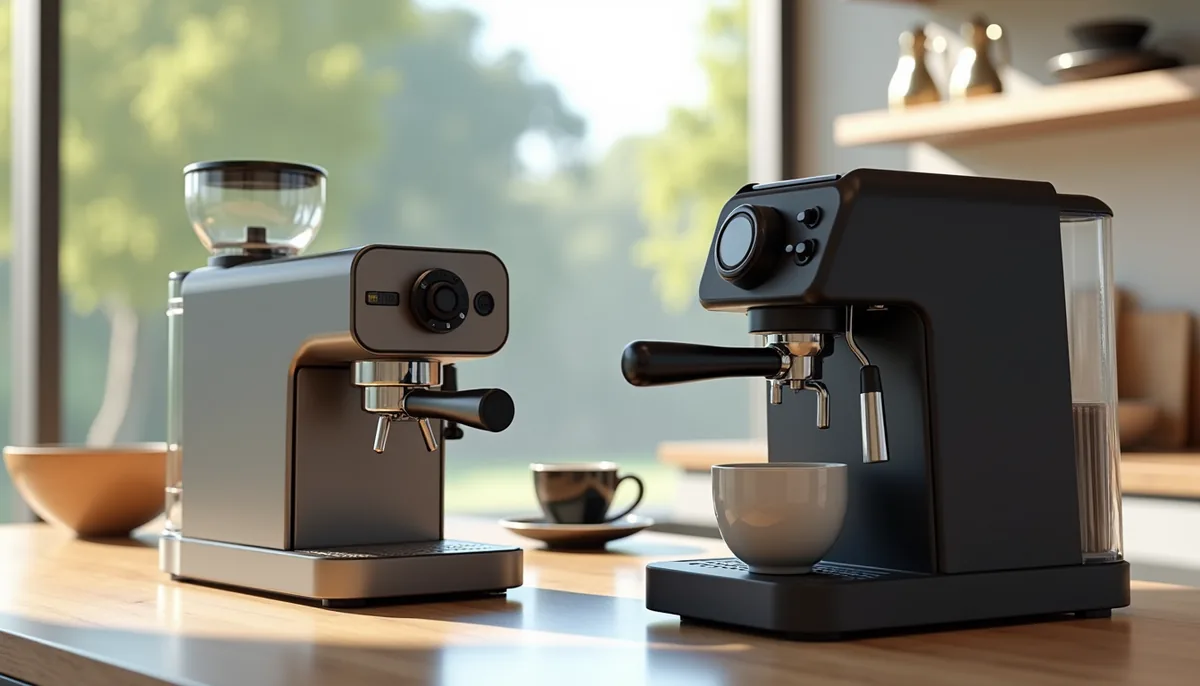
In short: choose a bean-to-cup machine if several people want milk drinks at the press of a button and nobody wants to learn barista skills. Choose an espresso machine with a portafilter if you care most about taste, are happy to spend a few minutes per cup and will buy a proper grinder.

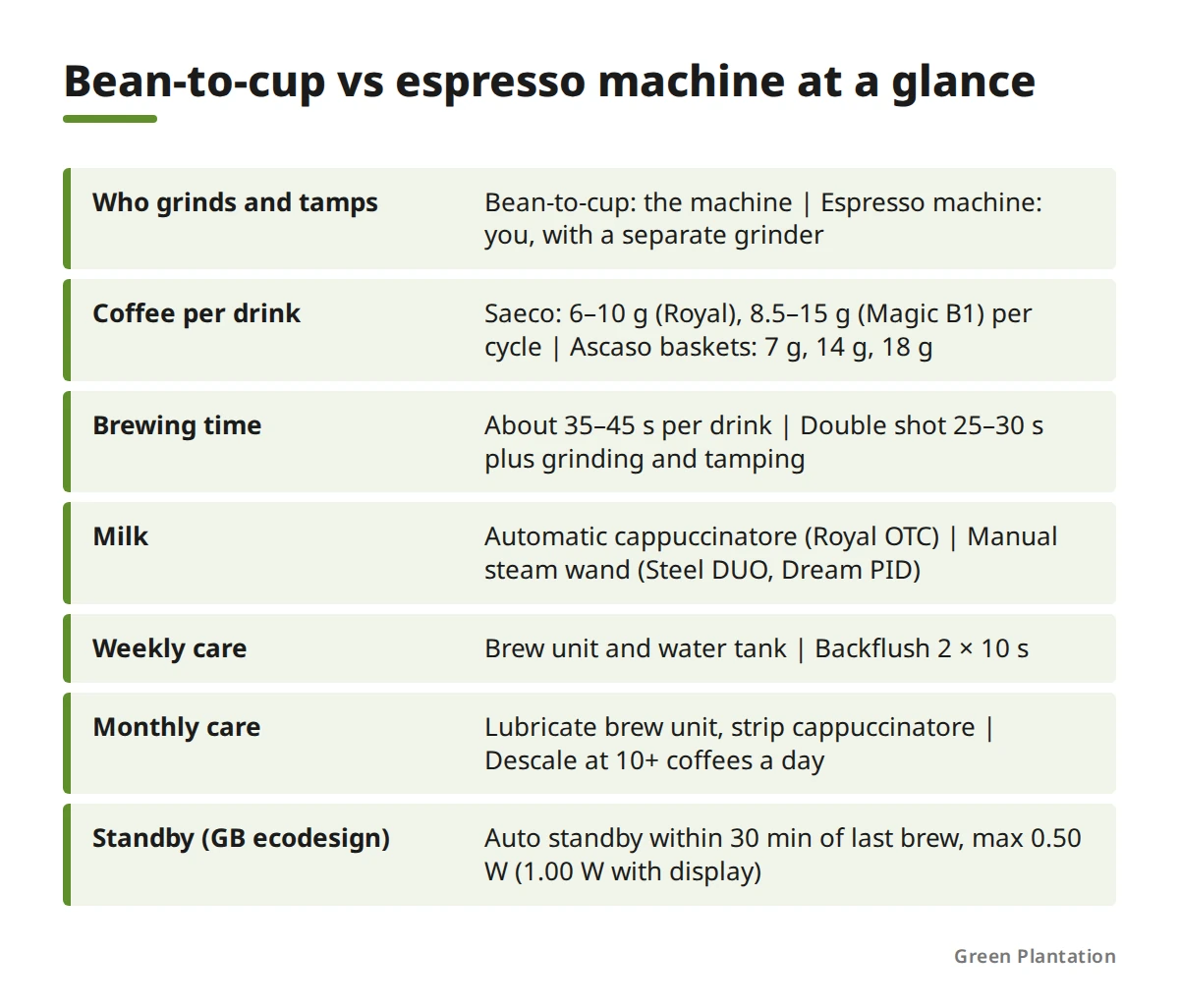
| Who does the work | Bean-to-cup: the machine grinds, doses, tamps and brews. Espresso machine: you do, the machine supplies pressure and heat. |
|---|---|
| Coffee per drink | Saeco bean-to-cup: 6 to 10 g (Royal) or 8.5 to 15 g (Magic B1) per brew cycle. Ascaso portafilter baskets: 7 g single, 14 g or 18 g double |
| Grinder | Built in on bean-to-cup machines; a separate grinder is needed for an espresso machine |
| Milk | Automatic cappuccino system (Royal OTC) or none (Magic B1) versus a manual steam wand |
| Weekly routine | Brew unit rinse and water tank clean versus a backflush with a blind basket |
| Best for | Busy households and small offices versus home baristas who want control |
The difference in one minute
Both types push hot water through finely ground coffee under pressure, so both make espresso. The difference is who controls each step.
A bean-to-cup machine (also called a superautomatic or fully automatic coffee machine) has a hopper for whole beans, a built-in grinder and a removable brew unit. You press a button; the machine grinds a set amount, compresses it, brews and throws the spent puck into a grounds container. Models with a milk system, such as the Saeco Royal OTC, draw milk straight from a jug or fridge through a tube and froth it automatically. You adjust the result through settings: grind step, coffee amount and drink volume.
A traditional espresso machine with a portafilter leaves the craft to you. You grind fresh on a separate grinder, dose into a basket, level and tamp, lock the portafilter into the group, start and stop the shot and steam milk by hand. Small changes in grind, dose and timing change the cup, which is exactly why enthusiasts like it. If the terms are new, our guide to portafilter types and how to choose one explains the hardware.
Decision table: match the machine to your daily routine
Most buyers start with taste; the better question is what your mornings look like.
| Your routine | Better fit | Why |
|---|---|---|
| One or two espressos a day, you enjoy the ritual | Espresso machine | You control dose, grind and ratio; the extra minutes are part of the appeal |
| Two or three flat whites or cappuccinos back to back | Espresso machine with separate steam (dual thermoblock) | You can brew and steam at the same time instead of waiting between drinks |
| Several people, different drinks, everyone in a hurry | Bean-to-cup with milk system | Anyone can press a button; the result does not depend on who makes it |
| Black coffee only (espresso, lungo, americano) for a team | Bean-to-cup without milk | No milk circuit to clean, two cups at once, quick refills |
| Guests, Airbnb or B&B, staff who will not be trained | Bean-to-cup | Consistent drinks without barista skills |
| Light roasts, single origins, experimenting with recipes | Espresso machine with PID | Brew temperature and pre-infusion can be adjusted |
| Very oily dark roasts | Espresso machine | Owners of bean-to-cup machines regularly ask whether oily beans clog the grinder and hopper |
Time per cup: where the minutes actually go
“Bean-to-cup is faster” is only half true. The machine saves you hands-on work, not necessarily seconds. A UK foodservice supplier, Bidfood, puts a typical bean-to-cup drink at roughly 35 to 45 seconds and notes that a two-group traditional machine in a café can make up to four coffees in 60 to 90 seconds. At home, with one group and one person, the picture looks different.
| Step | Bean-to-cup | Espresso machine with portafilter |
|---|---|---|
| Warm-up | Heats up at switch-on; Saeco does not publish a warm-up time | Steam ready in about 1.5 minutes on the Ascaso Steel DUO (manual); allow time for the group and portafilter to warm up too |
| Grinding and dosing | Automatic | Separate grinder, weighing, distributing and tamping by hand |
| Brewing | Automatic, around 35 to 45 seconds per drink (Bidfood) | A double shot usually runs 25 to 30 seconds |
| Milk | Automatic on the Royal OTC; pre-heating takes a moment, then milk froth and coffee in one go | Steaming by hand; on the Dream PID coffee and steam cannot run at the same time, and after steaming you wait about 5 minutes or purge water through the wand before the next espresso (manual) |
| After the drink | Quick Clean of the milk circuit offered after every milk drink (Royal OTC) | Knock out the puck, rinse the group, purge and wipe the steam wand |
Our reading: for a single espresso the time gap is small once you have a routine. The gap grows with every extra milk drink, and it grows most on single-thermoblock machines that have to switch between brewing and steaming.
How much coffee goes into each cup (and a fair way to work out cost)
Dose is the hidden variable in every “cost per cup” claim. According to Saeco, the Royal grinds 6 to 10 g per brew cycle in seven steps, and the Magic B1 adjusts between 8.5 and 15 g in four steps. Pressing the button twice for a double on the Royal runs two grinding and brewing cycles. Ascaso supplies the Dream with baskets for 7 g (one coffee) and 14 g or 18 g (two coffees). A typical starting recipe for a double espresso on the Steel DUO is 16 to 18 g of ground coffee for 32 to 36 g in the cup.
That is why a portafilter double often uses more coffee than a single bean-to-cup brew, while delivering a more concentrated shot. To compare honestly, calculate per drink rather than per machine:
- Coffee: grams per drink × price per kilo ÷ 1,000
- Milk: millilitres per drink × price per litre ÷ 1,000
- Electricity: kWh used per day × your tariff ÷ drinks per day
- Care products: cleaning tablets, milk cleaner, descaler and water filters ÷ number of drinks between replacements (Saeco Professional recommends cleaning tablets after 500 dispensings or once a month)
Add the grinder to the espresso side of the equation; it is part of the machine, not an optional extra.
Cleaning and maintenance: weekly and monthly
Neither type is maintenance free. Bidfood calls “bean-to-cup machines are easier to look after” a myth, and the manuals agree: the jobs are different, not fewer. The table below follows the manufacturers' instructions for our four machines.
| How often | Bean-to-cup (Saeco Royal OTC manual) | Espresso machine (Ascaso Steel and Dream manuals) |
|---|---|---|
| After every use | Quick Clean of the cappuccinatore after milk drinks, rinse the milk tube | Purge and wipe the steam wand, rinse the group |
| Daily | Empty the drip tray; empty the grounds container (recommended daily) | Empty the drip tray, rinse the portafilter and basket |
| Weekly | Clean the water tank and the brew unit; clean the whole machine at least once a week | Backflush with the blind basket, 2 × about 10 seconds |
| Every 80 to 100 shots | (no equivalent) | Remove and clean the shower screen |
| Monthly | Lubricate the brew unit and clean the bean hopper (or after 500 cycles); take the cappuccinatore apart and wash it with Saeco detergent | Descale if you make more than 10 coffees a day |
| Every 2 to 3 months | Descale when the machine asks | Descale every 2 months at 5 to 10 coffees a day, every 3 months at 1 to 5 |
Two points matter most. First, Saeco states that the Quick Clean rinse is not enough on its own; the milk circuit also needs its full cleaning cycle and the monthly strip-down, otherwise bacteria can build up. Second, limescale is the main enemy of thermoblock espresso machines: owners of the Steel DUO name scaled thermoblocks among the most common faults. In hard water areas a filter or low-mineral water pays off on both types. Our step-by-step guide to cleaning and descaling an automatic coffee machine covers the bean-to-cup routine in detail.
Energy use and standby
Manufacturers of these four machines publish rated power rather than annual consumption: 1,100 W for the Dream PID, 1,300 W for the Magic B1, 1,400 W for the Royal OTC and 2,068 W for the Steel DUO, which heats two thermoblocks.
What saves energy is switching off. Under the ecodesign rules in force in Great Britain (Regulation 1275/2008 as retained), household coffee machines other than drip filter machines must drop into standby or off mode no later than 30 minutes after the last brew, and standby must not exceed 0.50 W, or 1.00 W with a display. The Dream PID lets you set automatic standby to 0.5, 1 or 2 hours. If your machine sits idle between breakfast and lunch, a shorter standby delay is the easiest saving.
What owners say
We summarised public discussion threads from the Arctic Shift Reddit archive (r/espresso, r/superautomatic, r/Kaffee; counts as of November 2026). It is not a representative survey, but the patterns are consistent.
- Switching direction: of 89 r/espresso threads with “superautomatic” in the title, about 12 describe moving from a bean-to-cup machine to a portafilter set-up, usually for taste or to learn the craft. About 4 go the other way, typically for easier mornings or for a partner, or the owner keeps both.
- Main worries about bean-to-cup: weaker or watery espresso and crema (about 8 threads), whether oily dark roasts are safe (about 8), descaling and brew unit care (about 4).
- What buyers ask about: in 100 recent r/superautomatic threads, 41 mention milk, 30 taste and 21 cleaning or maintenance, of which 14 refer directly to the brew unit, descaling or mould.
- German owners (60 r/Kaffee threads on “Vollautomat”) ask most often for buying advice (about 15), around 6 weigh up a portafilter machine against a bean-to-cup, and about 4 complain about watery coffee.
On our specific machines: Steel DUO owners praise fast heat-up and strong steam; about one in three posts is about dialling in, about one in six describes a fault such as falling pump pressure or a scaled thermoblock. Dream owners praise heat-up time and the adjustable OPV, but mention a small drip tray and weaker steam than boiler machines. For the current Saeco Royal OTC and Magic B1 there are almost no public owner reviews yet, so we rely on manufacturer data for those two.
Our four machines side by side
| Ascaso Steel DUO | Ascaso Dream PID | Saeco Royal OTC | Saeco Magic B1 | |
|---|---|---|---|---|
| Type | Espresso machine, dual thermoblock | Espresso machine, thermoblock with PID | Bean-to-cup with one-touch milk | Bean-to-cup, black coffee only |
| Grinder | Separate grinder needed | Separate grinder needed | Built in, steel conical burrs, 8 steps | Built in, steel conical burrs, 8 steps |
| Coffee per drink | 16 to 18 g double (starting recipe) | 7 g, 14 g and 18 g baskets | 6 to 10 g per cycle | 8.5 to 15 g per cycle |
| Milk | Steam wand, brew and steam at once | Steam wand, 110 to 165 °C, not at the same time as brewing | Cappuccinatore, left or right side | None |
| Temperature control | Electronic, thermometer, 80 to 110 °C | PID, 80 to 110 °C in 1 °C steps | Set by the machine | Set by the machine |
| Water tank | 2.0 l | 1.3 l | 2.5 l | 2.5 l |
| Power | 2,068 W | 1,100 W | 1,400 W | 1,300 W |
| Size (W × H × D) | 270 × 360 × 315 mm | 245 × 345 × 280 mm | 280 × 398 × 460 mm | 280 × 435 × 481 mm |
| Best for | Milk drinks in a row, small kitchen | Espresso lovers who want temperature control | Small office, B&B, household with milk drinks | Office or showroom serving espresso, lungo and americano |
Note that the two Saeco models are professional machines aimed at offices and small hospitality; Saeco does not publish a cups-per-day capacity for either. Neither has a mains water connection.
Who should choose what
- Choose the Ascaso Steel DUO if you drink cappuccino or flat white and make two or three in a row. Separate thermoblocks for coffee and steam mean no switching and no waiting.
- Choose the Ascaso Dream PID if espresso comes first and milk is occasional. Its PID gives you 1 °C control, useful for lighter roasts, in a compact body.
- Choose the Saeco Royal OTC if several people need cappuccino or latte macchiato without training, and someone will run the milk cleaning routine.
- Choose the Saeco Magic B1 if your team drinks black coffee and you want the simplest possible hygiene: no milk circuit at all, two cups at once.
- Not sure? If you have never owned a grinder and want café-style milk drinks with zero learning curve, start with bean-to-cup. If you already weigh your coffee, you will probably outgrow it. Our article Is a home espresso machine worth it? looks at that step in more detail, and how to choose a home automatic coffee machine covers the bean-to-cup side. If you are tempted by a portafilter machine with an integrated grinder as a middle ground, read why (not) buy one with a built-in grinder first.
FAQ
What does “bean to cup” mean?
It describes a machine that takes whole coffee beans and turns them into a finished drink without manual steps: it grinds, doses, brews and, on milk models, froths. The grinder and brew unit sit inside the machine.
Are bean-to-cup coffee machines a good option for me?
They are a good fit if convenience and consistency matter more than fine control, especially when several people use the machine. They are a weaker fit if you want to experiment with light roasts, dose and temperature, or if you mainly use very oily dark roasts.
What is the difference between an espresso machine and a coffee maker?
An espresso machine forces hot water through a compact bed of finely ground coffee under pressure, producing a short, concentrated drink. A filter coffee maker lets water drip through coarser coffee by gravity. Bean-to-cup machines brew espresso-style coffee and can also run longer drinks.
Does a bean-to-cup machine make real espresso?
It brews under pressure, so it makes espresso-style coffee. Owners often describe it as softer than a well-made portafilter shot; the dose per cycle (6 to 10 g on the Royal) is also lower than a 14 to 18 g portafilter double.
Recommended machines
- Ascaso Steel DUO: the pick for milk drinks in a row thanks to separate coffee and steam thermoblocks; also available as Ascaso Steel DUO Black.
- Ascaso Dream PID: compact, precise temperature control and a 58 mm portafilter for espresso-first households.
- Saeco Royal OTC: one-touch cappuccino and latte macchiato for offices and guest houses without trained staff.
- Saeco Magic B1: black coffee only, 7 inch touchscreen and adjustable dose for teams that do not need milk.
Sources
- Ascaso: Dream PID and Dream ONE specifications
- Saeco Professional: Royal OTC
- Saeco Professional: Magic B1
- Saeco Professional: maintenance and care products
- legislation.gov.uk: Regulation (EC) No 1275/2008, Annex II (standby and power management)
Updated: November 2026
Author: Petra Novotná, editorial name of the Green Plantation.
You might also like
 Best Espresso Machine Under €1,500: Single Boiler, HX or Dual Boiler?
Single boiler, thermoblock, heat exchanger or dual boiler: which design under €1,500 suits the way you drink coffee, with figures for boilers, warm-up and… 24. 11. 2026
 Manual Espresso Maker: Flair 58 vs 9Barista (plus La Pavoni and Picopresso)
Hand lever with kettle water or steam on the hob: the Flair 58 and 9Barista compared, with the La Pavoni Europiccola and Wacaco Picopresso as alternatives and… 24. 11. 2026
 Espresso machine for a small café: Ascaso Baby T Plus vs Barista T 2G Compact
One group or two for a small café? Ascaso Baby T Plus and Barista T 2G Compact compared on peak trade, steam, electrics, counter space, water and maintenance,… 24. 11. 2026