
 Česky (CZK)
 Slovensky (EUR)
 Magyar (HUF)
 Polski (PLN)
 English (EUR)
 Deutsch (EUR)
 Français (EUR)
 Español (EUR)
 Português (EUR)
 Italiano (EUR)
 Svenska (SEK)
 Suomi (EUR)
 Nederlands (EUR)
 Dansk (EUR)
 Lëtzebuergesch (EUR)
 Eesti (EUR)
 Latviešu (EUR)
 Lietuvių (EUR)
 Slovenščina (EUR)
 Română (RON)
 Български (EUR)
 Hrvatski (EUR)
 Ελληνικά (EUR)
 Українська (EUR)
 Norsk (EUR)
 Srpski (EUR)
 Tiếng Việt (EUR)
Manual Espresso Maker: Flair 58 vs 9Barista (plus La Pavoni and Picopresso)
In short: The Flair 58 builds pressure with your arm and water from the kettle; the 9Barista builds it with steam on the hob. Pick the Flair if you want control over pressure and temperature, the 9Barista if you want a fixed 9 bar and around 93 °C with almost no learning curve. Neither steams milk.

| How it works | Flair 58: hand lever, kettle water · 9Barista: twin-boiler unit that sits on the hob |
|---|---|
| Brew pressure | Flair 58: by hand, 6–9 bar on the gauge · 9Barista: fixed at around 9 bar |
| Brew temperature | Flair 58: cylinder preheat at roughly 85 / 90 / 95 °C · 9Barista: fixed at around 93 °C |
| Time per shot | Flair 58 Plus 2: under 3 minutes including preheat · 9Barista: 3–6 minutes on the hob, then a 25–30 s shot |
| Needs mains power? | Flair 58: only for the optional preheater · 9Barista: no, but it needs a heat source |
| Milk | Neither steams; only the La Pavoni Europiccola does, and that needs a plug |
Two very different manual espresso makers
Search for a manual espresso maker in the UK and you get a mixed bag: lever presses, hand pumps, stovetop gadgets and the odd semi-automatic that has wandered in. The Flair 58 and the 9Barista both promise proper espresso without a pump machine on the worktop, but they get there in completely different ways, and that difference decides which one you will still be using in a year.
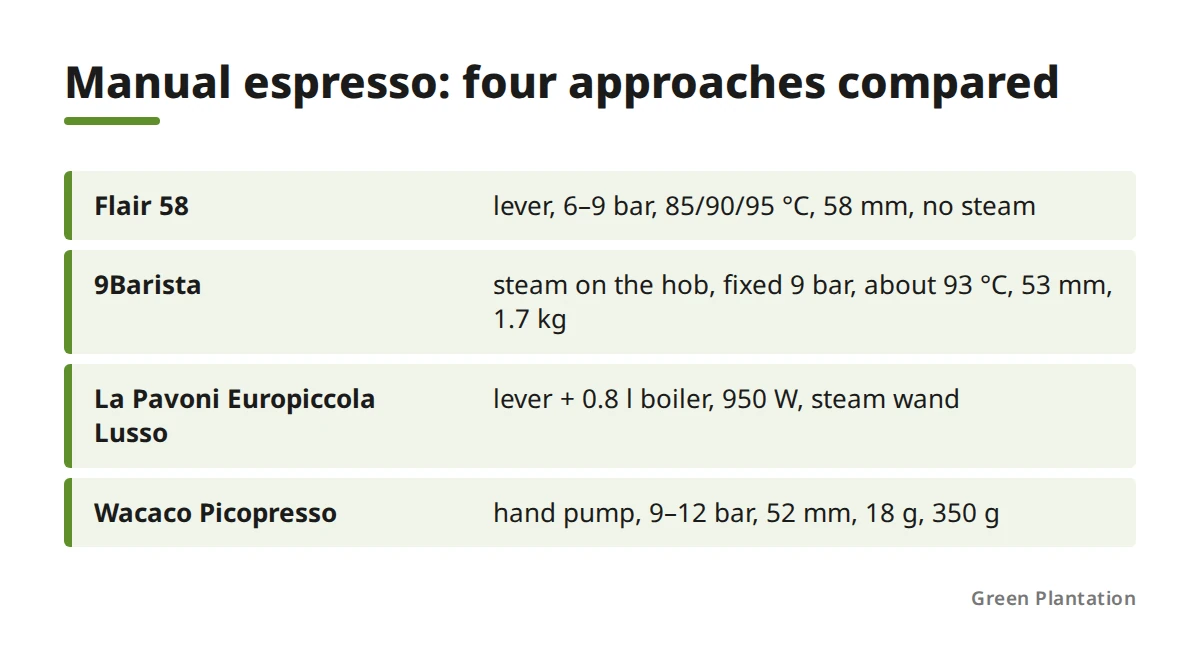
- Arm and kettle (Flair 58, Wacaco Picopresso): you pour hot water into a brew cylinder and supply the pressure yourself, with a long lever on the Flair or a small hand pump on the Picopresso. The device does not heat water.
- Steam on the hob (9Barista): water in the lower boiler heats on gas, ceramic, electric or induction (the last only with the induction pad). A spring valve opens at about 9 bar and the water passes through two heat exchangers, reaching the coffee at roughly 93 °C according to the manufacturer.
- Lever with a boiler (La Pavoni Europiccola): the classic home lever machine with a 0.8 litre boiler and up to 950 W of heating. Same lever feel, but it is plainly an electric machine.
Read the Flair 58 small print before you file it under "espresso without electricity". It ships with an electric preheater for the brew cylinder with three settings. The manual says it also works unplugged: preheat the cylinder with water just off the boil, then brew. That is fine for a weekend away, but you give up some temperature stability. And no option here is truly energy free, because the water has to be heated somewhere, whether in a kettle, on a camping stove or on the hob.
If you are weighing up the wider Flair range (NEO Flex, PRO, 58), our comparison of the Flair lever espresso makers covers the differences. This guide is about the decision between the two flagships of their kind.
Decision table: which one suits you?
Most comparisons stop at specs. Start here instead: find the line that sounds like you.
| If you… | Choose | Why |
|---|---|---|
| want to dial in light roasts and play with pressure profiles | Flair 58 | gauge, three preheat levels, pressure entirely in your hands |
| want a repeatable shot with no fiddling | 9Barista | fixed 9 bar and about 93 °C, nothing to profile |
| make two or three espressos back to back | Flair 58 | refill and go; the 9Barista has to cool before it can be reopened |
| cook on gas or induction and want it to live by the hob | 9Barista | compact, about 1.7 kg, no plug at all |
| want milk drinks every morning | La Pavoni Europiccola | the only one with a steam wand |
| need something for a rucksack or a flight | Wacaco Picopresso | 350 g, fits in a jacket pocket |
| already own 58 mm accessories | Flair 58 | standard 58 mm portafilter, baskets and tampers fit |
Pressure, temperature and dose side by side
The figures below come from the manufacturers' product pages and manuals. For deeper detail on either machine, see our separate reviews; here we keep to what matters for the choice.
| Spec | Flair 58 | 9Barista |
|---|---|---|
| Principle | direct lever, no pump or boiler | two boilers with heat exchangers |
| Pressure | manual, 6–9 bar recommended, gauge | fixed, around 9 bar |
| Temperature | preheat about 85 / 90 / 95 °C (dark / medium / light roast) | about 93 °C |
| Basket | 58 mm, low-flow around 18 g (Plus 2: 16–20 g) | 53 mm, start at 18 g |
| Water / yield | 90 ml cylinder, up to 55 ml in the cup | 120 g of water, 35–40 g in the cup |
| Shot time | 30–35 s | 25–30 s |
| Weight | around 5.4 kg (Plus 2) | around 1.7 kg, 18 cm tall |
| Steam | no | no |
The practical takeaway: the 9Barista is a fixed recipe, which is exactly what makes it easy. The Flair is an instrument. Owners typically start with a short preinfusion at 1–2 bar and then ramp up to 6–9 bar, adjusting both grind and pressure to taste.
Your morning, minute by minute
On paper both take a few minutes. In a real kitchen the rhythm is quite different.
Flair 58: switch on the preheater (or pour boiling water through the cylinder if you are unplugged), grind and tamp about 18 g, fill the cylinder from the kettle, then pull. Flair quotes under 3 minutes per shot for the Plus 2, preheat included. A second shot is simply a matter of knocking out the puck and going again.
9Barista: fill the lower boiler with 120 g of water, dose 18 g, screw it together and put it on the hob. The manufacturer aims for 3–6 minutes of heating and a maximum of 8; its FAQ gives 5–8 minutes from cold. You hear it gurgle, the shot runs in 25–30 s and you take it off the heat. For a second cup it has to cool, the safety valve released (only once cold), then opened and rinsed. Allow roughly 10 minutes for two drinks.
Above about 1,500 m, the 9Barista instructions suggest a finer grind and a 30–35 s shot, which matters if you take it up into the Alps. Picopresso owners, for comparison, preheat with kettle water and pump to 9–12 bar after about 8 seconds of preinfusion.
Running it: consumables, power and upkeep
Day-to-day ownership costs are mostly time and a handful of spares rather than electricity.
- Flair 58: no descaling needed, according to Flair, as there is no boiler. Rinse without detergent, do not submerge the head, and check the piston has not twisted when you reassemble. The spares people buy most are puck screens and alternative baskets. Power use is limited to the optional preheater.
- 9Barista: no electronics and nothing to plug in. You do need the heat transfer plate on gas or the induction pad on an induction hob. After overheating, one Mk.2 Pro owner reported a leak, so keep an eye on the 8 minute limit. A spare parts set with seals is available.
- La Pavoni Europiccola: the costs of a proper boiler machine. Limescale builds up on the heating element, so soft or filtered water helps in hard water areas such as London and the South East. The group gasket (60×50×5.5 mm) is the classic wear part, and after 3–4 coffees the group head runs hot and needs a pause.
- Wacaco Picopresso: occasional seal checks; owners mention seal issues or faults in about 6 of 100 threads.
Whichever you pick, the grinder is the real running cost of good manual espresso. All four need a fine, even espresso grind; a cheap blade grinder will undo the lot.
Milk drinks: who steams and who does not
If a flat white is your daily drink, be honest with yourself here. Neither the Flair 58 nor the 9Barista produces steam. Your options are a separate milk frother, such as the battery powered Subminimal NanoFoamer, which textures warmed milk well enough for latte art practice, or a lever machine with a boiler. The La Pavoni Europiccola has a steam wand (three holes of 1.2 mm) that gives up to about 2 minutes of steam, which covers one or two milk drinks. In the 9Barista sample, milk came up in roughly 40 comments, almost always as the question "how do I make a cappuccino with it?"
Off grid: campervan, bothy, boat
This is where the 9Barista earns its keep. It runs on a gas camping stove, needs no plug and weighs about 1.7 kg. Owners regularly mention narrowboats, campervans and weekend cabins; travel and camping came up in roughly 35 of the analysed texts. The Flair 58 travels too, but at around 5.4 kg it is better suited to a campervan than a rucksack, and unplugged you rely on preheating with boiling water. For walking, cycling or flying the Picopresso is the obvious pick: 71 × 78 × 106 mm and 350 g, you just need hot water. Our guide on how to choose a travel coffee machine covers other options for life on the move.
What owners report
We summarised 707 owner posts and comments from Reddit (r/FlairEspresso, r/espresso, r/Coffee, r/lapavoni, via the Arctic Shift archive) plus the CoffeeGeek review. Categories overlap and are based on thread titles and content, so treat the numbers as tendencies.
- Flair 58 (100 threads, Jan–Nov 2026, 52 of them explicitly about the Plus 2): pressure and grind questions dominate (25–30), followed by parts and assembly (around 20), choosing a model (around 15), the grinder (around 10), temperature (9) and milk (3). CoffeeGeek scored it 9.1/10, with gripes about the bulky power supply, cleaning the puck screen and the lack of a temperature readout.
- 9Barista (342 texts, 2019 to Nov 2026): price (around 80), grinder (around 60), milk (around 40), travel and camping (around 35), lack of control or weighing (around 25) and slow follow-up shots (around 15). About 20 praise the build quality. Light roasts are often described as sour.
- La Pavoni (164 posts): second-hand buys and restorations (around 75), upgrades (around 55), grind (around 52), parts (around 37). Owners praise longevity, spares availability and flavour; the complaints are the learning curve, the hot group head and the small boiler.
- Picopresso (100 posts, 67 authors): grinder and grind (35), choosing between models (33), travel (24), temperature (11), sour or bitter shots (9).
The common thread across all four: the grinder makes or breaks the result. A hand grinder built for espresso, such as the Timemore Chestnut ESP, is a sensible starting point. More on technique in our guide to preparing espresso in a Flair.
Verdict
Buy the Flair 58 if you enjoy the craft, drink lighter roasts or pull several shots in a row. Buy the 9Barista if you want a consistent espresso from the hob with no plug and no profiling, especially with medium to dark roasts, and you mostly make one cup at a time. The 9Barista background article explains how it differs from a moka pot, which only reaches about 0.5 bar. If milk drinks matter, the La Pavoni Europiccola is the honest answer, at the price of needing mains power; our overview of which La Pavoni lever machine to choose helps with the models. And if it has to fit in a pocket, the Picopresso wins.
FAQ
What is a manual espresso maker?
A device that makes espresso without an electric pump. The pressure comes from your arm (lever or hand pump) or, in the case of the 9Barista, from steam in a boiler heated on the hob.
Does the Flair 58 work without electricity?
Yes. According to the manual you unplug the preheater and warm the cylinder with water just off the boil. The shot works, but the temperature is less stable than with the electric preheat.
Is the 9Barista just a fancy moka pot?
No. A moka pot works at roughly 0.5 bar; the 9Barista opens a valve at about 9 bar and cools the water through heat exchangers to around 93 °C, which is espresso territory.
Which is better for light roasts?
The Flair 58. You can preheat to around 95 °C and adjust pressure by hand. 9Barista owners frequently describe light roasts as sour, as temperature is fixed.
Are stovetop espresso makers any good?
Classic moka pots make strong coffee rather than espresso. The 9Barista is the exception, since it reaches around 9 bar, though it is slower between cups than a lever.
Do I need a special grinder?
Yes. Owners of all four machines name the grinder as the most common source of problems. You need a fine, consistent espresso grind, from a good hand grinder or an electric espresso grinder.
Recommended products
- Flair 58: for anyone who wants to control pressure and temperature, with a standard 58 mm portafilter.
- 9Barista Espresso Machine: fixed 9 bar from the hob, no plug, ideal for campervans and boats.
- La Pavoni Europiccola Lusso: the lever classic with a boiler and a steam wand, for milk drinks.
- Wacaco Picopresso: 350 g espresso for rucksacks and hand luggage.
- Timemore Chestnut ESP black: a hand grinder designed for espresso, so you can grind anywhere.
- Subminimal NanoFoamer V2: textured milk without a steam wand, a natural partner for the Flair or 9Barista.
Sources
- Flair Espresso: Flair 58 Plus 2
- Flair Espresso: Flair 58 user manual (PDF)
- 9Barista: FAQs and Getting started
- La Pavoni: lever machine user manual
- Wacaco: Picopresso
Updated: November 2026
Author: Petra Novotná, editorial name of the Green Plantation.
You might also like
 Best Espresso Machine Under €1,500: Single Boiler, HX or Dual Boiler?
Single boiler, thermoblock, heat exchanger or dual boiler: which design under €1,500 suits the way you drink coffee, with figures for boilers, warm-up and… 24. 11. 2026
 Bean-to-cup vs espresso machine: which suits your daily routine?
Bean-to-cup or a traditional espresso machine with a portafilter? A practical decision guide based on your daily routine, time per cup, coffee dose and the… 24. 11. 2026
 Espresso machine for a small café: Ascaso Baby T Plus vs Barista T 2G Compact
One group or two for a small café? Ascaso Baby T Plus and Barista T 2G Compact compared on peak trade, steam, electrics, counter space, water and maintenance,… 24. 11. 2026