
 Česky (CZK)
 Slovensky (EUR)
 Magyar (HUF)
 Polski (PLN)
 English (EUR)
 Deutsch (EUR)
 Français (EUR)
 Español (EUR)
 Português (EUR)
 Italiano (EUR)
 Svenska (SEK)
 Suomi (EUR)
 Nederlands (EUR)
 Dansk (EUR)
 Lëtzebuergesch (EUR)
 Eesti (EUR)
 Latviešu (EUR)
 Lietuvių (EUR)
 Slovenščina (EUR)
 Română (RON)
 Български (EUR)
 Hrvatski (EUR)
 Ελληνικά (EUR)
 Українська (EUR)
 Norsk (EUR)
 Srpski (EUR)
 Tiếng Việt (EUR)
Flat vs Conical Burrs: How Burr Geometry Changes Espresso and Filter Flavour, and Which Grinder to Choose (2026)
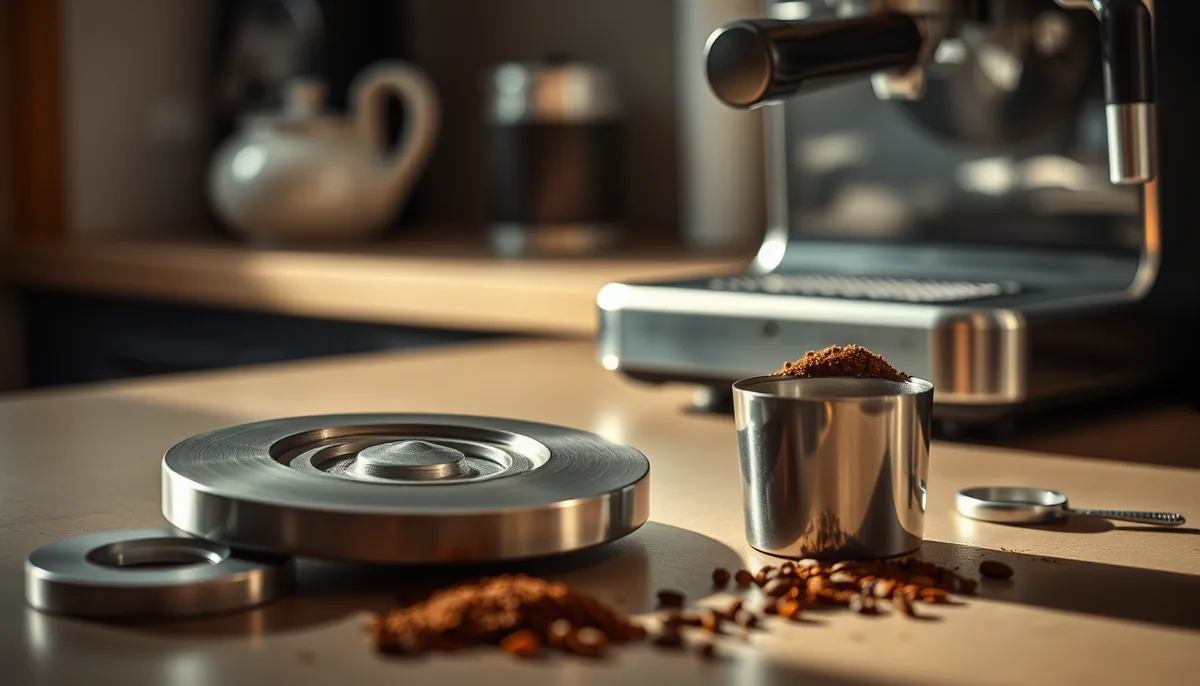
In short: Flat burrs tend to give a narrower particle size distribution with fewer fines; conical burrs produce more fines and spin more slowly. Owners usually describe this as clarity versus body. It is a tendency, not a rule: the specific burr set, tooth geometry and alignment matter more.



| Flat burr grinders we stock | 54–78 mm, 1050–1950 rpm (Eureka, Mahlkönig), adjustable speed on Timemore |
|---|---|
| Conical burr grinders we stock | 40 mm in the electric Baratza models (550 and 650 rpm), plus Comandante and Timemore hand grinders |
| What the measurements show | 24 grinders, same coffee, same instrument: conicals produce more fines on average, but the results overlap heavily |
| Speed and burr size | no clear link to grind uniformity in the same dataset |
| Milk drinks | the difference between burr types is smallest in a cappuccino |
| Light-roast espresso and filter | this is where flat burrs most often win |
Saturday morning in a Manchester flat. The espresso machine has been warming up for twenty minutes and there is a bag of light-roast Ethiopian on the counter. The shot runs 28 seconds, the 1:2 ratio is spot on, and yet the cup tastes flat and slightly astringent. Ask on a coffee forum and you get three answers: “buy a flat burr grinder”, “stick with conical, flat burrs are just hype” and “your grinder is fine, fix your recipe”. Each of them is partly right. Below we break down what really separates flat and conical burrs, what has actually been measured and what is simply owner experience.
We are not covering burr material (steel, titanium coating, ceramic) or grind size adjustment here. Both sit alongside geometry, but they are separate topics. Burr material has its own article, steel, titanium or ceramic burrs, and if you are after a hand grinder for filter coffee on the go, see our guide on how to choose a manual coffee grinder.
What is different inside: shape, diameter and the path of the bean
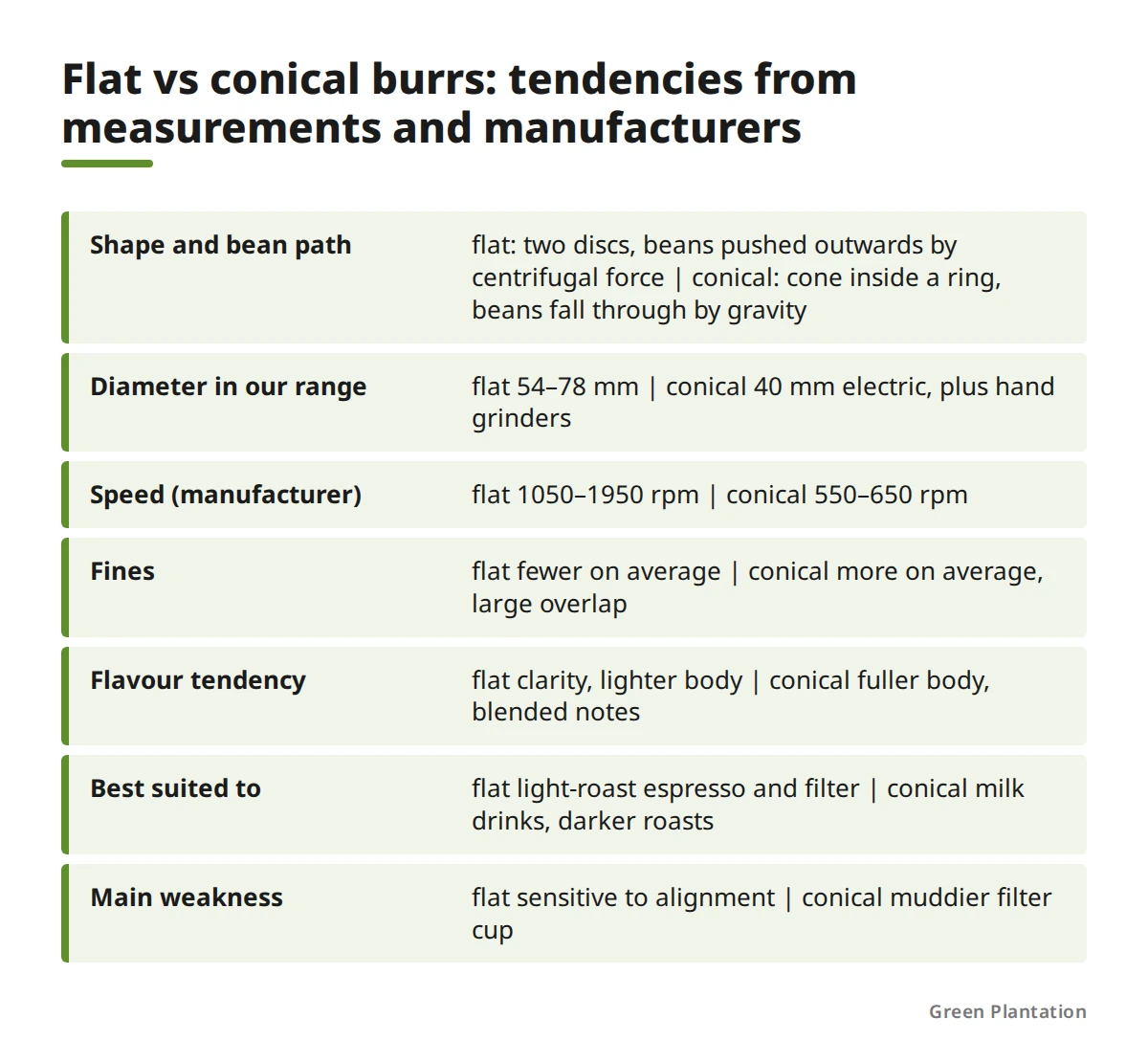
Flat burrs are two toothed discs facing each other. One is fixed, the other spins. Beans drop into the centre and centrifugal force pushes them outwards through ever finer teeth to the edge. The gap between the discs sets the grind size.
Conical burrs are an inner cone turning inside an outer ring. Beans travel from top to bottom: coarse teeth crack them first, then they are ground down in the narrowing gap. Gravity does more of the work and centrifugal force less, which is why a conical burr can turn more slowly.
That leads to practical differences you can see on the spec sheets:
- Diameter. Flat burrs in home grinders now range from 50 to 83 mm (54–78 mm in our range); our conicals are 40 mm in the electric Baratza grinders and smaller in hand grinders. Note that you cannot compare a cone and a disc by diameter alone, because in a cone the bean does not travel along a radius but diagonally down the full height of the cone.
- Speed. Eureka quotes 1350 rpm for the Mignon range and Mahlkönig 1950 rpm for the X64 SD. Baratza quotes 550 rpm for the conical Encore ESP and 650 rpm for the Sette 270. A conical usually turns more slowly and gets by with a smaller motor.
- Grounds path and retention. In a flat burr grinder the coffee has to travel from the edge of the chamber to the chute, and unless the design is built for single dosing, some old grounds stay inside. A conical with a vertical path drops coffee almost straight down. Retention depends more on the whole grinder design than on burr shape, though: the flat burr Eureka Mignon Zero 65 All Purpose has around 0.55 g retention according to the manufacturer.
- Noise and heat. Lower speed means a lower pitch and less friction. But an 18 g home dose grinds in a few seconds, and heating the coffee is negligible in home grinders of either type. It mainly matters in a café grinding hundreds of doses a day. Noise also depends on the motor and housing: the conical Baratza Sette 270 is one of the louder grinders, while Eureka focuses on sound damping with its flat burr models.
- Alignment. A flat burr has to sit perfectly parallel to its partner, otherwise it grinds unevenly. A conical is less sensitive to this, which is why manufacturers favour it in hand grinders and cheaper electric models.
Bimodal distribution and fines: what has actually been measured
Every burr grinder produces two groups of particles. The main peak matches your grind setting; the second is made up of fines below roughly 100 micrometres. That is a bimodal distribution, and both flat and conical burrs have one. What differs is the ratio between the two groups and how many “boulders”, particles larger than intended, you get. No home burr grinder is truly unimodal; “unimodal burrs” is marketing shorthand for burrs with a very small fines peak.
The best data available comes from a dataset collected by Kaffeemacher together with the Swiss university ZHAW: 24 espresso grinders, the same coffee, the same laser analyser, dozens of settings. Physicist Jonathan Gagné drew these conclusions from it:
- conical burrs produce on average more fines and a wider main peak, but the results overlap a lot, so a particular flat burr set can perform worse than a particular conical;
- speed shows no clear link to grind uniformity;
- larger flat burrs are not automatically more uniform in this sample; tooth geometry and surface matter more;
- a grinder that produces fewer fines needs a finer setting for espresso, because when you dial in a shot you are in practice adjusting the amount of fines in the basket.
So “flat = uniform” holds statistically, but only as a rough guide when you are buying a specific grinder. Timemore, for example, states outright that its 078 burrs are designed to reduce fines. That is a feature of that particular geometry, not of all flat burrs.
Flavour: body or clarity?
Owners, baristas and manufacturers describe the difference in much the same way. Treat it as a tendency shaped by the coffee, the recipe and the specific burrs.
- Conical burrs: more fines slow the flow and some of them end up in the cup. Espresso is often described as thicker, with fuller body and a rounder flavour, and the tasting notes blend together more. Darker and medium-dark roasts often benefit.
- Flat burrs: fewer fines, the puck lets water through more evenly and you grind finer. Espresso tastes cleaner, tasting notes are easier to pick apart (fruit, florals, acidity) and body can be lighter. With light roasts and filter coffee this is the difference people most often give as the reason for switching.
Why it is not a rule: you can add body through the recipe (a shorter ratio, a higher dose), and you can open up a light roast on a conical with a longer ratio and higher temperature. Milk and sugar blur the difference further, and in a cappuccino most owners describe it as small.
In filter coffee the difference is clearer than in espresso. Fines in a V60 clog the paper filter, stretch the drawdown and add bitterness and muddiness. That is why almost all electric grinders designed purely for filter (Fellow Ode Gen 2, Timemore Sculptor 078) use flat burrs. We show how to brew it in our step-by-step V60 pour over guide.
Comparison table: grinders in our range by burr geometry
All figures come from the manufacturer (spec sheet or product page). Where the manufacturer gives no figure, we say “not stated”.
| Grinder | Burrs | Speed (manufacturer) | Retention / single dosing | Best for |
|---|---|---|---|---|
| Eureka Mignon Specialita | flat 55 mm | 1350 rpm, 310 W | 300 g hopper, not single dose | espresso, all-rounder |
| Eureka Mignon Libra | flat 55 mm | 1350 rpm, 310 W | grind by weight (±0.2 g), 300 g hopper | espresso |
| Eureka Mignon Zero | flat 55 mm | 1350 rpm, 320 W | single dose, “very low retention” | espresso and filter |
| Eureka Mignon Zero 65 All Purpose | flat 65 mm | 1350 rpm, 310 W | single dose, around 0.55 g retention | espresso and filter (All Purpose) |
| Eureka Atom Specialty 65 | flat 65 mm | 1310 rpm, 280 W | 1.2 kg hopper, dose counter | espresso, high volume |
| Mahlkönig X54 | flat 54 mm | 1050 rpm unloaded, 120 W | 250 g hopper | espresso to cold brew |
| Mahlkönig X64 SD | flat 64 mm | 1950 rpm | single dose with bellows | espresso to cold brew |
| Timemore Sculptor 064S | flat 64 mm | adjustable (Gen II 800–1600 rpm) | single dose, rotating knocker | espresso and filter |
| Timemore Sculptor 078S | flat 78 mm | adjustable, 400 W | single dose, rotating knocker | espresso and filter |
| Fellow Ode Gen 2 | flat 64 mm | not stated | single dose, knocker | filter only (31 steps) |
| Baratza Sette 270 | conical 40 mm | 650 rpm, 200 W | timer, 300 g hopper | espresso |
| Baratza Encore ESP | conical 40 mm (M2) | 550 rpm, 70 W | manual dosing | espresso and filter |
| Comandante C40 MK4 | conical Nitro Blade | hand grinder | grinds into a jar, no hopper | filter, espresso with a precision axle |
| Timemore C3 ESP PRO | conical | hand grinder | grinds into a jar | espresso (ESP version) |
To be honest: we do not stock the large electric conical grinders (60 mm and up) that get the most attention on forums. In our range, conical means an entry-level electric Baratza or a good hand grinder. If you want a big conical for its flavour profile, you will need to look elsewhere. We also sell the DF64 Gen2 and DF54, but we could not find a verified manufacturer spec sheet for them, so they are not in the table.
How to choose, step by step
- Write down what you drink five days a week. Not what you want to experiment with at the weekend. Milk drinks, straight espresso or filter?
- Mostly cappuccino and flat white from medium and darker roasts. Geometry matters least here. Choose a grinder that is convenient and tidy: the flat burr Eureka Mignon Specialita with a hopper and timer, or the Mignon Libra, which grinds straight to weight. The conical Baratza Sette 270 gives full body and grinds quickly, but it is louder.
- Straight espresso from light roasts. This is where flat burrs make the most sense, because an even grind without excess fines helps bring out acidity without astringency. Good options are the Mignon Zero 65 All Purpose, the Mahlkönig X64 SD or the Timemore Sculptor 078S. Expect to grind finer and spend longer dialling in.
- Switching between espresso and filter. Look for a single dose grinder with stepless adjustment and a wide range: Zero 65 All Purpose, X64 SD, Sculptor 064S. Going from espresso to filter means dozens of turns of the dial on any grinder, which is why many people end up with two grinders.
- Filter only. A flat burr grinder built for filter, typically the Fellow Ode Gen 2. It is not suitable for espresso, but it grinds filter cleanly and quickly. A cheaper or travel-friendly alternative is the conical Comandante C40 MK4 hand grinder.
- Check space and noise. The X64 SD fits under a kitchen cabinet (24.9 cm tall according to the manufacturer); the Sculptor 078S is big and heavy.
- Set realistic expectations. Basket, distribution, tamping and bean freshness will show up sooner than burr shape. If you are still working out which grinder to pair with your espresso machine, read our guide on how to choose a home espresso grinder.
The honest weaknesses of each type
Flat burrs
- Sensitive to alignment. A poorly seated burr grinds unevenly, and some owners have to align the burrs or replace the burr carrier.
- Less forgiving for espresso: a narrower window when dialling in, shots gush or choke more quickly, and light roasts take longer to dial in.
- Without a single dosing design, grounds from the previous grind stay in the chamber and chute, which is why with hopper grinders you purge the first gram or two.
- Seasoning burrs: owners often report that flavour only settles after a few kilos of coffee.
Conical burrs
- More fines: muddier filter coffee and slower drawdown through paper, and more often astringency in light-roast espresso.
- In our range only 40 mm electric models or hand grinders, so lower output, and with a hand grinder several dozen seconds of cranking per espresso dose.
- Owners say the Baratza Sette 270 is noticeably louder than the sound-damped Eurekas.
- A hand grinder for espresso needs fine adjustment: on models without a dedicated espresso axle the jump between settings is too big.
What owners struggle with: 100 threads from r/espresso
We went through the 100 most recent posts containing “conical” on r/espresso (13 September to 24 November 2026, an international sample, full-text search via Arctic Shift; treat the numbers as a tendency). Out of 100 threads:
- 70 are buying or upgrade questions (“which grinder”, “is it worth it”), and 45 of those compare conical and flat burrs directly;
- 43 mention milk drinks, 38 light roasts and 31 filter coffee. The typical advice in replies: a conical is enough for milk and darker coffee, flat burrs for light-roast espresso and filter;
- 26 are about clarity and flavour separation, 22 about body and texture, which is exactly the clarity versus body trade-off;
- 25 describe a dialling-in problem (fast shots, sourness, channelling), and replies often point to puck prep rather than burr shape;
- 17 are considering two grinders, 12 raise retention, 10 noise, 9 fines and 4 burr alignment.
Frequently asked questions
Is a flat burr grinder always better for espresso?
No. Flat burrs produce fewer fines on average, but a large measurement of 24 grinders showed that the two types overlap considerably. For milky espresso from a medium roast, a well-designed conical is just as good a choice.
64 mm or 83 mm burrs: is bigger better?
Not automatically. Larger flat burrs grind faster and wear more slowly, but grind uniformity depends more on tooth geometry and alignment. In the data from 24 grinders, a larger diameter did not on its own mean a more even grind. Nor can you compare a 40 mm conical with a 64 mm flat burr, because the bean takes a different path through it.
Do flat burrs heat the coffee more?
With a home dose of 15–20 g, heating is negligible with either type. Heat starts to matter in a café, where the grinder runs dozens of doses back to back. That is why grind chamber temperature is mainly addressed in commercial grinders.
Can one grinder do both espresso and filter?
Yes, if you choose a single dose model with stepless adjustment and a wide range, such as the Mignon Zero 65 All Purpose or the X64 SD. Be prepared to turn the dial by dozens of rotations, though. A more common and practical setup is an electric espresso grinder plus a hand grinder for filter, which may well be a conical.
Why does my espresso run fast on a flat burr grinder when I grind at my old setting?
Because fewer fines are produced, and fines are what slow the water down in the puck. On flat burrs you need to grind finer than you were used to on a conical. It is also the most common surprise after switching.
Recommended products
- Eureka Mignon Libra CR White – 55 mm flat burrs and grind by weight, the most convenient choice for milk drinks and a fixed recipe.
- Eureka Mignon Zero 65 All Purpose – larger 65 mm flat burrs, single dosing and around 0.55 g retention according to the manufacturer, for switching between espresso and filter.
- Mahlkönig X64 SD – 64 mm flat burrs, 1950 rpm and a low height that fits under cabinets, for light-roast espresso and filter.
- Timemore Sculptor 078S – the largest flat burrs in our range at 78 mm with adjustable speed, for anyone chasing maximum clarity from light roasts.
- Baratza Sette 270 – 40 mm conical burrs, 650 rpm and fast grinding straight into the portafilter, for full body in milk drinks.
- Comandante C40 MK4 Nitro Blade – a conical hand grinder for filter and travel, a companion to your espresso grinder.
If you are putting together a whole setup from scratch, you will find an overview of grinder types in our coffee grinder buying guide.
Sources
- Jonathan Gagné, Coffee ad Astra: What I learned from analyzing 300 particle size distributions for 24 espresso grinders (Kaffeemacher and ZHAW data), coffeeadastra.com
- Eureka: technical data for the Mignon Specialita, Mignon Zero, Zero 65 All Purpose, Mignon Libra and Atom Specialty 65, eureka.co.it
- Mahlkönig: X54 Allround Home Grinder and X64 SD brochure, mahlkoenig.com
- Timemore: Sculptor 064S Gen II and Sculptor series (078S), timemore.com
- Baratza: Sette 270 and Encore ESP, baratza.com
- Fellow: Ode Brew Grinder Gen 2, fellowproducts.com
Updated: November 2026
Author: Petra Novotná, editorial name of the Green Plantation.
You might also like
 Eureka Atom Pro review: experience, tech and limits of the 75 mm filter grinder
The Eureka Atom Pro is a filter grinder with 75 mm brew burrs and a Blow-Up bellows. Who it is worth it for, how to set it up and why it is not an espresso… 26. 11. 2026
 Grind-by-Weight Coffee Grinders: Eureka Atom W 65, Atom W 75 or Mahlkönig E65S GbW? 2026 Comparison
Comparison of the Eureka Atom W 65, Atom W 75 and Mahlkönig E65S GbW grind-by-weight grinders: dose accuracy, speed, step-by-step calibration and a calculation… 26. 11. 2026
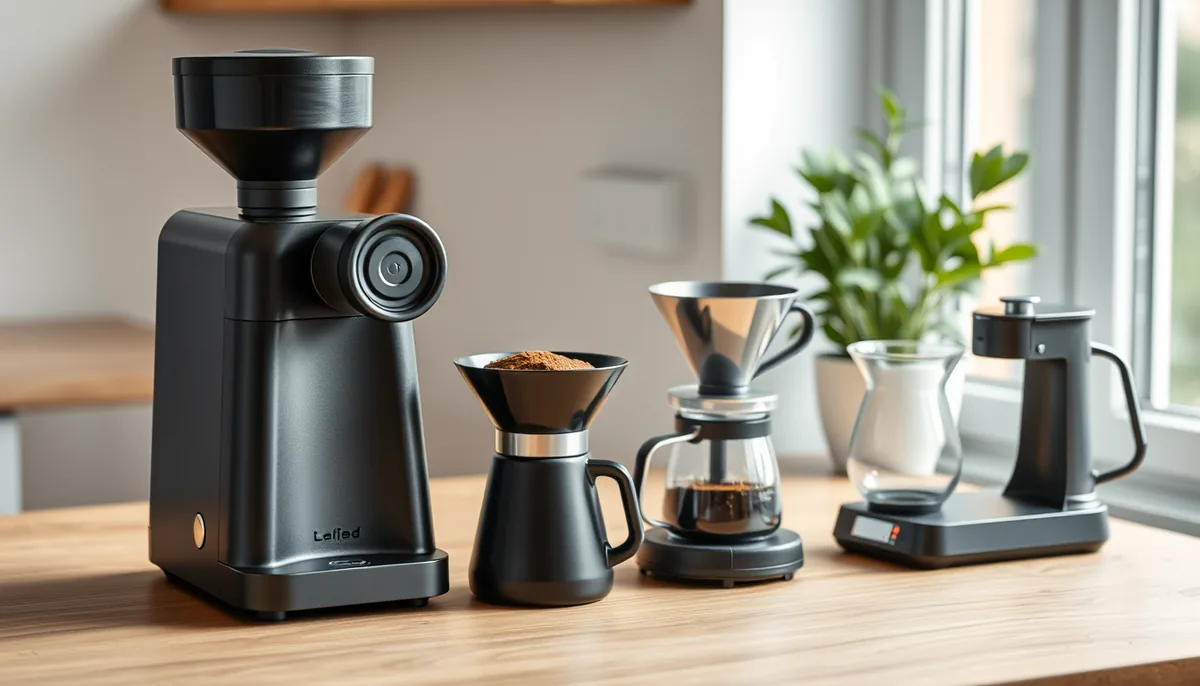 Timemore Sculptor 078S review: 078, 078S or 064S, which one should you buy?
The Sculptor 078S explained: how it differs from the 078 and 064S, espresso and filter settings, maintenance, flaws reported by owners and single dose… 26. 11. 2026