
 Česky (CZK)
 Slovensky (EUR)
 Magyar (HUF)
 Polski (PLN)
 English (EUR)
 Deutsch (EUR)
 Français (EUR)
 Español (EUR)
 Português (EUR)
 Italiano (EUR)
 Svenska (SEK)
 Suomi (EUR)
 Nederlands (EUR)
 Dansk (EUR)
 Lëtzebuergesch (EUR)
 Eesti (EUR)
 Latviešu (EUR)
 Lietuvių (EUR)
 Slovenščina (EUR)
 Română (RON)
 Български (EUR)
 Hrvatski (EUR)
 Ελληνικά (EUR)
 Українська (EUR)
 Norsk (EUR)
 Srpski (EUR)
 Tiếng Việt (EUR)
Ascaso Dream ONE review: the entry Dream, who it suits and when to pay for PID
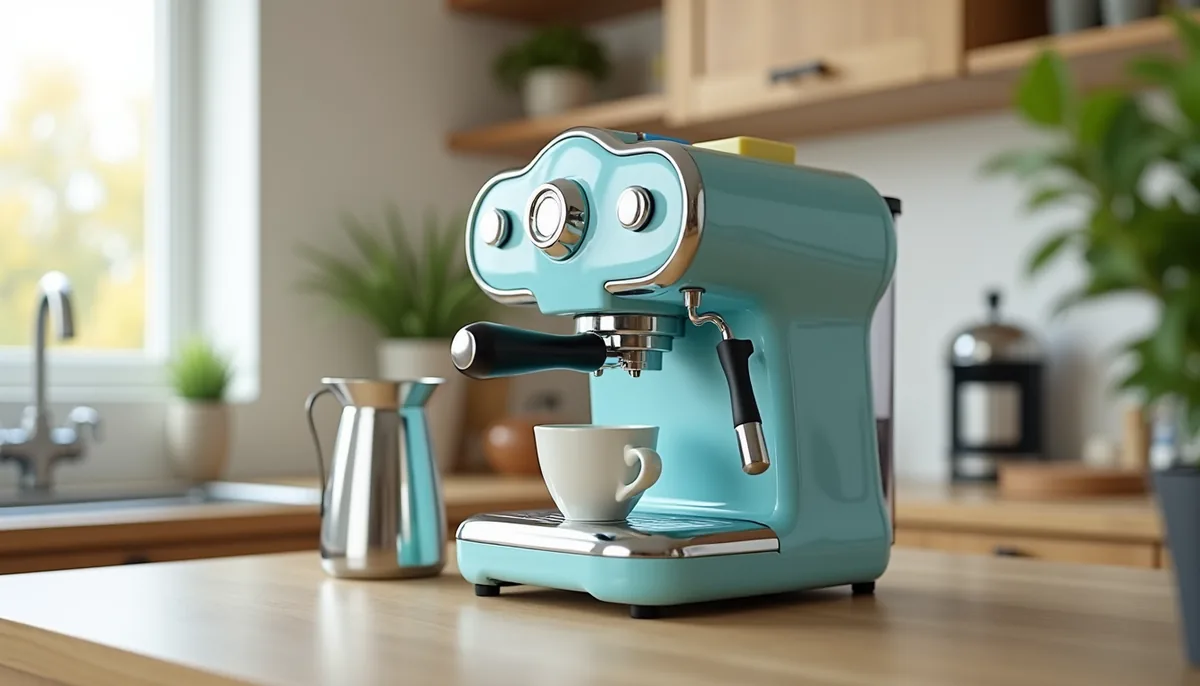
In short: The Ascaso Dream ONE is the entry version of the Dream: a compact thermoblock espresso machine with a 58 mm portafilter, pressure gauge and adjustable OPV. Brew temperature is set in 2 °C steps, steam is fixed at 165 °C, and coffee and steam run one after the other.



| Heating | thermoblock, stability ±1.5 °C (manufacturer) |
|---|---|
| Brew temperature | 90–106 °C in 2 °C steps |
| Steam | fixed at 165 °C, 10 mm cool-touch wand |
| Pump and pressure | vibratory, 20 bar max; OPV adjustable from outside |
| Tank and power | 1.3 l side tank; 1,050 W at 230 V |
| Size and weight | 245 × 345 × 280 mm (W × H × D), 10 kg |
Who the Dream ONE is for
The Dream ONE is for someone who wants proper espresso from a small, good-looking machine and does not want to spend the morning in menus. You switch it on, it heats quickly, you pull a shot, and if you fancy a flat white you switch to steam. That is the whole routine.
It suits a household that drinks one or two milk drinks at a time, has settled on one or two coffees it likes, and values a compact footprint: the machine is 24.5 cm wide. It is less suited to a family that makes four cappuccinos back to back every morning, or to someone who switches between very light and dark roasts and wants to fine-tune every degree.
The silhouette was designed by Marc Aranyó in 2000 and has hardly changed since. What has changed is the inside. Today Ascaso builds two versions on the same aluminium body: the Dream ONE and the Dream PID. If you want a broader look at the brand and its colour range, see our piece on Ascaso coffee machines and their colours.
Dream ONE versus Dream PID: what you give up
Both machines share the body, the side tank, the pump, the portafilter and the pressure gauge. The differences are in control and comfort. According to Ascaso, the ONE sets brew temperature electronically between 90 and 106 °C in 2 °C steps, with no display, and its steam is fixed at 165 °C. The PID version adds a display, 1 °C steps and adjustable steam.
| Feature (manufacturer data) | Dream ONE | Dream PID |
|---|---|---|
| Brew temperature | 90–106 °C in 2 °C steps | 80–110 °C in 1 °C steps, on display |
| Steam temperature | fixed 165 °C | 110–165 °C in 1 °C steps |
| Temperature stability | ±1.5 °C | ±1.5 °C |
| Display, shot timer, statistics | no | yes |
| Volumetric dosing | no | 2 programmable doses |
| Pre-infusion | no | 0–5 s in 1 s steps |
| Pressure gauge, external OPV | yes | yes |
| Insulated thermoblock | no | yes |
| Active cup warmer | no | yes |
| Auto stand-by | no | after 0.5, 1 or 2 h |
| Handles | standard | walnut |
| Power | 1,050 W | 1,100 W |
So when is the ONE enough? If you drink one blend, usually a medium or darker roast, a 2 °C step is fine: you find the setting that tastes right and leave it. Fixed steam at 165 °C is the top of the PID's own steam range, so for milk you are not losing power, only the option to go gentler.
When is the PID worth the extra? If you buy light, fruity single origins one week and a dark espresso blend the next, 1 °C steps help. Pre-infusion makes even extraction easier, especially with finer grinds. A built-in timer saves you a phone on the drip tray, and volumetric dosing stops the shot for you. We cover the PID version in a separate review. If the idea of temperature control is new to you, our article on whether a home machine needs PID control explains the basics.
Key specifications and what they mean
Thermoblock, not boiler. Water is heated as it flows through the thermoblock rather than sitting in a tank. That is why owners keep mentioning how quickly it is ready. Ascaso's website speaks of a single thermoblock, the 2025 brochure of an "insulated dual thermoblock", and the manual of an exchanger with stainless steel ducts. In practice the result is the same: coffee first, then steam, never both at once.
Pump and pressure. The vibratory pump is rated at 20 bar, but what matters is brewing pressure. The manual gives 9–12 bar. You limit it with the over-pressure valve (OPV) next to the group, using a flat screwdriver and the blind basket. One owner reports about 11 bar out of the box, and many people turn it down to around 9 bar. Why 9 bar is the usual target is explained in our article on 9, 15 or 19 bar in a coffee machine.
58 mm portafilter. Ascaso now lists a 58 mm group, the common standard for tampers, baskets and bottomless portafilters. The 2022 manual still states Ø 60 mm, and older Dream generations use 57 mm, so measure the inside of your basket before buying accessories.
Steam wand. A 10 mm stainless cool-touch wand with a single-hole tip. As a safety feature, steam switches off after 3 minutes of continuous use.
In the box. Double-spout portafilter; 7, 14 and 18 g baskets; pressurised 7 and 14 g baskets; an ESE pod basket; a blind basket for backflushing; an aluminium tamper and a measuring spoon.
Daily use: espresso and milk
Switch on and wait until the light stops flashing. Leave the portafilter locked in the group so it warms up too.
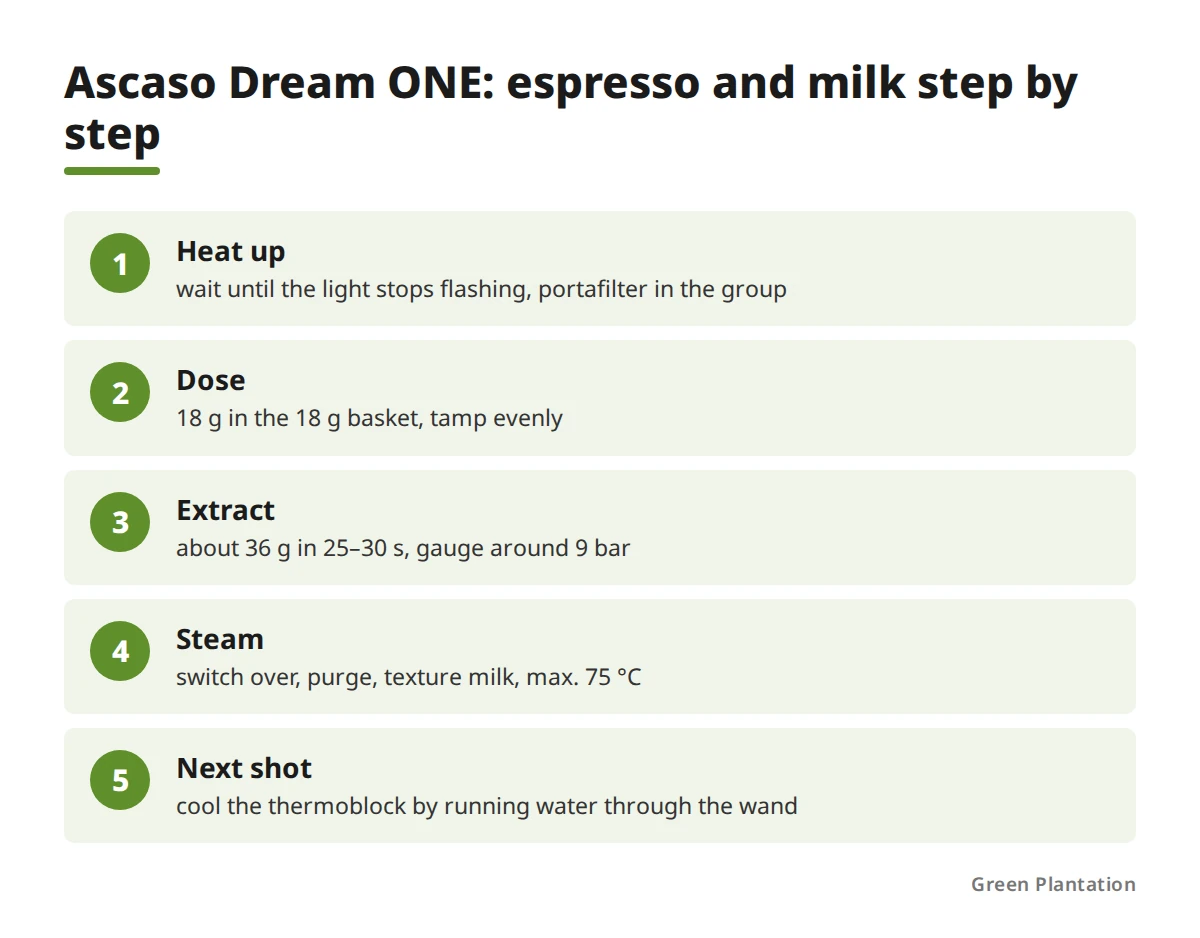
A sensible starting point with the 18 g basket is 18 g of ground coffee and about 36 g in the cup in 25–30 seconds, with the gauge showing around 9 bar. Fast and sour means grind finer; slow, with pressure climbing above 12 bar, means coarser. The gauge is a real advantage over cheaper machines, because you can see at once whether the grind is right. Without a built-in timer on the ONE, use scales with a timer.
The grinder matters as much as the machine. The pressurised baskets will forgive a coarser grind, but the standard stainless baskets need an espresso grinder with fine adjustment. Our guide on choosing an electric grinder for home will help you pick one.
Milk: after the shot, switch to steam, wait for the light to settle and purge condensation from the wand. Keep the tip just below the surface until the milk has gained volume, then lower it and finish heating. The manual advises not to go above 75 °C. After steaming, the thermoblock is too hot for coffee; let it cool before the next shot, which you can speed up by running water through the wand. The manual suggests waiting about 5 minutes or purging water in this way.
One or two cappuccinos in a row are no problem. Four milk drinks in a row means a lot of switching and waiting.
Cleaning and descaling
- Backflush weekly: blind basket in the portafilter, run the pump for 10 seconds, stop, repeat twice (as per the manual).
- Shower screen: clean after 80–100 espressos with warm water and a mild detergent.
- Descaling by usage: more than 10 coffees a day monthly, 5–10 a day every 2 months, 1–5 a day every 3 months.
- Dishwasher: baskets, drip tray and water tank (top rack). Never the portafilter.
- Water: Ascaso recommends water low in minerals. In hard-water areas a filter or suitable bottled water protects the thermoblock.
- Steam wand: wipe and purge briefly after every use so milk does not dry inside.
Thermoblocks have narrow channels, so scale builds up faster than many people expect. Read how to tell if your water is damaging your coffee machine before you choose your water.
What owners say
We went through 79 threads about the Ascaso Dream on r/espresso from 2025 and 2026. The sample is international, mostly from the US and Western Europe, and covers the ONE, the PID and older generations; few owners name the ONE specifically. The counts are approximate.
What they like: fast heat-up, mentioned again and again; espresso clearly better than from entry machines such as the Sage Bambino; the adjustable OPV; a solid 58 mm portafilter; and above all the look and colours. Several owners have used a Dream as their main machine for years.
Recurring complaints: a small tank and an even smaller drip tray. Most find steam weaker than on boiler machines and the wand small, though opinions differ and some are pleasantly surprised. Around 30 threads deal with repairs (leaks, pumps, steam valves), but a large share concern older second-hand units from 2006 to 2017.
What they warn about: for several milk drinks in a row, some owners eventually move to a heat exchanger or dual boiler. Views on after-sales support differ, from praise for service in Europe to complaints. Buying used, check the steam valve, pump and group gasket.
Weak points and what to check
- Coffee and steam in sequence. Fine for one or two drinks, slow for a busy household.
- No fine control. 2 °C steps, fixed steam, no pre-infusion and no timer. If you think you will want these within a year, buy the PID straight away.
- Small drip tray and 1.3 l tank. Expect to refill the tank often and empty the tray almost daily.
- Tamper in the box. The aluminium tamper is a stopgap; owners swap it for a precise 58 mm one.
- Generations. Parts for the Dream Zero, Up or MF may not fit the ONE. Always search for showers, gaskets and portafilters by generation.
- Weight. The website gives 10 kg, the older manual 7–8 kg. It is narrow but 28 cm deep without the portafilter.
Dream ONE versus the alternatives
| Machine | Heating | Temperature control | Portafilter | Best for |
|---|---|---|---|---|
| Ascaso Dream ONE | thermoblock | electronic, 2 °C steps, no display | 58 mm | design and simplicity |
| Ascaso Dream PID | insulated thermoblock | PID with display, pre-infusion | 58 mm | tuning temperature and pre-infusion |
| Profitec GO | single boiler | PID with display | 58 mm | compact boiler machine with PID |
| Lelit Anna PL41TEM | single boiler | PID | 57 mm | smaller budget, beginners |
| Rancilio Silvia E | single boiler | thermostat | 58 mm | sturdy classic to upgrade |
| Gaggia Classic E24 | single boiler | thermostat | 58 mm | simplest way into espresso |
All of these make coffee and steam in sequence. The Dream ONE wins on heat-up speed and looks. Boiler machines, according to owners, usually have stronger steam and are simpler to repair.
Verdict
The Dream ONE is a good choice if you want a compact, stylish machine that is ready quickly, you drink one kind of coffee and you make one or two milk drinks at a time. You get the same body, pump, 58 mm portafilter and gauge as the PID, without the screen. Pay extra for the Dream PID if you switch roasts, want pre-infusion, a timer or adjustable steam. If you regularly make several milk drinks in a row, look at a heat exchanger or dual boiler instead.
Frequently asked questions
What is the difference between the Ascaso Dream ONE and the Dream PID?
The PID has a display, brew temperature of 80–110 °C in 1 °C steps, adjustable steam from 110 to 165 °C, pre-infusion, volumetric dosing, a timer, an insulated thermoblock and a cup warmer. The ONE sets 90–106 °C in 2 °C steps and has fixed 165 °C steam. Body, portafilter, tank and pump are the same.
Does the Ascaso Dream ONE have a boiler?
No. It heats water as it flows through a thermoblock, which is why it is ready quickly. You cannot brew and steam at the same time.
What size tamper fits the Dream ONE?
Ascaso lists a 58 mm portafilter for the current ONE and PID. Older generations (Zero, Up, MF) use 57 mm. Measure the inside of your basket before buying.
Can you adjust the pressure on the Dream ONE?
Yes. The OPV next to the group can be adjusted from outside with a flat screwdriver and the blind basket. The manual gives a working range of 9–12 bar.
How often should I descale it?
According to the manual: every 3 months at 1–5 coffees a day, every 2 months at 5–10, and monthly above 10. Backflush with the blind basket once a week.
Will it run on a normal UK socket?
The machine is rated at 1,050 W and 230 V, so a standard household socket is fine.
Recommended products
- Ascaso Dream ONE Dark Black – the machine reviewed here, for simple everyday espresso.
- Ascaso Dream ONE Kid Blue – the same machine in pastel blue; the Dream comes in nine colours.
- Ascaso Dream ONE Cloud White – the white version for a lighter kitchen.
- Ascaso Dream PID Dark Black – if you want 1 °C steps, pre-infusion, a timer and adjustable steam.
- Eureka Mignon Specialita – a quiet espresso grinder with fine adjustment for the stainless baskets.
- Ascaso tamper 58 mm, walnut – a precise replacement for the aluminium tamper in the box.
Sources
- Ascaso: Dream, comparison of Dream PID and Dream ONE
- Ascaso: Dream technical brochure 2025 (PDF)
- Ascaso: Dream PID and ONE user manual, MAN.29 V10 (PDF)
- r/espresso: owner discussions about the Ascaso Dream
Updated: November 2026
Author: Petra Novotná, editorial name of the Green Plantation.
You might also like
 Eureka Atom Pro review: experience, tech and limits of the 75 mm filter grinder
The Eureka Atom Pro is a filter grinder with 75 mm brew burrs and a Blow-Up bellows. Who it is worth it for, how to set it up and why it is not an espresso… 26. 11. 2026
 Eureka Costanza Review: HX Machine with PID, Costanza R and Owner Experiences
The Eureka Costanza is a compact E61 heat exchanger machine with PID and a shot timer. We clear up the dual boiler myth, explain how it differs from the… 26. 11. 2026
 Grind-by-Weight Coffee Grinders: Eureka Atom W 65, Atom W 75 or Mahlkönig E65S GbW? 2026 Comparison
Comparison of the Eureka Atom W 65, Atom W 75 and Mahlkönig E65S GbW grind-by-weight grinders: dose accuracy, speed, step-by-step calibration and a calculation… 26. 11. 2026