
 Česky (CZK)
 Slovensky (EUR)
 Magyar (HUF)
 Polski (PLN)
 English (EUR)
 Deutsch (EUR)
 Français (EUR)
 Español (EUR)
 Português (EUR)
 Italiano (EUR)
 Svenska (SEK)
 Suomi (EUR)
 Nederlands (EUR)
 Dansk (EUR)
 Lëtzebuergesch (EUR)
 Eesti (EUR)
 Latviešu (EUR)
 Lietuvių (EUR)
 Slovenščina (EUR)
 Română (RON)
 Български (EUR)
 Hrvatski (EUR)
 Ελληνικά (EUR)
 Українська (EUR)
 Norsk (EUR)
 Srpski (EUR)
 Tiếng Việt (EUR)
Dual Boiler Espresso Machines Explained: What Is (and Isn't) a Dual Boiler
In short: A true dual boiler espresso machine has two separate, independently controlled boilers: a small one for brew water and a larger, hotter one for steam. A dual thermoblock (such as the Ascaso Steel DUO) also brews and steams at once, but holds no hot water in a boiler. It only pays off if you make milk drinks most days.



| Dual boiler | two boilers, e.g. Lelit Elizabeth: 0.3 l brass brew boiler + 0.6 l stainless steam boiler, elements 1,200 W + 1,000 W |
|---|---|
| Dual thermoblock | no boiler, two flow heaters; Ascaso Steel DUO: 2,068 W, steam ready in about 1.5 minutes |
| Heat exchanger (HX) | one large steam boiler (1.6 to 1.8 l) with a tube that heats brew water on its way through |
| Single boiler | one boiler or thermoblock, espresso and steam one after the other |
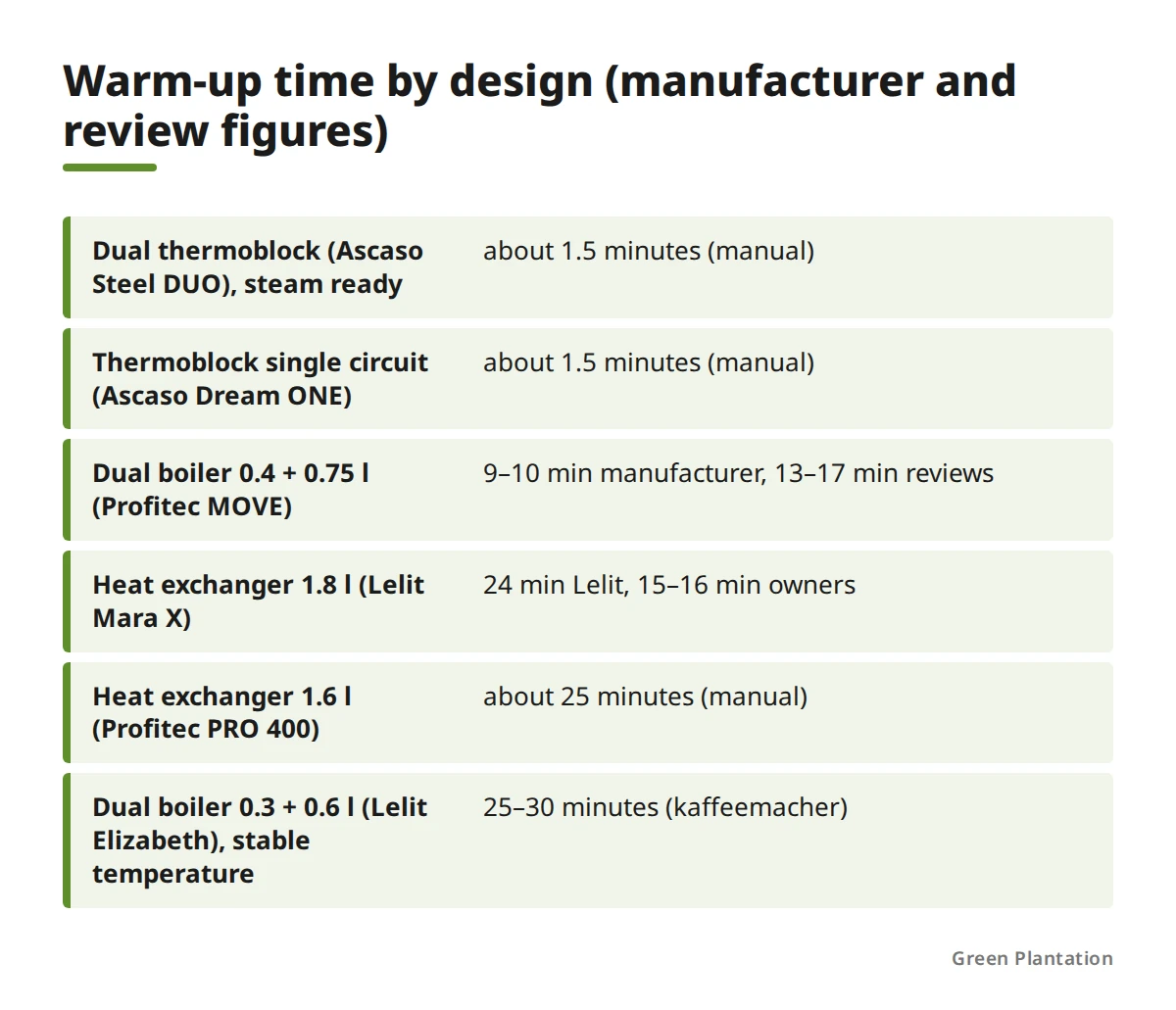
| Warm-up | thermoblock about 1.5 min; Elizabeth 25 to 30 min to fully stable temperature (kaffeemacher measurement) |
| Group | every machine in this guide takes a 58 mm portafilter |
What a dual boiler actually is
Search for "dual boiler espresso machine" in the UK and most of the first page is shop categories and one very well known Sage model. What you rarely get is a plain explanation of what the term means, so here it is.
A dual boiler machine has two separate boilers, each with its own temperature control. The brew boiler holds water at espresso temperature, typically around 93 °C. The steam boiler runs much hotter: on the Lelit Elizabeth the manual gives a range of 120 to 145 °C. Because the two circuits are independent, you can pull a shot and steam milk at the same moment, and steaming does not drag the brew temperature around.
That is the whole point. People who want a dual boiler usually want two things: espresso and milk without waiting, and a brew temperature that is stable and adjustable. Two boilers deliver both. But they are not the only design that does, and the alternatives trade off differently.
Thermoblock vs boiler vs heat exchanger
Four designs get lumped together in shop listings. They behave very differently on a Tuesday morning.
- Dual boiler: two heated water reservoirs. Thermally very steady once warm, but slow to get there and the most expensive to build.
- Dual thermoblock: two flow heaters, one for coffee and one for steam and hot water. Water is heated as it passes through a metal block, nothing sits hot in a tank. You can still brew and steam at once. Example: Ascaso Steel DUO.
- Heat exchanger (HX): one big steam boiler with a copper or steel tube running through it. Brew water is heated on its way through that tube. Plenty of steam, but brew temperature is controlled indirectly and the water in the tube overheats when the machine sits idle.
- Single boiler: one boiler or thermoblock for everything. Pull the shot, switch to steam, wait for it to heat up, then steam.
If you want the boiler side of this in more depth, our piece on two boilers versus a heat exchanger goes through the plumbing.
The machines, sorted honestly
Figures come from manufacturer pages and manuals; measured times come from independent reviews. Where sources disagree, both numbers are given.
| Machine | Design | Boiler / heating | Power | Temperature control | Warm-up | Tank |
|---|---|---|---|---|---|---|
| Lelit Elizabeth PL92T | Dual boiler | 0.3 l brass + 0.6 l AISI 316L stainless | 1,200 W + 1,000 W (elements) | LCC with OLED, coffee 80–110 °C, steam 120–145 °C | 25–30 min to stable (kaffeemacher) | 2.5 l |
| Ascaso Steel DUO (standard version) | Dual thermoblock | no boiler, 2 thermoblocks, stainless water path | 2,068 W | electronic, thermometer, no PID display | steam about 1.5 min (manual) | 2.0 l |
| Ascaso Dream PID | Single, thermoblock | insulated thermoblock | 1,100 W | PID 80–110 °C in 1 °C steps | quick (owners); Dream ONE about 1.5 min (manual) | 1.3 l |
| Rancilio Silvia E | Single boiler | 0.3 l | 1,150 W | thermostat, no PID | no manufacturer figure | 2 l |
| Lelit Mara X PL62X | Heat exchanger | 1.8 l steam boiler with HX | about 1,400 W (retailer figure) | temperature modes, X mode | Lelit 24 min, owners 15–16 min | 2.5 l |
| Profitec PRO 400 | Heat exchanger | 1.6 l stainless with HX | 1,400 W (website) / 1,500 W (catalogue) | PID on the boiler, 120/124/128 °C | about 25 min (manual) | 2.8 l |
Just above the €2,000 mark sit two more true dual boilers: the Rancilio Silvia PRO X (0.3 l + 1 l, two PID controllers, 1,100 W, only 25 cm wide) and the first-generation Profitec MOVE (0.4 l + 0.75 l, 2,200 W, 57 to 58 dB in two reviews). They are the natural next step if the Elizabeth's small steam boiler feels limiting.
Lelit Elizabeth: the one true dual boiler we stock under €2,000
The Elizabeth PL92T is compact for a twin-boiler machine. Lelit's current page lists 32 × 38 × 38 cm and 15.3 kg; the older manual says 31 × 27 × 38 cm and 12 kg, so measure your worktop with a margin. Both boilers are set separately, and you can switch the steam boiler off completely on espresso-only days.
Two features make it more than "two boilers in a box":
- Pre-infusion from steam boiler pressure: after you press the button, the pump waits 1 to 20 seconds while pressure from the steam boiler pushes water gently into the puck. kaffeemacher found this helps most with light roasts. It does not work with the steam boiler switched off.
- LELIT58 group: accessories made for LELIT58 fit, which matters if you later add precision baskets or a bottomless portafilter.
The downsides are well documented. kaffeemacher describes the small steam boiler as "powerful but slow": at 145 °C, texturing milk takes longer than on a 1.8 l HX machine, although beginners often find that easier to control. And it needs time. In its repeat review in 2026, kaffeemacher recommends allowing 25 to 30 minutes for the brew temperature to settle. After that it holds 92.5 to 94 °C but rises by 4 to 5 °C during a shot. A plug-in timer solves the warm-up in daily life.
Check the model plate when buying: the newer Elizabeth3 PL92T3, with the "Pagaia" flow-control paddle and a 200 ml brew boiler, is a different machine. What we sell is the PL92T.
Ascaso Steel DUO: two thermoblocks, no boiler
The Steel DUO is often listed as a dual boiler. It is not one, and Ascaso does not call it that: the manufacturer describes a dual thermoblock system. One block heats brew water, the other produces steam and hot water. That has consequences worth knowing before you buy.
- Very fast start. According to the manual, steam is ready in about 1.5 minutes. For a stable shot, still give the group and portafilter a few minutes and run a blank shot through.
- Brew and steam at the same time. Just like a dual boiler, no switching. Steam is generated on demand by pump and block, so you will hear the pump working. After three minutes of continuous steaming the manual says steam shuts off for safety.
- No boiler, but scale still matters. The narrow channels in a thermoblock are sensitive to hard water.
- High power draw: 2,068 W. A standard socket copes, but avoid running the kettle on the same circuit at the same time.
Mind the version. Our product page 347 is the standard Steel DUO: same steel body and two thermoblocks, electronic temperature control with a front thermometer, but no PID display, no adjustable pre-infusion and no pressure gauge. Most reviews online cover the Steel DUO PID (V3) or the PID PLUS. Steam power, housing and footprint carry over; temperature adjustment and pre-infusion do not. The pump is rated at 20 bar and the over-pressure valve limits working pressure; Ascaso recommends 9 to 12 bar. Without a gauge on the machine, you need a portafilter pressure gauge to adjust it.
Bottom line: the Steel DUO makes sense if you want two cappuccinos quickly in the morning and have little space (27 cm wide). If you want a machine that sits thermally rock steady for hours and shows you every degree, a true dual boiler suits you better. If you are weighing it against Ascaso's single-circuit Dream, that is a separate question with its own comparison.
Heat exchangers: the big steam boiler alternative
An HX machine has only one boiler, but a large one: 1.8 l on the Lelit Mara X, 1.6 l on the Profitec PRO 400. Brew water passes through a heat exchanger inside it, so you get lots of steam and can work in parallel too. The catch: water in the exchanger overheats while idle, so you run a short cooling flush before each shot. Profitec spells this out in the PRO 400 manual, and the length of the flush changes your brew temperature. At boiler settings of 120, 124 or 128 °C, the manufacturer measured roughly 90, 94 or 98 °C at the group after warm-up and a 2-second flush.
The Mara X tackles the problem with its X mode, which regulates temperature from the heat exchanger side. Lelit quotes 24 minutes to heat up; owners report 15 to 16. An HX is worth it if you make several milk drinks back to back and can live with the flush.
When a single boiler with PID is all you need
Plenty of people buy a dual boiler for milk drinks they make twice a week. If you mostly drink espresso, or make one cappuccino a morning, a single boiler machine is cheaper to run, warms up faster and takes less space. Our guide to single boiler home machines covers the workflow.
- Ascaso Dream PID: thermoblock with PID, coffee 80 to 110 °C in 1 °C steps, steam 110 to 165 °C, pre-infusion 0 to 5 seconds, 1,100 W. Espresso and steam only one after the other. After steaming, Ascaso advises waiting 5 minutes or purging water through the wand. Steam stops after 3 minutes of continuous use. The 1.3 l tank is small.
- Rancilio Silvia E: classic single boiler with a 0.3 l brass boiler, 1,150 W, 2 l tank. To be clear: it has no PID, it uses a thermostat. For consistent shots you run some water through before brewing (temperature surfing). In return the technology is simple, with little electronics to fail.
What PID control changes in practice is explained in do you need a home machine with PID control. On energy: kaffeemacher measured a single boiler with PID (Profitec GO 2.0) at 0.088 kWh for warm-up plus one espresso and 0.044 kWh per hour kept hot. The makers of the dual boilers here publish no kWh figures. What is clear is that two boilers heating for 25 minutes and then held hot use more than a thermoblock ready in minutes. Use the eco mode or a timer.
When a dual boiler pays off: a decision table
| Your routine | Design | Our pick | Why |
|---|---|---|---|
| mostly espresso, milk now and then | Single with PID | Ascaso Dream PID | adjustable temperature, quick to heat, compact |
| espresso, tight budget, prefer repairable tech | Single with thermostat | Rancilio Silvia E | simple build, little electronics |
| 2 cappuccinos before work, little time and space | Dual thermoblock | Ascaso Steel DUO | steam in about 1.5 min, brew and steam together, 27 cm wide |
| stable brew temperature plus milk, light roasts too | Dual boiler | Lelit Elizabeth PL92T | two controlled boilers, pre-infusion, steam boiler can be switched off |
| lots of milk drinks in a row, guests | Heat exchanger | Lelit Mara X or Profitec PRO 400 | 1.6 to 1.8 l steam boiler, strong steam |
| dual boiler with stronger steam, budget a little over €2,000 | Dual boiler | Rancilio Silvia PRO X or Profitec MOVE | 1 l or 0.75 l steam boiler, PID, quiet running (MOVE) |
The rule of thumb that keeps coming up among owners: from two or three milk drinks in a row, a dual boiler or HX earns its keep. Below that, the money is better spent on the grinder.
Water, cleaning and descaling
Whatever the design, water causes more repair bills than anything else, and much of England has hard water. Test your hardness before the first shot and use a filter or low-mineral bottled water if it is high. Our article on how to tell if water is ruining your machine explains why.
- Backflush with a blind basket weekly on machines with a solenoid valve (Elizabeth, Steel DUO, Dream, E61-type HX machines).
- Descale per the Ascaso manual: monthly above 10 shots a day, every 2 months at 5 to 10, every 3 months at 1 to 5. With boiler machines, filtering in advance beats descaling a boiler later.
- Shower screen: unscrew and clean every 80 to 100 shots (Ascaso).
- Steam wand: purge and wipe after every jug.
What owners report
We went through public posts on r/espresso, r/Kaffee and r/ranciliosilvia (archive, mostly November 2025 to November 2026). The sample is international and not representative: people post when they have questions or problems. The patterns are still clear.
- Dual boilers in general: of 100 posts with "dual boiler" in the title, 64 were about a Breville/Sage model, which we do not stock. 17 asked the basic question of whether a dual boiler is worth it over a single boiler or HX. The usual answer: yes, from two or three milk drinks back to back.
- Lelit Elizabeth (100 posts): praise for working in parallel, compact size and precise temperature. 19 posts concerned leaks or servicing, such as hissing at steam boiler joints or a tripping RCD. 25 were really about the grinder.
- Ascaso Steel DUO (49 posts, all versions): praise for the short warm-up, strong steam for latte art and the compact steel body. Roughly one in six described a fault, mainly falling pump pressure, scaled thermoblocks, solenoid valves and relays. About a third were grind and dose questions.
- Single boilers: in 56 posts with "single boiler" in the title, 11 were about milk and waiting between shot and steam. For the Ascaso Dream (79 threads), steam and milk was the top topic, and three threads were about upgrading to an HX or dual boiler.
- Silvia PRO X (142 threads): owners who moved up from the Silvia E were mostly positive, chiefly about steam from the 1 l boiler. Recurring topics were electronics error messages (29) and valves or hoses (28).
The pattern across every model: the grinder decides the taste more than the boiler layout. Budget for it from the start; see how to choose an electric grinder for home.
Verdict
A dual boiler is the right tool if you want stable brew temperature and steam at the same time, every day, and can accept a long warm-up. In our range under €2,000 that means one machine: the Lelit Elizabeth. The Ascaso Steel DUO gives you simultaneous brewing and steaming without a boiler and is ready in a minute and a half, but it is less thermally steady and the standard version has no PID display. HX machines give the most steam but ask for a cooling flush. And if milk is an occasional treat, a single boiler saves money, space and electricity.
FAQ
What is a dual boiler in an espresso machine?
It is a machine with two separate boilers: one keeps brew water around 93 °C, the other holds water well above 100 °C for steam. Each has its own temperature control, so you can pull a shot and steam milk at the same time.
Do I really need a dual boiler espresso machine?
Only if you make milk drinks regularly, especially two or more in a row. For mostly espresso, a single boiler with PID is simpler, cheaper and quicker to heat. Owners on forums typically draw the line at two to three milk drinks per session.
Is the Ascaso Steel DUO a dual boiler?
No. It has two thermoblocks instead of boilers. It brews and steams at the same time like a dual boiler and has steam in about 1.5 minutes, but holds no reservoir of hot water. The standard version has no PID display and no pressure gauge.
What is the difference between a dual boiler and a heat exchanger?
A dual boiler has two independently controlled boilers. A heat exchanger machine has one large steam boiler with a tube that heats brew water on its way through. With an HX you control brew temperature indirectly and run a short flush before each shot.
How long does a dual boiler take to heat up?
It depends on boiler size and group. For the Lelit Elizabeth, kaffeemacher recommends 25 to 30 minutes for stable temperature. For the Profitec MOVE the manufacturer quotes 9 to 10 minutes, while reviews measured 13 to 17.
Recommended products
- Lelit Elizabeth PL92T: the true dual boiler in this class, with pre-infusion and a steam boiler you can switch off.
- Ascaso Steel DUO: dual thermoblock for quick cappuccinos in a small kitchen.
- Ascaso Dream PID: single circuit with PID for espresso drinkers who rarely steam.
- Rancilio Silvia E: classic single boiler with a 0.3 l boiler and simple, serviceable tech.
- Rancilio Silvia PRO X: the step up just over €2,000, a dual boiler with a 1 l steam boiler.
- Eureka Mignon Specialita: stepless espresso grinder that suits any of these machines.
Sources
- Lelit: Elizabeth PL92T product page
- Lelit: Elizabeth PL92T user manual (PDF)
- kaffeemacher: Lelit Elizabeth review (2026)
- Ascaso: Dream PID and Dream ONE
- Rancilio: Silvia PRO X specifications
- Profitec: PRO 400
Updated: November 2026
Author: Petra Novotná, editorial name of the Green Plantation.
You might also like
 Eureka Costanza Review: HX Machine with PID, Costanza R and Owner Experiences
The Eureka Costanza is a compact E61 heat exchanger machine with PID and a shot timer. We clear up the dual boiler myth, explain how it differs from the… 26. 11. 2026
 Eureka Pura and Pura R review: experience, tech and an honest verdict on the E61 heat exchanger
The Eureka Pura is an E61 heat exchanger machine with a pressurestat; the Pura R is the same machine with a rotary pump. Here are the official specs, the… 26. 11. 2026
 E61 Group Head: The Complete Guide – How It Works, Maintenance and Modifications (Flow Control, Thermometer, Pressure Gauge)
How the E61 group head works (thermosiphon, cam, pre-infusion), how often to backflush and grease the cam, how to replace the gasket and shower screen, and… 26. 11. 2026