
 Česky (CZK)
 Slovensky (EUR)
 Magyar (HUF)
 Polski (PLN)
 English (EUR)
 Deutsch (EUR)
 Français (EUR)
 Español (EUR)
 Português (EUR)
 Italiano (EUR)
 Svenska (SEK)
 Suomi (EUR)
 Nederlands (EUR)
 Dansk (EUR)
 Lëtzebuergesch (EUR)
 Eesti (EUR)
 Latviešu (EUR)
 Lietuvių (EUR)
 Slovenščina (EUR)
 Română (RON)
 Български (EUR)
 Hrvatski (EUR)
 Ελληνικά (EUR)
 Українська (EUR)
 Norsk (EUR)
 Srpski (EUR)
 Tiếng Việt (EUR)
Eureka Atom W 65 review: the grind by weight burr grinder for cafés and busy home bars
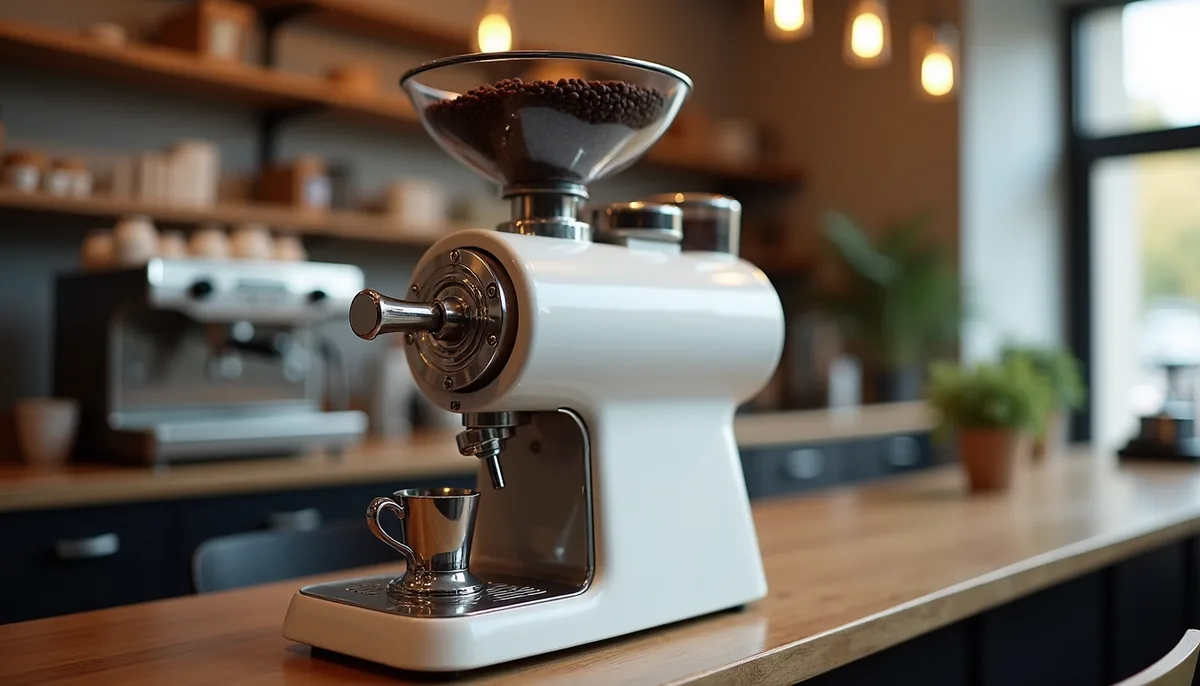
In short: The Eureka Atom W 65 is a quiet 65 mm flat burr grinder with a load cell built into the portafilter fork, so it grinds by weight rather than by time. Eureka quotes 0.2 g dose consistency. It suits cafés and busy home bars running one espresso blend, not single dosing.



| Burrs | 65 mm flat, hardened steel, 1,370 rpm |
|---|---|
| Dosing | Grind by weight (Instant Grind Weighing), 3 programmable doses plus continuous grinding; time mode available |
| Dose consistency | 0.2 g, according to Eureka |
| Motor and output | 280 W, 2.3 to 3.8 g per second, 1.2 kg hopper |
| Size and weight | 544 × 278 × 204 mm (H × W × D), 11.5 kg on the maker's spec sheet |
| Best for | small cafés, offices and households pulling several shots of the same coffee in a row |
Who is the Atom W 65 for?
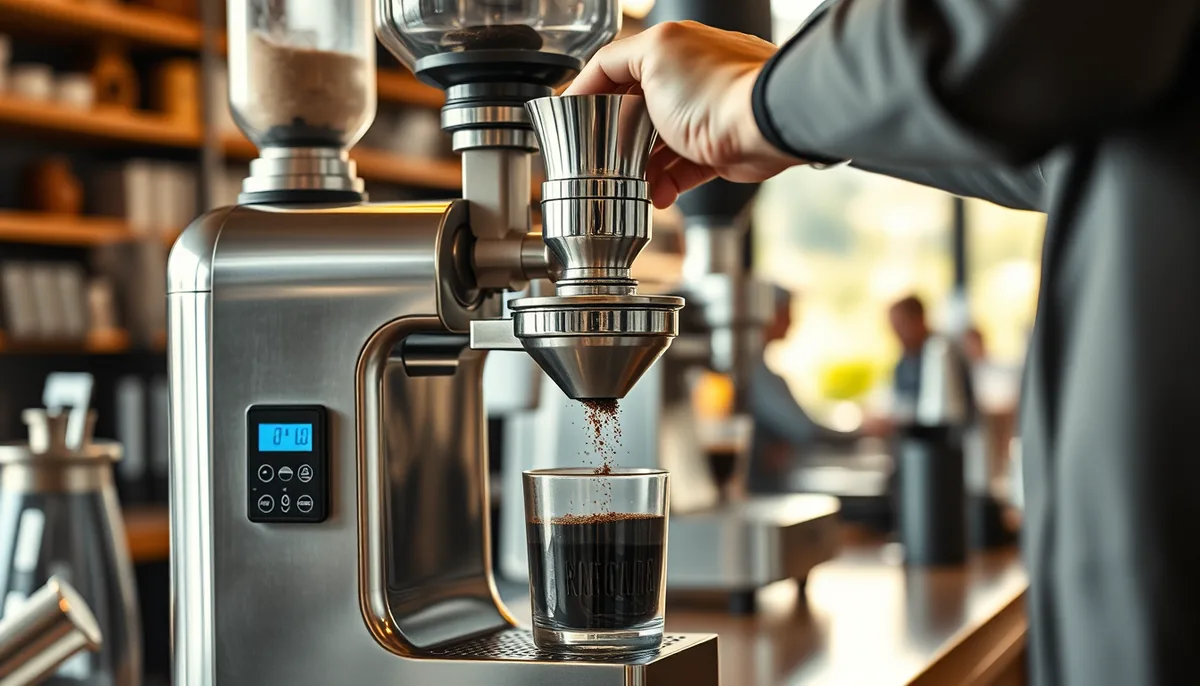
Eureka files the Atom W 65 under its commercial grinders. In plain terms it is an Atom 65 with a scale under the fork: you hook the portafilter on, the grinder tares itself, starts a couple of seconds later and stops when it hits your target weight. No weighing on a separate scale, no fiddling with grind time as the beans age.
It makes sense if you:
- pull several espressos or milk drinks a day from the same bag,
- make breakfast flat whites for three or four people back to back,
- want a grinder that is quiet enough for an open plan kitchen,
- run a small bar, an office coffee point or a coffee cart with a 58 mm portafilter.
It is the wrong tool if you swap beans every morning and weigh each dose by hand. The 1.2 kg hopper is not built for that, and more coffee stays inside than on a single dose grinder. With the big hopper fitted it stands over 54 cm tall, so measure the gap under your wall cupboards before you order.
How it works: burrs, scale and controls
Burrs and motor
The W 65 runs 65 mm hardened steel flat burrs at 1,370 rpm, drawing 280 W on UK and European 230 V mains. Eureka's product page lists 2.3 to 3.8 g per second; the user manual gives 2.8 to 3.3 g per second at 50 Hz. Either way, an 18 g double takes roughly six to eight seconds. Some retailers quote 430 W for the W 65, but that figure belongs to the larger Atom W 75 (and to 60 Hz or 110 V versions sold elsewhere).
Grind size is set with a stepless dial on top: clockwise is finer. Eureka's Silent Technology and the heavy steel body keep the noise down, and the ACE system is meant to cut clumping and static at the chute.
The scale: Instant Grind Weighing
The load cell sits in the fork. According to the manual:
- You get three weight presets plus continuous grinding while you hold the button.
- Grinding starts automatically once the portafilter is seated and stops at the target weight.
- For the next dose, lift the portafilter out, wait about two seconds and put it back.
- A knock on the fork or portafilter pauses grinding; tap the dose button to carry on.
- If the scale sees no weight gain, the grinder stops to protect the motor.
- Prefer time based dosing? Switch it in the menu. The home screen turns green instead of red.
Calibration with a reference weight is built into the menu. Eureka says you only need it when accuracy drifts, but owners recommend doing it once with your own portafilter on day one.
App, Wi-Fi, display
Eureka does not list an app, Wi-Fi or Bluetooth for the Atom W 65. Everything runs through the touchscreen: doses, a dose lock with a four digit password, shot counters per dose, brightness, standby, language and a burr replacement reminder.
Dialling in: from set-up to first shot
Start with the fork. It adjusts for height with two screws underneath, so set it to your portafilter first. Then calibrate the scale with that same portafilter and a weight you trust.
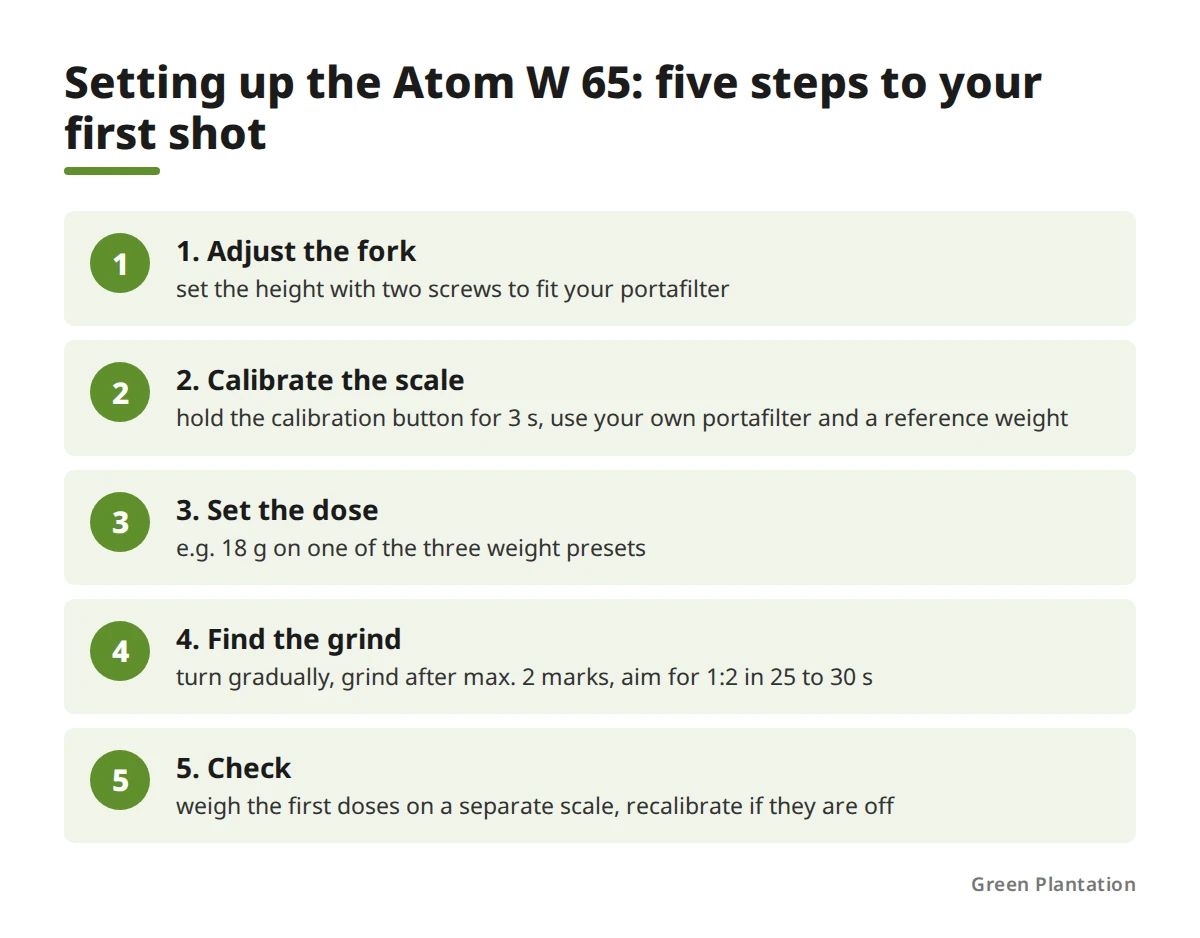
When you change the grind, the manual says to turn the dial gradually and grind a little after every two marks at most. A full turn with the motor stopped can jam the burrs. Owners on r/espresso add that the result settles only after about two doses, because grounds from the old setting are still sitting in the chamber.
A sensible starting recipe: 18 g in a double basket, about 36 g in the cup, 25 to 30 seconds at around 93 °C. Once the flow is right, leave the dose alone and only touch the grind. This is where grinding by weight earns its keep: as beans age and flow changes, the dose stays at 18.0 g and only the grind time moves, so you are chasing flavour rather than a moving target.
Mind the duty cycle in the manual: no more than 30 seconds of grinding, then 270 seconds of rest. That is irrelevant for espresso but rules out grinding half a kilo of filter coffee in one go. The W 65 is an espresso grinder, not an all rounder for cafetière or cold brew batches.
Cleaning and maintenance
- Hopper: wash at least once a week with water and mild soap, dry thoroughly, never in the dishwasher.
- Grinding chamber: with the hopper off, clean with a brush or dry cloth; a vacuum or compressed air helps. Grinder cleaning tablets are allowed.
- Chute: clumps and spray usually start with build-up at the chute and the anti-static area. Brush it out regularly, especially with dark, oily roasts.
- Burrs: Eureka says to check them every 500 kg and replace if worn. The menu keeps count for you.
Unplug before cleaning and take the portafilter off the fork. For a fuller routine covering both machine and grinder, see our guide on how to clean your coffee machine and grinder.
What owners report
UK reviews of the W 65 are thin on the ground, and most English language reviews come from US retailers. So we went through the international r/espresso forum via the Arctic Shift archive: 67 threads with "Atom W 65" in the title between April 2024 and October 2026 (deleted posts and threads only about the Casa version excluded), plus around 116 comments in eight detailed threads.
- 31 threads are buying advice, usually against the Fiorenzato AllGround Sense, Mahlkönig E64 WS or Mazzer Philos.
- 7 threads are positive owner reports: very quiet, heavy and solid, a fast workflow ("a latte in under three minutes"), accurate after one calibration.
- 8 threads are about grounds spraying past the portafilter and too little room for a dosing funnel under the chute. This is the most common complaint.
- 5 threads concern the scale: overdosing by 0.7 to 0.9 g, one unit about 1 g heavy, random pauses mid grind, and one case of wrong readings after 21 months.
- 2 threads report genuine faults (unit would not switch on; motor jamming almost daily, replaced by the retailer).
- The rest are questions about portafilter sizes, hopper height and retention.
The pattern is clear. Owners praise the low noise, the build and the workflow. The pain points are mess at the chute and, on some units, scale accuracy. Several owners fixed scale issues with a recalibration; one needed the display unit replaced under service. A German coffee blog measured the cheaper Atom W 65 Casa in September 2026: over 15 doses of 18 g the standard deviation was 0.21 g, with a range of 17.7 to 18.2 g. Good, but no better than well set time dosing. Those are Casa figures, not W 65 figures.
Weak spots and what to watch
- Spray at the chute: many owners fit a dosing funnel, but clearance between chute and portafilter is tight, so a low funnel (under 15 mm) fits best. If a new grinder sprays badly, check the chute and anti-static area first and contact the retailer.
- Check the scale: weigh your first doses on a separate scale. If they are consistently off, recalibrate with your own portafilter and an accurate reference weight.
- Retention: a hopper grinder keeps coffee in the chamber. One owner found 9.8 g plus residue after the last dose. When you change beans, purge two doses or use them for iced coffee.
- 51 to 54 mm portafilters: smaller portafilters from entry level machines often sit awkwardly in the fork. A 58 mm portafilter is the safe bet.
- Size: 11.5 to 13 kg (spec sheet and manual differ) and over 54 cm tall with the full hopper.
- Service: Eureka specifies maintenance by authorised technicians only. Ask before buying who handles warranty repairs. Your statutory rights under UK consumer law apply either way.
Atom W 65 vs the alternatives
| Model | Burrs | Dosing | Motor and output | Hopper | Best for |
|---|---|---|---|---|---|
| Eureka Atom W 65 | 65 mm flat, 1,370 rpm | by weight, 3 presets | 280 W, 2.3 to 3.8 g/s | 1.2 kg | cafés and heavy home use, one blend |
| Eureka Atom W 75 | 75 mm flat, 1,400 rpm | by weight, 3 presets | 430 W, 3.3 to 4.8 g/s | 1.2 kg | more throughput at busy times |
| Eureka Atom Excellence 65 | 65 mm flat, 1,370 rpm | by time, touchscreen | 280 W, 2.3 to 3.8 g/s | 1.2 kg | same platform without the scale |
| Eureka Mignon Libra 65 All Purpose | 65 mm flat, 1,350 rpm | by weight, 2 presets | 310 W | 350 g | home, espresso and filter |
| Eureka Mignon Zero 65 All Purpose | 65 mm flat | single dose, no hopper workflow | see product page | single dose | home baristas who switch beans daily |
Figures are the manufacturer's. Between the W 65 and W 75, owners mainly notice a double that grinds two to three seconds faster; the body and controls are identical. The Excellence 65 is the same grinder without the scale. If you want grind by weight in a smaller footprint, look at the compact Mignon Libra 65. If you change beans daily and care about low retention, the Eureka Mignon Zero 65 is the better match, as it is designed for single dosing. For the wider Mignon range, see our comparison of Eureka Mignon grinders, and if you are wondering about the Eureka coffee machine, our article on a century of Eureka grinders and their new espresso machines covers it.
Verdict
The Eureka Atom W 65 is a solid, very quiet 65 mm burr grinder that genuinely simplifies the routine at the machine: hook the portafilter on, wait, done. It shines wherever many shots come from the same beans, in a small café, an office or a household making several drinks every morning. Expect some calibration at the start, budget for a low dosing funnel and do not buy it as a single dose grinder. If you swap beans often, a single dose grinder will serve you better. For a broader look at commercial options, read how to choose a professional espresso grinder.
Eureka Atom W 65: frequently asked questions
How accurate is the Atom W 65 scale?
Eureka quotes 0.2 g dose consistency. Most owners report consistent doses after one calibration; a few units were 0.5 to 2 g out and needed recalibration or a service visit.
What is the difference between the Atom W 65 and the Atom W 65 Casa?
The Casa is the home version: according to Eureka 320 W, 1,350 rpm, two weight presets, a 300 g hopper, 10 kg and 48 cm tall. The W 65 has three presets, a 1.2 kg hopper and is built for all day café use.
Does the Atom W 65 have an app or Wi-Fi?
No, not according to Eureka. Doses, calibration and all settings are on the grinder's touchscreen.
Is the W 75 worth it over the W 65?
At home, hardly. The W 75 has 75 mm burrs and 430 W, and owners talk of a double ground two to three seconds faster. In a café with a morning rush the extra speed can pay off.
Can I grind filter coffee with the Atom W 65?
Occasionally, yes, the burrs open up far enough. But it is designed as an espresso grinder, and the duty cycle of 30 seconds on, 270 seconds off limits large batches.
How much coffee stays in the grinder?
Eureka gives no figure. One owner found just under 10 g plus residue in the chamber after the last dose. Plan to purge one or two doses when you change beans.
Recommended products
- Eureka Atom W 65 white: the grinder reviewed here, in a white finish that suits light counters and kitchens.
- Eureka Atom W 65 grey: identical tech in an understated grey colour.
- Eureka Atom W 75 black: for cafés that need more throughput and shorter grind times.
- Eureka Mignon Libra 65 All Purpose black: a compact grind by weight burr grinder for home espresso and filter.
- Eureka Mignon Zero 65 All Purpose black: the single dose choice if you change beans every day.
- Felicita Parallel digital scale black: for checking your first doses and weighing the shot in the cup.
To cross-check the grinder's scale against a separate espresso scale, see our guide on how to choose a barista scale.
Sources
- Eureka: Atom W 65 specifications (as of November 2026)
- Eureka: Atom W user manual, W 65/75 (PDF)
- Eureka: Atom W 75 specifications
- Eureka: Atom W 65 Casa specifications
- Arctic Shift: r/espresso archive, title search "atom w65"
Updated: November 2026
Author: Petra Novotná, editorial name of the Green Plantation.
You might also like
 Eureka Atom Pro review: experience, tech and limits of the 75 mm filter grinder
The Eureka Atom Pro is a filter grinder with 75 mm brew burrs and a Blow-Up bellows. Who it is worth it for, how to set it up and why it is not an espresso… 26. 11. 2026
 Eureka Costanza Review: HX Machine with PID, Costanza R and Owner Experiences
The Eureka Costanza is a compact E61 heat exchanger machine with PID and a shot timer. We clear up the dual boiler myth, explain how it differs from the… 26. 11. 2026
 Grind-by-Weight Coffee Grinders: Eureka Atom W 65, Atom W 75 or Mahlkönig E65S GbW? 2026 Comparison
Comparison of the Eureka Atom W 65, Atom W 75 and Mahlkönig E65S GbW grind-by-weight grinders: dose accuracy, speed, step-by-step calibration and a calculation… 26. 11. 2026