
 Česky (CZK)
 Slovensky (EUR)
 Magyar (HUF)
 Polski (PLN)
 English (EUR)
 Deutsch (EUR)
 Français (EUR)
 Español (EUR)
 Português (EUR)
 Italiano (EUR)
 Svenska (SEK)
 Suomi (EUR)
 Nederlands (EUR)
 Dansk (EUR)
 Lëtzebuergesch (EUR)
 Eesti (EUR)
 Latviešu (EUR)
 Lietuvių (EUR)
 Slovenščina (EUR)
 Română (RON)
 Български (EUR)
 Hrvatski (EUR)
 Ελληνικά (EUR)
 Українська (EUR)
 Norsk (EUR)
 Srpski (EUR)
 Tiếng Việt (EUR)
Immersion vs pour over: how drip and cafetière coffee really differ
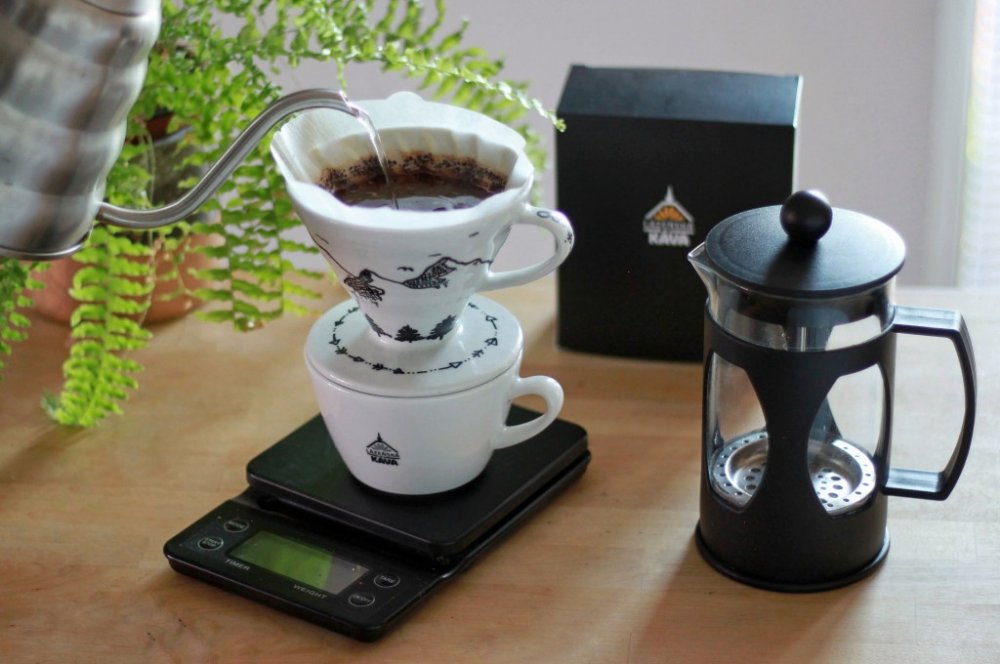
In short: Pour over (percolation) runs fresh water through a bed of coffee and usually gives a cleaner, brighter cup. Immersion steeps all the grounds in all the water, as in a cafetière, AeroPress or Clever Dripper, and gives more body with far less technique. Neither is better; the filter matters as much as the method.



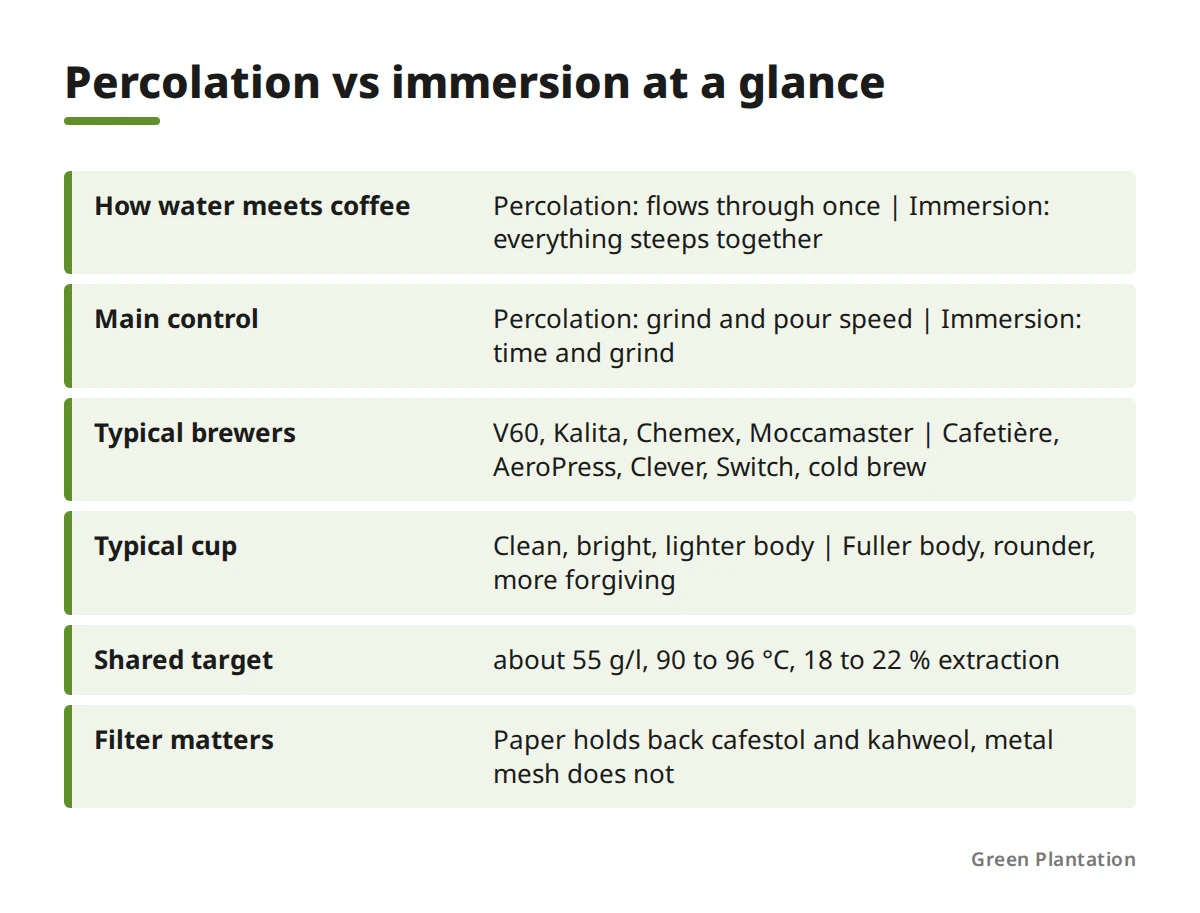
| Percolation (pour over, filter machine) | V60, Chemex, Kalita Wave, Moccamaster; water flows through the coffee |
|---|---|
| Immersion | Cafetière (French press), AeroPress, Clever Dripper, Hario Switch, cold brew |
| Starting ratio | about 55 g of coffee per litre of water (SCA reference, roughly 1:18) |
| Water temperature | 90 to 96 °C for hot brews (SCA range) |
| Target extraction | 18 to 22 % of the coffee dissolved (classic Brewing Control Chart) |
| Paper vs metal filter | paper holds back the oily diterpenes cafestol and kahweol; a metal mesh lets them through |
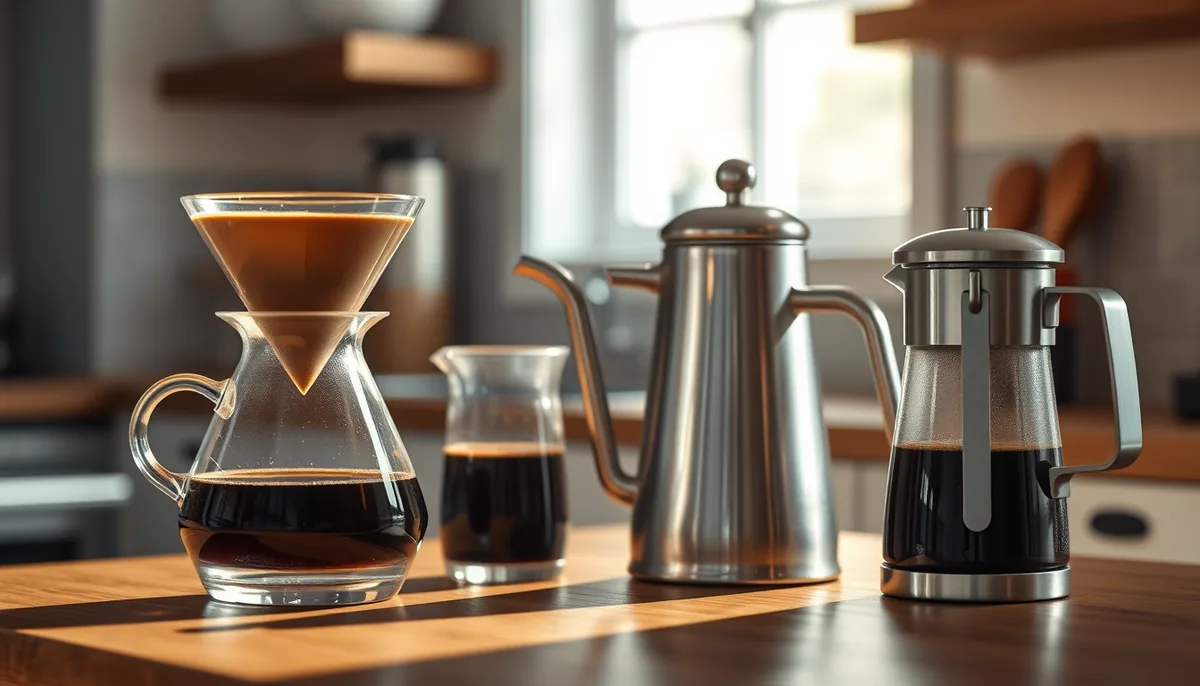
Percolation and immersion: the actual difference
Every brewer you can buy falls into one of two families, and the split is about how water meets coffee, not about the shape of the gadget.
Percolation means water passes through the coffee bed once and leaves. With a V60, Chemex, Kalita Wave or a filter machine such as a Moccamaster, fresh hot water keeps arriving at the top while brewed coffee drips out of the bottom. Because the water touching the grounds is always fairly clean, it keeps pulling flavour out efficiently. The catch is that you control contact time indirectly, through grind size, pouring speed and how evenly the water moves through the bed.
Immersion means all the water and all the coffee sit together for a set time, then you separate them. In a cafetière you press a mesh plunger, in an AeroPress you push through a paper disc, in a Clever Dripper or Hario Switch you open a valve and let it drain through paper. As the water becomes more concentrated, extraction slows down, so immersion is more forgiving: a minute too long changes the cup less than a badly channelled pour over.
The old idea that "drip coffee" is the gentle one and "infused coffee" is the strong one is too simple. You can brew a thin, tea-like immersion and a heavy, syrupy pour over. What really separates the cups you drink at home is usually the filter: paper or metal.
Recipes side by side
These are sensible starting points that baristas use, not laws. Adjust one variable at a time, and change the grind first. If you are unsure what "medium-fine" looks like, our guide to grind size and how to adjust it has photos.
| Method | Family | Coffee : water | Grind | Total time | Water | Filter |
|---|---|---|---|---|---|---|
| Hario V60 | Percolation | 15 g : 250 g | medium-fine | 2:30 to 3:30 | 92 to 96 °C | thin paper |
| Kalita Wave 185 | Percolation | 20 g : 320 g | medium | 3:00 to 4:00 | 92 to 96 °C | paper, flat bed |
| Chemex 6 cup | Percolation | 30 g : 500 g | medium-coarse | 4:00 to 5:00 | 93 to 96 °C | thick bonded paper |
| Filter machine (Moccamaster) | Percolation | 55 to 60 g per litre | medium | set by the machine | set by the machine | paper, size 4 |
| Cafetière (French press) | Immersion | 30 g : 500 g | coarse | 4 min steep, then settle | just off the boil | metal mesh |
| Clever Dripper / Hario Switch | Immersion, paper drain | 20 g : 320 g | medium | 2 to 3 min steep + 1 min drain | 92 to 96 °C | paper |
| AeroPress (official recipe) | Immersion, pressed | 16 to 18 g to the "4" mark | medium | 60 s steep, gentle press | 85 °C | paper disc |
| Cold brew | Immersion, cold | about 1 : 8 for concentrate | coarse | 12 to 24 h in the fridge | cold | paper or cloth |
The ratios cluster around the Specialty Coffee Association reference of 55 g of coffee per kilogram of water, roughly 1:18. Cafetière and Clever recipes often run a little stronger, around 1:16, because many people drink them with milk. The AeroPress line comes from the manufacturer's own Signature recipe, which uses cooler water and a short steep.
How the cup tastes, and why
Pour over through paper tends to taste clean and transparent. Acidity reads as fruit rather than sourness, and floral or tea-like notes in light roasts come through clearly. The V60's large single hole and spiral ribs make it quick and sensitive to your pouring. The Kalita's flat bed and three small holes slow the flow and forgive an uneven pour, which is why it often tastes sweeter and rounder in less practised hands. The Chemex uses a heavy bonded paper that traps more oils and fines than other filters, so it gives the lightest body of the three, not the "most intense" cup it is sometimes credited with.
A cafetière gives weight, texture and a slightly gritty finish, because the mesh lets oils and very fine particles into the cup. That is exactly what people love about it with chocolatey, nutty or darker roasts, and what they dislike if they want clarity.
Paper-filtered immersion (Clever Dripper, Hario Switch, AeroPress) sits in between: the even, forgiving extraction of steeping, with the clean finish of paper. For many home brewers this is the best of both worlds. We cover the Clever step by step in Clever Dripper and its preparation.
Extraction numbers: the Brewing Control Chart
Coffee professionals describe a brew with two numbers. Strength is the percentage of dissolved solids in the cup (TDS), measured with a refractometer. Extraction is how much of the dry coffee ended up dissolved. The classic Brewing Control Chart, which goes back to the 1950s, puts the "ideal" zone at 18 to 22 % extraction and 1.15 to 1.35 % strength; European charts aim slightly stronger.
Both families can land in that zone. The difference is how you get there:
- Pour over: extraction is mainly steered by grind and flow. A drawdown that stalls usually means too fine or too many fines; a cup that tastes hollow and sour usually means the water ran through too fast.
- Immersion: extraction is mainly steered by time and grind, and agitation matters less. Under-extracted immersion tastes thin; over-extracted immersion tastes dry and bitter, especially if you leave it sitting on the grounds.
Research from UC Davis published in 2023 rebuilt the chart from sensory panels and consumer tests on drip-brewed coffee. It found that sweetness tends to peak at lower strength and extraction, bitterness at higher values, and that consumers split into two preference groups with different likes. The "golden" box is a reference point, not a verdict on your taste.
Paper vs metal: cafestol and kahweol
This is the one difference with a health angle, and it is well documented. Coffee beans contain the oily diterpenes cafestol and kahweol, about 1 % of the bean by weight. Hot water extracts them, but a paper filter holds them back. In their review, Urgert and Katan explain that this is why paper-filtered coffee did not affect blood cholesterol in studies, whereas Scandinavian boiled coffee, cafetière coffee and Turkish coffee did raise it.
So the relevant question is not percolation versus immersion, but paper versus no paper. A Clever Dripper or AeroPress with a paper disc behaves like filter coffee here; a cafetière, a metal pour over cone or a metal AeroPress disc does not. The authors suggest that people at higher risk of heart disease who drink a lot of coffee choose low-diterpene brews. If that applies to you, talk to your GP; nothing here is medical advice. For taste differences between paper, cloth and metal, see cloth, metal or paper coffee filters compared.
Which method suits you?
| If you want… | Choose | Why |
|---|---|---|
| Clarity and acidity from light roasts | V60 or Kalita Wave | fast percolation through paper, full control |
| Body and texture, often with milk | Cafetière | metal mesh keeps oils and fines in the cup |
| Consistent results with no pouring skill | Clever Dripper or Hario Switch | steep like a cafetière, drain through paper |
| A jug for the household or office | Moccamaster filter machine | repeatable percolation at the right temperature |
| Travel and single cups | AeroPress | short immersion, paper filter, hard to break |
| Iced coffee in summer | Cold brew | long cold immersion, low perceived acidity |
If your mornings are rushed, immersion wins: weigh, pour, set a timer and walk away. If brewing is part of the pleasure, a pour over rewards attention. And if several people want coffee at once, a good filter machine is simply a well-engineered pour over; read how to choose and use a Moccamaster before buying.
Common mistakes in each family
- Leaving coffee on the grounds. A pressed cafetière keeps extracting. Decant everything into a jug or mugs as soon as it is ready.
- Plunging hard and early. Let the grounds settle for a few minutes after breaking the crust, skim the foam, then press gently or barely at all. You will get much less sludge.
- Uneven pour over beds. Pour in slow spirals, give the brewer a gentle swirl after the bloom, and avoid pouring straight down the paper walls, where water bypasses the coffee.
- Skipping the rinse. Rinse paper filters with hot water first; it removes papery taste and warms the brewer.
- Blade grinders. Both families need an even grind; percolation punishes fines and boulders most. A decent burr grinder improves a cheap brewer more than the other way round.
Cold brew deserves its own recipe; ours is in how to make cold brew.
FAQ
Is pour over better than a cafetière?
Not better, different. Pour over through paper gives a cleaner, brighter cup; a cafetière gives more body and texture. Choose by the flavour you like and how much time you want to spend.
Is AeroPress immersion or pour over?
Immersion. The coffee steeps with all the water in the chamber, then you press it through a paper or metal disc. The official recipe uses 16 to 18 g, water at 85 °C and a 60 second steep.
Does immersion coffee have more caffeine?
Not inherently. Caffeine dissolves easily, so the dose of coffee and the size of the drink matter far more than the method. A strong cafetière mug and a large filter jug can contain similar amounts.
Is cafetière coffee bad for cholesterol?
Unfiltered methods, including the cafetière, let cafestol and kahweol into the cup, and studies reviewed by Urgert and Katan link these diterpenes to higher blood cholesterol. Paper-filtered coffee did not show this effect. If you are concerned, use a paper filter and ask your GP.
What is the 80/20 rule for coffee?
It is not a formal standard. People use it in different ways, for example saying that grind and fresh beans account for most of the result. The useful version: get the grind and ratio right before buying a new brewer.
Clever Dripper or V60 for a beginner?
The Clever. It uses the same kind of paper filter but takes pouring technique out of the equation, so your results are repeatable from day one. Move to a V60 when you want more control.
Recommended equipment
- Clever Dripper L 530 ml – the easiest route into immersion with a paper filter; makes two cups and drains straight into a mug or jug.
- Kalita WDG-185 pour over set – glass flat-bottom dripper, server and filters in one box; the most forgiving way into percolation.
- Hario Buono gooseneck kettle – a narrow spout is what makes a slow, even pour over possible.
- Comandante C40 MK4 – a hand grinder with a very even grind from fine filter to coarse cafetière, the single upgrade that helps both families.
- Espro French Press 530 ml – a double micro-filter cuts the sediment that puts many people off the cafetière.
- Moccamaster KBG Select – an SCA-certified filter machine for full jugs, with a half-jug setting for smaller batches.
Sources
- SCA Standard 310-2021 (brewing ratio and temperature)
- SCA News: Coffee Decoded – The Science of Dialling-In
- Frost, Ristenpart, Guinard et al.: A new Coffee Brewing Control Chart, Journal of Food Science 2023
- Urgert, Katan: The cholesterol-raising factor from coffee beans, Annual Review of Nutrition 1997
- AeroPress: How to use (official recipe)
Updated: November 2026
Author: Petra Novotná, editorial name of the Green Plantation.
You might also like
 Filter coffee vs espresso (and moka pot): differences, caffeine and when filter makes sense
Espresso, moka pot and filter coffee compared with real numbers: doses, pressure, dissolved solids and caffeine per cup. Plus when filter coffee makes sense… 26. 11. 2026
 Moka pot on an induction hob: why aluminium won't work, what to choose and when an electric one makes sense
Why an aluminium moka pot won't work on induction, how to spot an induction-ready moka pot, what an adapter plate can do and how to set the power so your… 26. 11. 2026
 Toddy Pro Series 20 review: yield planning for high-volume cold brew
The Toddy Pro Series 20 makes about 38 litres of cold brew concentrate per batch. Here is how that translates into daily serves, when it beats two smaller… 24. 11. 2026