Česky (CZK)
 Slovensky (EUR)
 Magyar (HUF)
 Polski (PLN)
 English (EUR)
 Deutsch (EUR)
 Français (EUR)
 Español (EUR)
 Português (EUR)
 Italiano (EUR)
 Svenska (SEK)
 Suomi (EUR)
 Nederlands (EUR)
 Dansk (EUR)
 Lëtzebuergesch (EUR)
 Eesti (EUR)
 Latviešu (EUR)
 Lietuvių (EUR)
 Slovenščina (EUR)
 Română (RON)
 Български (EUR)
 Hrvatski (EUR)
 Ελληνικά (EUR)
 Українська (EUR)
 Norsk (EUR)
 Srpski (EUR)
 Tiếng Việt (EUR)



Why Your Kettle Decides Your Pour Over
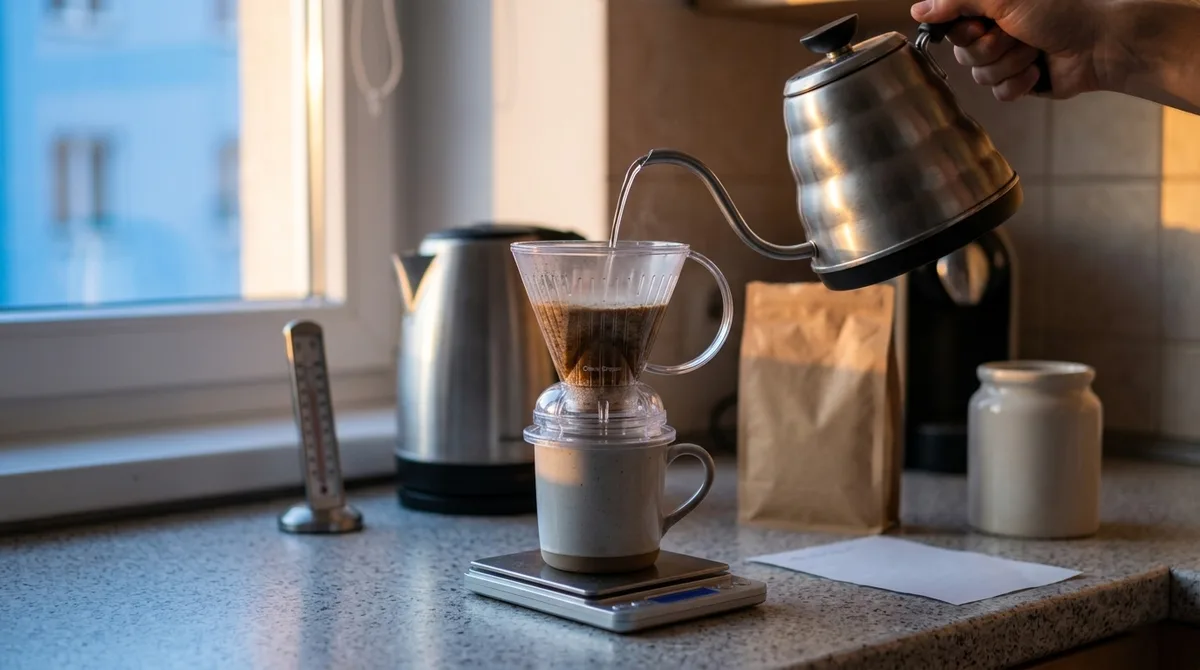
During pour over brewing (V60, Chemex, Kalita Wave), water is your only tool to influence extraction in real time. You don't have pressure like espresso, you don't have immersion like French press. You only have water – its temperature, stream, speed, and direction. And these four parameters are completely in the hands of the kettle you're holding.
A standard electric kettle with a wide spout opening produces an uncontrollable stream that hits the coffee bed with too much force and disperses unpredictably. The result is uneven extraction – some parts of the bed are over-extracted and bitter, others under-extracted and sour.
A gooseneck kettle solves exactly this problem. The narrow, curved spout allows you to precisely control the stream speed, direction, and volume. It's the difference between painting with a fine brush and watering a garden with a hose – the same water, completely different results.
Why Gooseneck for Pour Over
Flow Control
The most essential advantage of a gooseneck kettle is precise flow control. The narrow spout with its long neck limits maximum flow rate and allows you to smoothly regulate intensity – from a thin stream to a medium flow – with a simple wrist movement.
Why it matters:
- Bloom phase (first 30–45 seconds) requires a slow, gentle stream that evenly saturates the entire coffee bed without creating puddles. Proper bloom releases CO2 and prepares the coffee for even extraction.
- Main pour requires an even, circular motion at medium speed from center to edge – so-called agitation, which keeps the bed in motion and prevents channeling.
- Final pour requires precise dosing – every extra gram of water changes the extraction ratio.
With a standard kettle, the bloom phase is practically impossible to control – the stream is too strong and breaks the surface of the bed before CO2 is released. With a gooseneck kettle, the entire process feels natural and intuitive.
Precision of Direction
The long neck of a gooseneck kettle directs water exactly where you want it. The stream lands on the bed in a narrow, controlled point that you can move in concentric circles from center to edge and back. This spatial control is essential for pour over methods – extraction depends directly on whether every part of the coffee bed receives the same amount of water at the same time.
Consistent Pouring Height
The ideal pouring height is 3–5 cm above the surface of the coffee bed. Too high a drop causes turbulence and uneven contact between water and coffee. With a standard kettle, maintaining this height is difficult – the short spout forces you into uncomfortable wrist angles. A long gooseneck neck allows you to maintain a comfortable, stable wrist position throughout the entire pour.
Types of Kettles – Overview
Gooseneck Electric with Variable Temperature
The most sophisticated and practical category for home baristas. An electric heater with precise temperature setting (usually in 1°C increments within a 40–100°C range), a hold function (maintaining set temperature), and a gooseneck spout all in one device.
Advantages:
- Precise temperature – set it to 92°C and the kettle stops at exactly that point, not at 100°C with subsequent cooling
- Hold function – maintains temperature for 30–60 minutes, essential when brewing multiple cups in succession
- Fast heating – most models heat 0.9 l in 3–5 minutes
- Complete flow control thanks to the gooseneck spout
Disadvantages:
- Highest price in the category
- Requires an electrical outlet
- Not suitable for travel without an adapter
Gooseneck Stovetop (for Stove)
A classic kettle with a gooseneck spout but no built-in heater – it heats on gas, induction, or electric cooktops. For many baristas, this is the ideal compromise between price and functionality.
Advantages:
- Significantly lower price
- No electronics – minimal chance of failure
- Portable for travel with camping stove
- Long lifespan with proper care
Disadvantages:
- No integrated temperature control – external thermometer or temperature probe required
- No hold function – water cools quickly after removing from heat, complicating multiple cups
- Slower heating compared to electric models
Electric Kettle (Standard)
A standard electric kettle with a wide spout opening. It heats water quickly and efficiently, but is practically unusable for pour over.
Advantages:
- Lowest price
- Fastest heating (1.5–2 l in 3–5 minutes)
- Large capacity for household use
- Universal use – tea, instant meals, blanching
Disadvantages:
- No flow control – unsuitable for pour over
- Usually no temperature setting (some premium models have presets)
- Coarse, uncontrollable stream doesn't allow gentle pouring
Comparison Table: Gooseneck vs Electric
| Parameter | Gooseneck Electric | Gooseneck Stovetop | Electric Kettle |
|---|---|---|---|
| Flow Control | Excellent | Excellent | None |
| Temperature Control | Precise (1°C increments) | None (thermometer) | None / basic presets |
| Hold Function | Yes (30–60 min) | No | No (some models yes) |
| Volume | 0.6–1.2 l | 0.7–1.2 l | 1.0–1.7 l |
| Heating Time (1 l) | 3–5 min | 5–8 min | 3–4 min |
| Price | 60–170 EUR | 25–60 EUR | 15–50 EUR |
| Suitable for Pour Over | Ideal | Very good | Unsuitable |
| Suitable for French Press | Yes (precise temperature) | Yes | Yes |
| Travel | No | Yes | No |
You can find water kettles in the Water Kettles section. Gooseneck models in the Gooseneck Kettle section. Electric kettles in the Electric Kettles section.
Top Models – Recommendations by Budget
Fellow Stagg EKG – Premium Choice
The Fellow Stagg EKG is the reference gooseneck kettle that practically defined the premium kettle category for home baristas and remains one of the best-selling models even in 2026. It combines iconic design with technical precision and exceptional flow control.
- Volume: 0.9 l (30 oz)
- Temperature: Adjustable in 1°C increments (57–100°C)
- Hold: Up to 60 minutes at set temperature
- Power: 1,200 W, heats 0.9 l in ~4 minutes
- Display: LCD on base shows current and target temperature simultaneously
- Material: Stainless steel 304
- Flow: Slow and very precisely controllable – ideal for gentle bloom and slow, focused pour
- Price: 130–170 EUR
For whom: Pour over enthusiasts who demand maximum control, repeatability, and a design that holds its own at a coffee bar. The slow stream is an advantage for V60 and Chemex; for more aggressive pouring (AeroPress, Kalita Wave with quick recipes), it may feel limiting.
Brewista Artisan – Powerful Alternative
The Brewista Artisan is a direct Fellow Stagg competitor with faster flow and comparable functionality. Popular among baristas working with variable recipes requiring different pouring speeds.
- Volume: 0.6 l or 1.0 l
- Temperature: Adjustable in 1°C increments
- Hold: Yes
- Material: Stainless steel
- Flow: Medium-fast – noticeably faster than Fellow Stagg, but still fully controllable
- Price: 80–120 EUR
For whom: Baristas who value a wider range of speeds – from gentle bloom to more aggressive pouring with Kalita Wave or AeroPress. Faster flow also makes filling larger volumes easier during batch brewing.
Hario Buono – Proven Classic (Stovetop)
The Hario V60 Buono is a Japanese classic among stovetop gooseneck kettles. Proven neck design, reliable construction, and excellent flow control for a relatively low price – which is why it remains the first choice for many beginning pour over enthusiasts.
- Volume: 1.0 l or 1.2 l
- Temperature: No integrated control (stovetop)
- Material: Stainless steel
- Compatibility: Gas, electric, induction (VKB model)
- Flow: Medium-fast, smooth and predictable
- Price: 30–50 EUR
For whom: Those who have an external thermometer and don't need an electric kettle. Ideal as a first gooseneck kettle – low price, proven design, and long lifespan with normal use.
Timemore Fish – Budget Choice (Stovetop)
The Timemore Fish is an affordable gooseneck kettle from a renowned coffee accessory manufacturer, known primarily for quality grinders. Minimalist design and functional neck at the lowest price in the category.
- Volume: 0.6 l or 0.9 l
- Temperature: No integrated control (stovetop)
- Material: Stainless steel
- Flow: Good, slightly faster than Hario Buono
- Price: 25–40 EUR
For whom: Beginners in pour over who want a quality gooseneck kettle from an established manufacturer at minimal investment. A good choice if you want to try the method first before investing in an electric model.
Water Temperature for Different Methods
Correct water temperature is equally important as flow control. Water that's too hot over-extracts coffee – resulting in bitterness and harshness. Water that's too cool under-extracts – resulting in sour, unimpressive flavor. Each method and roast level has different optimal ranges.
| Method | Recommended Temperature | Note |
|---|---|---|
| V60 Pour Over | 90–96°C | Light roast: higher temperature; dark roast: lower temperature |
| Chemex | 92–96°C | Thicker filter slows flow and compensates for higher temperature |
| Kalita Wave | 90–94°C | More even flow thanks to flat-bottomed dripper |
| AeroPress | 80–96°C | Wide range – depends on specific recipe and extraction time |
| French Press | 92–96°C | Long extraction (4 min) at lower temperature may under-extract |
| Cold Brew | Room temperature / iced | Extraction without heat – 12–24 hours |
| Cupping | 93°C | International SCA standard for coffee evaluation |
Practical tip: If you don't have a variable temperature kettle, let water sit in an open kettle for 45–60 seconds after boiling (100°C) – the temperature will drop to approximately 92–94°C. Exact temperature drop depends on water volume, kettle material, and room temperature. For repeatable results, an external thermometer or temperature probe is recommended.
Other Things to Consider When Choosing
Volume
The kettle's volume directly affects comfort during brewing and physical control while pouring:
- 0.6 l – suitable for 1–2 cups of pour over. The kettle is light and easy to handle, but for more cups you need to refill water and wait for reheating.
- 0.9–1.0 l – optimal compromise. Enough water for 2–3 cups, weight still comfortably manageable with one hand even at the end of pouring.
- 1.2 l – suitable for batch pour over or larger households. A full kettle is noticeably heavier, which may negatively affect precision and comfort during longer pouring.
Handle and Ergonomics
Handle ergonomics are subjective but critical. The entire pour over takes 2–4 minutes – during this time you hold the kettle in one hand in a slight forward lean. The handle must be comfortable, non-slip, and heat-insulated so you can focus on pouring, not hand fatigue. The Fellow Stagg EKG has an ergonomic handle with rubber non-slip surface; the Hario Buono has a traditional wood-plastic combination handle. Ideally, physically test the kettle before purchase – the feel in your hand is individual.
Base Stability (Electric Models)
For electric kettles, base stability is both a safety and practical priority. Kettles are lifted and placed dozens of times daily – the base must be non-slip and the connection with the kettle secure. Quality models have rubber feet and a sufficiently heavy base that doesn't move when removing the kettle with one hand.
Frequently Asked Questions (FAQ)
Do I need a gooseneck kettle for French press?
No – French press doesn't require water direction or flow control. Water is poured directly onto coffee and left to steep for 4 minutes without further intervention. However, if you have an electric gooseneck kettle with variable temperature, you'll appreciate precise setting to 93–95°C, which improves consistency and repeatability compared to temperature guessing.
Can I make pour over with a standard electric kettle?
Technically yes – but the result will be inconsistent and the process frustrating. The strong stream from a standard kettle hits the bed with large kinetic energy, creates "craters," tears the coffee surface, and causes channeling (where water takes the easiest path instead of passing evenly through). For serious and repeatable pour over, a gooseneck is a necessity, not a luxury.
Fellow Stagg or Brewista Artisan – which to choose?
It depends on your pouring style and preferred methods. The Fellow Stagg EKG has a slower, gentler stream – ideal for V60, Chemex, and slow, controlled pouring in the Japanese style. The Brewista Artisan offers faster stream with greater range of control – better for variable recipes, Kalita Wave, and AeroPress. Both models are excellently made. If you're unsure, the Fellow Stagg is the safer choice for beginners – with its slower stream, you'll hardly go wrong with technique.
Is a kettle with variable temperature worth it?
For regular pour over enthusiasts, absolutely. Precise temperature is one of the key extraction parameters – the difference between 92°C and 96°C is clearly noticeable in the cup, especially with light specialty roasts. The hold function adds further comfort – you don't need to rush and temperature stays stable even when brewing multiple cups in succession. For occasional pour over, a stovetop gooseneck combined with an external thermometer is sufficient.
How much should I invest in a kettle?
For beginners, a stovetop gooseneck at 25–50 EUR (Hario Buono, Timemore Fish) is an ideal start – it lets you learn pouring technique without major investment. If you know pour over will be your primary brewing method and you value comfort and consistency, an electric gooseneck with variable temperature at 80–170 EUR is worth it. A standard electric kettle for pour over simply won't work – it's not a matter of price, but physical properties of the spout.
Sources
- Coffee Chronicler. "Gooseneck Kettles for Home-Baristas – My Favorite" – coffeechronicler.com
- Creators of Coffee. "The Best Electric Gooseneck Kettle (2026 Reviews)" – creatorsofcoffee.com
- Homegrounds. "Best Gooseneck Kettles in 2025" – homegrounds.co
- The Coffee Folk. "Best Gooseneck Kettle of 2025" – thecoffeefolk.com
- Fellow Products. "Compare Stagg EKG Kettles" – fellowproducts.com
- Rogue Wave Coffee. "How To Choose A Gooseneck Kettle" – roguewavecoffee.ca