
 Česky (CZK)
 Slovensky (EUR)
 Magyar (HUF)
 Polski (PLN)
 English (EUR)
 Deutsch (EUR)
 Français (EUR)
 Español (EUR)
 Português (EUR)
 Italiano (EUR)
 Svenska (SEK)
 Suomi (EUR)
 Nederlands (EUR)
 Dansk (EUR)
 Lëtzebuergesch (EUR)
 Eesti (EUR)
 Latviešu (EUR)
 Lietuvių (EUR)
 Slovenščina (EUR)
 Română (RON)
 Български (EUR)
 Hrvatski (EUR)
 Ελληνικά (EUR)
 Українська (EUR)
 Norsk (EUR)
 Srpski (EUR)
 Tiếng Việt (EUR)
Bean to Cup Coffee Machine for the Office: Saeco Magic B1 vs Magic B2+ vs Royal OTC
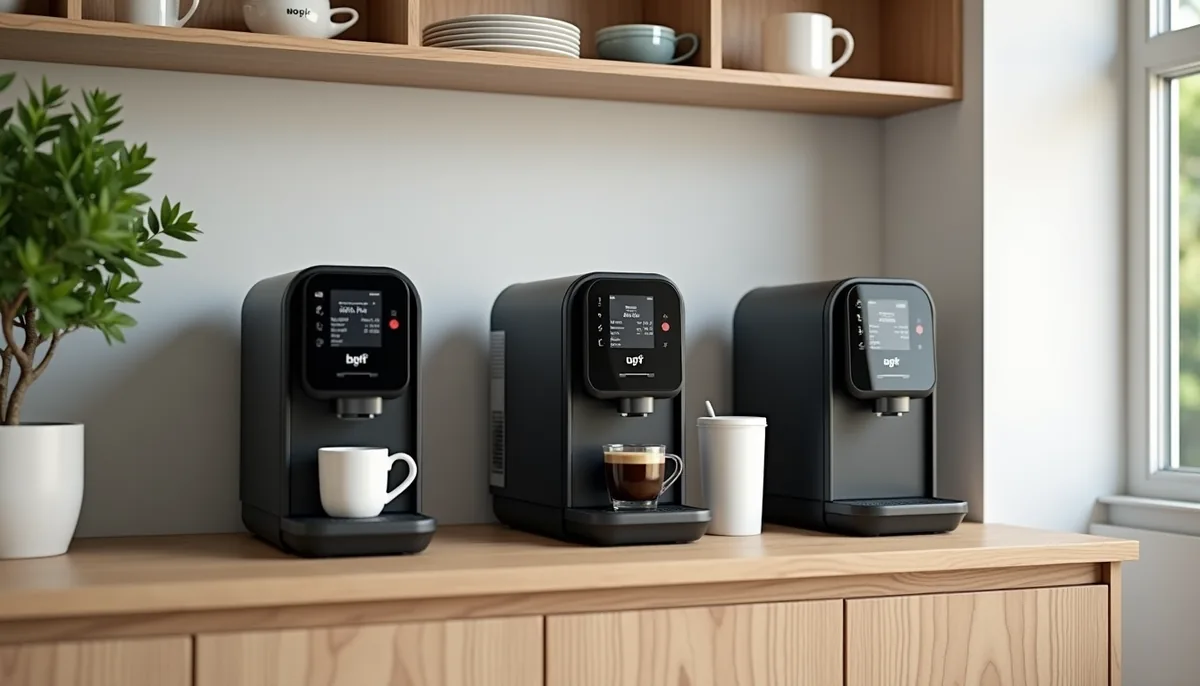
In short: If your team mostly drinks black coffee, the Saeco Magic B1 is the lean choice for a small office and the Magic B2+ is the one for higher throughput, with a plumbed-in option. If lots of people want cappuccino, go for the Royal OTC, but only with a fixed cleaning rota for the milk system.



| Magic B1 | no milk system, 2.5 l tank, 600 g bean hopper, 30 grounds, 1,300 W |
|---|---|
| Magic B2+ | no milk system, 4 l tank, 1.2 kg bean hopper, 30 grounds, plumbed-in via 3/4" connection possible |
| Royal OTC | one-touch cappuccino from fresh milk, 2.5 l tank, 600 g beans, 18 grounds, 1,400 W |
| Cups per day | not stated by the manufacturer; in practice the tank, hopper and grounds bin set the limit |
| Cleaning | B1 and B2+ a few minutes a week, Royal OTC also a daily milk clean |
| Service | Saeco Professional (Evoca Group), not Philips domestic customer care |
The three contenders at a glance
All three come from Saeco Professional, the commercial arm of Italy's Evoca Group, and share little but the badge with Philips Saeco home machines: different brew units, parts and service.
- Saeco Magic B1: a compact bean to cup machine for espresso, coffee and hot water, no milk system, 7-inch touchscreen, user profiles and an MDB payment interface.
- Saeco Magic B2+: the same brew unit and controls as the B1, but with a 4-litre tank, a bean hopper twice the size with a lockable lid, and the option of a plumbed-in water supply.
- Saeco Royal OTC: the Royal from the current range launched in 2021 (type 9J0080), with One Touch Cappuccino: cappuccino and latte macchiato from fresh milk at the press of a button.
The real question is how many people drink what, whether there is water nearby, and who will do the cleaning.
Specifications side by side
All figures are as stated by the manufacturer in the Saeco Professional datasheets and user manuals.
| Feature | Magic B1 | Magic B2+ | Royal OTC |
|---|---|---|---|
| Milk drinks | no | no | yes, one touch from fresh milk |
| Water | 2.5 l tank | 4 l tank, plumbed-in 3/4" (1.5–8 bar) possible | 2.5 l tank |
| Bean hopper | 600 g | 1.2 kg, lockable | 600 g |
| Grounds drawer | 30 pucks | 30 pucks | 18 portions |
| Coffee dose per drink | 8.5–15 g | 8.5–15 g | 6–10 g |
| Grinder | steel conical burrs, 8 settings, manual adjustment | ||
| Power | 1,300 W | 1,300 W | 1,400 W |
| Dimensions (W × H × D) | 280 × 435 × 481 mm | 280 × 470 × 481 mm | 280 × 398 × 460 mm |
| Weight | approx. 12.8 kg | approx. 13.8 kg | approx. 10.5 kg |
| Controls and payment | 7-inch touchscreen, profiles, MDB | 7-inch touchscreen, profiles, MDB, ready for Saeco Pro.Up | one touch for cappuccino and latte macchiato |
Note the brew chamber: the Magic models take up to 15 g of coffee, the Royal up to 10 g, which matters for the large, strong mugs offices pour. The Royal is lower and fits more easily under wall cupboards; the B2+ needs 47 cm plus clearance to fill the hopper.
How many staff, how many cups a day?
Saeco Professional does not publish a recommended daily output for any of the three. Figures such as "30 cups a day" come from resellers. What matters is how often someone has to step in, and that follows from the container sizes. The figures below are our own calculation from the manufacturer's capacities, not a manufacturer rating.
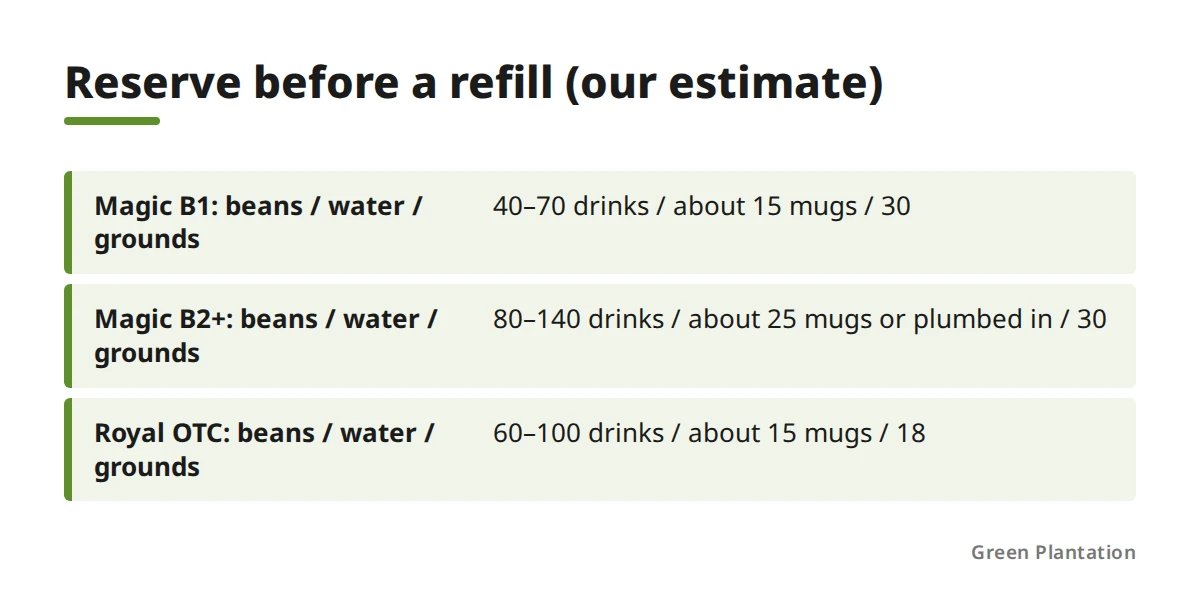
| Reserve before a refill (our estimate) | Magic B1 | Magic B2+ | Royal OTC |
|---|---|---|---|
| Beans | 40–70 drinks | 80–140 drinks | 60–100 drinks |
| Water, mugs of around 150 ml | about 15 mugs | about 25 mugs, unlimited when plumbed in | about 15 mugs, milk saves a little water |
| Empty the grounds drawer after | 30 drinks | 30 drinks | 18 drinks |
The water figures ignore rinse water at switch-on and switch-off. For planning:
- Up to about 8 people, two coffees each a day, so 15–20 drinks: the B1 and the Royal OTC manage with one tank refill mid-morning and one grounds empty in the afternoon.
- 8 to 15 people, 20–30 drinks: the B1 needs refilling two or three times a day, and the Royal OTC needs its 18-portion grounds drawer emptied several times. This is where the B2+ earns its place.
- Well over 30 drinks a day: with the B2+ the 30-puck grounds drawer becomes the bottleneck, not the brewing. At that volume it is worth looking at commercial machines built for catering.
Most UK buying guides skip this sum, yet it decides whether colleagues love the machine or curse it.
Plumbed-in vs tank
Only the Magic B2+ can be plumbed in; the B1 and Royal OTC cannot, not even as a retrofit. Per the manual:
- You need a cold-water tap with a 3/4-inch thread, a hose certified to IEC 61770 and a mains pressure of 1.5 to 8 bar.
- The connection is made by a technician or the service partner. Plumbed-in mode is switched on in the password-protected technician menu.
- The tank stays in the machine when plumbed in and acts as a buffer. A solenoid valve refills it as soon as the level drops below the minimum.
The version we stock is the B2+ tank-mounted, without a direct water connection. In tank mode it is simply a machine with a 4-litre tank. If your kitchen gets a supply later, budget for a technician to convert it, and ask beforehand whether a filter is needed in the supply line. In the UK, have the installer confirm that the hose and fittings meet local water fittings rules, including backflow protection. One owner of the sister M2+ reported a "Not Allowed" error after switching to mains water that needed a technician login to clear: a single case, but not a job for the office manager.
If the coffee point is far from a sink or the premises are rented, the tank is easier. Plumbing in pays off beyond one or two tanks a day.
Milk in the office: convenience vs cleaning
None of the three has a panarello or steam wand. The Magic B1 and B2+ make no milk drinks; milk is added cold. For teams that mostly drink black that is sensible: no milk pipe, no residue, no daily rinse.
The Royal OTC draws milk through a tube from a container next to the machine and froths it in the cappuccinatore. One press gives a cappuccino or latte macchiato, and the container can sit on either side.
The machine does not chill the milk. The instructions say it should go back in the fridge after use. For offices pouring milk drinks all day, Saeco offers the FR7L-N milk fridge as an accessory. Without one, milk left out for hours and a pipe not rinsed in the evening are the classic causes of sour flavours and deposits.
For a staff canteen, ask your local authority's environmental health team which food hygiene rules apply; in an office kitchen, pin a cleaning rota with names to the machine. More on frothing in our article about milk in coffee and the formation of milk foam.
Cleaning, descaling and UK hard water
Office machines usually taste poor or break down because nobody feels responsible. Decide who looks after it, and expect this workload:
| How often | Magic B1 and B2+ | Royal OTC |
|---|---|---|
| daily | empty the drip tray, empty the grounds when prompted | empty the drip tray and grounds, rinse and clean the milk system as per the manual |
| weekly | remove the brew group and rinse it under the tap | clean the water tank, rinse the brew unit in lukewarm water without detergent |
| monthly | a cleaning tablet against coffee oils roughly every 200 cups | or every 500 drinks: lubricate the brew unit, clean the bean hopper |
| when prompted | descale | descale |
On the Royal OTC, the manufacturer says the quick rinse alone is not enough to clean the milk circuit.
Hard water and filters: much of England, particularly London, the South East and East Anglia, has hard to very hard water, while Scotland, Northern Ireland and much of Wales and the North West are generally soft. Your water supplier publishes the figure by postcode, usually in mg/l CaCO3; the Saeco menu uses German degrees, and as a general conversion 1 °dH is roughly 17.8 mg/l (ppm), so 300 mg/l is about 17 °dH. Test with the supplied strip and set it in the menu. With an Intenza filter in the tank the machines ask for descaling less often, after eight filter changes according to the manual. Replace the filter itself at least every three months. For how a descaling cycle works in general, see our guide to cleaning and descaling the automatic coffee machine.
Electricity: Saeco Professional quotes no annual kWh figure. What counts is idle time, so programme on and off times around office hours; the Magic models have energy-saving slots for each weekday.
Service, spare parts and what to check before buying
- Service partner: maintenance and parts go through authorised Saeco Professional or Evoca partners, not Philips. Ask who covers your area; one retailer review criticised slow manufacturer response.
- Right model for parts: the new Royal OTC (9J0080) shares only its name with the old HD8930; old parts and fault guides do not apply.
- Track record: there are still few public user reports on the current Magic range and the new Royal OTC. Posts on the sister M2 and M2+ mention false "drip tray full" warnings and default recipes too small for large mugs (fixable in the recipe settings). The old Royal was known as a long-lived workhorse; whether the new one matches it is not yet known.
- Warranty: commercial terms often differ from consumer ones, so get them in writing.
- Charging for coffee: the B1 and B2+ have an MDB interface for payment systems.
For the general points to look for in professional machines, read how to choose a professional automatic coffee machine.
Which model for which office?
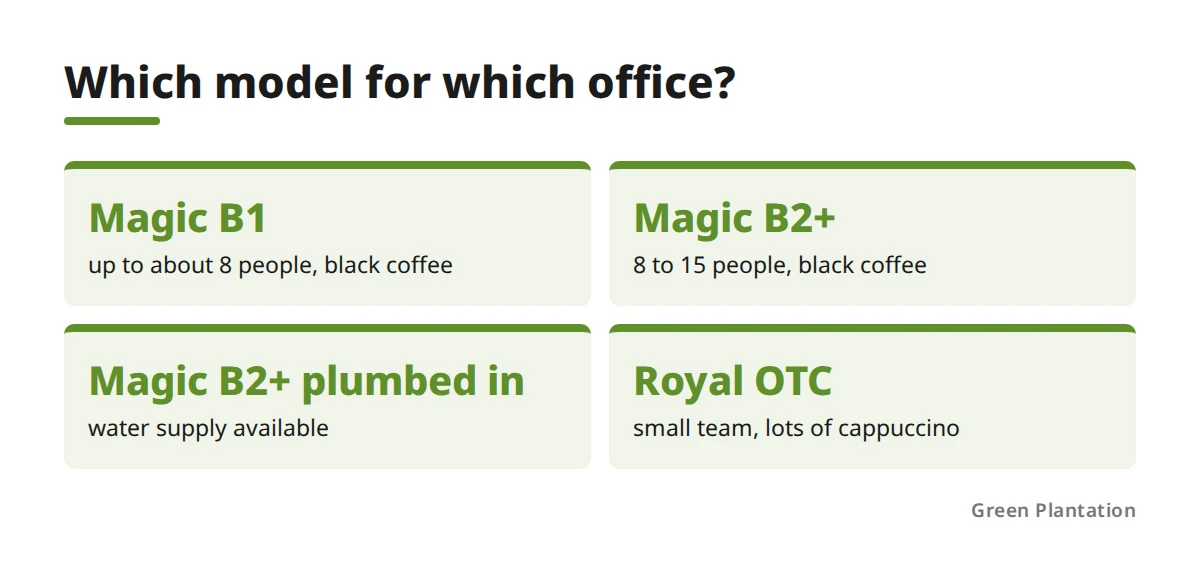
| Your office | Our pick | Why |
|---|---|---|
| Up to about 8 people, almost all black coffee | Magic B1 | compact, large brew chamber, minimal cleaning |
| 8 to 15 people, mostly black, no water supply | Magic B2+ on the tank | 4 l of water and 1.2 kg of beans halve the refills |
| Kitchen with a supply nearby, growing team | Magic B2+, plumbed in by a technician | no more filling the tank, the grounds drawer remains the limit |
| Small team, many milk drinkers, someone owns the milk cleaning | Royal OTC | one touch from fresh milk, low height |
| Large team with lots of milk drinks | none of the three | 18 grounds portions and a 2.5 l tank are not enough, a catering-class machine suits better |
| Coffee paid for by staff or visitors | Magic B1 or B2+ | MDB interface for payment systems |
The rule of thumb: B2+ over B1 as soon as you regularly get through more than one tank a day. Royal OTC over Magic only if milk drinks are genuinely in demand and the daily cleaning is firmly assigned. For a broader look at machine types for businesses, see which coffee machine to choose for the office, and for a brand comparison, automatic coffee machines for the office: Nivona vs Saeco.
FAQ
What is the best office coffee maker?
For most offices it is a bean to cup machine sized to the team: fresh coffee at the press of a button, no capsules and little training needed.
How many cups a day can an office bean to cup machine handle?
Saeco Professional gives no daily output for the Magic B1, B2+ or Royal OTC. The B1 and Royal OTC cope with 15–20 drinks, while the B2+ is far more convenient for 20–30.
Do I need a plumbed-in coffee machine for the office?
No. All three run from a tank. Plumbing in pays off once you get through several tanks a day, and among these three it is only possible with the Magic B2+, connected by a technician.
Do you need a milk frother with a coffee machine?
Only if your team drinks milk-based coffee regularly. If more than one or two people have a cappuccino every day and someone takes on the cleaning, the Royal OTC with its automatic milk system makes sense. Otherwise a machine without a milk system, such as the Magic B1 or B2+, is more hygienic and less prone to faults.
How often should an office bean to cup machine be descaled?
The machines prompt you themselves, based on the water hardness set and whether a filter is fitted. With an Intenza filter they ask after eight filter changes according to the manual, and the filter is changed at least every three months. In hard-water areas, an unfiltered machine will ask noticeably more often.
Is a bean to cup machine worth it for an office?
Yes, if people drink coffee daily and someone owns the cleaning. Without a rota, even a good machine soon tastes worse.
Machines and accessories in our shop
- Saeco Magic B1: for small teams that drink black and want as little cleaning as possible.
- Saeco Magic B2+ tank-mounted, without direct water connection: double the bean capacity and a bigger water reserve for medium-sized teams.
- Saeco Royal OTC: One Touch Cappuccino for small offices with plenty of milk drinkers.
- Saeco Brita Intenza Water Filter: stretches the intervals between descales, especially useful in hard-water areas.
- Saeco Coffee Machine Descaler, 250 ml: for the descaling cycle as soon as the machine asks for it.
Sources
- Saeco Professional: Magic B1, technical data
- Saeco Professional: Magic B2 / B2+, technical data
- Saeco Professional: Royal OTC
- Evoca Group: Saeco Magic user manual (PDF)
- Saeco Professional: Royal brochure 2024 (PDF)
Updated: November 2026
Author: Petra Novotná, editorial name of the Green Plantation.
You might also like
 Eureka Atom Pro review: experience, tech and limits of the 75 mm filter grinder
The Eureka Atom Pro is a filter grinder with 75 mm brew burrs and a Blow-Up bellows. Who it is worth it for, how to set it up and why it is not an espresso… 26. 11. 2026
 Eureka Costanza Review: HX Machine with PID, Costanza R and Owner Experiences
The Eureka Costanza is a compact E61 heat exchanger machine with PID and a shot timer. We clear up the dual boiler myth, explain how it differs from the… 26. 11. 2026
 Grind-by-Weight Coffee Grinders: Eureka Atom W 65, Atom W 75 or Mahlkönig E65S GbW? 2026 Comparison
Comparison of the Eureka Atom W 65, Atom W 75 and Mahlkönig E65S GbW grind-by-weight grinders: dose accuracy, speed, step-by-step calibration and a calculation… 26. 11. 2026