
 Česky (CZK)
 Slovensky (EUR)
 Magyar (HUF)
 Polski (PLN)
 English (EUR)
 Deutsch (EUR)
 Français (EUR)
 Español (EUR)
 Português (EUR)
 Italiano (EUR)
 Svenska (SEK)
 Suomi (EUR)
 Nederlands (EUR)
 Dansk (EUR)
 Lëtzebuergesch (EUR)
 Eesti (EUR)
 Latviešu (EUR)
 Lietuvių (EUR)
 Slovenščina (EUR)
 Română (RON)
 Български (EUR)
 Hrvatski (EUR)
 Ελληνικά (EUR)
 Українська (EUR)
 Norsk (EUR)
 Srpski (EUR)
 Tiếng Việt (EUR)
Saeco Magic B1 review: a milk-free bean-to-cup machine for the office
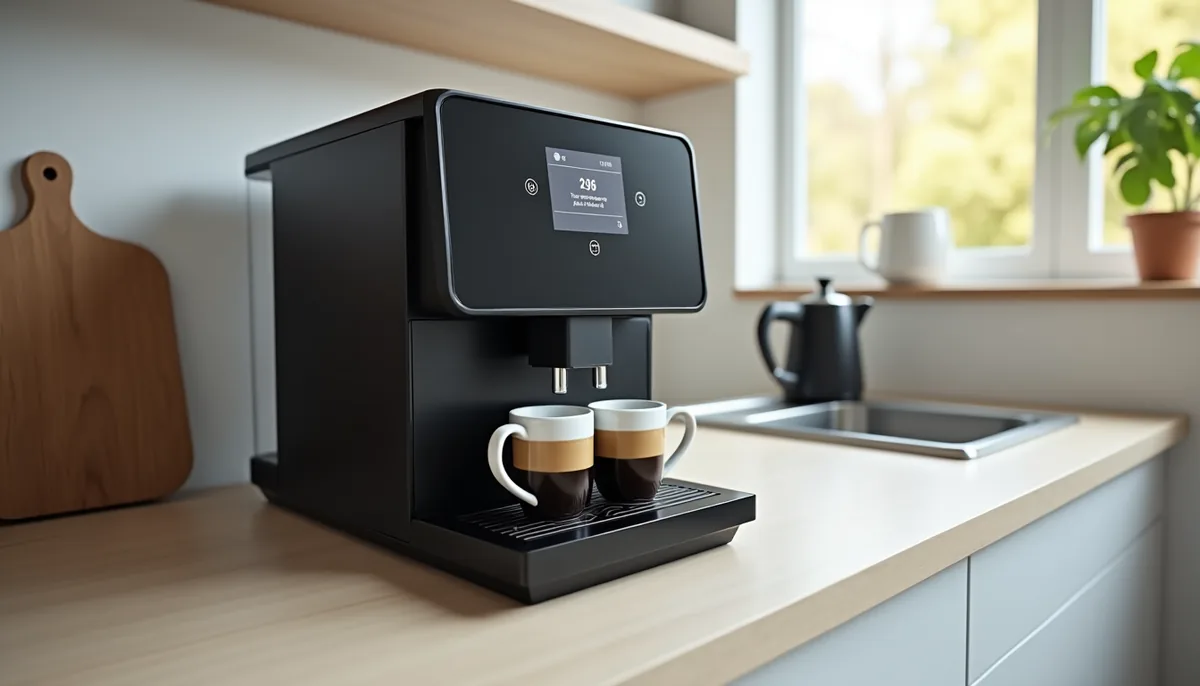
In short: The Saeco Magic B1 is a compact professional bean-to-cup machine for black coffee only: espresso, lungo, coffee and hot water, with no milk system and no mains water connection. It suits a small office where most people drink it black. If your team lives on cappuccino, look at the Magic M1 instead.



| Type | Bean-to-cup machine without milk system, single circuit, 1,300 W |
|---|---|
| Water | 2.5 litre tank, no plumbed-in option |
| Beans and grounds | 600 g bean hopper, grounds drawer for 30 pucks |
| Grinder and dose | Conical steel burrs, 8 settings, brew chamber 8.5 to 15 g |
| Controls | 7 inch colour touchscreen, editable recipes, ready for MDB payment systems |
| Best for | Small offices, surgeries, showrooms and B&Bs where most people drink black coffee |
What exactly is the Saeco Magic B1?
Search for "Saeco Magic" on eBay and you will mostly find the old domestic Magic De Luxe and Magic Comfort from the 1990s. The Magic B1 has nothing to do with them. The current Magic range comes from Saeco Professional, the commercial brand of the Italian Evoca Group, not from the Philips Saeco household line you see in high street shops. The range was launched in 2022: the milk models came first, and the coffee-only versions followed later.
The model names are easy to decode once you know the pattern:
- M1 and M2 have a fresh milk system, B1 and B2 do not.
- 1 is the compact body with a 2.5 litre tank and 600 g of beans, 2 is the taller version with 4 litres and 1.2 kg.
- Plus (B2+, M2+) means the machine can also be plumbed into the mains water supply.
So the B1 is the entry point: the smallest machine in the range, built purely for coffee from fresh beans. According to the manufacturer, the Magic range is aimed at everything from offices to bed and breakfasts, conference centres and boutique hotels.
Who is a bean-to-cup machine without milk right for?
In plenty of British offices the reality is simple: most people take their coffee black, or add a splash of cold milk from the fridge. In that setting a machine with a cappuccinatore mainly means extra cleaning that nobody wants to own. The B1 is a good fit for:
- small offices, solicitors, accountants, dental and GP practices where the team mostly drinks espresso, lungo or a mug of coffee,
- teams where nobody wants to be responsible for cleaning a milk line every day,
- reception areas, meeting rooms and showrooms where the office coffee machine has to look smart,
- coworking spaces and guest kitchens that want to charge per cup through a coin or card system.
It is less suited to teams with lots of cappuccino and latte drinkers, and to places with big peaks such as a staff canteen or a conference venue. Saeco Professional does not publish a cups per day figure. UK dealers quote anywhere from 50 to 80 cups a day for the Magic range, but those are not factory figures. In practice, the 2.5 litre tank and the drawer for 30 coffee pucks decide how often somebody has to step in.
Specifications according to the manufacturer
The figures below come from the Saeco Professional product page and brochure, and from the user manual for the Magic range.
| Feature | Saeco Magic B1 |
|---|---|
| Dimensions (W × H × D) | 280 × 435 × 481 mm |
| Weight | 12.8 kg |
| Power supply | 230 V, 50 Hz, 1,300 W |
| Hydraulics | single circuit |
| Water tank | 2.5 litres, no mains water connection |
| Bean hopper | 600 g |
| Grounds drawer | up to 30 pucks |
| Drip tray | 2 litres |
| Grinder | conical steel burrs, 8 settings, manual adjustment |
| Brew unit | removable, variable brew chamber 8.5 to 15 g, strength set electronically in 4 steps |
| Spout | height adjustable from 75 to 160 mm, 2 cups at once, coffee and hot water from one dispenser |
| Display | 7 inch colour touchscreen, 1,024 × 600 pixels |
| Connectivity | ready for MDB payment systems and Saeco Pro.Up remote management |
Two things stand out. First, the brew chamber takes 8.5 to 15 g of ground coffee per cup. That is generous for a compact bean-to-cup machine: the older Royal Black from the same professional line works with 6 to 10 g. More coffee in the brew unit gives you room for a full-bodied lungo or a large mug that does not taste watery. Second, the power: the milk models have two circuits and 1,900 W, while the B1 has one circuit and 1,300 W. Black coffee does not need steam, so you are not missing anything.
Do check the depth, though. The machine is only 28 cm wide but 48 cm deep. Measure your worktop or cabinet first, especially in a narrow office kitchen with wall units above.
Day to day: making coffee with the B1
Everything runs through the 7 inch touchscreen. According to the manual, you can edit recipes and add new ones, set up password-protected user profiles and pull drink statistics. In an office that is more useful than it sounds: the office manager sets the default recipes, and not everyone fiddles with the water volume.
- Strength: set electronically in 4 steps, by changing the dose between 8.5 and 15 g.
- Grind: 8 settings, adjusted by hand on the grinder. Move one step at a time; you will only taste the difference after two or three cups.
- Two cups at once: the spout goes from 75 to 160 mm. A standard mug fits, a tall flask usually will not.
- Hot water: for tea or warming cups, from the same dispenser. In a British office that matters, because the kettle and the coffee machine often share one corner.
- Beans only: there is no bypass chute for pre-ground coffee. Offering decaf means emptying or swapping the bean hopper.
Do not expect a bean-to-cup machine to match espresso from a well set up traditional espresso machine and grinder. What you do get is consistent coffee at the touch of a button, which is exactly what an office needs. The beans and the grind setting have the biggest effect on flavour. An espresso blend with a medium roast usually works better for lungo and a mug of coffee than a very dark roast.
If energy use matters to you, the energy saving mode lets you set time slots for each day of the week, according to the manual. The machine switches off in the evening and at weekends and is ready for the first cup in the morning.
Cleaning and descaling: the real benefit of going milk-free
This is where the B1 becomes the smarter choice for many offices. For the Magic M1, the manual asks you to dismantle the milk spouts every 48 hours and to take the cappuccinatore apart completely once a week. With the B1, all of that disappears. What is left is the standard routine for a bean-to-cup machine:
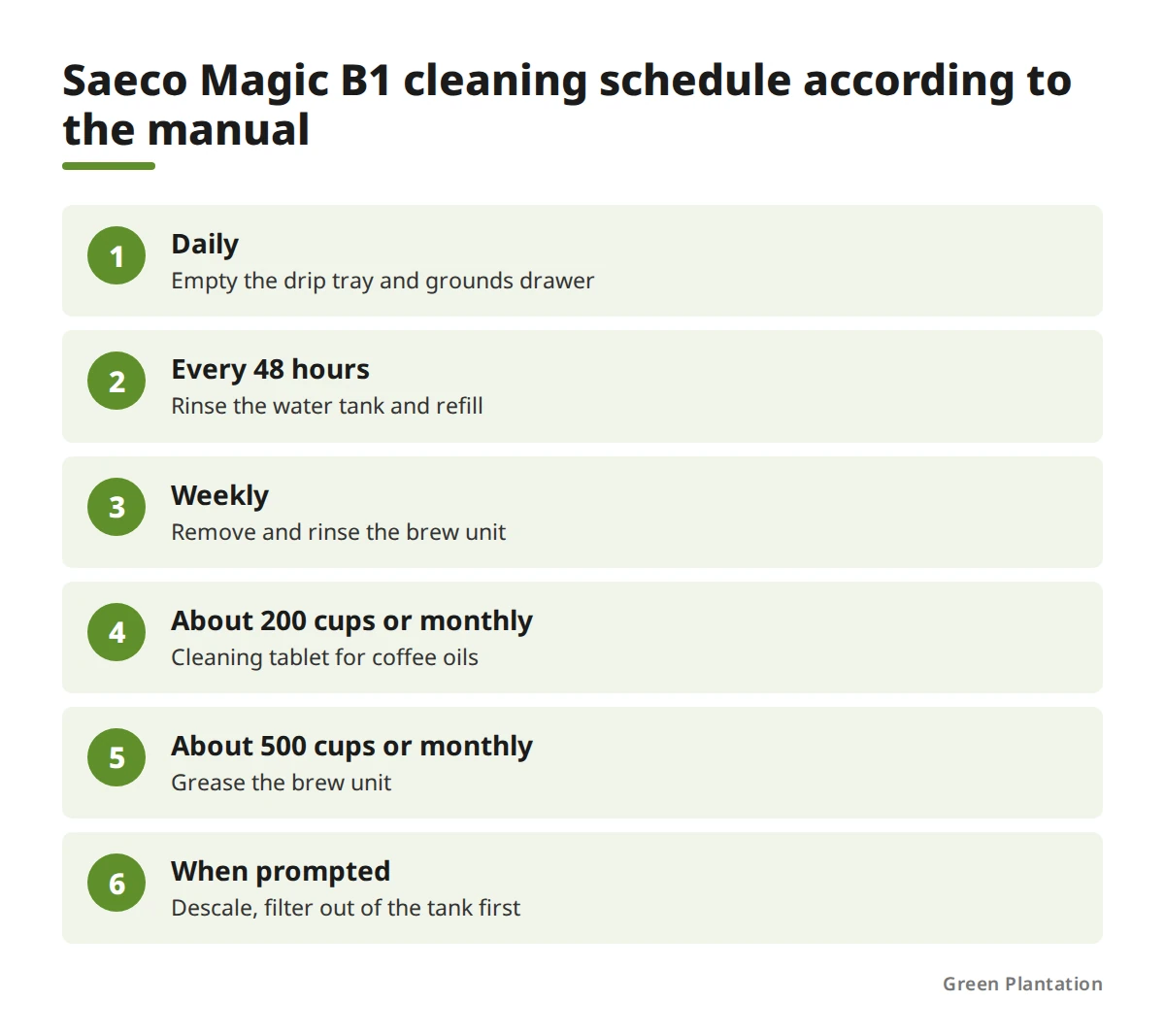
- Daily: empty the drip tray; empty the grounds drawer when the machine asks, and the manual recommends doing it every day.
- Every 48 hours: rinse the water tank and refill it with fresh water.
- Weekly: remove the brew unit and rinse it under running water.
- About every 200 cups or once a month: run a cleaning tablet through the brew unit to remove coffee oils.
- About every 500 cups or once a month: grease the brew unit with Saeco lubricant.
- When the machine asks: descale, after taking the water filter out of the tank first.
Measure the water hardness with the test strip and enter it in the menu; the machine uses it to work out when to ask for descaling. Water hardness varies a lot across the UK, from soft water in Scotland and Wales to hard water in much of the South and East of England, so measure it rather than guess. The tank takes an Intenza+ filter, which you set using the "Intenza Aroma System" scale printed on the pack. Parts must not go in the dishwasher.
For a team of five to ten people, that works out at topping up the water and emptying the drip tray once a day, plus five minutes on the brew unit once a week. Easy to fit into a cleaning rota.
What owners say
To be straight with you: there are no independent reviews of the Magic B1 yet, and hardly any user reviews, in English, German or Dutch. The Reddit archive of r/superautomatic has six posts about the new Magic range since 2021, all about the larger M2 or M2+ and none about the B1. On top of that there are a handful of retailer reviews of the M1 and M2. Professional machines are often bought through a dealer or service partner, and those buyers rarely write reviews. The B1 shares its brew unit, grinder, screen and software with its sister models, so these reports show a direction and no more.
- Positives: owners like the design, the large touchscreen and how precisely the recipes can be adjusted.
- Sensor warnings: two posts about the M2 describe false warnings, such as "drip tray full" with an empty tray, and a "Not Allowed" message after switching from tank to mains water.
- Recipe tweaks: one owner found the default volume for a large mug too small and had to edit the recipes.
- Service: one retailer review complains that Saeco Professional did not answer emails. Parts and servicing go through Evoca's authorised service partners, not Philips customer care.
The most common complaint about the milk models, poor milk foam caused by an air valve problem, simply does not apply to the B1.
Weak points and what to watch out for
- No plumbed-in option: the B1 runs on its 2.5 litre tank only. In a busy office someone will be refilling it several times a day. If that is a deal-breaker, you need a plus model.
- Grounds drawer for 30 pucks: fine for a small team, but it fills quickly after a meeting with visitors.
- No milk, now or later: if you decide to offer cappuccino in a year's time, you will need a different machine.
- No bypass for ground coffee: decaf only works with beans.
- No locks: lockable lids on the tank and bean hopper are only on the B2 and M2. In a public space that may matter.
- Sort out servicing first: find out who covers maintenance and parts for Saeco Professional in your area before you buy. Your statutory rights as a buyer apply separately.
- Dealer figures: some UK sites list the Magic range as mains fed or quote dimensions in the wrong order. Go by the manufacturer's data sheet.
Magic B1, M1 or B2+? How they compare
The choice comes down to two questions: does your team want milk drinks at the touch of a button, and how often is someone willing to refill the water? For reference, the Royal Black, the black coffee entry model from the older professional line, is included too.
| Feature | Magic B1 | Magic M1 | Magic B2+ | Royal Black |
|---|---|---|---|---|
| Milk system | no | cappuccinatore for fresh milk, 2 cappuccinos at once | no | no |
| Water | 2.5 l tank | 2.5 l tank | 4 l tank, plus version also plumbed in | 2.5 l tank |
| Bean hopper | 600 g | 600 g | 1.2 kg | 600 g |
| Grounds drawer | 30 pucks | 30 pucks | 30 pucks | 18 pucks |
| Brew chamber | 8.5 to 15 g | 8.5 to 15 g | 8.5 to 15 g | 6 to 10 g |
| Hydraulics | 1 circuit, 1,300 W | 2 circuits, 1,900 W | 1 circuit, 1,300 W | 1 circuit, 1,400 W |
| Display | 7 inch touchscreen | 7 inch touchscreen | 7 inch touchscreen | graphic display, not touch |
| MDB payment | yes | yes | yes | no |
| Cleaning effort | low | daily milk system | low | low |
| Best for | small team, black coffee only | small team with milk drinkers | bigger team, less refilling | very small team, tight budget |
Go for the Magic M1 if more than one or two colleagues drink a cappuccino or latte every day. Cold milk from the carton is no long-term substitute, and a separate milk frother next to the machine is rarely kept clean in an office. Be ready for the daily cleaning, though.
Go for the B2+ if your team is growing or the kitchen has a water supply nearby. Plumbing it in ends the refilling, and the bean hopper is twice the size. According to the manufacturer, the plus version can be switched back to tank operation in a few simple steps. Check which configuration you are getting when you order.
The Royal Black is the simpler alternative, with no touchscreen and no payment connection, a smaller brew chamber and room for just 18 pucks in the grounds drawer.
Verdict: who should buy the Magic B1?
The Saeco Magic B1 is a well thought-out office coffee machine for workplaces where black coffee is the norm and nobody is keen on cleaning milk lines. The generous brew chamber, the touchscreen with recipes and profiles, and the MDB connection lift it above a domestic machine. Its limits are clear: a 2.5 litre tank, 30 pucks, no milk. For a small team that is fine; for a large office the plumbed-in B2+ makes more sense. And because there is still very little owner feedback on the B1, it is wise to know your service partner before you buy.
Saeco Magic B1 FAQ
Can the Saeco Magic B1 froth milk?
No. The B1 has no cappuccinatore and no steam wand. It makes espresso, lungo, coffee and hot water. For milk drinks at the touch of a button, the Magic M1 is the model to look at.
What is the difference between the Magic B1 and B2?
The B2 is 35 mm taller (470 instead of 435 mm), has a 4 litre tank and a 1.2 kg bean hopper instead of 600 g, plus locks on the tank and hopper. The B2+ can also be plumbed in. Brew unit, grinder and screen are the same.
Can the Magic B1 be plumbed in?
No, the B1 has no mains water connection. Only the plus versions of the larger models, the B2+ and M2+, have one.
How many people is the Magic B1 suitable for?
Saeco Professional does not give a cups per day figure. In practice the 2.5 litre tank, 600 g of beans and the drawer for 30 pucks decide how often you need to refill and empty it. That works well for a small team; for a bigger one the B2+ is more practical.
Is Saeco a good brand for an office coffee machine?
Saeco Professional is the commercial coffee brand of the Italian Evoca Group, separate from the Philips household range. The Magic range is built for offices, hotels and similar sites, with features a domestic machine lacks: MDB payment readiness, remote management through Pro.Up and user profiles. Long-term reliability data for the B1 itself is not yet available, so local service support matters.
Where can I find the Magic B1 manual?
Saeco Professional points to the Evoca Group download area for manuals. The English manual covers the whole range: M1, M2, B1 and B2.
Recommended products
- Saeco Magic B1: the milk-free bean-to-cup machine reviewed here, with a 7 inch touchscreen and MDB connection.
- Saeco Magic M1: the same body with a cappuccinatore for two milk drinks at once, for teams that drink cappuccino.
- Saeco Magic B2+ tank-mounted: the bigger sibling with a 4 litre tank and 1.2 kg of beans, if the B1 needs refilling too often.
- Saeco Royal Black: the simpler milk-free alternative without a touchscreen, for very small teams.
- Saeco descaler, 250 ml: for descaling whenever the machine asks for it.
- Brita Intenza+ water filter: the filter type that goes in the tank of the Magic range.
Still weighing up which type of machine suits your business? Read which coffee machine to choose for the office. For a brand comparison, see automatic coffee machines for the office: Nivona vs Saeco. What to look for in commercial machines in general is covered in how to choose a professional automatic coffee machine. If you are leaning towards a plumbed-in model, read why have a coffee machine with a water connection, and you will find the maintenance routine step by step in cleaning and descaling the automatic coffee machine.
Sources
- Saeco Professional: Magic B1, technical data
- Saeco Professional: Magic range brochure 2024 (PDF)
- Evoca Group: Saeco Magic M1, M2, B1, B2 user manual (PDF)
- Saeco Professional: Pro.Up
- Arctic Shift: r/superautomatic archive, search "saeco magic"
Updated: November 2026
Author: Petra Novotná, editorial name of the Green Plantation.
You might also like
 Eureka Atom Pro review: experience, tech and limits of the 75 mm filter grinder
The Eureka Atom Pro is a filter grinder with 75 mm brew burrs and a Blow-Up bellows. Who it is worth it for, how to set it up and why it is not an espresso… 26. 11. 2026
 Eureka Costanza Review: HX Machine with PID, Costanza R and Owner Experiences
The Eureka Costanza is a compact E61 heat exchanger machine with PID and a shot timer. We clear up the dual boiler myth, explain how it differs from the… 26. 11. 2026
 Grind-by-Weight Coffee Grinders: Eureka Atom W 65, Atom W 75 or Mahlkönig E65S GbW? 2026 Comparison
Comparison of the Eureka Atom W 65, Atom W 75 and Mahlkönig E65S GbW grind-by-weight grinders: dose accuracy, speed, step-by-step calibration and a calculation… 26. 11. 2026