Česky (CZK)
 Slovensky (EUR)
 Magyar (HUF)
 Polski (PLN)
 English (EUR)
 Deutsch (EUR)
 Français (EUR)
 Español (EUR)
 Português (EUR)
 Italiano (EUR)
 Svenska (SEK)
 Suomi (EUR)
 Nederlands (EUR)
 Dansk (EUR)
 Lëtzebuergesch (EUR)
 Eesti (EUR)
 Latviešu (EUR)
 Lietuvių (EUR)
 Slovenščina (EUR)
 Română (RON)
 Български (EUR)
 Hrvatski (EUR)
 Ελληνικά (EUR)
 Українська (EUR)
 Norsk (EUR)
 Srpski (EUR)
 Tiếng Việt (EUR)
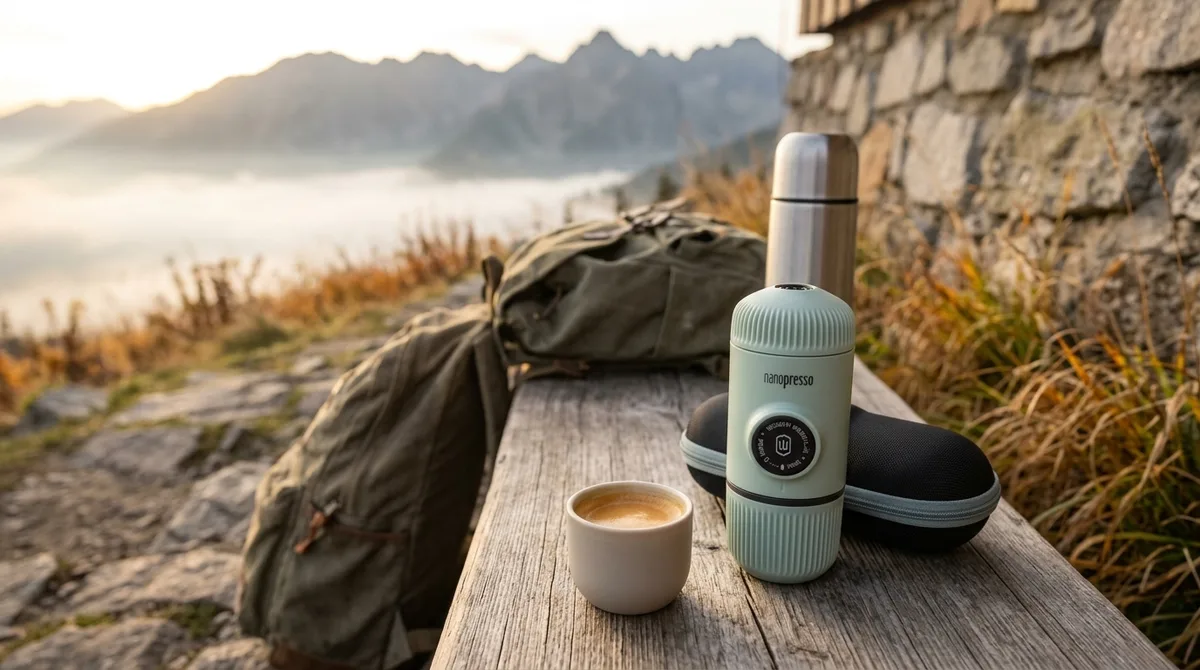



Travel Coffee Maker – A Guide to Coffee on the Go
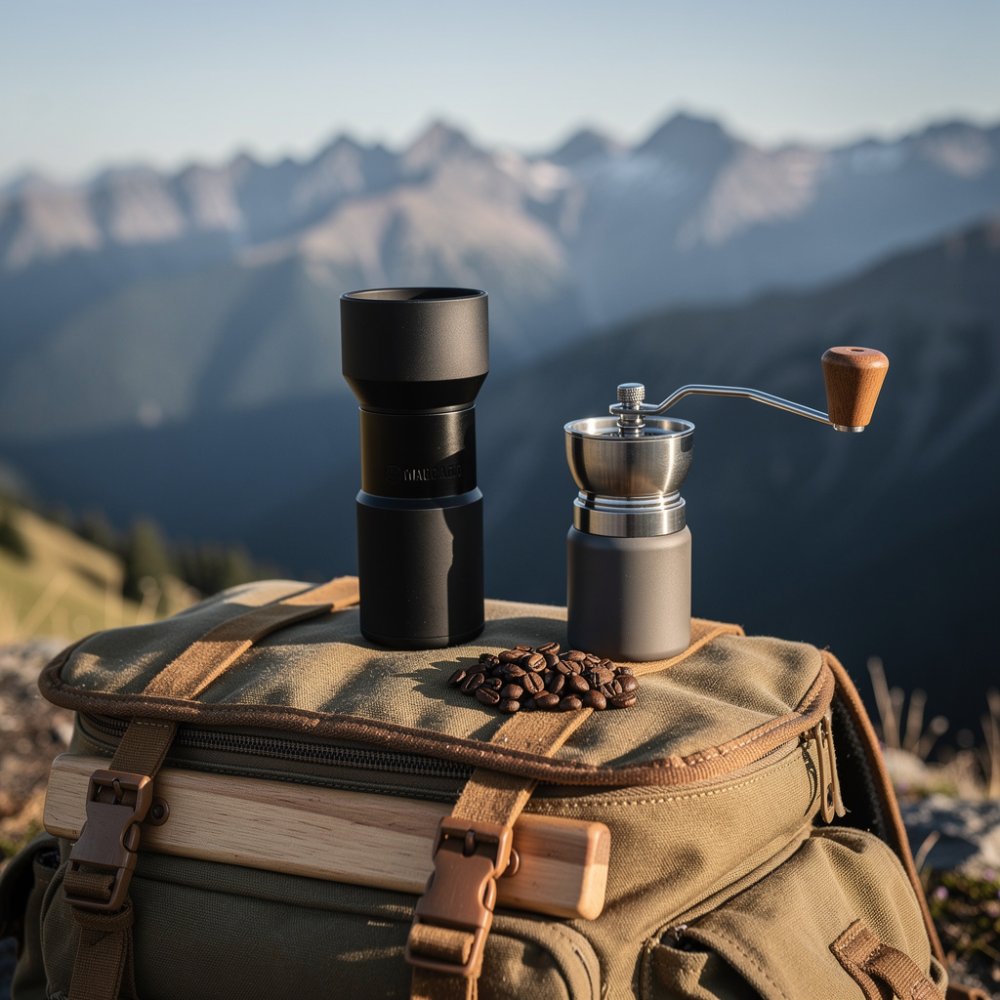
Why Pack a Coffee Maker for Travels
If you're accustomed to quality espresso at home, hotel instant coffee or lobby filter is a painful disappointment. Finding a decent café in an unfamiliar city – especially early morning, in a mountain cabin or remote campsite – is definitely not a given. A travel coffee maker solves this problem elegantly and definitively.
Over recent years, the market for portable espresso makers has advanced significantly. Devices like Wacaco Picopresso or Flair PRO 2 can now prepare espresso comparable to a home lever coffee maker – and fit into carry-on luggage. Add a compact hand grinder and a bag of fresh beans, and you have a complete coffee setup weighing less than a kilogram.
This guide covers all categories of travel coffee makers – from manual lever through capsule to car-specific models.
Manual Lever – Flair
Flair Espresso is an American brand specializing in manual lever espresso makers. They work on a lever principle – you generate pressure by pushing a lever downward. No electricity, no battery, no compromise in result quality.
Flair Model Overview
| Model | Portafilter | Dose | Pressure Gauge | Preheating | Travel Case | Purpose |
|---|---|---|---|---|---|---|
| Flair Neo | Pressurized | 12–18 g | No | Yes (manual) | No | Beginners, pre-ground coffee OK |
| Flair Classic | Naked | 12–18 g | No | Yes (manual) | Yes | Travel, entry-level |
| Flair PRO 2 | Naked | 16–24 g | Yes | Yes (manual) | Yes | Travel and home use |
| Flair PRO 3 | Naked | 16–24 g | Yes | No (isolated head) | Yes | Premium travel espresso |
| Flair 58 | 58 mm standard | 16–20 g | Yes | Electric | No | Home use, barista workflow |
| Flair GO | Compact | 12–16 g | No | No | Integrated | Maximum portability |
Who Flair Is For
Flair is for you if you want true espresso while traveling – with full control over pressure, pre-infusion and pressure profile. The manual lever enables pressure profiling: you start with slow pre-infusion at 2–3 bar, increase to working 6–9 bar and slightly release pressure toward the end of extraction. The result is a complex shot with clean flavor nuances that many automatic coffee makers cannot replicate.
Flair PRO 2 is the long-time favorite travel model – a pressure gauge for visual pressure control, larger brew chamber (16–24 g) and protective travel case are its strong points. Flair GO is the smallest and lightest model for those counting every gram in a backpack who don't need full double-shot capacity.
Find the complete range in the Flair coffee makers section.
Portable Espresso – Wacaco
Wacaco is a Hong Kong brand that revolutionized fitting an espresso maker into pocket size. Unlike Flair, it doesn't use an external lever – you generate pressure by pumping a piston mechanism directly on the device body, which simplifies operation and dramatically reduces the overall set volume.
Wacaco Model Overview
| Model | Pressure | Dose | Weight | Water Volume | Special | Approx. Price |
|---|---|---|---|---|---|---|
| Minipresso GR | 8 bar | 8 g | 360 g | 70 ml | Most compact, single shot | 50–60 eur |
| Nanopresso | 18 bar | 8 g | 336 g | 80 ml | Adapters for capsules and larger tank | 70–80 eur |
| Picopresso | 18 bar | 16–20 g | 350 g | 80 ml | 52 mm naked portafilter, WDT needle, tamper | 120–150 eur |
Minipresso vs Nanopresso vs Picopresso
Minipresso is the original – the most affordable and simplest model for single-shot espresso. A reliable travel companion when comfort of preparation is priority and result is adequate at "good coffee" level.
Nanopresso is the direct successor with higher pressure (18 bar), expanded flexibility through optional adapters (Nespresso Original capsules, larger tank) and yet remains extremely compact. An ideal choice if you alternate between bean coffee and capsules depending on situation.
Picopresso is the flagship of the entire line – 52 mm professional naked portafilter, included tamper and WDT needle make espresso preparation a serious ritual. The result is true double-shot espresso with crema comparable to a home lever coffee maker. In an independent La-Barista.com test from 2025, it won the title "Testsieger" for best portable espresso on the market.
For whom: Wacaco is ideal for those wanting espresso while traveling with minimal weight and size. Choose Picopresso for quality first, Nanopresso for use flexibility, Minipresso if price is the deciding factor.
Find travel coffee makers for bean coffee in the travel coffee makers for bean coffee section.
Capsule Travel Coffee Makers
If you don't want to deal with grinding, dosing and tamping while traveling, capsule travel coffee makers are the most convenient choice. You insert a capsule, pump or press a button, and espresso is ready – without any barista skills.
Types of Capsule Travel Coffee Makers
Manual (no battery):
- Wacaco Nanopresso + NS adapter – compatible with Nespresso Original capsules
- Manual pumping, no dependence on electricity or charging
Battery-powered:
- CONQUECO portable – built-in battery, integrated water heating, 3–4 cups per charge
- Outin Nano – compact, built-in battery, USB-C charging, compatible with Nespresso Original and ground coffee
Advantages of Capsule Travel Coffee Maker:
- No grinder or weighing – capsules are ready for immediate use
- Consistent result without barista skills
- Minimal cleaning, no coffee grounds on work surface
- Ideal for hotel rooms, offices or time-pressured mornings
Disadvantages:
- Espresso quality is directly limited by capsule quality – premium fresh beans are not utilized here
- Higher cost per cup (0.30–0.60 eur/capsule vs. 0.15–0.25 eur/dose from beans)
- Aluminum or plastic capsule waste production
Find capsule travel coffee makers in the Nespresso capsule travel coffee makers section.
Car Coffee Makers
For those spending long hours behind the wheel – business travelers, truck drivers, family road trips – there are coffee makers powered from a 12V car outlet. Espresso preparation then doesn't depend on a café or rest stop.
What They Offer
- Water heating directly from 12V or 24V car battery
- Espresso or lungo preparation during a stop without leaving the vehicle
- Some models compatible with Nespresso capsules and ground coffee
- Built-in rechargeable battery with capacity for 3–4 cups
What to Watch
- Heating time: Expect 3–8 minutes from car battery – significantly slower heating than from mains outlet
- Safety: Car coffee makers are intended for use during stops, not while driving. Stop, prepare espresso, and continue.
- Expected quality: The goal is decent coffee on the road, not café perfection – adjust expectations accordingly
- Compatibility: Verify if the model supports your power type (12V cigarette lighter, 24V for trucks, or USB-C)
Find car coffee makers in the car travel coffee makers section.
Hand Grinder for Travel
A travel coffee maker for bean coffee without a grinder is like a camera without a lens. Pre-ground coffee loses a significant portion of aroma within hours of grinding – while traveling, where an open package sits for several days, grinding fresh right before preparation is more important than at home.
Ideal Travel Grinder
| Property | Requirement |
|---|---|
| Weight | Under 500 g |
| Size | Fits in carry-on luggage |
| Grind Setting | Fine espresso grinding without issues |
| Speed | 18 g in less than 60 seconds |
| Durability | Metal body resistant to impacts |
Recommended Models
| Model | Weight | Burrs | Ideal for | Price |
|---|---|---|---|---|
| 1Zpresso Q Air | 365 g | 38 mm | Filter, AeroPress | 60–80 eur |
| Timemore C3 | 430 g | 38 mm | Filter, travel | 50–70 eur |
| Timemore C3 ESP Pro | 450 g | 38 mm | Espresso and filter | 80–100 eur |
| 1Zpresso JX-Pro | 660 g | 48 mm | Espresso (primarily) | 140–170 eur |
| Comandante C40 | 480 g | 39 mm | Filter (primarily) | 250–290 eur |
Practical tip: If traveling with Wacaco Picopresso or Flair, you need a grinder capable of consistent fine espresso grinding with precise regulation. Timemore C3 ESP Pro or 1Zpresso JX-Pro are the best choices in this regard for reasonable price. For AeroPress or pour over at a cabin without espresso demands, the lightweight 1Zpresso Q Air is sufficient.
Comparison Table – All Categories
| Property | Flair PRO 2 | Wacaco Picopresso | Wacaco Nanopresso | Capsule (Outin Nano) | Car Maker |
|---|---|---|---|---|---|
| Type | Manual lever | Manual pump | Manual pump | Battery + pump | 12V / battery |
| Espresso Quality | Exceptional | Very good | Good | Depends on capsule | Average |
| Weight | ~900 g (with case) | 350 g | 336 g | ~500 g | 800–1200 g |
| Dose | 16–24 g | 16–20 g | 8 g | 1 capsule | 1 capsule / 8–15 g |
| Requires Grinder | Yes | Yes | Yes / capsules | No | Depends on model |
| Water Heating | External | External | External | Built-in | Built-in |
| Pressure | Manual (up to 9+ bar) | 18 bar | 18 bar | 15–19 bar | 15–19 bar |
| Pressure Profiling | Yes | No | No | No | No |
| Cleaning | Moderately complex | Simple | Simple | Minimal | Simple |
| Price | 150–200 eur | 120–150 eur | 70–80 eur | 80–120 eur | 80–150 eur |
| Ideal for | Quality first | Best quality/portability compromise | Flexibility, capsules | Maximum convenience | Long car trips |
Travel Coffee Kit – What to Pack
Minimalist Kit (under 1 kg)
- Wacaco Picopresso (350 g)
- 1Zpresso Q Air or Timemore C3 ESP Pro (365–450 g)
- Bag of fresh bean coffee (100–250 g)
- Foldable travel cup (100 g)
Total: around 900 g – fits comfortably in carry-on or side pocket of backpack. This setup is sufficient for quality double-shot espresso anywhere you have access to hot water.
Premium Kit (1.5–2 kg)
- Flair PRO 2 with travel case (~900 g)
- 1Zpresso JX-Pro (660 g)
- Digital scale (200 g)
- Fresh bean coffee (250 g)
Total: ~2 kg – top-tier espresso with pressure profiling anywhere you have access to hot water. The weight matches the result.
Kit for Cabin or Vanlife
- Flair Classic or AeroPress + Wacaco Nanopresso
- Hand grinder (Timemore C3)
- Foldable camping stove or 12V car kettle
- Fresh bean coffee (500 g)
- Thermos for pre-heating water and maintaining temperature
Frequently Asked Questions (FAQ)
How do I heat water for a travel coffee maker?
Wacaco and Flair don't heat water – you need an external source. Available options: hotel kettle, portable electric kettle, camping gas stove, or thermos filled at home. For cars, practical 12V kettles exist. Optimal water temperature for espresso extraction is 90–96 °C – let water cool 30–45 seconds after boiling if you don't have a kettle with temperature control.
Which travel coffee maker makes the best espresso?
Flair PRO 2 or PRO 3 – the manual lever with pressure profiling and professional portafilter provide unique extraction control that no compact automatic device offers. Wacaco Picopresso is a solid second choice with excellent results in significantly smaller and lighter format. However, both models require a quality grinder and fresh beans – without them, their potential is not utilized.
Can I take a travel coffee maker on an airplane?
Yes – Wacaco and Flair are directly designed for carry-on luggage. Manual models contain no batteries or liquids, so they don't present a security issue. A grinder is also unrestricted. Fresh bean coffee should be packed in carry-on – in cargo hold it may be exposed to extreme temperatures and pressure fluctuations, which accelerates oxidation.
What's the difference between Flair and Wacaco?
Flair uses a classic lever – you push down from above and have full, direct control over pressure profile during the entire extraction. The result is closest to a traditional lever coffee maker. Wacaco uses a piston pump – you pump by hand and the device generates pressure through an internal mechanism. It's more compact, easier to operate and better for beginners, but without pressure profiling capability.
Is AeroPress worth it as a travel coffee maker?
AeroPress is an excellent travel companion for a different reason than espresso. It's extremely lightweight (175 g), virtually unbreakable, and remarkably versatile – it handles espresso-style concentrate, filter coffee and cold brew. True espresso with 9 bar pressure it won't make, but the resulting concentrate is surprisingly tasty and can be used as a base for americano or flat white. If you value versatility more than classic espresso protocol, AeroPress is one of the best travel coffee kit investments.
How do I clean a travel coffee maker while traveling?
Wacaco: disassemble portafilter, rinse all parts under running water, let dry before storage. Flair: same – disassemble brew head, thorough rinsing, drying. With regular cleaning after each use, no chemical agents are needed. Upon return from travel (or once monthly) more thorough washing with a few drops of mild soap and rinsing with clean water is recommended.
Summary
A travel coffee maker is not a compromise – it's freedom. Freedom to drink quality espresso anywhere, without dependence on a café, hotel or random gas station. The key is choosing based on your own priorities:
- Maximum espresso quality – Flair PRO 2 or PRO 3 with quality hand grinder
- Best quality/portability compromise – Wacaco Picopresso with Timemore C3 ESP Pro
- Maximum convenience without barista skills – capsule travel coffee maker
- Long car trips – 12V powered car coffee maker
Browse the complete range: travel coffee makers for bean coffee | Flair coffee makers | capsule travel coffee makers | car coffee makers
Sources
- La-Barista. "Wacaco Test 2025 – The Best Portable Espresso Machines" – la-barista.com
- Home Coffee Expert. "Wacaco Picopresso Review" – homecoffeeexpert.com
- Coffee Chronicler. "Portable Espresso Makers Guide" – coffeechronicler.com
- Coffeeness. "Wacaco Nanopresso Review 2026" – coffeeness.de
- Flair Espresso. "Buyer's Guide" – flairespresso.com
- Green Plantation. "Flair 58 vs Flair PRO 2" – greenplantation.com
- Green Plantation. "Comparison of Flair Manual Lever Coffee Machines" – greenplantation.com
- Homegrounds. "Best Portable Espresso Maker" – homegrounds.co