
 Česky (CZK)
 Slovensky (EUR)
 Magyar (HUF)
 Polski (PLN)
 English (EUR)
 Deutsch (EUR)
 Français (EUR)
 Español (EUR)
 Português (EUR)
 Italiano (EUR)
 Svenska (SEK)
 Suomi (EUR)
 Nederlands (EUR)
 Dansk (EUR)
 Lëtzebuergesch (EUR)
 Eesti (EUR)
 Latviešu (EUR)
 Lietuvių (EUR)
 Slovenščina (EUR)
 Română (RON)
 Български (EUR)
 Hrvatski (EUR)
 Ελληνικά (EUR)
 Українська (EUR)
 Norsk (EUR)
 Srpski (EUR)
 Tiếng Việt (EUR)
V60 plastic vs ceramic, glass or metal: which Hario V60 material is best?
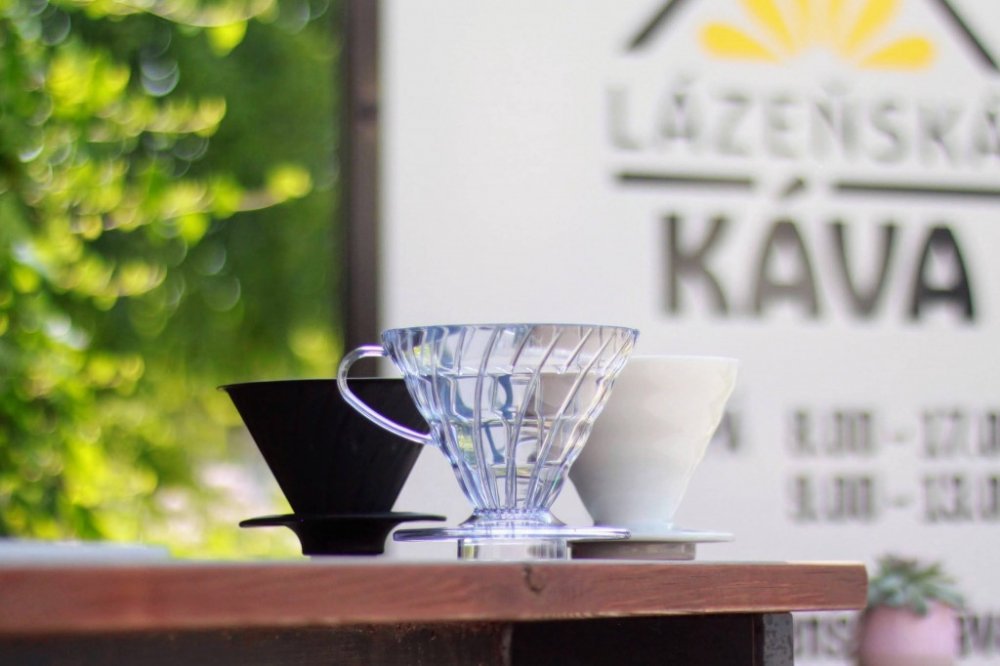
In short: For temperature stability, the cheap plastic V60 is the best performer: it barely absorbs heat, so the slurry stays hottest with little or no preheating. Ceramic and glass match it only when thoroughly preheated. Steel loses the most heat; copper works if heated hard. Choose on habits, not hype.

| Most stable brew temperature | Plastic (AS resin or polypropylene) |
|---|---|
| Needs the most preheating | Ceramic (Arita porcelain), then glass and metal |
| Measured difference in cup | About 1–2 °C between plastic and ceramic in an 18‑brew roaster test |
| Most durable | Stainless steel and copper; plastic is shatterproof but can stress‑crack with age |
| Sizes | Plastic 01, 02, 03; ceramic and glass 01 and 02 (glass also 03); steel and copper 02 only |
| Cheapest | Plastic, by a wide margin |
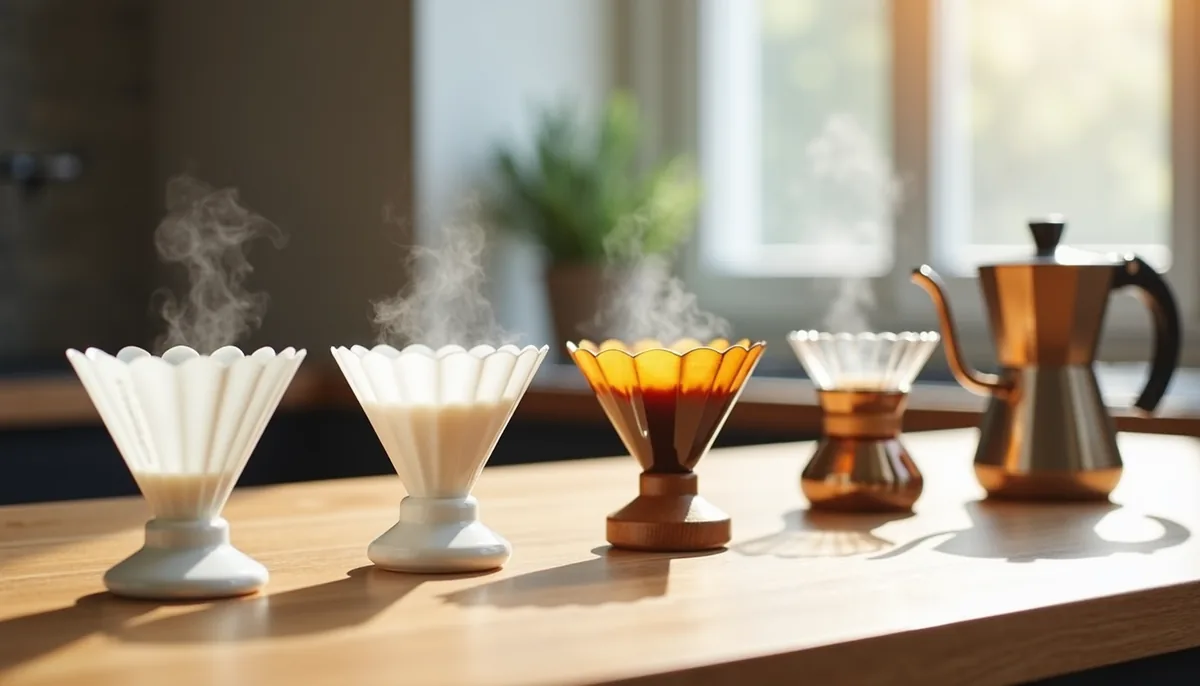
The Hario V60 has looked the same since it was launched: a 60° cone, spiral ribs and one large hole at the bottom. What changes is the material, and that is where the internet argument starts. Some brewers swear the ceramic version tastes rounder, a few competition baristas have praised metal for clarity, and many home brewers worry about pouring 94 °C water through plastic. This guide looks at what each material actually does to brew temperature, how it handles daily use and which one is worth your money.
The geometry is identical across materials, so your recipe from our step‑by‑step V60 pour‑over guide works in all of them. Only the heat behaviour and the handling differ.
Why the material matters at all: heat in, heat out
Every gram of dripper that starts colder than your water steals energy from the slurry. Two properties decide how much:
- Thermal conductivity – how quickly heat moves from the hot water into the wall. Plastic is a poor conductor, so only a thin skin of it ever warms up.
- Thermal mass – how much energy the whole dripper soaks up before it stops taking heat. This is weight multiplied by specific heat. A ceramic V60 is several times heavier than the plastic one, so it has far more to warm through.
A third factor is what happens after preheating: a hot, conductive dripper keeps radiating heat into the room while you weigh coffee and fold the filter. That is why a ceramic cone rinsed with boiling water can be noticeably cooler 30 seconds later.
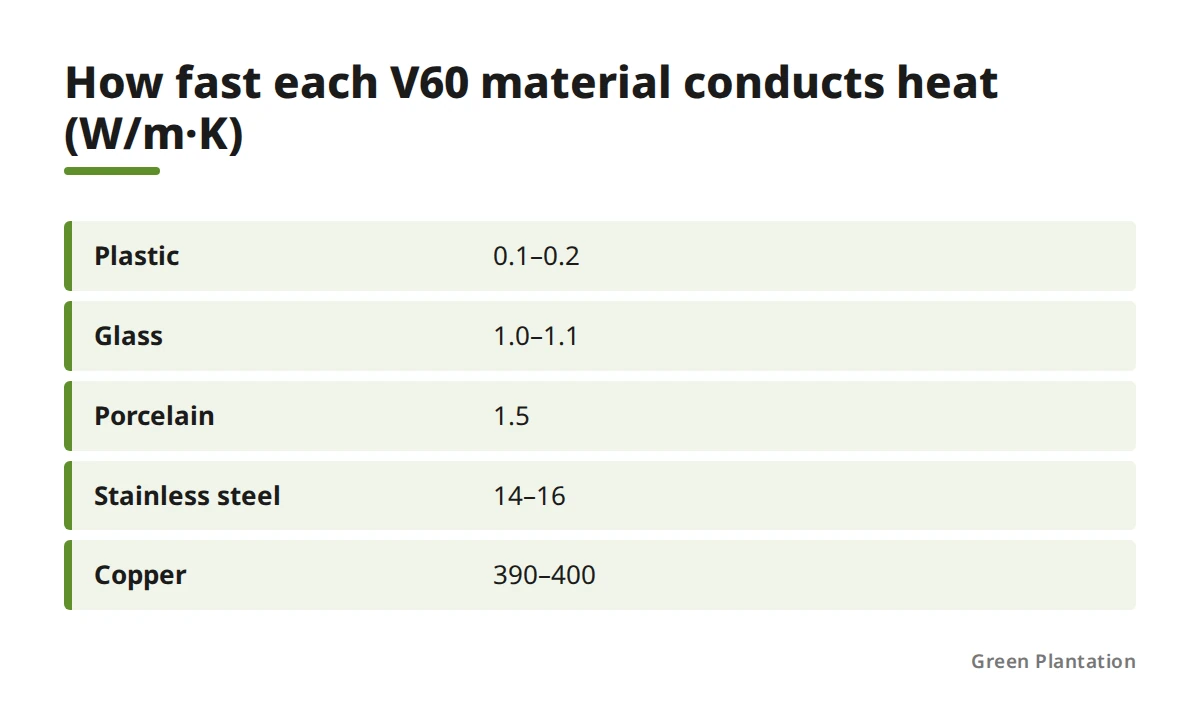
| Material | Typical thermal conductivity (W/m·K) | What it means for the brew |
|---|---|---|
| Plastic (AS resin, polypropylene) | about 0.1–0.2 | Hardly pulls heat from the slurry; little preheating needed |
| Borosilicate glass | about 1.0–1.1 | Slow to warm through; needs a thorough rinse |
| Porcelain (ceramic) | about 1.5 | High mass; holds heat once hot but takes a lot to get there |
| Stainless steel | about 14–16 | Heats and cools fast; loses the most heat if not kept hot |
| Copper | about 390–400 | Reaches water temperature almost instantly when preheated |
Values are typical reference figures from engineering tables and vary with the exact grade. Note that porcelain sits around 1.5 W/m·K, not the 4–5 W/m·K you still see quoted on some coffee sites.
What the measurements show
Physics only tells you the direction. Three practical tests tell you the size of the effect:
- Andytown Coffee Roasters brewed 18 cups in plastic, glass and ceramic V60s with two coffees. On average the plastic dripper gave the hottest coffee bed and brew; glass came out about 2 °F (roughly 1 °C) cooler and ceramic about 4 °F (roughly 2 °C) cooler. Tasters still found the cups different: plastic punchier, glass clean and sweet, ceramic rounder.
- Eight Ounce Coffee placed a thermocouple between the filter and the dripper wall, brewing 20 g of coffee with 320 g of water at 93 °C. The biggest gaps appeared during the bloom; glass was slow to pick up heat and metal lost it fastest. Over the full brew the authors called the difference in heat retention negligible.
- Vibrant Coffee Roasters ran blind tastings of a heavily preheated copper and steel V60 against plastic. Four tasters found no difference between copper and plastic, while steel tasted flat and under‑extracted next to plastic in both rounds. Their verdict: plastic first, copper as good if you preheat it a lot, steel last.
An often‑shared r/Coffee experiment with a roaster's data logger reached the same conclusion: the ceramic V60 never matched the peak temperature of the plastic one, even after preheating with 500 ml of boiling water.
Put simply, the material shifts your slurry by one or two degrees. That is the same as changing your kettle setting, and many brewers simply compensate by brewing 1–2 °C hotter in ceramic. It matters most for light roasts and small 01 brews, where there is less water to carry heat.
Plastic V60: the brewer's choice, not the budget compromise
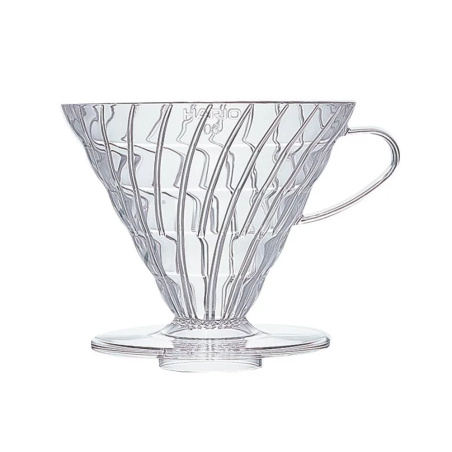
The clear Hario V60 is made from acrylonitrile‑styrene (AS) resin according to Hario; coloured plastic versions use polypropylene. Both are BPA‑free and designed for near‑boiling water. It is the only material made in all three sizes, 01, 02 and 03.
Strengths: best temperature stability, lightest to carry, does not shatter, dishwasher safe and cheap enough to own two.
Weak points: owners on r/Coffee report fine stress cracks around the rim after several years of daily use and dishwasher cycles. Heat‑resistance figures quoted by retailers range from 90 to 130 °C, so do not leave it on a hob or in a sterilising steamer. If you want to avoid hot liquid touching plastic altogether, that is a valid personal choice rather than a measured health risk; our article on microplastics and paper cups covers what the research says about plastics and hot drinks more generally.
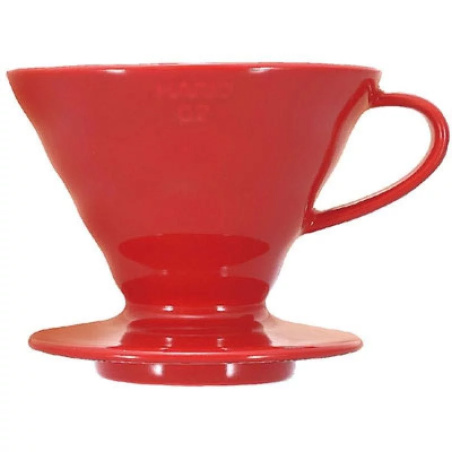
Ceramic V60: Arita porcelain for the counter and the café bar
Hario's ceramic drippers are made from Arita‑yaki porcelain in Japan, a ceramic tradition with a 400‑year history, and come in a wide range of colours. The surface is smooth, easy to clean and does not hold odours.
Strengths: looks, weight and stability on the server, and a cup many people describe as rounder. Once properly hot it holds temperature well.
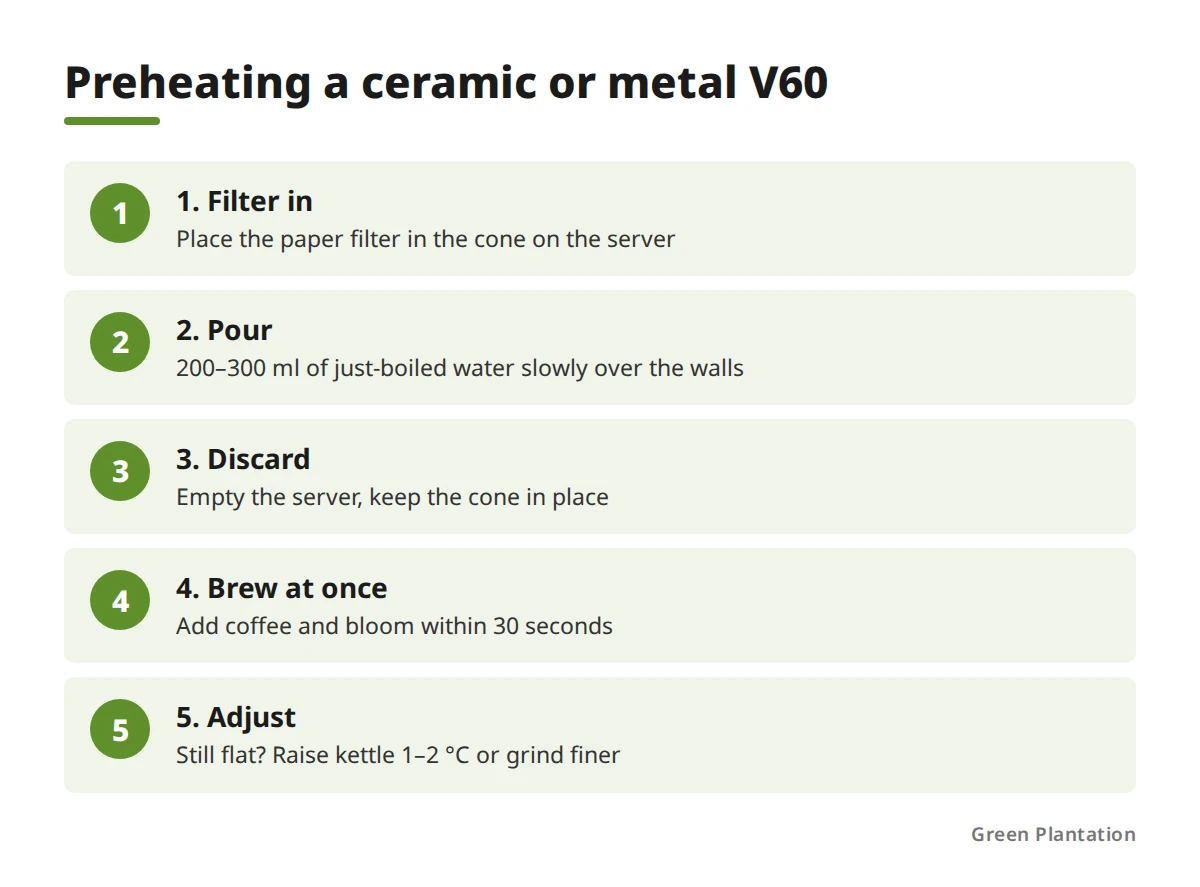
Weak points: it needs a generous preheat (at least 200–300 ml of just‑boiled water, poured slowly over the walls) and you should brew straight after. It chips if dropped and is the heaviest option for travel. One trick owners share on r/pourover is resting the cone on the lid of the kettle while the water heats.
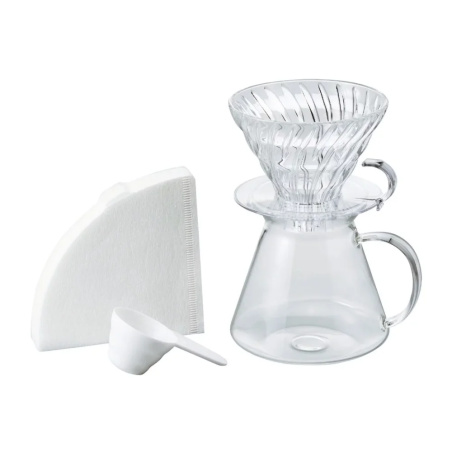
Glass V60: clean look, middle ground
The glass V60 uses heat‑resistant borosilicate glass with a plastic or wooden base ring. Thermally it sits between plastic and ceramic: it warms slowly during the bloom, so preheat it thoroughly. Glass does not absorb colour or odour, which makes it a good choice if you also brew tea.
The weak point is the base: the ring is usually the first part to break when dropped, and the cone itself will not survive a hard floor.
Steel and copper V60: durable and beautiful, but heat them hard
The metal V60 comes only in size 02, in brushed steel, matte black and copper. It is virtually unbreakable and looks superb, which is why you see it in competition and on camping trips.
Thermally the two metals behave differently. Steel conducts heat well enough to drain the slurry, but not so well that a quick rinse brings the whole cone up to temperature. Copper conducts around 25 times better than steel, so a thorough preheat takes it practically to water temperature, which matches Vibrant's tasting result. If you buy steel, rinse it hard and consider grinding a touch finer or brewing a degree or two hotter.
Which V60 should you buy?
| Material | Brew temperature | Preheat needed | Durability | Travel | Best for |
|---|---|---|---|---|---|
| Plastic | Most stable | Minimal (rinse filter) | Shatterproof, can craze with age | Excellent | Light roasts, beginners, travel |
| Ceramic | About 1–2 °C cooler unless very hot | Heavy | Chips if dropped | Poor | Home bar, café service, looks |
| Glass | Slightly cooler, slow in bloom | Medium to heavy | Fragile base ring | Poor | Plastic‑free home brewing |
| Stainless steel | Coolest if under‑heated | Heavy | Virtually unbreakable | Very good | Outdoor use, durability |
| Copper | Close to plastic when hot | Heavy | Unbreakable, patinates | Good | Plastic‑free brewing with top thermals |
Our advice as baristas: if you only want one, start with plastic. If you want something more beautiful or avoid plastic, take ceramic or copper and build a proper preheat into your routine. The upgrade that improves your cup far more than any dripper material is a good burr grinder and a kettle that holds a set temperature. Our comparison of gooseneck and electric kettles explains why, and if you are still choosing a cone shape, see Hario vs Origami vs Timemore.
Frequently asked questions
Is a plastic V60 safe for hot water?
Hario designs the plastic V60 for brewing with near‑boiling water, and both AS resin and polypropylene versions are BPA‑free. Replace it once it shows stress cracks or clouding, and do not heat it on a hob or in a steriliser.
Does V60 material change the taste?
Slightly. Tests show a difference of about 1–2 °C in slurry temperature, which can make a light roast taste a little brighter in plastic and rounder in ceramic. A good preheat or a slightly hotter kettle closes most of the gap.
Plastic vs ceramic V60: which is better for beginners?
Plastic. It forgives a missed preheat, survives drops and lets you focus on grind size and pouring. Ceramic is a fine second dripper once your recipe is stable.
How should I preheat a ceramic or metal V60?
Place the paper filter, then pour 200–300 ml of just‑boiled water slowly over the whole inside, letting it run into the server. Discard the water and start brewing immediately. Our guide to V60 paper filters covers rinsing in more detail.
Is the copper V60 worth the money?
Only if you want a plastic‑free dripper with excellent thermals and you are happy to preheat it every time. In blind tastings it matched plastic, it did not beat it.
Can I put a V60 in the dishwasher?
Plastic and ceramic V60s are dishwasher safe. Wash metal and glass versions by hand to protect the finish and the base ring.
Recommended V60s and brewing gear
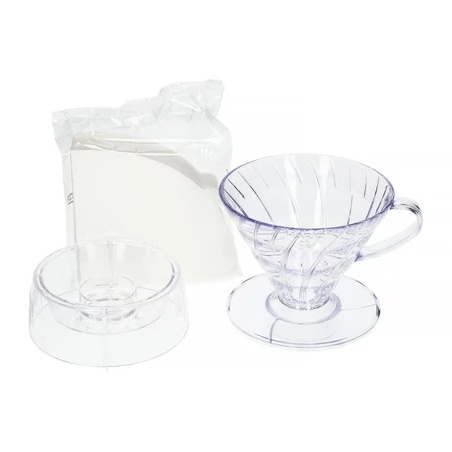
- Hario V60‑02 plastic dripper – the most temperature‑stable V60 and the one we recommend to start with.
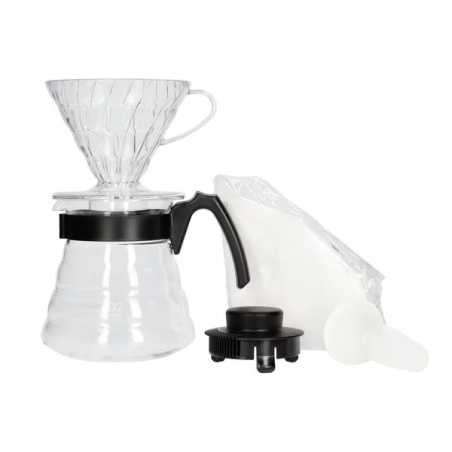
- Hario V60‑02 Ceramic Dripper Set – Arita porcelain cone with matching accessories for a home bar that looks the part.
- Hario V60‑02 copper dripper – plastic‑free, unbreakable and, when preheated, thermally close to plastic.
- Hario V60‑02 stainless steel dripper, matte black – the toughest option for travel and outdoor brewing; preheat it well.
- Fellow Stagg EKG Pro electric kettle – holds water to the degree, so you can add the extra 1–2 °C a ceramic or steel cone needs.
- Comandante C40 MK4 Nitro Blade – a hand grinder with an even filter grind that makes a bigger difference to your cup than the dripper material.
Sources
- Hario USA – V60 Plastic Dripper 03 (material: acrylonitrile‑styrene resin)
- Hario USA – V60 Ceramic Dripper 02 (Arita‑yaki porcelain)
- Eight Ounce Coffee – Hario V60 material and temperature comparison
- Andytown Coffee Roasters – Glass, ceramic or plastic: how do V60 drippers affect flavour?
- Vibrant Coffee Roasters – Battle of the V60s
Updated: November 2026
Author: Petra Novotná, editorial name of the Green Plantation.
Recommended products (6)

- Bestseller
You might also like
 Best Espresso Machine Under €1,500: Single Boiler, HX or Dual Boiler?
Single boiler, thermoblock, heat exchanger or dual boiler: which design under €1,500 suits the way you drink coffee, with figures for boilers, warm-up and… 24. 11. 2026
 Bean-to-cup vs espresso machine: which suits your daily routine?
Bean-to-cup or a traditional espresso machine with a portafilter? A practical decision guide based on your daily routine, time per cup, coffee dose and the… 24. 11. 2026
 Manual Espresso Maker: Flair 58 vs 9Barista (plus La Pavoni and Picopresso)
Hand lever with kettle water or steam on the hob: the Flair 58 and 9Barista compared, with the La Pavoni Europiccola and Wacaco Picopresso as alternatives and… 24. 11. 2026